Golden Retriever Puppies: Complete Week-by-Week Care Guide
Raising dogs golden retriever puppies? This week-by-week guide covers feeding, potty training, vaccines, socialization, & first-year costs for Golden...

Golden Retrievers consistently rank among the top three most popular breeds in the United States, and for good reason: their intelligence, gentle temperament, and trainability make them exceptional family companions. But raising dogs golden retriever puppies into well-adjusted adults requires understanding breed-specific developmental milestones, nutritional needs, and the critical socialization window that shapes their behavior for life.
This guide walks you through every stage of your Golden Retriever puppy's first year with exact feeding amounts, vaccination timelines, crate training progressions, and realistic potty training expectations. Whether you're picking up your puppy at 8 weeks or preparing your home in advance, you'll find actionable specifics rather than generic advice.
When to Bring Your Golden Retriever Puppy Home
The American Kennel Club and most veterinary behaviorists agree: 8 weeks is the minimum responsible age to bring a Golden Retriever puppy home. Many experienced breeders hold puppies until 8.5 to 9 weeks to ensure they pass through the first fear imprint period (weeks 8–10) in a familiar, low-stress environment.
Golden Retrievers mature more slowly than smaller breeds. While a Chihuahua puppy might be developmentally ready at 8 weeks, Golden Retriever puppies benefit from the extra week or two of littermate interaction, where they learn bite inhibition and social cues from their mother and siblings.
Red flags in breeders who release puppies early:
- Offering puppies at 6 weeks or younger
- No documented deworming schedule (should begin at 2 weeks)
- No first DHPP vaccine administered before pickup
- Unable to provide OFA (Orthopedic Foundation for Animals) hip and elbow scores for both parents
Golden Retriever Puppy Milestones: Week by Week
Understanding what to expect at each developmental stage prevents panic and helps you set appropriate expectations. Golden Retrievers follow a predictable timeline, though individual puppies may vary by 1–2 weeks.
Feeding Schedule: Exact Portions for Golden Retriever Puppies
Golden Retrievers are prone to obesity and hip dysplasia, making precise feeding critical. Overfeeding accelerates growth rate, which increases the risk of developmental orthopedic diseases. According to Merck Veterinary Manual, large-breed puppies should consume diets with controlled calcium (1.1–1.4% on a dry matter basis) and moderate caloric density.
Choose an AAFCO-approved large-breed puppy formula. Look for the statement: "This food is formulated to support the reduced growth rate of large-breed puppies." Recommended brands include Purina Pro Plan Large Breed Puppy, Royal Canin Golden Retriever Puppy, and Hill's Science Diet Large Breed Puppy.
How often should I feed my puppy at 8 weeks? Four meals per day, spaced roughly 4 hours apart during waking hours (e.g., 7 AM, 11 AM, 3 PM, 7 PM). Remove the food bowl after 15–20 minutes to establish mealtime routines that aid potty training.
The Critical Socialization Window: Weeks 3–14
Golden Retriever puppies have a primary socialization period between approximately 3 and 14 weeks of age. During this window, their brains are uniquely receptive to forming positive associations with new stimuli. After 14 weeks, novel experiences trigger fear responses more readily, and counter-conditioning becomes significantly harder.
This does not mean socialization ends at 14 weeks — it means the quality and quantity of exposure during this window has an outsized impact on lifelong temperament. The American Veterinary Medical Association recommends structured socialization begin as early as possible, balancing disease risk against behavioral risk.
Golden Retriever Puppy Socialization Checklist
Surfaces: Grass, gravel, tile, hardwood, carpet, wet pavement, metal grates, tarps, sand
People: Children (supervised), elderly individuals, people wearing hats/sunglasses, people in wheelchairs, people with beards, people carrying bags/umbrellas, delivery workers
Sounds: Vacuum cleaner (start at low volume, 20 feet away), thunderstorm recordings, doorbells, car horns, construction noise, fireworks recordings, hair dryer
Handling: Paw touching, ear inspection, mouth opening, nail clipping simulation, collar grabbing, being lifted, being placed on a table, towel drying
Environments: Car rides, parking lots, outdoor patios, friend's houses, pet-friendly stores (carried if unvaccinated), veterinary clinic (happy visits only)
Animals: Fully vaccinated adult dogs (known health status), cats (supervised), livestock if accessible, birds
Objects: Bicycles, skateboards, strollers, plastic bags blowing in wind, flags, balloons, hoses
When can my puppy go outside and meet other dogs? After your puppy's second DHPP vaccine (typically at 10–12 weeks), controlled outdoor exposure is generally safe. Avoid dog parks and high-traffic areas until the full vaccination series is complete at 16 weeks. Puppy kindergarten classes that require proof of vaccination are excellent early socialization environments.
Vaccination Schedule for Golden Retriever Puppies
Golden Retrievers follow the standard core vaccination protocol recommended by the AVMA and the AAHA (American Animal Hospital Association) Canine Vaccination Guidelines. Your veterinarian will adjust timing based on local disease prevalence and your puppy's individual risk factors.
Non-core vaccines to discuss with your vet: Leptospirosis (recommended if your Golden will hike near standing water or live in areas with wildlife), Lyme disease (tick-endemic regions), and Canine Influenza (if boarding frequently or attending dog shows).
Potty Training Timeline and Troubleshooting
When will my puppy be fully potty trained? Most Golden Retriever puppies achieve reliable house training between 4 and 6 months of age, with occasional accidents possible until 8–10 months. Golden Retrievers are generally easier to house train than many breeds due to their intelligence and eagerness to please, but consistency matters more than breed disposition.
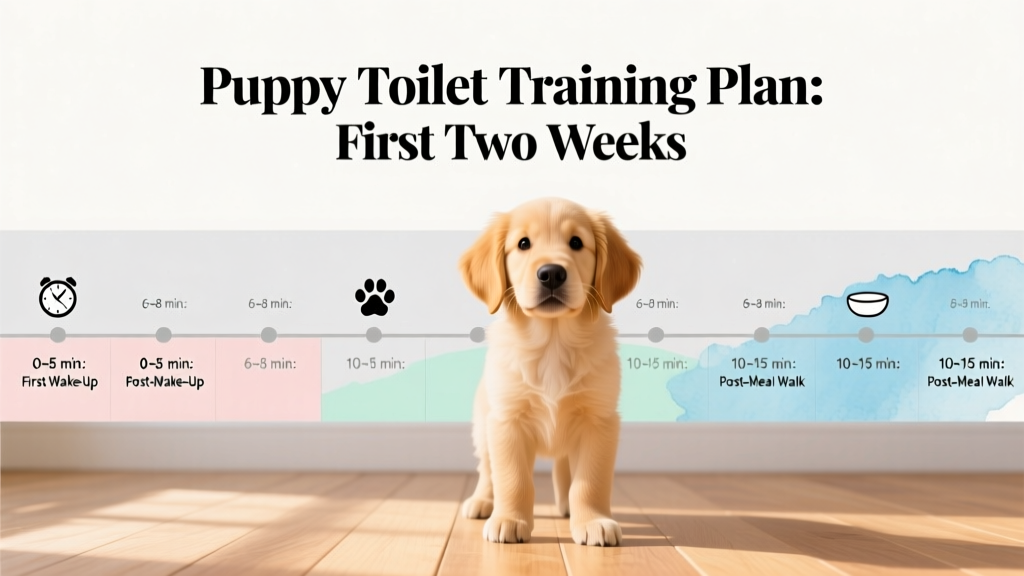
The foundational rule: A puppy can hold their bladder for approximately one hour per month of age, plus one. An 8-week-old puppy can hold for roughly 2–3 hours maximum. A 4-month-old puppy, about 5 hours.
Potty Training Schedule by Age
8–12 weeks: Take outside every 1–2 hours during the day, immediately after waking, eating, drinking, and playing. Expect to wake once overnight (around 2–3 AM).
12–16 weeks: Every 2–3 hours during the day. May begin sleeping 5–6 hours overnight.
16–24 weeks: Every 3–4 hours during the day. Most puppies can sleep 7–8 hours overnight by 16–20 weeks.
6–12 months: Every 4–6 hours. Reliable overnight holding established.
Golden Retriever-specific troubleshooting:
- Submissive urination: Common in Golden puppies when greeting. Do not scold — crouch to their level, avoid direct eye contact during greetings, and take them outside immediately after calm greetings. Most outgrow this by 12 months.
- Excitement urination: Similar to submissive urination but triggered by high arousal. Keep arrivals low-key. Practice "sit" before opening the door.
- Regression at 4–5 months: Normal developmental phase. Return to more frequent outings and high-value treats for outdoor elimination. Do not punish accidents — it creates fear of eliminating in your presence.
Crate Training Progression and Time Limits
Golden Retrievers adapt well to crate training when introduced positively. The crate becomes their den — a safe space for rest and a management tool for potty training. Never use the crate as punishment.
Maximum crate time by age (while awake and crated during the day):
- 8–10 weeks: 30–60 minutes maximum (outside the crate between sessions)
- 10–12 weeks: 1–2 hours maximum
- 3–4 months: 2–3 hours maximum
- 5–6 months: 3–4 hours maximum
- 6+ months: 4–5 hours maximum during the day
Overnight crating follows bladder capacity — your 10-week-old puppy will likely need a 2–3 AM bathroom break. Set an alarm rather than waiting for whining, which teaches the puppy that vocalizing gets attention.
Crate training steps for Golden Retriever puppies:
- Place the crate in a high-traffic area with the door open. Toss high-value treats (small pieces of chicken or cheese) inside. Let the puppy enter and exit freely for 2–3 days.
- Begin feeding all meals inside the crate with the door open.
- Close the door during meals. Open immediately when finished.
- Close the door for 5-minute intervals while you sit nearby. Gradually increase to 15, then 30 minutes.
- Leave the room for short periods (5 minutes, then 15, then 30) while the puppy is crated.
- Practice overnight crating with the crate in your bedroom for the first 2–3 weeks, then gradually move to the permanent location.
Teething Timeline and Relief Strategies
Golden Retriever puppies begin teething around 3–4 months, with the process continuing through approximately 6–7 months. Deciduous (baby) teeth are replaced by 42 adult teeth. During peak teething (4–5 months), chewing intensity increases dramatically, and you may find small teeth on the floor or notice mild bleeding from the gums — both are normal.
Safe chew recommendations for teething Golden Retriever puppies:
- Kong Classic (puppy size, pink/blue rubber): Fill with soaked kibble and frozen peanut butter (verify xylitol-free). The softer puppy rubber is gentler on developing teeth.
- Nylabone Puppy Chew: Designed for dogs under 25 lb; switch to the adult version as your puppy grows past this weight.
- Frozen washcloth: Wet a clean washcloth, twist into a rope, and freeze. Supervise use and discard if pieces tear off.
- Bully sticks (6-inch, thin): Supervise all bully stick use. Remove when the piece becomes small enough to swallow whole.
- Carrots (frozen, whole): Low-calorie, safe, and satisfying. Most Goldens love the crunch.
Avoid: Raw bones (splintering risk, bacterial contamination), antlers and hooves (tooth fracture risk in puppies), and any chew toy harder than your fingernail. If you can't indent the material with your thumbnail, it's too hard for a puppy's developing teeth.
Common Golden Retriever Puppy Problems and Solutions
How do I stop puppy biting and nipping? Golden Retrievers are mouthy dogs — it's a breed trait rooted in their retrieving heritage. Puppy nipping peaks between 10 and 16 weeks. This is normal behavior, not aggression.
Effective bite inhibition training:
- When teeth touch skin, say "ouch" in a calm, slightly high-pitched voice and immediately withdraw attention (stand up, turn away, or step behind a baby gate) for 10–15 seconds.
- Return and redirect to an appropriate chew toy. Praise enthusiastically when they chew the toy.
- If nipping continues, end the play session entirely. Puppies learn that teeth on skin = fun stops.
- Ensure your puppy gets adequate physical exercise (5 minutes per month of age, twice daily) and mental enrichment (snuffle mats, puzzle feeders, training sessions). Overtired puppies bite more.
Other common Golden Retriever puppy challenges:
- Destructive chewing (3–8 months): Goldens explore the world with their mouths. Puppy-proof your home by removing shoes, remotes, and anything at puppy height. Provide 8–10 appropriate chew toys rotated weekly to maintain novelty.
- Whining in the crate at night: If the puppy has been outside recently and isn't ill, wait 5–10 minutes before responding. Reward silence, not whining. A snuggle puppy toy with a heartbeat simulator can ease the transition from littermates.
- Jumping on people: Goldens are enthusiastic greeters. Teach "four on the floor" by rewarding all four paws on the ground with treats and attention. Ask visitors to ignore the puppy until all paws are down.
- Counter-surfing and food stealing: Goldens are highly food-motivated. Never leave food unattended on counters. Teach "leave it" starting at 10 weeks using positive reinforcement — hold a treat in a closed fist, reward with a different treat when the puppy stops nosing your hand.
First-Year Cost Breakdown for a Golden Retriever Puppy
Budgeting accurately prevents surprises. Golden Retrievers are large dogs, which means higher food costs, larger (and more expensive) supplies, and higher medication dosages. Below is a realistic first-year cost range based on 2025–2026 US pricing.
Golden Retriever-specific health costs to plan for: This breed has higher-than-average rates of hip dysplasia (approximately 20% of Golden Retrievers, per OFA data), elbow dysplasia, and certain cancers (hemangiosarcoma, lymphoma). Pet insurance enrolled at 8 weeks covers these conditions if they develop later. Without insurance, hip dysplasia surgery (total hip replacement) costs $3,500–$7,000 per hip.
Frequently Asked Questions
When should I bring my Golden Retriever puppy home?
Eight weeks is the minimum responsible age. Many reputable Golden Retriever breeders prefer to keep puppies until 8.5–9 weeks so they pass through the first fear imprint period (8–10 weeks) in a stable, familiar environment. Never accept a puppy younger than 7 weeks — early separation is linked to increased behavioral problems including resource guarding, excessive barking, and difficulty with bite inhibition.
How often should I feed my Golden Retriever puppy at different ages?
At 8–12 weeks, feed 3–4 meals per day (approximately 1.5–2.5 cups of large-breed puppy kibble total daily). At 3–6 months, reduce to 3 meals per day (2.5–4 cups total). At 6–12 months, feed 2 meals per day (3–4.5 cups total). Always use the feeding guide on your specific food bag as a starting point and adjust based on your puppy's body condition score — you should be able to feel ribs without pressing hard, but not see them prominently.
When will my Golden Retriever puppy be fully potty trained?
Most Golden Retrievers are reliably house trained by 4–6 months, though occasional accidents are normal until 8–10 months. Consistency matters more than breed intelligence. Take your puppy out on a strict schedule (every 1–2 hours at 8 weeks, extending by roughly 1 hour per month of age), reward outdoor elimination immediately with treats and praise, and clean indoor accidents with an enzymatic cleaner to eliminate scent markers.
What vaccines does my Golden Retriever puppy need and when?
Core vaccines include DHPP (Distemper, Hepatitis, Parainfluenza, Parvovirus) at 6–8 weeks, 10–12 weeks, and 14–16 weeks, plus Rabies at 14–16 weeks. Non-core vaccines your vet may recommend based on lifestyle include Bordetella (for group classes/boarding), Leptospirosis (for outdoor/water-loving dogs), and Lyme (for tick-endemic areas). Your vet will determine the exact schedule based on your puppy's risk profile.
How do I stop my Golden Retriever puppy from biting and nipping?
Golden Retrievers are naturally mouthy due to their retrieving genetics. Nipping peaks between 10–16 weeks. Use positive redirection: when teeth touch skin, say "ouch," withdraw attention for 10–15 seconds, then return and offer an appropriate chew toy. Ensure your puppy gets adequate exercise (5 minutes per month of age, twice daily) and mental stimulation (puzzle toys, short training sessions). Never use physical punishment — it damages trust and can escalate to fear-based biting. If biting persists past 6 months or intensifies, consult a certified professional dog trainer (CPDT-KA) or veterinary behaviorist.
When can my Golden Retriever puppy go outside and meet other dogs?
After the second DHPP vaccine (typically 10–12 weeks), controlled outdoor exploration in low-risk environments is generally safe. Avoid dog parks, pet store floors, and areas with unknown dog traffic until the full vaccination series is complete at approximately 16 weeks. Puppy kindergarten classes that require proof of vaccination are ideal for early socialization. Carry your puppy in a sling or backpack for outings before full vaccination — exposure to new sights and sounds is still valuable even without direct ground contact.
Beth Carrasco
All our authors care for dogs every day — read more of their work on the authors page.