Raising Golden Retriever Puppies in Ohio: A Complete Puppy Care Guide
raising golden retriever puppies in Ohio — milestones, feeding, potty training, vaccines, socialization, and first-year costs.

Bringing Home Golden Retriever Puppies: What Ohio Families Need to Know
If you've committed to raising one of the many golden retriever puppies Ohio breeders and rescues produce each year, you're in for one of the most rewarding experiences in dog ownership — and one of the most demanding. Golden retrievers are consistently among the top three most popular breeds in the United States, according to AKC registration data, and for good reason: they're intelligent, eager to please, and deeply bonded to their families.
But golden retriever puppies come with specific developmental needs that differ from, say, a Chihuahua or a German Shepherd. They're mouthy. They mature slowly (emotionally, goldens can be puppy-like until age two or three). They're prone to specific orthopedic conditions that make early nutrition and exercise management critical. And Ohio's climate — hot, humid summers and icy winters — adds its own layer of planning for outdoor socialization, paw care, and parasite prevention.
This guide walks you through every major milestone from weeks 4 through 12 months, with specific numbers, timelines, and troubleshooting strategies. Whether you're picking up your puppy from a breeder in Columbus, adopting through a golden retriever rescue in Cleveland, or preparing for a litter in Cincinnati, you'll find actionable detail here.
When Should I Bring My Golden Retriever Puppy Home?
The ideal age to bring a golden retriever puppy home is 8 to 10 weeks. The AVMA supports early socialization beginning at the breeder's facility, but the critical littermate bonding and bite-inhibition learning that happens between weeks 6 and 8 should not be interrupted unless medically necessary.
Some Ohio breeders hold puppies until 10 or even 12 weeks, particularly for families with very young children or first-time owners. This can be beneficial — the puppy arrives with more bladder control, better bite inhibition, and often initial crate familiarity. However, it means you have a narrower socialization window to work with once the puppy is in your home.
Before pickup day, prepare:
- A wire crate (36-inch minimum for a golden; they'll grow into it — use a divider panel) — expect $45–$80 for a quality Midwest iCrate or Frisco model
- An exercise pen (x-pen) for supervised containment — $35–$60
- Stainless steel or ceramic food and water bowls — $15–$25 for a set
- A 6-foot leather or biothane leash and a front-clip harness (size medium, adjustable) — $25–$50 combined
- Enzymatic cleaner (Nature's Miracle or Rocco & Roxie) — $12–$18
- At least three types of appropriate chew toys: KONG Classic (large, red rubber), Nylabone Power Chew, and frozen washcloths — $20–$35
Golden Retriever Puppy Milestones: Week by Week, Month by Month
Golden retrievers develop on a fairly predictable timeline, but individual variation is normal. Use these milestones as benchmarks, not guarantees. If your puppy seems significantly behind in any area, flag it with your veterinarian.
Weeks 4–8 (Still With the Breeder)
During this period, your puppy is learning bite inhibition from littermates, beginning to eat solid food (gruel transitioning to softened kibble), and receiving initial deworming. The breeder should be introducing novel surfaces, sounds, and gentle handling. By week 7–8, most golden puppies can hold a sit for 2–3 seconds and are beginning to eliminate away from their sleeping area. This is also when the first DHPP vaccine is typically administered (week 6–8).
Weeks 8–12 (Home Transition & Bonding)
Expect significant stress behaviors in the first 72 hours: whining, crying at night, loose stools from dietary and environmental change, and clinginess. Your puppy will sleep 18–20 hours per day. Attention span is roughly 5–10 minutes per training session. Bladder capacity is approximately 1 hour per month of age plus 1 — so a 2-month-old puppy can hold it roughly 3 hours maximum during the day, less when active. Begin hand-feeding portions of meals to build focus and bond. Start name recognition games and "sit" luring with food.
Weeks 12–16 (Foundation Training Window)
This is your prime learning window. Golden retrievers are highly food-motivated and can learn sit, down, come, leave-it, and loose-leash walking basics during this period. Bladder control extends to roughly 4 hours. Puppy may begin testing boundaries — ignoring recalls, stealing items, mouthing harder. Fear periods commonly occur around weeks 8–10 and again around 16 weeks; during these windows, avoid forcing the puppy into frightening situations and instead use high-value treats to create positive associations.
Weeks 16–24 (Adolescence Begins)
Teething peaks. Adult teeth erupt, pushing out deciduous teeth (you may find tiny teeth around the house or the puppy may swallow them — both are normal). Chewing intensity increases dramatically. Energy levels surge. Many golden puppies appear to "forget" training during this phase — this is normal adolescent regression, not failure. Increase mental enrichment (puzzle feeders, snuffle mats, frozen KONGs) and maintain consistent training sessions. Spay/neuter is typically discussed with your vet during this window; the AKC recommends discussing timing with your veterinarian based on breed-specific orthopedic research.
Months 6–12 (Late Adolescence)
Your golden retriever will reach roughly 60–75% of adult weight by 6 months and approach full height by 10–12 months, though they'll continue filling out (gaining chest width and muscle mass) until 18–24 months. Males typically reach 65–75 lb (29–34 kg) and females 55–65 lb (25–29 kg) by 12 months. Energy remains high. Continue structured exercise — the general guideline is 5 minutes of structured exercise per month of age, twice daily (so a 6-month-old gets roughly 30 minutes of structured walks or play, twice per day). Avoid forced running, jumping from heights, or repetitive high-impact activity until growth plates close (typically 14–18 months for large breeds like goldens).
Feeding Schedule: Exact Portions for Golden Retriever Puppies
Golden retrievers are prone to rapid growth-related orthopedic diseases, including hip dysplasia and elbow dysplasia. Research published in veterinary journals has shown that keeping golden puppies lean (body condition score 4–5 on a 9-point scale) and on a controlled-growth diet reduces the incidence and severity of these conditions. You should feed a large-breed puppy formula that meets AAFCO nutrient profiles for growth — look for this statement on the bag.
The following table provides general portion guidelines based on age and expected weight. Always adjust based on your individual puppy's body condition — you should be able to feel (but not prominently see) ribs, and the puppy should have a visible waist when viewed from above.
| Age | Meals Per Day | Approximate Daily Amount (Large-Breed Puppy Kibble) | Notes |
|---|---|---|---|
| 8–12 weeks | 3–4 meals | 1.5–2 cups/day (split across meals) | Soften kibble with warm water if transitioning; puppy weighs ~10–20 lb |
| 3–4 months | 3 meals | 2–2.5 cups/day | Puppy weighs ~20–30 lb; begin phasing out softened kibble |
| 4–6 months | 2–3 meals | 2.5–3.5 cups/day | Puppy weighs ~30–50 lb; transition to 2 meals by 6 months |
| 6–12 months | 2 meals | 3–4 cups/day | Puppy weighs ~50–70 lb; adjust to maintain lean body condition |
| 12+ months | 2 meals | 3.5–5 cups/day (adult formula) | Transition to adult food gradually over 7–10 days around 12–15 months |
Recommended large-breed puppy foods commonly stocked at Ohio pet supply stores and veterinary clinics include Purina Pro Plan Large Breed Puppy, Royal Canin Golden Retriever Puppy, Hill's Science Diet Large Breed Puppy, and Fromm Gold Large Breed Puppy. Expect to spend $55–$85 per 30-lb bag, which typically lasts 4–6 weeks depending on the puppy's age. Consult your veterinarian before adding supplements — excessive calcium supplementation in large-breed puppies can actually increase orthopedic disease risk.
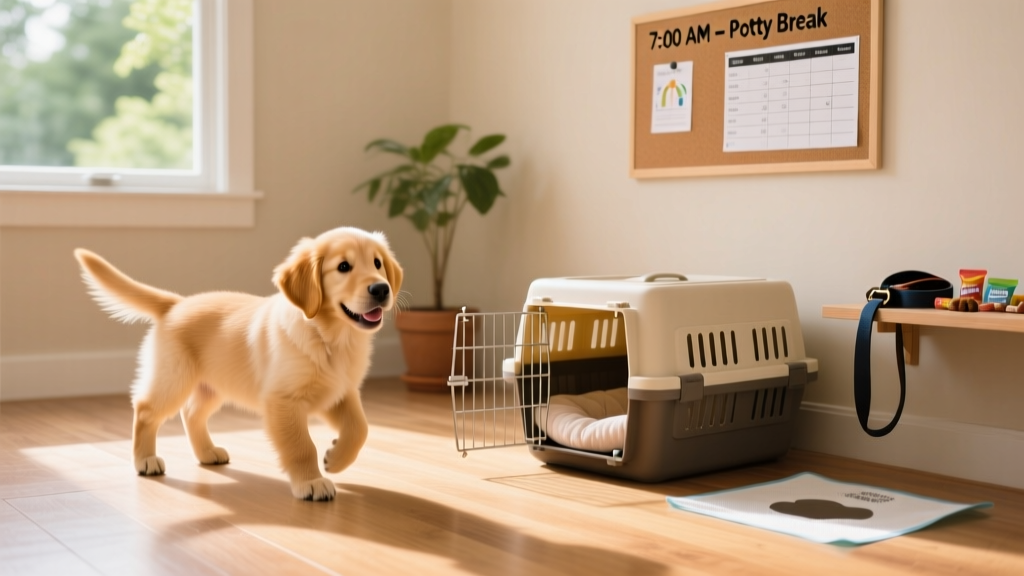
Potty Training Your Golden Retriever Puppy: Timeline & Troubleshooting
Realistic expectation: most golden retriever puppies develop reliable house manners by 4 to 6 months of age, though occasional accidents may continue until 8–10 months, especially during excitement or schedule disruptions. Any source claiming a puppy can be "fully potty trained in 3 days" is misleading — bladder control is a physiological developmental milestone, not just a learned behavior.
The Core Routine
Take your puppy outside:
- Immediately upon waking (morning and after every nap)
- Within 5–15 minutes after every meal
- After vigorous play sessions
- Before and after crate time
- Every 1–2 hours during active daytime hours for puppies under 4 months
- Once during the night for puppies under 12 weeks (set an alarm for 3–4 hours after bedtime)
Ohio Weather Considerations
Ohio winters create a specific potty training challenge. Cold temperatures, snow, and ice can make puppies reluctant to eliminate outside. Strategies that work:
- Shovel a clear, small potty area close to your door
- Use a verbal cue consistently ("go potty," "do your business") and reward immediately with a high-value treat upon completion
- For very cold days (below 20°F / -6°C), limit outdoor time to the elimination task and reward generously, then bring the puppy back inside for play
- Consider a covered potty area or porch section with puppy pads as a backup for extreme weather — but understand that pad training can slow outdoor reliability
When Accidents Happen
Clean accidents immediately with an enzymatic cleaner (not ammonia-based products, which can attract the puppy back to the spot). Never punish a puppy for an accident — this teaches the puppy to hide elimination from you, not to eliminate outside. If you catch the puppy mid-accident, calmly interrupt with a neutral sound, carry or lead them outside, and reward if they finish outdoors. If you find an accident after the fact, simply clean it and adjust your supervision schedule — the puppy wasn't taken out frequently enough.
Vaccination Schedule for Golden Retriever Puppies
Your puppy's vaccination protocol will be determined by your veterinarian based on local disease prevalence, the puppy's health status, and the breeder's prior vaccine history. The following represents a standard core vaccine schedule for puppies in Ohio, where diseases like parvovirus, distemper, and Lyme disease are present in the environment.
| Age | Vaccines Administered | Notes |
|---|---|---|
| 6–8 weeks | DHPP (Distemper, Hepatitis/Adenovirus, Parainfluenza, Parvovirus) — 1st dose | Often given by breeder before pickup; confirm documentation |
| 10–12 weeks | DHPP — 2nd dose; Bordetella (optional, recommended if attending puppy classes or visiting grooming facilities) | Lyme vaccine may be recommended in Ohio due to tick prevalence |
| 14–16 weeks | DHPP — 3rd (final puppy) dose; Rabies (required by Ohio law); Leptospirosis (2-dose series, 2–4 weeks apart) | Rabies is legally required; keep certificate for licensing |
| 12–16 months | DHPP booster; Rabies booster (1-year or 3-year depending on product); Bordetella, Lyme, Lepto boosters as indicated | Discuss titer testing with your vet as an alternative to DHPP boosters after the initial series |
When can my puppy go outside and meet other dogs? This is one of the most common questions new golden retriever owners ask. The answer balances disease risk against the critical socialization window. The AVMA's position on early socialization supports controlled exposure to vaccinated, healthy dogs in low-risk environments (your home, a friend's yard with known dogs) starting immediately. Avoid high-risk environments — dog parks, pet store floors, unknown dog feces — until at least 7 days after the final DHPP dose at 14–16 weeks. Many veterinary behaviorists recommend enrolling in a well-managed puppy class (where all attendees show proof of first vaccination) starting at 8–10 weeks, as the socialization benefit outweighs the controlled disease risk.
Socialization Window: Weeks 3–14 — Your Golden's Critical Period
The primary socialization window for puppies closes between 12 and 14 weeks of age. After this period, novel stimuli are more likely to trigger fear responses than curiosity. For golden retrievers — a breed prized for stable, friendly temperament — maximizing positive exposures during this window is arguably the single most important thing you can do for your dog's lifelong behavioral health.
Socialization does not mean overwhelming your puppy. It means controlled, positive exposures where the puppy can observe, approach at their own pace, and receive rewards. Watch for stress signals: tucked tail, lip licking, yawning, freezing, trying to hide. If you see these, increase distance from the stimulus and let the puppy decompress.
Golden Retriever Puppy Socialization Checklist (Weeks 8–14)
People (aim for 30+ positive encounters):
- Men with beards, hats, sunglasses
- Children of various ages (supervised, calm interactions only)
- People in uniforms, using wheelchairs or walkers
- People of different ethnicities, heights, and body types
- Delivery workers, mail carriers (very common trigger for reactivity if not socialized)
Environments:
- Different floor surfaces: tile, gravel, grass, metal grates, wet pavement
- Elevated surfaces (grooming table, park bench — safely supported)
- Car rides (start with 2-minute trips, build to 15+ minutes)
- Veterinary clinic (schedule a "happy visit" — just treats and praise, no procedures)
- Busy outdoor areas at a distance (farmer's markets, outdoor café perimeters)
Sounds (play recordings at low volume, pair with treats):
- Thunderstorms, fireworks, construction noise
- Vacuum cleaners, blenders, doorbells
- Children screaming/playing
Handling & grooming:
- Paw handling, nail trimming practice (use a scratch board or Dremel introduction)
- Ear inspection, mouth opening, teeth examination
- Brush introduction (golden retrievers need regular grooming — start the association early)
- Bathing with lukewarm water and positive reinforcement
Other animals:
- Fully vaccinated, calm adult dogs (playdates, not dog parks)
- Cats (if applicable to your household — supervised, barrier-separated initial introductions)
- Observing livestock or wildlife at a distance (relevant for rural Ohio homes)
Teething Timeline & Managing the Mouthy Golden Puppy
Golden retrievers are an exceptionally mouthy breed. This is not a flaw — it's a retriever trait. They were bred to carry game gently in their mouths, and that oral fixation persists as a strong drive to hold, chew, and carry objects. Teething amplifies this natural tendency significantly.
Teething Phases
- 3–4 weeks: Deciduous (baby) teeth begin erupting — typically handled by the breeder
- 8–12 weeks: Full set of 28 baby teeth in place; puppy explores everything orally
- 12–16 weeks: Baby teeth begin loosening as adult teeth push through; you may notice increased drooling, blood-tinged chew toys, and temporary "shark mouth" (both baby and adult teeth present simultaneously)
- 4–6 months: Peak teething discomfort; 42 adult teeth fully erupting; chewing intensity at maximum
- 6–7 months: All adult teeth should be in; if any baby teeth remain (retained deciduous teeth), your vet should evaluate for extraction to prevent orthodontic problems
Safe Chew Recommendations & Relief Strategies
- Frozen KONG Classic (large size): Fill with a mixture of plain yogurt, peanut butter (xylitol-free — always check the label), and kibble, then freeze for 4+ hours. The cold numbs sore gums and the extraction work tires the puppy mentally. $13–$17 per KONG; buy at least three so one is always frozen and ready.
- Wet washcloth twist: Wet a clean washcloth, twist it into a rope, freeze, and offer under supervision. Replace when it begins to shred. Essentially free.
- Benebone Wishbone or Nylabone Power Chew (large): Designed for aggressive chewers; discard when pieces become small enough to swallow. $12–$18.
- Bully sticks (6-inch, odor-free): High-value, fully digestible chew; supervise to prevent choking on the final piece (use a bully stick holder). $3–$6 each.
- Ice cubes: Simple, free, and many goldens love crunching them. Offer in a bowl or toss for the puppy to chase.
What to avoid: Raw bones (splintering risk, tooth fractures), antlers (too hard — golden retrievers can fracture carnassial teeth on them), cheap imported rawhide (chemical processing concerns, choking hazard), and any toy small enough to be swallowed whole. If your puppy ingests a foreign object, contact your veterinarian or the ASPCA Animal Poison Control Center at (888) 426-4435 (24/7, consultation fee applies).
Crate Training Progression: Building a Safe Space
Crate training is essential for golden retrievers — not just for potty training, but because goldens are prone to destructive chewing well into their second year if unsupervised, and a crate keeps them safe from ingesting dangerous objects when you can't watch them. The crate should always be associated with positive experiences, never used as punishment.
Time Limits by Age
A general guideline for maximum continuous crating time during the day:
- 8–10 weeks: 30–60 minutes maximum (with potty breaks); overnight: 3–4 hours before a potty break
- 10–12 weeks: 1–2 hours maximum; overnight: 4–5 hours
- 3–4 months: 2–3 hours maximum; overnight: 5–6 hours
- 4–6 months: 3–4 hours maximum; overnight: 6–8 hours
- 6+ months: 4–5 hours maximum during the day; overnight: 8 hours is typical
No puppy or adult dog should be crated for more than 5–6 consecutive hours during waking hours without a break for exercise, elimination, and social interaction. If your work schedule requires longer absences, arrange for a dog walker, neighbor, or pet sitter to provide a midday break, or set up a safe puppy-proofed area (exercise pen with potty area) as an alternative.
Building Positive Crate Associations
- Week 1: Leave the crate door open. Toss treats inside. Feed meals near, then inside, the crate. Let the puppy nap in the crate with the door open.
- Week 2: Close the door for 1–5 minutes while you sit nearby. Gradually increase duration. Reward quiet behavior; do not release the puppy while whining (wait for a 3-second pause).
- Week 3: Step away from the crate for short intervals (1–10 minutes) while the puppy is inside with a frozen KONG or safe chew. Return before the puppy finishes the chew.
- Week 4+: Extend absences gradually. Begin leaving the room, then the house, for short periods. Build to your normal schedule over 2–4 weeks.
Common Golden Retriever Puppy Problems & Solutions
Puppy Biting and Nipping
This is the number one complaint from golden retriever puppy owners. Golden puppies use their mouths the way human toddlers use their hands — to explore, play, and communicate. The goal is not to eliminate mouthing entirely (unrealistic for a retriever) but to teach bite inhibition and redirect to appropriate objects.
Effective strategies:
- Redirect: When the puppy mouths your skin, immediately offer an appropriate chew toy. Praise enthusiastically when they chew the toy instead.
- Withdraw attention: If redirecting doesn't work, stand up, cross your arms, and become still and boring for 10–15 seconds. Resume interaction only when the puppy is calm. This teaches that biting ends play.
- Time-outs (not punishment): If biting is intense and persistent, calmly place the puppy in their crate or a quiet pen for 30–60 seconds with a chew toy. This is a "calm down" break, not a penalty. Release when the puppy is settled.
- Provide sufficient exercise and enrichment: Overtired and under-stimulated puppies bite more. Ensure your puppy is getting adequate physical activity (per the 5-minute-per-month guideline) and mental stimulation (training sessions, puzzle toys, sniffy walks).
Never hold the puppy's mouth shut, slap their muzzle, or use physical punishment. These methods damage trust, can provoke fear-based aggression, and do not teach the puppy what to do instead. Force-free, positive reinforcement methods are more effective and are supported by the American Veterinary Society of Animal Behavior.
Whining and Crying (Especially at Night)
Nighttime whining in the first 1–2 weeks home is normal and expected — your puppy has been separated from their littermates for the first time. Place the crate near your bed initially so the puppy can hear and smell you. A Snuggle Puppy (a plush toy with a simulated heartbeat and heat pack, ~$30–$40) can ease the transition. If the puppy whines after being settled for a while, take them outside for a quick potty break (keep it boring — no play), then return them to the crate. Gradually move the crate to its permanent location over 1–2 weeks.
Destructive Chewing
Golden retrievers are powerful chewers, and their adolescent phase (6–18 months) can be particularly destructive if the puppy has unsupervised access to your home. Management is the primary strategy: crate or x-pen when unsupervised, puppy-proof rooms by removing shoes, cords, and small objects, and provide abundant appropriate chewing options. Rotate toys every 2–3 days to maintain novelty.
First-Year Cost Breakdown for Golden Retriever Puppies in Ohio
Budgeting accurately prevents unpleasant surprises. The following reflects 2026 pricing for the Columbus/Cleveland/Cincinnati metro areas. Rural Ohio costs may be 10–20% lower; specialty veterinary practices may be 15–25% higher.
| Category | Estimated Cost Range | Details |
|---|---|---|
| Puppy purchase (breeder) | $1,800–$3,500 | AKC-registered, health-tested parents; Ohio breeders typically $2,000–$2,800 |
| Adoption (rescue) | $300–$600 | Includes initial vetting; check Buckeye Golden Retriever Rescue or similar |
| Veterinary care (first year) | $600–$1,200 | Wellness exams (3–4), vaccines, deworming, fecal tests, spay/neuter ($300–$600), heartworm test |
| Food (large-breed puppy formula) | $500–$800 | ~10–14 bags at $55–$85 each over 12 months |
| Preventive medications | $250–$500 | Heartworm (year-round in Ohio), flea/tick (critical in Ohio's tick-heavy environment) |
| Supplies (crate, leash, harness, bowls, toys, grooming tools) | $250–$500 | Initial setup; grooming tools (slicker brush, undercoat rake, nail grinder) ~$40–$80 |
| Training (puppy class + basic manners) | $200–$500 | Group puppy class: $150–$250 for 6–8 weeks; private sessions: $75–$125/hour if needed |
| Pet insurance (optional but recommended) | $400–$700 | $35–$60/month for accident+illness; golden retrievers are prone to expensive conditions |
| Total (breeder puppy, first year) | $3,500–$7,200 | Does not include emergency veterinary care; maintain a $1,000–$2,000 emergency fund |
Ohio-specific cost notes: Heartworm prevention is essential year-round — Ohio has documented heartworm cases in every county, and mosquitoes are active from April through October at minimum. Flea and tick prevention is similarly critical; Ohio's deer tick population carries Lyme disease, anaplasmosis, and ehrlichiosis. Products like Simparica Trio, NexGard, or Bravecto (prescription from your vet) provide combined protection. Budget for annual heartworm testing even with preventive use — no product is 100% effective.
Frequently Asked Questions About Golden Retriever Puppies
How often should I feed my golden retriever puppy at each age?
From 8–12 weeks, feed 3–4 meals per day. From 3–6 months, feed 2–3 meals per day. From 6 months onward, feed 2 meals per day. Splitting daily portions across multiple meals helps prevent bloat (gastric dilatation-volvulus), a life-threatening condition that golden retrievers are at elevated risk for. Never feed one large meal, and avoid vigorous exercise for 30–60 minutes before and after eating.
When will my golden retriever puppy be fully potty trained?
Most golden retrievers develop reliable house habits between 4 and 6 months of age with consistent scheduling and supervision. Some individuals may have occasional accidents until 8–10 months, particularly during excitement, schedule changes, or adolescent regression periods. If your puppy is having frequent accidents past 6 months despite consistent management, consult your veterinarian to rule out urinary tract infections or anatomical issues.
What vaccines does my golden retriever puppy need and when?
Core vaccines include DHPP (a combination vaccine covering distemper, adenovirus/hepatitis, parainfluenza, and parvovirus) given in a series at 6–8, 10–12, and 14–16 weeks, plus rabies at 14–16 weeks (required by Ohio law). Lifestyle vaccines your Ohio vet may recommend include Bordetella (kennel cough), Lyme disease (due to significant tick prevalence in the state), Leptospirosis, and canine influenza. Your veterinarian will tailor the protocol to your puppy's specific risk profile.
How do I stop my golden retriever puppy from biting and nipping?
Redirect biting to appropriate chew toys, withdraw attention when biting persists (stand still, become boring for 10–15 seconds), ensure the puppy gets adequate physical exercise and mental enrichment, and use calm time-outs in the crate for intense mouthing episodes. Puppy biting typically peaks between 12–16 weeks and gradually diminishes as adult teeth come in and the puppy learns bite inhibition. Consistency from all family members is critical — if one person allows mouthing and another punishes it, the puppy becomes confused and the behavior persists longer.
When can my golden retriever puppy go outside and meet other dogs?
Controlled exposure to known, vaccinated dogs in clean environments can begin immediately after bringing your puppy home. Avoid high-risk areas (dog parks, pet stores, areas with unknown dog feces) until 7 days after the final DHPP vaccine at 14–16 weeks. Well-managed puppy socialization classes — where all puppies have proof of at least one DHPP dose — are generally considered safe starting at 8–10 weeks and are strongly recommended to make the most of the socialization window.
How much exercise does a golden retriever puppy need?
The standard guideline is 5 minutes of structured exercise per month of age, up to twice daily. So a 4-month-old puppy gets about 20 minutes of structured walks or play, twice per day. This does not include free play in a safe, fenced yard — that's self-regulated and generally fine. Avoid forced running (jogging, biking with the dog), repetitive jumping, or long hikes on hard surfaces until growth plates close around 14–18 months. Mental exercise (training, puzzle toys, scent games) tires a golden puppy as effectively as physical exercise and carries no orthopedic risk.
Beth Carrasco
All our authors care for dogs every day — read more of their work on the authors page.