Golden Retriever Puppies in Eastern NC: A Complete Puppy Care Guide
Everything you need to raise Golden Retriever puppies in Eastern NC — milestones, feeding, potty training, vaccines, socialization, and first-year costs.

Bringing Home Golden Retriever Puppies in Eastern NC: What Makes This Region Unique
Raising a Golden Retriever puppy along North Carolina's coastal plain comes with specific considerations that generic puppy guides simply don't address. Eastern NC's hot, humid summers, high tick and flea pressure from April through November, and the prevalence of heartworm-carrying mosquitoes mean your puppy's preventive care calendar looks different from one in the Mountain West or Pacific Northwest.
Whether you're picking up your puppy from an AKC-registered breeder in the Greenville, New Bern, or Wilmington corridor, or adopting through a regional rescue like Carolina Golden Retriever Rescue, this guide gives you the breed-specific, age-specific roadmap you need for the first twelve months.
Golden Retrievers mature slowly — both physically and mentally. Expect puppy-level exuberance well into their second year. Their adult weight typically lands between 55–75 lb (25–34 kg) for males and 55–65 lb (25–29 kg) for females, with shoulder heights of 22–24 inches (males) and 20–22 inches (females). Lifespan averages 10–12 years.
When Should I Bring My Golden Retriever Puppy Home?
The ideal age to bring a Golden Retriever puppy home is 8 weeks (56 days). The AVMA and responsible breeders agree that puppies benefit from staying with their littermates through weeks 6–8, when they learn bite inhibition and social signaling from siblings.
In Eastern NC, many reputable Golden Retriever breeders conduct their first wellness exam and initial DHPP vaccine at 6–7 weeks before releasing puppies at 8 weeks. If a breeder offers a puppy earlier than 7 weeks, that's a red flag — early separation correlates with higher rates of fear-based reactivity and resource guarding later in life.
Plan your pickup for a weekend or a period when you can be home for at least 3–5 consecutive days. Eastern NC summers mean car temperatures spike dangerously fast; if you're driving from a breeder in the Sandhills or Piedmont back to the coast, use a climate-controlled vehicle and bring a towel-lined carrier, fresh water, and a small bag of the breeder's food to avoid immediate GI upset.
Golden Retriever Puppy Milestones: Weeks 4 Through 12 Months
Weeks 4–8 (At the Breeder)
- Weight: 3–7 lb (1.4–3.2 kg)
- Development: Eyes and ears fully functional; deciduous teeth erupting; beginning to eat gruel/kibble soaked in warm water
- Behavior: Littermate play wrestling peaks — this is where bite inhibition foundations form
- What you should verify: Breeder has started early neurological stimulation (ENS) or Puppy Culture protocols, dewormed at 2, 4, 6 weeks, and scheduled first DHPP vaccine
Weeks 8–12 (Home Adjustment)
- Weight: 10–20 lb (4.5–9 kg) by week 12
- Development: Rapid brain growth; fear imprint periods can occur around weeks 8–10
- Behavior: Mouthy exploration of everything; crying in crate at night is normal; short attention spans (3–5 minutes per training session)
- Key action: Begin positive reinforcement name-recognition, sit, and crate familiarity. Keep sessions under 5 minutes.
Weeks 12–16 (Foundation Training)
- Weight: 20–30 lb (9–14 kg)
- Development: Coordination improves; bladder capacity increases to roughly 1 hour per month of age
- Behavior: Second fear period may emerge around 12 weeks; test boundaries with selective hearing
- Key action: Enroll in a force-free puppy kindergarten class. Many Eastern NC trainers (search for CCPDT or KPA-certified professionals) offer 6-week sessions starting at 12 weeks.
Weeks 16–24 (Adolescent Transition)
- Weight: 30–50 lb (14–23 kg)
- Development: Teething begins around 16 weeks; adult teeth push in through 6 months
- Behavior: Chewing intensity peaks; recall may regress as independence grows
- Key action: Rotate safe chew toys daily; practice recall on a long line (15–30 ft) in fenced areas only
Months 6–12 (Adolescence)
- Weight: 50–75 lb (23–34 kg); most growth in height slows after 9 months
- Development: Sexual maturity — discuss spay/neuter timing with your vet (many Golden specialists recommend waiting until 12–18 months for joint development, per Merck Veterinary Manual guidance)
- Behavior: "Teenage" phase — previously solid cues may seem forgotten; consistency and patience are essential
- Key action: Transition from puppy to adult food around 12 months; maintain structured training through 18+ months
Feeding Schedule: Exact Portions for Golden Retriever Puppies
Golden Retrievers are prone to rapid growth-related orthopedic issues, including hip dysplasia and elbow dysplasia. Feeding a large-breed puppy formula (look for AAFCO statement specifying growth for large-size dogs, with calcium at 1.0–1.8% on a dry matter basis) is non-negotiable. Overfeeding accelerates skeletal problems.
| Age | Meals/Day | Approximate Daily Amount (Large-Breed Puppy Kibble) | Notes |
|---|---|---|---|
| 8–12 weeks | 3–4 meals | 1.5–2.5 cups/day | Soak kibble in warm water if puppy struggles with hard pieces |
| 3–6 months | 3 meals | 2.5–4 cups/day | Adjust based on body condition score — ribs should be palpable without visible |
| 6–12 months | 2 meals | 3–4.5 cups/day | Reduce if BCS exceeds 5/9; growth rate slows after 9 months |
| 12+ months | 2 meals | 3–4 cups/day (adult formula) | Transition over 7–10 days; choose adult large-breed maintenance food |
How often should I feed my puppy at each age? The short answer: 8–12 weeks gets 3–4 meals, 3–6 months gets 3 meals, and 6+ months gets 2 meals daily. Always measure with a standard 8 oz measuring cup — "eyeballing it" is the leading cause of puppy obesity in Golden Retrievers, a breed already predisposed to weight gain.
Potty Training Timeline: Realistic Expectations for Golden Retriever Puppies
When will my puppy be fully potty trained? Most Golden Retriever puppies achieve reliable house training between 4–6 months of age, though occasional accidents are normal through 8–9 months. Any guide promising a fully trained puppy in days is misleading you.
Golden Retrievers are generally eager to please and pick up routines faster than some independent breeds, but their bladder capacity is the real limiting factor. Use the "one hour per month of age" rule: an 8-week-old puppy can hold it roughly 2 hours maximum (less when active), while a 4-month-old manages about 4 hours.
| Age | Max Bladder Hold Time | Outdoor Trip Frequency | Accidents Expected |
|---|---|---|---|
| 8–10 weeks | 1–2 hours | Every 30–60 min when awake; after every meal, nap, and play session | Multiple daily — this is normal |
| 10–14 weeks | 2–3 hours | Every 1–2 hours during the day | 1–3 per week if on consistent schedule |
| 3–4 months | 3–4 hours | Every 2–3 hours | Rare if routine maintained |
| 5–6 months | 5–6 hours | 4–5 trips/day | Should be reliably house trained |
Eastern NC troubleshooting: During summer months (June–September), afternoon thunderstorms can make puppies reluctant to go outside. Use a covered porch or carport as a transitional potty area, and reward generously with high-value treats (freeze-dried liver or small pieces of boiled chicken) for outdoor elimination. If your puppy has recurring accidents past 5 months, ask your vet to rule out a urinary tract infection — common in young females.
Socialization Window: Weeks 3–14 (Don't Miss This Critical Period)
The primary socialization window for puppies closes around 14 weeks of age. What your Golden Retriever experiences — positively — during this period shapes their lifelong confidence. The AKC recommends structured exposure to a wide range of stimuli during this window.
Eastern NC offers excellent socialization environments: the boardwalks of Wilmington and Morehead City provide varied surfaces and sounds, farm supply stores allow leashed dogs, and the region's many dog-friendly brewery patios offer controlled people-watching.
When can my puppy go outside or meet other dogs? You can carry your puppy outside immediately for socialization exposure. However, avoid letting their paws touch ground where unknown dogs have been until your vet confirms the full vaccination series is complete — typically around 16–18 weeks. Puppy kindergarten classes that verify vaccination status are generally safe starting at 10–12 weeks (after at least one DHPP dose), per AVMA guidance on balancing socialization with disease risk.
Vaccination Schedule for Golden Retriever Puppies in Eastern NC
Eastern NC's warm, humid climate supports higher environmental pathogen loads than cooler regions. Your vet may recommend starting vaccines on the earlier side of standard windows. The following schedule follows AKC and AAHA canine vaccination guidelines:
| Age | Vaccine | Notes |
|---|---|---|
| 6–8 weeks | DHPP (Distemper, Hepatitis/Adenovirus, Parainfluenza, Parvovirus) — Dose 1 | Often given by breeder; confirm documentation |
| 10–12 weeks | DHPP — Dose 2; Bordetella (optional but recommended if attending puppy class) | Bordetella protects against kennel cough; intranasal or injectable |
| 14–16 weeks | DHPP — Dose 3 (final); Rabies (required by NC law) | Rabies is legally mandated in North Carolina; typically given at 16 weeks |
| 12 months | DHPP booster; Rabies booster (1-year or 3-year per vet discretion) | After the 1-year booster, DHPP typically moves to every 3 years |
What vaccines does my puppy need and when? The core vaccines are DHPP (protecting against distemper, adenovirus, parainfluenza, and parvovirus) given in three doses at 6–8, 10–12, and 14–16 weeks, plus rabies at 16 weeks. In Eastern NC, your vet may also recommend leptospirosis vaccination — this bacterial disease is spread through wildlife urine in standing water, which is common in the coastal plain's many swamps and retention ponds. Leptospirosis is also zoonotic, meaning it can transmit to humans.
Regional note: Heartworm prevention is effectively year-round in Eastern NC. Start your puppy on a monthly heartworm preventive (such as Heartgard Plus or Interceptor Plus) by 8 weeks of age — no heartworm test needed for puppies under 7 months. Discuss flea and tick prevention (e.g., NexGard, Simparica Trio) at your first vet visit, as tick-borne diseases like Ehrlichiosis and Lyme are present in the region.
Crate Training Progression: Building a Safe Den
Crate training serves triple duty for Golden Retriever puppies: it accelerates potty training, prevents destructive chewing when unsupervised, and gives your puppy a retreat when overstimulated. Golden Retrievers generally adapt well to crates because of their den-seeking instincts, but the progression must be gradual.
Crate size: Choose a 42-inch wire crate with a divider panel. The divider lets the sleeping area grow with your puppy — too much space in an oversized crate undermines potty training, as puppies may eliminate in one corner and sleep in another.
| Age | Max Crate Time (Daytime) | Overnight Expectation |
|---|---|---|
| 8–10 weeks | 30–60 minutes | Expect 1–2 overnight potty wake-ups; place crate near your bed |
| 10–14 weeks | 1–2 hours | May stretch to 4–5 hours overnight with one potty break |
| 3–4 months | 2–3 hours | 5–6 hours overnight is achievable for many puppies |
| 5–6 months | 3–4 hours | 6–8 hours overnight (full night for many Goldens) |
| 6+ months | 4–5 hours max | Full night sleeping through |
Never use the crate as punishment. Feed meals inside, toss high-value treats (like a stuffed Kong frozen with peanut butter and banana) into the crate, and keep the door open when you're home. If your puppy whines after being settled for 20+ minutes, they likely need a potty break — take them out on leash, reward elimination, and return to the crate without play.
Teething Timeline and Safe Chew Strategies
Golden Retriever puppies begin losing their 28 deciduous (baby) teeth around 12–16 weeks, with all 42 adult teeth typically in place by 6–7 months. The peak chewing intensity occurs between 3–6 months, when erupting adult teeth cause gum inflammation and discomfort.
Safe chew recommendations by stage:
- 8–16 weeks: Soft rubber toys (Kong Puppy, Nylabone Puppy); frozen washcloth twisted into a rope and soaked in low-sodium chicken broth
- 3–6 months: Medium-density rubber (Kong Classic red, West Paw Toppl); bully sticks (supervised only — remove when small enough to swallow); carrots and apple slices (remove seeds) as edible chews
- 6+ months: Durable rubber (Kong Extreme black for aggressive chewers, which many Goldens become); yak cheese chews; avoid rawhide due to choking and blockage risks
Common Golden Retriever Puppy Problems and Solutions
Puppy Biting and Nipping
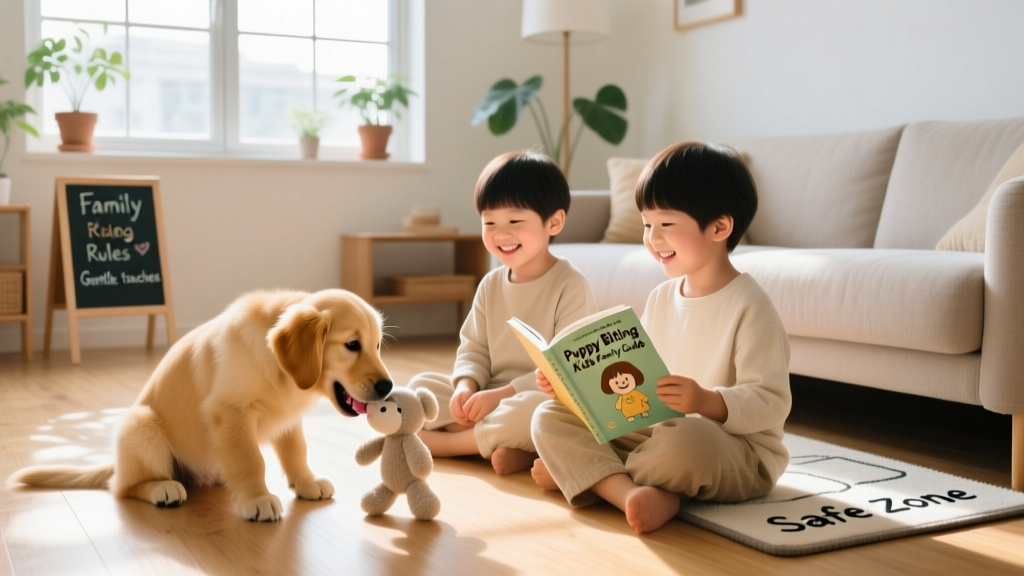
How do I stop puppy biting/nipping? Golden Retrievers are mouth-oriented by nature — they were bred to carry game. Biting is not aggression; it's exploration and teething relief. Use these force-free strategies:
- Redirect: When puppy teeth touch skin, say "oops" calmly, withdraw attention for 5 seconds, then offer an appropriate chew toy. Reward chewing the toy with praise.
- Reverse time-out: If nipping continues, YOU leave the play area for 15–30 seconds. This teaches that biting ends fun.
- Provide alternatives: Keep 3–4 chew toys accessible at all times. Rotate them to maintain novelty.
- Manage arousal: Overtired puppies bite more. Enforce 2–3 hour nap cycles in the crate during the day.
Biting typically decreases significantly by 5–6 months as adult teeth settle. If biting intensifies or is accompanied by growling over resources, consult a certified force-free trainer — resource guarding can emerge in Golden Retrievers and responds well to counter-conditioning protocols.
Whining and Crying (Especially in the Crate)
Nighttime whining in the first 1–2 weeks home is separation distress, not defiance. Keep the crate in your bedroom initially, place a warm blanket and a heartbeat toy (like a Snuggle Puppy) inside, and avoid dramatic goodbyes or greetings. If whining happens after a potty break and your puppy is physically comfortable, wait 5–10 minutes before responding — rewarding silence builds quiet confidence.
Destructive Chewing
Golden Retrievers can chew through baseboards, shoes, and furniture legs with alarming speed. Management is key: puppy-proof rooms by removing accessible items, use bitter apple spray on furniture legs, and ensure your puppy gets adequate physical exercise (15–20 minutes of structured play per session, 3–4 times daily for puppies under 6 months) and mental stimulation (snuffle mats, frozen Kongs, training sessions). A tired puppy is a well-behaved puppy.
First-Year Cost Breakdown for a Golden Retriever Puppy in Eastern NC
Budgeting realistically prevents surprises. Eastern NC costs tend to run slightly below national averages for veterinary care but align with national pricing for food and supplies. Here's what to expect:
| Category | Estimated Cost Range | Details |
|---|---|---|
| Puppy purchase (AKC breeder) | $2,000–$3,500 | Eastern NC breeders with OFA health testing; rescue adoption: $300–$600 |
| Veterinary care (first year) | $800–$1,500 | Includes vaccines, spay/neuter, heartworm/flea/tick prevention, fecal tests, wellness exams |
| Food (large-breed puppy + adult transition) | $500–$800 | Premium brands like Purina Pro Plan, Royal Canin, or Hill's at ~$55–$75/bag |
| Supplies (crate, bed, toys, leash, bowls, gates) | $300–$600 | 42" crate with divider: ~$60–$90; quality harness: $25–$45 |
| Training classes | $200–$500 | Puppy kindergarten (6 weeks): $150–$250; basic manners follow-up: $150–$250 |
| Grooming | $0–$400 | Goldens don't require professional grooming, but many owners opt for sanitary trims and deshedding: $50–$80/session |
| Pet insurance (optional but recommended) | $350–$600/year | Enroll at 8 weeks for lowest premiums; covers accidents, illness, hereditary conditions |
| Total first year | $4,150–$7,900 | Excludes puppy purchase price; includes all care, food, and supplies |
Budget tip: Set aside an emergency fund of $500–$1,000 for unexpected vet visits. Golden Retriever puppies are notorious for eating things they shouldn't — a foreign body surgery at an Eastern NC emergency clinic can run $2,500–$5,000 without insurance.
Frequently Asked Questions
When should I bring my puppy home?
8 weeks is the standard recommended age. Puppies benefit from staying with littermates through weeks 6–8 for critical social development. Never accept a puppy younger than 7 weeks from any breeder.
How often should I feed my puppy at 10 weeks old?
At 10 weeks, feed 3–4 meals per day of large-breed puppy kibble, totaling approximately 1.5–2.5 cups daily. Divide evenly across meals and remove uneaten food after 15–20 minutes to establish a routine.
When will my puppy be fully potty trained?
Most Golden Retrievers achieve reliable house training between 4–6 months. Consistency in schedule, generous rewards for outdoor elimination, and supervision (or crating when unsupervised) are the three pillars. Occasional accidents through 8–9 months are normal, especially during excitement or schedule disruptions.
What vaccines does my puppy need and when?
Core vaccines: DHPP at 6–8 weeks, 10–12 weeks, and 14–16 weeks; rabies at 16 weeks (required by NC law). Your Eastern NC vet may also recommend leptospirosis and Lyme vaccines based on your puppy's exposure risk. Bordetella is recommended if attending group puppy classes.
How do I stop puppy biting and nipping?
Redirect to appropriate chew toys, use reverse time-outs (you leave when biting starts), and manage your puppy's arousal level with enforced naps. Golden Retriever mouthiness is breed-typical and decreases significantly by 5–6 months. Never use physical punishment — it damages trust and can create fear-based aggression.
When can my puppy go outside and meet other dogs?
You can carry your puppy outside for socialization exposure from day one. However, avoid areas where unknown dogs frequent (dog parks, pet store floors) until 7 days after the final DHPP vaccine at 14–16 weeks. Controlled playdates with known, fully vaccinated adult dogs in private yards are safe earlier. Puppy kindergarten classes that verify vaccination status can begin at 10–12 weeks.
Raising a Golden Retriever puppy in Eastern NC is a rewarding investment. The breed's temperament — friendly, trainable, and deeply bonded to their people — makes the intense first year worthwhile. Stick to the milestones above, maintain regular communication with your local veterinarian, and remember that patience and positive reinforcement build the confident, well-mannered adult dog you're envisioning.
Priya Sutaria
All our authors care for dogs every day — read more of their work on the authors page.