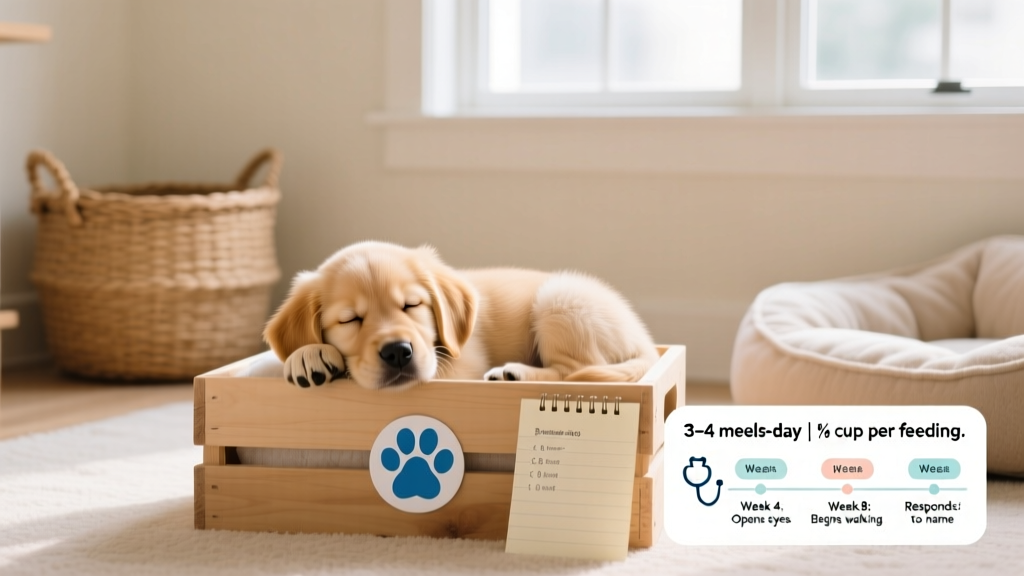
Best Puppy Foods & Feeding Guide for Golden Retrievers: Weeks 4–12 Months
Discover the best puppy foods for Golden Retrievers plus a complete week-by-week feeding, training, and health schedule from 4 weeks to 12 months.

Why Golden Retriever Puppies Need a Breed-Specific Nutrition Plan
Golden Retrievers are large-breed dogs with a genetic predisposition to hip and elbow dysplasia, obesity, and certain cardiac conditions. This means the best puppy foods for a Golden Retriever are not the same as those for a Beagle or a Chihuahua. Large-breed puppies must grow slowly and steadily — rapid growth from calorie-dense or calcium-rich diets increases the risk of developmental orthopedic disease (DOD), including osteochondrosis and hypertrophic osteodystrophy.
According to the American Kennel Club, large-breed puppy formulas should contain a calcium-to-phosphorus ratio between 1.0:1 and 1.5:1, with calcium levels at or below 1.5% on a dry matter basis. The AAFCO nutrient profile for growth specifically distinguishes "growth" from "growth for large-size dogs (70 lb or more as an adult)" — always look for this statement on the bag.
Best Puppy Foods for Golden Retrievers: What to Look For
Before we map out the feeding schedule, here are the nutritional benchmarks that separate adequate large-breed puppy foods from exceptional ones:
| Nutrient | Target Range (Dry Matter Basis) | Why It Matters for Goldens |
|---|---|---|
| Protein | 22–30% | Supports muscle without overloading kidneys |
| Fat | 12–18% | Lower fat prevents rapid growth; Goldens are obesity-prone |
| Calcium | 1.0–1.5% | Excess calcium directly linked to DOD in large breeds |
| Phosphorus | 0.8–1.2% | Must stay balanced with calcium |
| DHA (Omega-3) | ≥0.05% | Supports brain and retinal development |
| Calories (kcal/cup) | 350–425 | Moderate caloric density prevents growth spurts |
Three well-regarded large-breed puppy options available in 2026 include Royal Canin Golden Retriever Puppy (breed-specific kibble shape and EPA/DHA for coat), Hill's Science Diet Large Breed Puppy (clinically tested calcium levels, ~$55 for 30 lb bag), and Purina Pro Plan Large Breed Puppy Chicken & Rice (~$45 for 34 lb bag, includes DHA and guaranteed live probiotics). Always transition foods over 5–7 days to avoid gastrointestinal upset.
Golden Retriever Puppy Milestone Timeline: Weeks 4 Through 12 Months
Golden Retrievers mature slower than many breeds, both physically and mentally. Expect "puppy brain" to persist well into the second year. Here is what to anticipate at each developmental stage:
Weeks 4–8: Weaning and Early Socialization (Breeder's Domain)
Your puppy should still be with the breeder or rescue during this period. Puppies learn bite inhibition from littermates and begin the transition from mother's milk to softened kibble (puppy mush). Critical neurological development is happening — the breeder should be introducing novel textures, sounds, and gentle handling. Do not bring a Golden puppy home before 8 weeks of age. Puppies removed earlier show higher rates of separation anxiety and poor bite inhibition, per research published in the Journal of Veterinary Behavior.
Weeks 8–12: Homecoming and Foundation Building
This is the prime socialization window. Your Golden puppy will weigh approximately 10–20 lb and should be gaining about 2–2.5 lb per week. Expect intense mouthing and nipping — Goldens are a retriever breed and explore the world with their mouths. Begin crate training, establish a potty routine, and expose your puppy to at least 30 novel stimuli during this period (see socialization checklist below).
Weeks 12–16: Fear Periods and Rapid Growth
Many Golden puppies experience their first "fear imprint period" between 8–11 weeks and a second one around 6–14 months. During the 12–16 week window, your puppy may suddenly react fearfully to things they previously ignored. Keep training sessions short (5 minutes max), positive, and reward-based. Your puppy will weigh approximately 25–40 lb by 16 weeks.
Weeks 16–24 (4–6 Months): Teething and Adolescence Begins
Deciduous (baby) teeth fall out and adult teeth erupt, typically between 12–24 weeks. Chewing intensity peaks. Your Golden may chew baseboards, shoes, and furniture if not provided appropriate outlets. By 6 months, expect your puppy to weigh 40–55 lb — roughly 60–70% of adult weight. Spay/neuter discussions typically happen around this age; the AVMA recommends individualized timing based on breed and health status.
Months 6–12: Adolescent Energy and Continued Growth
Your Golden is now an adolescent — physically large but emotionally immature. Males may reach 60–75 lb; females 50–65 lb. Growth plates typically close between 14–18 months in large breeds, so avoid high-impact exercise (agility jumps, repetitive Frisbee catching on hard surfaces) until your veterinarian confirms skeletal maturity via X-ray. Continue feeding a large-breed puppy formula until approximately 12–15 months, then transition to adult food over 7–10 days.
Feeding Schedule: Exact Portions by Age and Weight
The following table assumes a large-breed puppy kibble at approximately 380–400 kcal per cup. Adjust based on your specific food's caloric density and your puppy's body condition score (BCS). A healthy Golden puppy should have a visible waist when viewed from above and ribs that are easily felt but not prominently visible.
| Age | Expected Weight | Meals Per Day | Approximate Daily Total | Per Meal |
|---|---|---|---|---|
| 8–12 weeks | 10–20 lb | 3–4 | 1.5–2.5 cups | ~0.5–0.75 cups |
| 12–16 weeks | 25–40 lb | 3 | 2–3.5 cups | ~0.75–1.25 cups |
| 4–6 months | 40–55 lb | 2–3 | 3–4 cups | ~1–1.5 cups |
| 6–9 months | 50–70 lb | 2 | 3.5–4.5 cups | ~1.75–2.25 cups |
| 9–12 months | 55–75 lb | 2 | 3.5–5 cups | ~1.75–2.5 cups |
Vaccination Schedule for Golden Retriever Puppies
Your veterinarian will customize this schedule based on local disease prevalence and your puppy's risk factors. The following represents the AAHA Canine Vaccination Guidelines core protocol:
| Age | Vaccine | Notes |
|---|---|---|
| 6–8 weeks | DHPP (Distemper, Hepatitis, Parainfluenza, Parvovirus) — 1st dose | Often administered by breeder/rescue |
| 10–12 weeks | DHPP — 2nd dose; Bordetella (optional) | Bordetella recommended if attending puppy classes |
| 14–16 weeks | DHPP — 3rd (final puppy) dose; Rabies | Rabies legally required; timing varies by state |
| 12–16 months | DHPP booster; Rabies booster | Then every 1–3 years per local law |
Non-core vaccines your vet may recommend based on lifestyle: Leptospirosis (if hiking or near standing water), Lyme disease (tick-endemic areas, particularly the Northeast and Upper Midwest), and Canine Influenza (H3N2/H3N8 — recommended if boarding or frequenting dog parks). Discuss titer testing as an alternative to automatic boosters after the initial puppy series.
Socialization Window (Weeks 3–14): Your Golden's Critical Exposure Checklist
The primary socialization period for puppies closes between 12–14 weeks of age. After this window, unfamiliar stimuli are more likely to trigger fear than curiosity. The Merck Veterinary Manual emphasizes that puppies need positive exposure — forced interactions that frighten a puppy can create lasting phobias.
Golden Retriever Socialization Checklist (Aim for 5–10 new positive experiences per week during weeks 8–14):
- Surfaces: Gravel, grass, tile, wet pavement, metal grates, sand, mulch
- People: Children, elderly individuals, people wearing hats/sunglasses/uniforms, people using wheelchairs or crutches, tall/short individuals
- Animals: Fully vaccinated, temperament-tested adult dogs; calm cats (supervised); livestock at a distance
- Sounds: Vacuum cleaner, thunderstorms (play recordings at low volume), fireworks recordings, doorbells, car engines, clapping
- Handling: Paw touching, ear inspection, mouth opening, nail clipping practice, gentle restraint, towel drying
- Environments: Car rides (start with 2-minute trips), pet-friendly store parking lots, outdoor café patios, school playgrounds (at a distance)
- Objects: Umbrellas opening, plastic bags rustling, balloons, skateboards, bicycles
Before the final DHPP vaccine at 14–16 weeks, avoid high-risk parvovirus environments: dog parks, pet store floors, and areas where unknown dogs defecate. Carry your puppy or use a stroller/wagon for socialization outings. Puppy classes that require proof of at least one DHPP dose and maintain sanitized facilities are generally considered safe, per the AVMA.
Potty Training Timeline and Troubleshooting
Golden Retrievers are generally eager to please and rank among the easier breeds to house-train. However, realistic timelines prevent frustration:
| Age | Bladder Capacity | Expected Accident Frequency | Outing Frequency Needed |
|---|---|---|---|
| 8–10 weeks | 20–30 minutes | Multiple daily accidents are normal | Every 30–60 min while awake; after every meal, nap, and play session |
| 10–14 weeks | 45–90 minutes | 1–2 accidents per week if on schedule | Every 60–90 min; overnight crate break may still be needed |
| 3–4 months | 2–3 hours | Rare accidents; regression possible during fear periods | Every 2 hours; overnight stretch of 5–6 hours achievable |
| 4–6 months | 3–4 hours | Occasional accidents with schedule changes | Every 3–4 hours; most puppies sleep through the night |
| 6–12 months | 4–6 hours | Should be reliably house-trained | 3–4 outings per day minimum |
Common Golden-specific potty training issues:
- Submissive urination: Goldens are sensitive dogs. If your puppy pees when greeted, avoid direct eye contact and crouch sideways. Do not scold — this worsens the behavior. Most puppies outgrow this by 6–8 months.
- Excitement urination: Similar to submissive urination but triggered by high arousal. Keep greetings calm and low-key.
- "I just went outside" syndrome: Young Goldens may not fully empty their bladder on the first outing. Wait 5–10 minutes after the first urination before coming inside, and reward heavily for a second void.
Crate Training Progression and Time Limits
Goldens are den-oriented dogs and typically adapt well to crate training when introduced positively. The crate should be sized to allow standing, turning, and lying down — but not so large that the puppy can eliminate in one corner and sleep in another. A 36-inch crate with a divider panel works well for growing Goldens (upgrade to a 42-inch crate for adult males).
| Age | Maximum Daytime Crate Duration | Maximum Overnight Duration | Notes |
|---|---|---|---|
| 8–10 weeks | 30–60 minutes | 2–3 hours (set alarm) | Crate near your bed; expect crying the first 2–3 nights |
| 10–14 weeks | 1–2 hours | 4–5 hours | Begin moving crate to permanent location |
| 3–4 months | 2–3 hours | 5–6 hours | Introduce "crate games" — feed meals inside, hide treats |
| 4–6 months | 3–4 hours | 7–8 hours | Should settle quietly; cover crate if puppy is easily stimulated |
| 6–12 months | 4–5 hours | 8 hours | Never exceed 5 hours crated during the day without a break |
Golden-specific crate training tips: Place a worn t-shirt with your scent in the crate during the first week. If your puppy whines at night, wait 5–10 minutes before responding — if you let them out while crying, you reinforce the behavior. However, if crying escalates to panicked shrieking or self-injury (bloody paws, broken nails), the puppy may have early separation anxiety and you should consult a certified behaviorist.
Teething Timeline and Safe Chew Strategies
Golden Retriever puppies have 28 deciduous teeth that erupt between 3–6 weeks and 42 permanent teeth that replace them between 12–24 weeks. The chewing urge peaks between 4–7 months and does not fully subside until approximately 12 months.
Safe chew recommendations by stage:
- 12–16 weeks (teeth loosening): Frozen wet washcloths, rubber KONG Classic (puppy size, ~$8) stuffed with softened kibble and frozen, Nylabone Puppy Chew (softer formula)
- 4–6 months (active eruption): Benebone Wishbone (puppy formula), frozen carrot sticks (supervised), West Paw Zogoflex Toppl for treat stuffing
- 6–12 months (jaw strengthening): KONG Classic (medium/large, red rubber), bully sticks (limit to 1 per day, ~$3–5 each, always supervise), Yak cheese chews
Common Golden Retriever Puppy Problems and Solutions
Mouthing and Nipping
Goldens are mouthy by genetic design — they were bred to carry waterfowl. Puppy nipping is not aggression, but it must be managed. When teeth touch skin, give a calm "ouch" or yelp, withdraw attention for 10–15 seconds, then redirect to an appropriate chew toy. Never hold the puppy's mouth shut, shake them, or use physical punishment — these methods increase fear and can trigger defensive biting. Consistent redirection typically reduces mouthing significantly by 5–6 months.
Jumping on People
Golden puppies are enthusiastic greeters. Teach "four on the floor" by turning sideways and withholding attention when the puppy jumps. Reward all four paws on the ground with calm petting and a treat. Ask guests to do the same. Management tools: keep a leash on the puppy during greetings so you can prevent the jump before it happens.
Counter Surfing and Food Stealing
Goldens are highly food-motivated. This breed will clear a kitchen counter given the opportunity. Management is the primary strategy: use baby gates, keep counters clear, and provide a stuffed KONG or lick mat during human mealtimes. Teach "leave it" starting at 10 weeks using positive reinforcement — place a treat on the floor, cover it with your hand, and reward from the other hand when the puppy looks away.
Separation Distress
Goldens bond deeply with their people and are prone to separation anxiety if not taught independence early. Practice brief departures (30 seconds to 5 minutes) daily from the first week home. Vary departure cues — pick up keys but don't leave, put on shoes then sit back down — to prevent the puppy from predicting and reacting to your exit routine.
First-Year Cost Breakdown for a Golden Retriever Puppy
Budget realistically. Golden Retrievers are large dogs, and costs scale with size — especially food, medication (heartworm preventives are weight-based), and veterinary care.
| Category | Estimated Cost Range (First Year) | Details |
|---|---|---|
| Puppy purchase/adoption | $500–$3,500 | Rescue: $300–$600; Responsible breeder: $1,500–$3,500 (includes health testing of parents) |
| Veterinary care | $600–$1,200 | Wellness exams (3–4 visits), vaccines, fecal tests, heartworm test, spay/neuter ($300–$600) |
| Food | $450–$750 | Large-breed puppy formula, ~$45–$65 per 30 lb bag, 8–12 bags per year |
| Preventive medications | $200–$400 | Monthly heartworm + flea/tick (e.g., Simparica Trio, ~$18–$25/month for 50+ lb dogs) |
| Supplies | $300–$500 | Crate ($60–$90), bed, bowls, leash/harness, toys, grooming tools, baby gates |
| Training | $150–$400 | Puppy kindergarten ($150–$250 for 6-week course); optional private sessions ($75–$125/session) |
| Grooming | $0–$400 | Goldens can be home-groomed; professional grooming $50–$80 per session if preferred |
| Pet insurance | $350–$600 | Recommended for Goldens (prone to hip dysplasia, cancer); ~$30–$50/month |
| Total estimated first year | $2,550–$7,750 | Varies significantly by purchase source, location, and optional services |
After the first year, expect annual costs of $1,500–$3,000 for food, preventives, routine veterinary care, and insurance. Emergency veterinary visits (foreign body ingestion is common in Goldens — they eat everything) can add $1,500–$5,000 per incident, making insurance or a dedicated emergency fund essential.
Golden Retriever Puppy FAQ
When should I bring my Golden Retriever puppy home?
No earlier than 8 weeks of age. Many reputable Golden Retriever breeders keep puppies until 9–10 weeks to allow for additional littermate socialization and the first round of vaccinations. Puppies brought home before 8 weeks miss critical bite inhibition learning from siblings and are at higher risk for behavioral problems later in life.
How often should I feed my Golden Retriever puppy?
Feed 3–4 meals per day from 8–12 weeks, 3 meals per day from 12 weeks to 4 months, and transition to 2 meals per day from 4–6 months onward. Never free-feed a Golden — this breed will overeat, leading to rapid growth and obesity. Scheduled meals also make potty training far more predictable, since puppies typically need to eliminate 15–30 minutes after eating.
When will my Golden Retriever puppy be fully potty trained?
Most Golden Retrievers are reliably house-trained between 4–6 months of age, with occasional accidents possible up to 8–10 months. Males may take slightly longer than females. "Fully trained" means no accidents for at least 4 consecutive weeks with a consistent schedule. If accidents persist beyond 6 months despite a proper routine, consult your veterinarian to rule out urinary tract infections, anatomical abnormalities, or ectopic ureters (a congenital condition seen more frequently in female Goldens).
What vaccines does my Golden Retriever puppy need and when?
Core vaccines: DHPP at 6–8, 10–12, and 14–16 weeks, with Rabies at 14–16 weeks. Non-core vaccines based on lifestyle: Bordetella (10–12 weeks, recommended for puppy classes), Leptospirosis (2-dose series starting at 12+ weeks), Lyme disease (2-dose series starting at 12+ weeks in endemic areas), and Canine Influenza (2-dose series). Always consult your veterinarian to build a protocol tailored to your region and your puppy's exposure risk.
How do I stop my Golden Retriever puppy from biting and nipping?
Redirect to appropriate chew toys every time teeth touch skin. Use a consistent cue ("ouch" or a yelp sound), withdraw attention for 10–15 seconds, then re-engage with a toy. Provide 3–5 minutes of structured chew time after every play session. Avoid physical punishment, which increases anxiety and can escalate biting. Most Golden puppies show significant improvement by 5–6 months as adult teeth fully erupt and with consistent redirection.
When can my Golden Retriever puppy go outside and meet other dogs?
Your puppy can go outside in low-risk environments (your own yard, carried in a sling through your neighborhood) immediately. For high-risk environments (dog parks, pet stores, hiking trails with heavy dog traffic), wait until 7–10 days after the final DHPP vaccine at 14–16 weeks — typically around 17–18 weeks of age. Puppy socialization classes that verify vaccination status are safe starting at 10–12 weeks. Balance disease risk against the closing socialization window — controlled exposure is essential for behavioral health.
Tom Renshaw
All our authors care for dogs every day — read more of their work on the authors page.