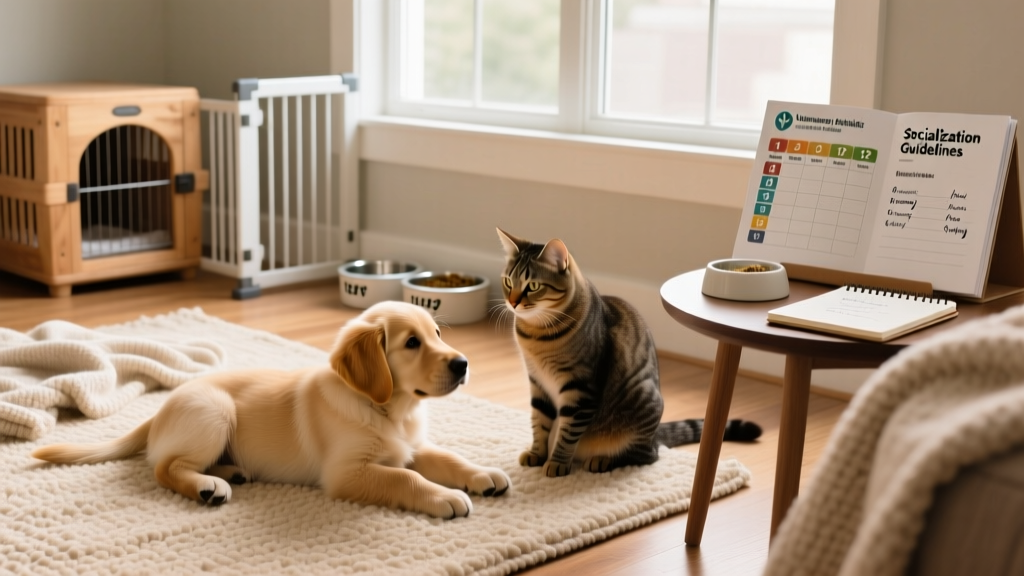
Golden Labrador Puppy: Week-by-Week Care, Feeding & Training Guide
Complete golden Labrador puppy guide covering feeding schedules, potty training timelines, vaccination weeks, socialization checklists, and first-year costs.

A golden Labrador puppy — the cross between a Golden Retriever and a Labrador Retriever — combines two of America's most popular breeds into one energetic, people-oriented companion. But those floppy ears and that wagging tail come with real responsibilities: precise feeding schedules, a narrow socialization window, and a teething phase that will test your patience (and your baseboards).
This guide walks you through every developmental stage from weeks 4 through 12 months, with specific numbers, timelines, and troubleshooting strategies drawn from veterinary developmental science and breed-specific experience. Whether you're picking up your puppy next week or preparing your home months in advance, you'll find exact action items rather than generic advice.
When to Bring Your Golden Labrador Puppy Home
The ideal age to bring your golden Labrador puppy home is 8 to 10 weeks. The American Veterinary Medical Association and the American Kennel Club both emphasize that puppies need to remain with their littermates through at least week 7 to learn bite inhibition and social cues from siblings and the dam.
Bringing a puppy home before 8 weeks increases the risk of:
- Excessive nipping and mouthing (missed sibling correction)
- Separation anxiety and difficulty settling in a crate
- Poor stress resilience in novel environments
Some responsible breeders of large breeds like the Goldador hold puppies until 10 weeks to complete an additional round of vaccinations and early socialization work. If your breeder suggests 10 weeks, this is a positive signal of responsible practice — not a red flag.
Age-Specific Milestones: What to Expect Each Stage
Golden Labrador puppies follow a predictable developmental arc, but "predictable" doesn't mean "easy." Here's what each stage actually looks like in your home.
Weeks 4–8: Neonatal to Transitional (Still with Breeder)
During this period, your puppy's eyes and ears fully open, deciduous (baby) teeth erupt, and littermate play teaches bite inhibition. If you're visiting your puppy during this window, expect a wobbly, curious animal that sleeps 18–20 hours per day and has very short attention spans (30–60 seconds of focused interaction).
Weeks 8–12: Primary Socialization & Bonding
This is the most critical period you directly influence. Your puppy will:
- Form primary attachments to household members
- Begin showing fear responses to novel stimuli (normal — do not force exposure)
- Have a bladder capacity of roughly 2 hours maximum
- Need 16–18 hours of sleep per day across multiple naps
- Chew and mouth everything as exploratory behavior peaks
Weeks 12–16: Expanding World & First Fear Period
Between weeks 12 and 14, many golden Labrador puppies enter their first fear period. A puppy that previously greeted strangers happily may suddenly cower behind your legs. This is developmentally normal and typically resolves within 1–2 weeks if you avoid forcing interactions and let the puppy approach novel things at their own pace. Bladder control extends to approximately 3–4 hours. Basic commands like "sit" and "come" begin to stick with consistent daily practice (5-minute sessions, 2–3 times daily).
Weeks 16–24 (4–6 Months): Adolescence Begins
Your golden Labrador puppy will hit adolescence — often the most challenging phase for owners. Expect:
- Regression in previously learned commands ("come" suddenly means "maybe")
- Increased independence and distractibility on walks
- Teething intensifies as adult teeth push in (see teething section below)
- Growth spurts that may cause temporary clumsiness and increased appetite
- Emerging sex-specific behaviors if not yet spayed/neutered
Months 6–12: Late Adolescence to Young Adult
By 6 months, your golden Labrador puppy will reach roughly 60–75% of adult weight. Most Goldadors mature to 55–80 lb (25–36 kg) depending on which parent breed they favor. Energy levels remain high — plan for 45–60 minutes of structured exercise daily (split into two sessions to protect developing joints). Impulse control gradually improves with consistent training, but don't expect full behavioral maturity until 18–24 months.
Feeding Schedule: Portions by Age and Weight
Golden Labrador puppies are prone to rapid growth, which increases the risk of developmental orthopedic diseases like hip dysplasia and elbow dysplasia. The Merck Veterinary Manual recommends feeding large-breed puppy formulas specifically designed to moderate growth rate. Look for the AAFCO statement on the bag confirming the food is formulated for "growth" or "all life stages" and specifically tested or formulated for large-breed puppies (expected adult weight over 70 lb / 32 kg).
| Age | Meals Per Day | Approximate Daily Amount (Large-Breed Puppy Kibble) | Notes |
|---|---|---|---|
| 8–12 weeks | 3–4 | 1.5–2 cups total | Soften kibble with warm water if puppy struggles to chew; feed at consistent times (7 AM, 12 PM, 5 PM, optional 9 PM) |
| 12–16 weeks | 3 | 2–2.5 cups total | Transition to dry kibble; monitor body condition score — ribs should be palpable without pressing hard |
| 4–6 months | 2–3 | 2.5–3.5 cups total | Drop to 2 meals/day around 5 months; adjust portions based on BCS, not bag recommendations alone |
| 6–12 months | 2 | 3–4 cups total | Gradually transition to adult formula around 10–12 months; Goldadors prone to obesity — do not free-feed |
Key feeding rules:
- Remove uneaten food after 15–20 minutes to establish meal structure
- Do not exercise your puppy for 30 minutes before or 1 hour after meals — large, deep-chested breeds like the Goldador carry risk for gastric dilatation-volvulus (bloat), and while less common in puppies, the habit of rest after eating is worth establishing early
- Limit treats to no more than 10% of daily caloric intake
- Expected food cost: $50–$80/month for quality large-breed puppy kibble (brands like Purina Pro Plan Large Breed Puppy, Royal Canin Large Puppy, or Hill's Science Diet Large Breed Puppy)
Vaccination Schedule: Week-by-Week Protection
Your golden Labrador puppy arrives with maternal antibodies that gradually wane, creating a window of vulnerability. The vaccination series is designed to close that gap. Your veterinarian will tailor the exact protocol, but the AKC-recommended core schedule follows this framework:
| Age | Vaccine(s) | Details |
|---|---|---|
| 6–8 weeks | DHPP (1st dose), Bordetella (optional) | DHPP covers distemper, hepatitis (adenovirus), parainfluenza, and parvovirus. Often administered by the breeder. |
| 10–12 weeks | DHPP (2nd dose), Leptospirosis (1st dose, optional), Lyme (1st dose, optional based on region) | Maternal antibodies begin declining; this dose is critical for building active immunity. |
| 14–16 weeks | DHPP (3rd dose), Rabies (legally required), Leptospirosis (2nd dose if started) | Final puppy DHPP ensures protection after maternal antibodies fully wane. Rabies is required by law in most US states. |
| 12–16 months | DHPP booster, Rabies booster, Bordetella (if boarding/daycare), Leptospirosis annual | First annual wellness visit; discuss titer testing as an alternative to ongoing boosters for DHPP. |
Socialization Window (Weeks 3–14): Your Exposure Checklist
The primary socialization window closes around 14 weeks — and the most impactful exposure happens between weeks 8 and 12, when your puppy is in your home. Missed socialization is the leading behavioral reason dogs are surrendered to shelters, according to the AVMA. For a golden Labrador puppy — a dog expected to be confident, friendly, and adaptable — this window is non-negotiable.
Important safety note: Until your puppy completes the DHPP series (around 16 weeks), avoid high-traffic dog areas like dog parks and pet store floors where parvovirus risk is real. You can still socialize extensively through controlled, low-risk exposures.
Weeks 8–10 Exposure Checklist
- ✓ Meet 5–10 different people (varying ages, heights, clothing styles, hats, sunglasses)
- ✓ Experience 3–4 different floor surfaces (tile, carpet, hardwood, concrete)
- ✓ Hear household sounds: vacuum cleaner (at distance, gradually closer), doorbell, TV, blender
- ✓ Ride in the car for 5–10 minutes (non-vet destination — pair with treats)
- ✓ Meet 1–2 fully vaccinated, calm adult dogs in controlled settings (friend's home, your yard)
- ✓ Practice gentle handling: touch paws, look in ears, open mouth, lift tail
Weeks 10–14 Exposure Checklist
- ✓ Visit 3–5 new environments (park bench, outdoor café patio, school pickup area, parking lot)
- ✓ Experience children playing nearby (at a distance if puppy shows concern)
- ✓ Walk on leash near bicycles, strollers, and wheeled objects
- ✓ Attend one puppy kindergarten class (verify all attendees are age-appropriately vaccinated)
- ✓ Practice brief separations (leave puppy in safe area for 5–15 minutes, return calmly)
- ✓ Grooming exposure: gentle brushing, nail clipper touching paws (no clipping yet), toothbrush in mouth
Rule of thumb: Every new experience should be paired with high-value treats (small pieces of boiled chicken, cheese, or commercial training treats). If your puppy shows fear — cowering, tail tucking, freezing — increase distance from the stimulus and let them observe without pressure. Forcing a fearful puppy into interaction can create lasting negative associations.
Potty Training Timeline and Troubleshooting
Set realistic expectations: most golden Labrador puppies are reliably potty trained between 4 and 6 months of age. "Reliably" means fewer than one accident per week with consistent management. Full bladder control — including overnight — typically solidifies by 6–8 months.
The Bladder Capacity Rule
A puppy can hold their bladder for approximately one hour per month of age, plus one. So:
- 8-week-old puppy: ~2 hours maximum (plan outings every 1–1.5 hours)
- 12-week-old puppy: ~3–4 hours maximum
- 16-week-old puppy: ~4–5 hours maximum
- 6-month-old puppy: ~6–7 hours (overnight stretching becomes possible)
Daily Potty Schedule Template (8–12 Weeks)
| Time | Action |
|---|---|
| Immediately upon waking | Carry puppy directly outside to designated spot |
| Within 15 min after each meal | Leash walk to potty spot; wait up to 5 minutes |
| After every play session | Post-play potty break (excitement triggers urgency) |
| After every nap | Carry outside — do not let puppy walk through house |
| Before crate time | Always potty before confining |
| Last outing before bed | 10–11 PM; keep lights low, interaction minimal |
| Overnight (8–12 weeks only) | Set alarm for one 3 AM outing; phase out by 14–16 weeks |
Troubleshooting Common Potty Problems
"My puppy pees inside 5 minutes after coming back in." This is extremely common at 8–12 weeks. The puppy didn't fully empty outside. Solution: Stay outside longer (up to 10 minutes), walk a short loop to stimulate movement, and reward enthusiastically the moment they eliminate — not after they come inside.
"My puppy was doing great and suddenly regressed." Regression around 12–16 weeks often coincides with the first fear period or a growth spurt that increases water intake. Return to a tighter schedule (more frequent outings) for 5–7 days until consistency returns.
"My puppy only pees in the crate now." This signals the crate is too large (puppy is eliminating in one corner and sleeping in another) or the puppy was left crated beyond bladder capacity. Reduce crate size using a divider panel and increase outing frequency. Clean the crate thoroughly with an enzymatic cleaner (Nature's Miracle or Rocco & Roxia) to remove residual scent.
Crate Training Progression and Time Limits
A crate is your golden Labrador puppy's den and your management tool for potty training, safety, and settling. Introduce it on day one, but follow age-appropriate time limits to prevent distress and crate aversion.
| Puppy Age | Maximum Continuous Crate Time | Notes |
|---|---|---|
| 8–10 weeks | 1–1.5 hours | Set a timer; puppy needs frequent potty breaks and social interaction |
| 10–12 weeks | 2 hours | Begin feeding meals in crate with door open to build positive association |
| 12–16 weeks | 3 hours | Puppy should enter crate voluntarily for naps by this stage |
| 4–6 months | 4 hours | Transition to a larger crate (42-inch) if puppy is outgrowing the 36-inch starter |
| 6–12 months | 5–6 hours | Adult overnight crating (7–8 hours) is acceptable once bladder control is established |
Crate sizing for a Goldador: Most golden Labrador mixes will need a 42-inch crate at full size. Purchase a 42-inch crate with a divider panel from the start — section off the back portion for your 8-week-old puppy and expand the space as they grow. Recommended models include the MidWest iCrate (approximately $60–$80) or the Frisco Ultimate Double Door Crate.
Crate training steps:
- Days 1–3: Leave crate door open, toss treats and meals inside. Never force puppy in.
- Days 4–7: Close door for 1–5 minutes while you sit nearby. Reward quiet behavior.
- Week 2: Close door, step 5 feet away for 5–10 minutes. Return before puppy whines if possible.
- Week 3: Leave the room for 15–30 minutes. Puppy should be napping by this point.
- Week 4+: Gradually extend absences. If puppy whines persistently, you've increased duration too quickly — step back one level.
Teething Timeline and Relief Strategies
Golden Labrador puppies are mouthy dogs by nature — both parent breeds are retrieving dogs genetically wired to carry things in their mouths. Teething amplifies this drive significantly.
Teething Phases
- Weeks 3–6: Deciduous (baby) teeth erupt — 28 total. Puppy is with breeder during this phase.
- Weeks 12–16: Baby incisors begin loosening. You may find tiny teeth on the floor or in toys (many puppies swallow them — this is harmless).
- Months 4–6: Peak teething discomfort. All 42 adult teeth are pushing through gums. Drooling, chewing, and mouthing intensify. Some puppies eat less during this phase due to gum soreness.
- Months 6–7: All adult teeth should be in. If any baby teeth remain (especially upper canines), your vet will evaluate whether extraction is needed — a common issue in medium-to-large breeds.
Safe Chew Recommendations
- Kong Classic (red or black rubber, size Medium for puppies): Stuff with a mixture of plain yogurt and mashed banana, then freeze for 2–4 hours. The cold numbs sore gums. Approximately $12–$15.
- Nylabone Puppy Chew (soft rubber, not hard nylon): Choose the puppy-specific version, which is softer and gentler on developing teeth. $6–$9.
- Frozen washcloth: Wet a clean washcloth, twist into a rope shape, freeze, and supervise chewing. Discard once it begins to fray. Free.
- Benebone Puppy Wishbone: Designed for puppies under 6 months with softer material. $13–$17.
Common Golden Labrador Puppy Problems and Solutions
Both Golden Retrievers and Labradors are mouth-oriented, high-energy, people-focused breeds. Their cross produces puppies with specific behavioral tendencies that catch first-time owners off guard.
Problem 1: Excessive Biting and Nipping
Golden Labrador puppies are notorious for "land shark" behavior — jumping and nipping at hands, ankles, and clothing. This is normal retriever-mouth behavior amplified by puppy energy, not aggression.
Solution:
- When teeth touch skin, say "ouch" in a calm, flat tone (not a high-pitched yelp, which can excite some puppies more) and immediately withdraw attention — stand up, fold arms, look away for 10–15 seconds.
- Redirect to an appropriate chew toy every single time. Keep toys in every room.
- Ensure your puppy is getting adequate physical exercise (15–20 minute walks, 2x daily by 12 weeks) and mental stimulation (snuffle mats, puzzle feeders, 5-minute training sessions). Overtired and under-stimulated puppies bite more.
- Enforce mandatory nap times. An 8–12 week old puppy that has been awake for more than 2 hours is overtired and will escalate biting. Crate them for a nap.
Problem 2: Whining and Crying in the Crate
Expect some protest the first 3–7 nights. This is adjustment, not a sign something is wrong.
Solution:
- Place the crate in your bedroom for the first 2–3 weeks so your puppy can hear and smell you.
- Use a Snuggle Puppy (a plush toy with a heartbeat simulator and heat pack, ~$35) to ease the transition from littermates.
- If whining occurs after the puppy has been settled for 30+ minutes, take them outside to potty (carry them, no play), then return to crate. If whining resumes immediately after pottying, it's protest — wait for 10–15 seconds of silence before opening the crate so you don't reward the noise.
Problem 3: Destructive Chewing
Between months 4 and 7, your golden Labrador puppy will chew furniture, shoes, remote controls, and anything else within reach. This is teething combined with breed-typical oral fixation.
Solution:
- Manage the environment: use baby gates to restrict access to puppy-proofed rooms only. Do not give a 4-month-old puppy free run of the house.
- Rotate toys every 2–3 days to maintain novelty. A basket of 10 toys rotated in sets of 4 keeps engagement higher than all toys available constantly.
- Apply bitter apple spray (Grannick's Bitter Apple, ~$8) to furniture legs and baseboards as a deterrent — but pair this with providing appropriate alternatives, not as a standalone fix.
When Can My Puppy Go Outside and Meet Other Dogs?
This is one of the most common questions golden Labrador puppy owners ask, and the answer requires balancing disease risk against socialization needs.
Safe outdoor exposure (starting at 8 weeks):
- Your own yard (if no unknown dogs have access)
- Carried outings in public — parks, outdoor shopping areas, friends' homes
- Controlled playdates with fully vaccinated, healthy adult dogs you know
- Puppy kindergarten classes that require proof of at least one DHPP dose (many reputable trainers follow the AVSAB position that socialization classes can begin 7 days after the first DHPP dose)
Avoid until DHPP series is complete (around 16 weeks):
- Dog parks (high parvovirus and parasite risk)
- Pet store floors (high traffic of unknown vaccination status)
- Unknown dogs at rest stops or public areas
- Shared grassy areas at apartment complexes with high dog traffic
After the final DHPP dose at 14–16 weeks, wait 5–7 days for immunity to build, then gradually introduce higher-traffic environments. By 5 months, your golden Labrador puppy should be able to enjoy supervised dog park visits, hiking trails, and group walks.
First-Year Cost Breakdown
Budget realistically before bringing your golden Labrador puppy home. These figures reflect 2025–2026 US averages across low, moderate, and high-cost scenarios.
| Category | Low Estimate | Mid Estimate | High Estimate | Details |
|---|---|---|---|---|
| Puppy purchase/adoption | $200 (rescue) | $800 (responsible breeder) | $2,000 (premier breeder) | Goldador puppies from health-tested parents typically range $600–$1,500 |
| Veterinary care (vaccines, spay/neuter, wellness) | $400 | $700 | $1,200 | Includes initial series, rabies, heartworm prevention, spay/neuter ($300–$600) |
| Food (12 months) | $480 | $720 | $1,000 | Large-breed puppy formula transitioning to adult; $40–$85/month |
| Supplies (crate, bed, leash, bowls, toys, gates) | $200 | $400 | $700 | One-time purchases; higher end includes premium orthopedic bed ($80–$150) |
| Training (puppy class, group classes) | $150 | $350 | $800 | Puppy kindergarten ($150–$200 for 6-week session) + intermediate class |
| Preventive medications (heartworm, flea/tick) | $200 | $350 | $500 | Monthly preventives like Interceptor Plus + NexGard: $25–$45/month |
| Pet insurance (optional) | $360 | $540 | $720 | $30–$60/month for accident/illness coverage; enroll at 8 weeks for lowest premiums |
| Total First Year | $1,990 | $3,860 | $6,920 |
Hidden costs to budget for: Emergency vet visits ($500–$3,000 for a single incident — golden Labrador puppies are prone to eating foreign objects), professional grooming if coat is Golden-leaning ($40–$70 per session, every 8–12 weeks), and boarding or pet sitting ($35–$65/night) if you travel.
Frequently Asked Questions
How often should I feed my golden Labrador puppy at 10 weeks?
At 10 weeks, feed three meals per day, totaling approximately 1.5–2 cups of large-breed puppy kibble daily. Divide into equal portions at roughly 7 AM, 12 PM, and 5 PM. Adjust based on your puppy's body condition — you should be able to feel ribs without pressing hard, and see a slight waist when viewed from above.
When will my golden Labrador puppy be fully potty trained?
Expect reliable potty habits (fewer than one accident per week) between 4 and 6 months with consistent schedule management. Full overnight control typically solidifies by 6–8 months. Male puppies may take slightly longer than females. If accidents increase suddenly after a period of success, rule out a urinary tract infection with your veterinarian.
What vaccines does my golden Labrador puppy need and when?
Core vaccines include DHPP at 6–8, 10–12, and 14–16 weeks, plus rabies at 14–16 weeks. Non-core vaccines your vet may recommend based on your region and lifestyle include Bordetella (kennel cough), Leptospirosis, and Lyme disease. Always consult your veterinarian for a protocol tailored to your puppy's risk factors and local disease prevalence.
How do I stop my golden Labrador puppy from biting my hands?
Use the redirect-and-withdraw method consistently: when teeth touch skin, say "ouch" calmly, stand up, and ignore for 10–15 seconds. Immediately offer a chew toy as the appropriate alternative. Ensure your puppy is getting enough sleep (enforced naps in the crate every 1.5–2 hours at 8–12 weeks) and enough mental stimulation. Most golden Labrador puppies significantly reduce nipping by 5–6 months as adult teeth come in and impulse control develops.
When should I spay or neuter my golden Labrador puppy?
For large-breed dogs like the Goldador, current veterinary research — including studies referenced in the Merck Veterinary Manual — suggests waiting until skeletal maturity, typically 12–18 months. Early spay/neuter (before 6 months) in large breeds has been associated with increased risk of hip dysplasia, cranial cruciate ligament tears, and certain cancers. Discuss the optimal timing with your veterinarian based on your individual puppy's growth and health status.
Is my golden Labrador puppy's coat going to change?
Yes. Most Goldador puppies have a softer, fluffier puppy coat that transitions to their adult coat between 6 and 12 months. The adult coat may be slightly different in color (often darker) and texture (wavier or denser). If your puppy inherited the Golden Retriever's longer coat, expect moderate-to-heavy shedding year-round with seasonal "blows" in spring and fall. Begin brushing 2–3 times per week from day one to establish the grooming routine.
Robin Maitland
All our authors care for dogs every day — read more of their work on the authors page.