Female Puppy Neutering: Timing, Recovery & First-Year Care Guide
Complete guide to female puppy neutering (spaying): optimal timing by breed size, recovery tips, vaccination schedule, feeding, potty training & first-year costs.

When Should You Spay Your Female Puppy? The Timing Debate Explained
If you've brought home a new female puppy, one of the first decisions you'll face with your veterinarian is when to schedule her spay surgery (ovariohysterectomy or ovary-sparing spay). The term "female puppy neutering" is often used interchangeably with spaying, though technically neutering is the umbrella term for sterilizing any dog, while spaying refers specifically to females.
The American Veterinary Medical Association (AVMA) supports individualized spay/neuter decisions based on breed, size, sex, and lifestyle. Here's what current veterinary consensus recommends for female puppies:
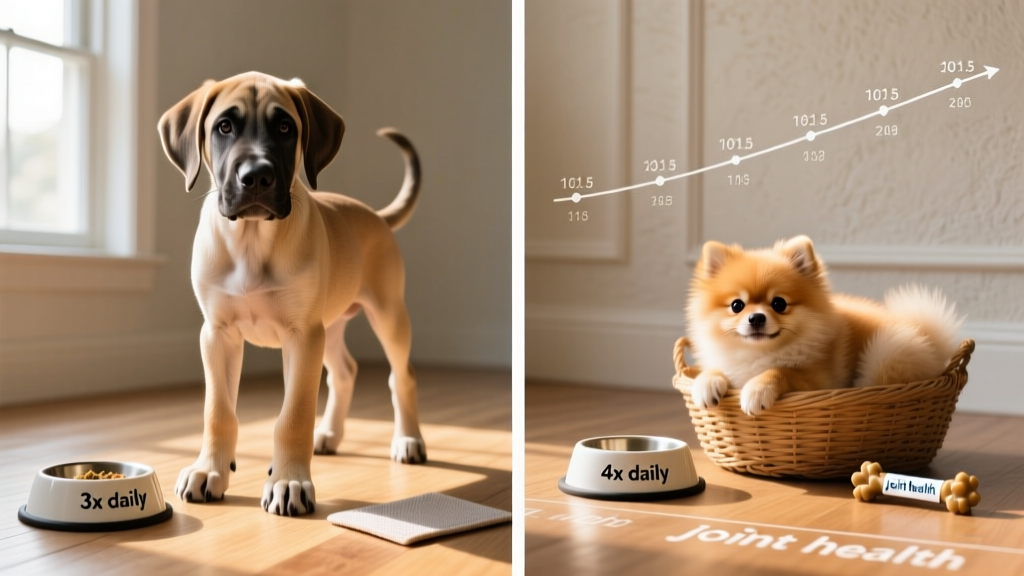
- Small breeds (under 25 lb / 11 kg adult weight): 6–9 months, often before first heat cycle
- Medium breeds (25–50 lb / 11–23 kg): 6–12 months
- Large breeds (50–90 lb / 23–41 kg): 12–18 months, after growth plates close
- Giant breeds (over 90 lb / 41 kg): 12–24 months, coordinated with your vet
Why the variation? Research published in peer-reviewed journals (including studies referenced by the Merck Veterinary Manual) suggests that early spaying in large and giant breeds may increase risks of orthopedic conditions like cranial cruciate ligament (CCL) tears and hip dysplasia, because estrogen plays a role in growth plate closure. For small breeds, these orthopedic risks are lower, and spaying before the first heat cycle (typically 6–10 months) virtually eliminates the risk of pyometra (a life-threatening uterine infection) and dramatically reduces mammary tumor risk.
Veterinary Disclaimer: Always consult your veterinarian to determine the optimal spay timing for your individual puppy. Factors like breed, body condition, comorbidities (co-existing conditions), and lifestyle all influence this decision. This article provides general guidance and does not replace professional veterinary care.
Your Female Puppy's First Year: Age-by-Age Milestone Timeline
Raising a puppy involves predictable developmental stages. Here's what to expect across key windows, with concrete benchmarks so you can track your puppy's progress.
Weeks 4–8: The Breeder/Foster Window
During this period, your puppy is still typically with her breeder or foster. Critical developments include:
- Weaning from mother's milk to softened puppy kibble (weeks 4–6)
- First socialization with littermates — learning bite inhibition and canine body language
- First deworming (typically at 2, 4, 6, and 8 weeks)
- First DHPP vaccine at 6–8 weeks
- Sensory exposure: new surfaces, sounds, gentle handling
Weeks 8–12: Welcome Home
This is when most puppies go to their new families. Expect:
- Sleep: 18–20 hours per day (puppies need enforced naps in a crate)
- Potty frequency: Every 1–2 hours during the day, plus overnight wake-ups
- Attention span: 5–10 minutes for training sessions
- Bite inhibition: Mouthing and nipping peak — this is normal exploration, not aggression
- Fear period: Weeks 8–11 often include a heightened sensitivity to scary experiences; avoid overwhelming situations
Weeks 12–16: Building Foundations
- Potty progress: Bladder control improves; can hold for approximately age in months + 1 (so a 3-month-old holds roughly 4 hours)
- Training: Can learn sit, down, come, name recognition using positive reinforcement with high-value treats
- Socialization urgency: The primary socialization window closes around 14 weeks — maximize safe exposures now
- Teething begins: Baby teeth start loosening around 12–16 weeks
Weeks 16–24 (4–6 Months): The Teenage Phase Begins
- Adult teeth: All 42 adult teeth typically in by 6 months
- Chewing intensity: Peaks as adult teeth set — provide appropriate outlets
- Second fear period: May occur around 6–14 months — sudden fear of previously familiar things
- Spay consultation: Good time to discuss timing with your vet for small/medium breeds
Months 6–12: Adolescence
- Energy surge: Adolescents need structured exercise and mental enrichment
- Regression: Previously reliable behaviors may temporarily deteriorate — stay consistent
- First heat risk: If not yet spayed, watch for vulvar swelling, bloody discharge, and increased male dog interest (estrus typically lasts 2–4 weeks)
- Spay window: Many small-breed females are spayed during this window; large breeds may wait longer
Feeding Your Female Puppy: Schedule and Portions by Age
Nutrition directly impacts growth rate, which is especially important for females you plan to spay — overfeeding accelerates growth and can compound orthopedic risks in larger breeds. Feed an AAFCO-certified, complete-and-balanced puppy formula appropriate for your dog's expected adult size.
| Age | Meals/Day | Small Breed (5–15 lb) | Medium Breed (15–40 lb) | Large Breed (40–80 lb) |
|---|---|---|---|---|
| 8–12 weeks | 4 | ¼–½ cup total/day | ½–1 cup total/day | 1–2 cups total/day |
| 3–6 months | 3 | ⅓–¾ cup total/day | ¾–1½ cups total/day | 1½–3 cups total/day |
| 6–12 months | 2 | ½–1 cup total/day | 1–2 cups total/day | 2–4 cups total/day |
Important notes: These are starting ranges — always adjust based on your puppy's body condition score (BCS). You should be able to feel ribs without pressing hard, and see a visible waist from above. After spaying, metabolic rate drops approximately 20–30%, so you'll need to reduce portions or transition to adult food per your vet's guidance to prevent obesity.
For large and giant breeds, use a large-breed puppy formula that restricts calcium and caloric density to slow growth rate and reduce orthopedic disease risk. The FDA (fda.gov) recommends checking the AAFCO statement on the label to confirm the food is appropriate for growth or "all life stages."
Vaccination Schedule: What Your Female Puppy Needs and When
Vaccinations protect your puppy from life-threatening diseases. Your vet will tailor this schedule to your region and risk factors, but here is the standard core vaccination protocol:
| Age | Vaccine | What It Protects Against |
|---|---|---|
| 6–8 weeks | DHPP (1st dose) | Distemper, Hepatitis (Adenovirus), Parainfluenza, Parvovirus |
| 10–12 weeks | DHPP (2nd dose) | Same — booster to build immunity as maternal antibodies wane |
| 14–16 weeks | DHPP (3rd dose) | Final puppy booster — critical for full protection |
| 12–16 weeks | Rabies | Rabies virus (legally required in most US states) |
| 8+ weeks (as needed) | Bordetella | Kennel cough — recommended for puppies attending group classes or boarding |
Non-core vaccines your vet may recommend based on lifestyle: Leptospirosis (outdoor/urban exposure), Lyme disease (tick-endemic areas), and Canine Influenza (H3N2/H3N8 — boarding/daycare settings).
Socialization Window (Weeks 3–14): Your Exposure Checklist
The primary socialization period — roughly weeks 3 through 14 — is when puppies form lasting impressions about the world. The American Kennel Club (AKC) emphasizes that under-socialized puppies are significantly more likely to develop fear-based behavioral problems later in life. This window is time-sensitive and cannot be fully recaptured once closed.
Goal: Expose your puppy to a wide variety of positive, low-pressure experiences. Never force interactions — let her approach at her own pace and pair new experiences with treats and praise.
Socialization Exposure Checklist
- Surfaces: Grass, gravel, tile, carpet, metal grates, wet pavement, sand, wooden planks
- People: Children (supervised), elderly individuals, people wearing hats/sunglasses/masks, people with mobility aids, tall/short individuals, various ethnicities
- Sounds: Vacuum cleaner, doorbell, thunderstorms (play recordings at low volume), traffic, construction noise, clapping, whistles
- Objects: Umbrellas opening, trash cans, bicycles, skateboards, plastic bags, flags
- Animals: Fully vaccinated, friendly adult dogs (one-on-one playdates — avoid dog parks until vaccination complete), cats (if household has them)
- Handling: Paw touching, ear inspection, mouth opening, nail clipping simulation, collar/harness handling, being lifted
- Environments: Car rides, outdoor café patios (carried), friend's homes, veterinary clinic (happy visits with treats, no procedures)
When can your puppy go outside and meet other dogs? You can carry your puppy in public immediately for exposure purposes. For ground-level walks and direct dog-to-dog contact, wait until at least 7 days after her second DHPP vaccine (around 12–13 weeks) for controlled settings with known, vaccinated dogs. Full dog park access should wait until 1–2 weeks after the final DHPP booster at 16 weeks.
Potty Training Timeline: Realistic Expectations and Troubleshooting
There is no shortcut to reliable house training. Here's a realistic timeline based on canine bladder development:
| Age | Bladder Hold Time (awake) | Bladder Hold Time (overnight) | Expected Accidents/Week |
|---|---|---|---|
| 8–10 weeks | 30–60 minutes | 2–3 hours | 5–10+ |
| 10–14 weeks | 1–2 hours | 3–5 hours | 3–6 |
| 4–6 months | 2–4 hours | 6–8 hours | 1–3 |
| 6–9 months | 4–6 hours | 8+ hours | 0–2 |
| 9–12 months | 6–8 hours | 8–10 hours | 0–1 |
When will your puppy be fully potty trained? Most puppies achieve reliable house training between 6 and 9 months, though some small breeds (with proportionally smaller bladders) may take up to 12 months. Consistency is the single biggest factor.
Potty Training Protocol
- Take puppy out immediately after waking, eating, drinking, playing, and every 1–2 hours otherwise
- Use a consistent cue ("go potty") while she's eliminating, then reward with a treat within 2 seconds of finishing
- Supervise or confine: When you can't watch her, she's in her crate or a puppy-proofed pen — no unsupervised roaming
- Interrupt accidents calmly: A neutral "oops" and carry outside — never punish, yell, or rub her nose in it (this creates fear of eliminating in front of you, not of eliminating indoors)
- Enzymatic cleaner (like Nature's Miracle or Rocco & Roxie) on any accident spots — standard cleaners don't remove the uric acid that attracts repeat eliminations
Crate Training Progression: Time Limits by Age
A crate provides a safe den and accelerates potty training by leveraging a dog's natural instinct not to soil her sleeping area. Crate training should always use positive reinforcement — the crate must be associated with good things, never used as punishment.
| Age | Max Continuous Crate Time | Overnight |
|---|---|---|
| 8–10 weeks | 1 hour | 2–3 hours (set alarm) |
| 10–14 weeks | 1–2 hours | 3–5 hours |
| 4–6 months | 3–4 hours | 6–8 hours |
| 6–12 months | 4–5 hours | 8–10 hours |
Crate training steps:
- Leave the crate door open with treats and a stuffed Kong inside — let puppy explore freely
- Feed meals in the crate with the door open, then gradually close it during meals
- Close the door for 30 seconds while you sit nearby, then release before she fusses
- Gradually extend time: 1 minute, 5 minutes, 15 minutes, then leave the room briefly
- Build to your target duration over 2–4 weeks — never jump from 5 minutes to 2 hours
Teething Timeline (3–6 Months): Relief Strategies and Safe Chews
Puppy teething is one of the most common reasons owners call their vet in the first year. Here's the progression:
- 3–4 months: Baby incisors loosen and fall out; puppy chews more intensely
- 4–5 months: Canines and premolars erupt; you may find tiny teeth in bedding or toys
- 5–6 months: Molars come in; all 42 adult teeth should be present by 6–7 months
Safe Teething Relief Options
- Frozen washcloth: Wet a clean washcloth, twist into a rope, freeze for 2 hours — the cold numbs gums and the texture satisfies chewing urges
- Kong Classic (puppy rubber, pink/blue): Stuff with plain yogurt and banana, freeze overnight — provides 20–30 minutes of engaged chewing
- Nylabone Puppy Chew: Designed for developing teeth with softer nylon than adult versions
- Carrots (frozen): Whole large carrots, chilled — supervise to prevent choking on broken pieces
Common Puppy Problems: Biting, Whining, and Chewing — Solutions That Work
How to Stop Puppy Biting and Nipping
Puppies explore the world with their mouths, and bite inhibition is learned through feedback. Here's a proven force-free protocol:
- Redirect: When teeth touch skin, say "ouch" in a calm, slightly surprised tone, then immediately offer an appropriate chew toy
- Withdraw attention: If she continues biting, stand up and turn away for 10–15 seconds — this teaches that biting ends play
- Time-outs: For persistent mouthing, calmly place puppy in her crate or a pen for 30–60 seconds to decompress (this is a calm reset, not punishment)
- Satisfy the need: Ensure your puppy has 15–20 minutes of structured chewing time daily with appropriate items
Nipping typically decreases significantly by 5–6 months as adult teeth come in and bite inhibition improves. If biting is aggressive (hard bites with growling, lunging, or resource guarding), consult a certified professional dog trainer (CPDT-KA) or veterinary behaviorist.
Crate Whining at Night
Nighttime whining is almost universal in the first 2–3 weeks. Strategies that work:
- Place the crate in your bedroom initially — proximity reduces separation distress
- Cover the crate with a breathable blanket to create a den-like feel
- Use a Snuggle Puppy (heartbeat toy with warming pack) to simulate littermate comfort
- Wait 30–60 seconds of silence before letting her out — releasing during whining reinforces the behavior
- Take her out for a potty break if it's been 2+ hours, keep it boring (no play), then return to crate
Destructive Chewing
Puppies chew for 3 reasons: teething discomfort, boredom, and exploration. Manage it with:
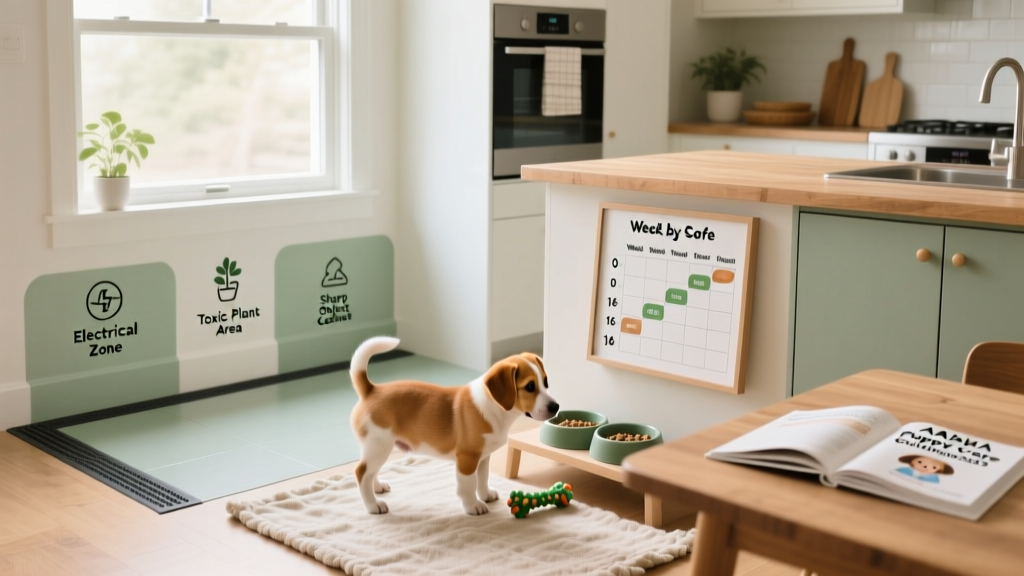
- Puppy-proof one room: remove shoes, cords, remote controls, and anything at puppy height
- Rotate 4–5 appropriate chew toys weekly to maintain novelty
- Provide 20–30 minutes of mental enrichment daily (snuffle mats, frozen Kongs, training sessions)
- Apply bitter apple spray (Grannick's Bitter Apple) to furniture legs and baseboards as a deterrent
Female Puppy Spay Surgery: What to Expect
When the time comes for your puppy's spay, here's what the process typically involves:
Pre-Surgery
- Pre-anesthetic bloodwork: Your vet will run a CBC and chemistry panel ($80–$150) to check organ function and ensure safe anesthesia
- Fasting: No food after midnight the night before; water is usually allowed until morning
- Drop-off: Most clinics have you drop off between 7–9 AM
The Procedure
A traditional spay (ovariohysterectomy) removes both ovaries and the uterus through a midline abdominal incision. The surgery itself takes 20–45 minutes depending on the dog's size. Some veterinarians offer laparoscopic spays (smaller incisions, faster recovery) at a higher cost. An ovary-sparing spay (OSS) removes the uterus but leaves the ovaries — discuss pros and cons with your vet.
Recovery (7–14 Days)
- Same day: Groggy from anesthesia; offer small amounts of water and a light meal; keep her confined to a small, quiet room
- Days 1–3: Reduced appetite is normal; administer prescribed pain medication (typically carprofen or meloxicam) as directed
- Days 3–7: Energy returns; you must restrict activity — no running, jumping, or rough play. Short leash walks only for potty
- Days 7–14: Incision check and suture/staple removal (if non-dissolving). An e-collar (cone) or recovery suit must be worn 24/7 to prevent licking the incision
- Spay surgery: $250–$600 (varies by clinic, region, and dog size)
- Pre-anesthetic bloodwork: $80–$150
- Pain medication (take-home): $25–$50
- E-collar or recovery suit: $15–$35
- Follow-up visit: $50–$85 (sometimes included)
First-Year Cost Breakdown for Your Female Puppy
Budgeting accurately prevents surprises. Here's a realistic first-year cost breakdown for a female puppy in the United States:
| Category | Low Estimate | High Estimate | Notes |
|---|---|---|---|
| Puppy purchase/adoption | $200 | $3,500+ | Rescue vs. responsible breeder |
| Veterinary (vaccines, exams, deworming) | $400 | $800 | 3–4 puppy visits + wellness exams |
| Spay surgery | $250 | $600 | Includes pre-op bloodwork |
| Food (puppy formula) | $200 | $600 | Depends on breed size and food quality |
| Supplies (crate, bed, leash, bowls, toys) | $150 | $400 | One-time purchases |
| Training (group classes) | $150 | $400 | Puppy kindergarten + basic obedience |
| Preventive medications (flea/tick/heartworm) | $150 | $350 | Monthly preventives year-round |
| Pet insurance (optional but recommended) | $350 | $700 | $30–$60/month; covers accidents/illness |
| Grooming (if applicable) | $0 | $600 | Breed-dependent; short-coat breeds may not need professional grooming |
| TOTAL FIRST YEAR | $1,850 | $7,950+ | Varies significantly by breed, region, and choices |
Frequently Asked Questions About Female Puppy Neutering and Care
When should I bring my puppy home?
The ideal age to bring a puppy home is 8–10 weeks. Puppies younger than 8 weeks miss critical littermate socialization that teaches bite inhibition and canine communication. Reputable breeders registered with the AKC typically release puppies at 8–12 weeks depending on breed. Some toy breeds are held until 10–12 weeks due to their fragility and slow development.
How often should I feed my puppy at each age?
Feed 4 meals per day from 8–12 weeks, 3 meals per day from 3–6 months, and transition to 2 meals per day from 6 months onward. Divide the daily portion evenly across meals. Consistent mealtimes also help predict potty schedules — puppies typically need to eliminate 15–30 minutes after eating.
Will my puppy's personality change after spaying?
Most owners report minimal personality change. Some female dogs become slightly calmer due to the elimination of hormonal fluctuations during heat cycles. Activity level, friendliness, and trainability are primarily determined by genetics, socialization, and training — not reproductive hormones. One documented change: spayed females have a slightly higher food motivation, which can actually help with training (but requires careful portion control).
What are the risks of NOT spaying my female puppy?
Intact female dogs face significant health risks: pyometra (uterine infection affecting up to 25% of intact females by age 10), mammary tumors (risk increases with each heat cycle — spaying before the first heat reduces risk to less than 0.5%), and the practical challenges of managing heat cycles every 6–8 months (bleeding, attracting male dogs, preventing unplanned pregnancies).
Can my puppy be spayed while in heat?
Technically yes, but most veterinarians prefer to wait 8–12 weeks after a heat cycle ends. During estrus, blood vessels supplying the reproductive tract are engorged, increasing surgical bleeding risk, operative time, and cost. Plan ahead with your vet to schedule the spay between cycles.
How do I find a responsible breeder or rescue?
For breeders: Look for AKC registration, OFA or PennHIP health testing on parent dogs, a written health guarantee, and a take-back clause (they should want the dog back at any point if you can't keep her). Visit the facility in person. For rescues: Check the ASPCA's shelter database (aspca.org), Petfinder, or breed-specific rescue organizations. Both paths are equally valid ways to find your companion.
Dr. Hannah Wickes
All our authors care for dogs every day — read more of their work on the authors page.