Dogo Argentino Puppy: Complete Week-by-Week Care & Training Guide
Everything you need to raise a Dogo Argentino puppy: age-specific milestones, feeding schedules, vaccination timelines, socialization checklists, and first-year costs.

Bringing Home a Dogo Argentino Puppy: What Makes This Breed Different
The Dogo Argentino is not a beginner's breed — and raising a Dogo Argentino puppy requires more intentional socialization, firmer boundary-setting, and a longer commitment to structured training than most large-breed puppies. Originally developed in Argentina by Dr. Antonio Martínez in the 1920s as a big-game hunting dog, the Dogo was bred for courage, tenacity, and cooperative pack instincts. Those traits don't disappear in your living room.
A well-raised Dogo Argentino puppy grows into a loyal, confident, and surprisingly gentle companion. But the margin for error is smaller than with, say, a Labrador Retriever. Miss the critical socialization window (weeks 3–14), and you may spend years managing reactivity toward other dogs. Underestimate their bite-force development during teething, and you'll replace furniture monthly. This guide gives you the breed-specific, week-by-week roadmap to get it right.
When Should I Bring My Dogo Argentino Puppy Home?
Responsible Dogo Argentino breeders will not release puppies before 8 weeks of age, and many experienced breeders of powerful guardian-type breeds prefer to hold puppies until 10–12 weeks. Here's why the extra weeks matter:
- Weeks 4–7 (litter learning): Puppies learn bite inhibition from siblings, develop early social hierarchies, and receive maternal antibodies through nursing. Removing a Dogo puppy before 8 weeks strips away critical canine-to-canine communication lessons.
- Weeks 8–10 (fear imprint period begins): This is when puppies are neurologically primed to form lasting associations. A Dogo Argentino puppy transitioning to your home during this window bonds deeply but is also vulnerable to traumatic experiences that can create permanent fear responses.
- Weeks 10–12 (extended breeder socialization): Breeders who hold puppies longer often expose them to varied surfaces, sounds, handling routines, and sometimes livestock or other animals — invaluable for a breed with high prey drive.
Recommendation: Aim to bring your Dogo Argentino puppy home between 8–10 weeks. If your breeder offers a structured 12-week program with documented socialization exposure, the wait is worthwhile for first-time Dogo owners.
Dogo Argentino Puppy Milestones: Weeks 4 Through 12 Months
| Age Range | Weight Range | Key Milestones | What to Expect |
|---|---|---|---|
| Weeks 4–8 | 5–15 lb / 2.3–6.8 kg | Weaning, litter play, first deworming, early bite inhibition from siblings | Puppy is still with breeder. Ask for video updates showing litter interaction and early enrichment (novel surfaces, sounds). |
| Weeks 8–12 | 15–25 lb / 6.8–11.3 kg | Home transition, bonding, first vet visit, DHPP vaccine #1, crate introduction | Expect 2–5 nights of crying. Puppy will test boundaries. Start name recognition and sit. Keep outings limited to your yard until vaccines are complete. |
| Weeks 12–16 | 25–40 lb / 11.3–18.1 kg | DHPP boosters, expanded socialization, leash walking foundations, potty training solidifying | Growth accelerates rapidly. Puppy may show early wariness of strangers — counter with positive exposure. Begin structured puppy kindergarten classes. |
| Weeks 16–24 | 40–60 lb / 18.1–27.2 kg | Teething peak, rabies vaccine, advanced socialization, recall training, leash reactivity prevention | This is where Dogo-specific challenges emerge: mouthing gets stronger, prey drive surfaces, and same-sex dog intolerance may appear. Consistency is critical. |
| Months 6–12 | 60–85 lb / 27.2–38.6 kg | Adolescent testing, spay/neuter discussion, advanced obedience, impulse control work | Expect regression in previously learned commands. Hormonal changes amplify guarding instincts and dog-selectivity. Maintain daily structured exercise and training. |
Dogo Argentino Puppy Feeding Schedule: Portions by Age and Weight
Dogo Argentino puppies are large-breed dogs that will reach 80–100+ lb (36–45+ kg) as adults. Feeding them correctly is one of the highest-impact decisions you'll make — overfeeding accelerates growth and dramatically increases the risk of developmental orthopedic diseases like hip dysplasia and osteochondrosis dissecans (OCD).
Always choose a food that meets AAFCO standards for large-breed puppy growth. Look for the statement: "formulated for growth/all life stages including growth of large-size dogs (70 lb or more as an adult)."
| Age | Estimated Weight | Meals Per Day | Daily Portion (Large-Breed Puppy Kibble) |
|---|---|---|---|
| 8–12 weeks | 15–25 lb / 6.8–11.3 kg | 3–4 meals | 2–3 cups total per day |
| 12–16 weeks | 25–40 lb / 11.3–18.1 kg | 3 meals | 3–4 cups total per day |
| 4–6 months | 40–60 lb / 18.1–27.2 kg | 2–3 meals | 4–5 cups total per day |
| 6–9 months | 60–75 lb / 27.2–34 kg | 2 meals | 4.5–5.5 cups total per day |
| 9–12 months | 75–85 lb / 34–38.6 kg | 2 meals | 5–6 cups total per day |
Key feeding rules for Dogo puppies:
- Keep them lean. You should be able to feel ribs without pressing hard, and see a visible waist from above. A body condition score (BCS) of 4–5 out of 9 is ideal for growing large breeds.
- Calcium-phosphorus ratio matters. Target 1.1:1 to 1.4:1. Excess calcium disrupts bone remodeling and is a primary dietary risk factor for hip dysplasia.
- No free-feeding. Scheduled meals let you monitor appetite changes (an early illness indicator) and prevent rapid growth from overeating.
- Transition foods over 7–10 days to avoid gastrointestinal upset. Mix 25% new food with 75% old food for days 1–3, then 50/50, then 75/25.
Vaccination Schedule for Your Dogo Argentino Puppy
The AVMA and AAHA vaccination guidelines recommend core vaccines for all puppies, with timing based on maternal antibody waning. Dogo Argentino puppies follow the standard large-breed puppy schedule, but their size means injection-site reactions (lethargy, mild swelling) can be more noticeable.
| Age | Vaccines Administered | Notes |
|---|---|---|
| 6–8 weeks | DHPP (Distemper, Hepatitis/Adenovirus, Parainfluenza, Parvovirus) — Dose 1 | Typically given by breeder before you bring puppy home. Ask for documentation. |
| 10–12 weeks | DHPP — Dose 2; Bordetella (optional, recommended if attending puppy classes) | Maternal antibodies may still partially block immune response — booster is essential. |
| 14–16 weeks | DHPP — Dose 3 (final puppy booster); Rabies (required by law in most US states) | This final DHPP dose is critical — it's the one most likely to confer lasting immunity after maternal antibodies wane. Rabies is given at 12–16 weeks depending on state law. |
| 12 months | DHPP booster; Rabies booster (1-year or 3-year depending on vaccine type) | After this, DHPP and Rabies typically move to 3-year intervals. Discuss titers testing as an alternative to automatic boosters with your vet. |
The Critical Socialization Window: Weeks 3–14
This is the single most important section of this guide for Dogo Argentino owners. The primary socialization period — when a puppy's brain is maximally receptive to forming positive associations with new stimuli — closes around 12–14 weeks of age. After this window, unfamiliar things trigger caution or fear by default rather than curiosity.
For a breed with natural wariness of strangers, strong prey drive, and same-sex dog intolerance tendencies, an under-socialized Dogo Argentino is a liability. A well-socialized one is a joy.
Dogo Argentino Puppy Socialization Checklist
Aim for minimum 3–5 new positive exposures per day during weeks 8–14. "Positive" means your puppy is relaxed, taking treats, and showing loose body language — not just tolerating something while stressed.
- People: Men with hats, women with sunglasses, children (supervised, calm), people in uniforms, people using wheelchairs or crutches, people of different ethnicities and body types
- Animals: Calm adult dogs (vaccinated, known temperament), cats (if applicable), livestock at a distance (Dogo was bred to work around horses and cattle)
- Surfaces: Gravel, metal grates, wet grass, plastic tarps, slippery tile, carpet transitions, elevated platforms
- Sounds: Thunderstorms (play recordings at low volume with treats), vacuum cleaners, power tools, car horns, fireworks recordings, doorbells, clapping
- Handling: Paw touching, ear inspection, mouth opening, nail clipping practice (no actual cutting at first), being held gently on their side, wearing a harness
- Environments: Car rides (short, positive destinations), pet store visits (carry puppy if vaccines incomplete), outdoor seating areas, parking lots, trails
- Objects: Umbrellas opening, balloons, flags, plastic bags blowing, skateboards, bicycles passing at a distance
Critical rule: Until your puppy has received their final DHPP booster at 14–16 weeks, avoid high-dog-traffic areas like dog parks, pet store floors, and communal grassy areas where parvovirus may be present. You can still socialize by carrying your puppy, using a stroller, or visiting the homes of friends with known-vaccinated dogs.
Potty Training Timeline: Realistic Expectations for a Dogo Puppy
When will your Dogo Argentino puppy be fully potty trained? Realistically, expect 4–6 months of age for reliable house training, with occasional accidents possible until 8–9 months. Large-breed puppies have proportionally larger bladder capacity than toy breeds, which works in your favor — but their physical maturity and sphincter control still take months to develop.
Potty Training Schedule by Age
- 8–10 weeks: Take outside every 1–1.5 hours during the day, plus immediately after waking, eating, drinking, and playing. Expect 1–3 accidents per day. This is normal.
- 10–14 weeks: Extend to every 1.5–2 hours. Puppy should start going to the door or showing restlessness when they need out. Accidents should drop to 0–1 per day.
- 14–20 weeks: Every 2–3 hours during the day. Overnight bladder control improves — most Dogo puppies can hold 5–6 hours overnight by 16 weeks.
- 5–6 months: Every 3–4 hours. Reliable overnight (7–8 hours). If accidents persist beyond this age, consult your vet to rule out urinary tract infection or anatomical issues.
Troubleshooting Common Potty Training Problems
Problem: Puppy pees inside 10 minutes after coming back in.
Cause: Incomplete emptying or excitement/submissive urination. Solution: Stay outside longer (5–10 minutes), use a consistent "go potty" cue, reward immediately after elimination with a high-value treat. For submissive urination, avoid greeting puppy with direct eye contact or reaching over their head.
Problem: Puppy only poops in the crate.
Cause: Crate is too large (puppy eliminates in one corner, sleeps in another), or puppy was previously kept in an oversized enclosure by a breeder. Solution: Use a crate divider to limit space to just enough for standing, turning, and lying down. Never use the crate as punishment.
Problem: Regression at 5–6 months.
Cause: Adolescent hormonal changes and increased independence. Solution: Return to more frequent outings, increase supervision, and avoid punishing accidents (which teaches puppy to hide elimination). Clean accident spots with enzymatic cleaner to remove scent markers.
Crate Training Progression and Time Limits
A crate is essential for a Dogo Argentino puppy — not just for house training, but because this breed matures into a powerful 80–100 lb dog that needs to be comfortable with confinement for vet visits, travel, and recovery from injury.
Crate size: Purchase a 42-inch or 48-inch wire crate (the adult size for a Dogo) and use a divider panel to shrink it as your puppy grows. The puppy should be able to stand without hitting their head, turn around, and lie down stretched out — but not have enough room to eliminate in one corner.
Crate Time Limits by Age
- 8–10 weeks: Maximum 1–1.5 hours during the day (except overnight). Introduce crate with door open, meals inside, and high-value chews (stuffed Kong, frozen washcloth).
- 10–14 weeks: Maximum 2 hours during the day. Begin closing door for short periods while you're visible. Puppy should nap in crate with door closed.
- 14–16 weeks: Maximum 3 hours during the day. Practice leaving the room briefly (30 seconds to 5 minutes) while puppy is crated and calm.
- 4–6 months: Maximum 4 hours during the day. Overnight: 6–7 hours.
- 6–12 months: Maximum 5–6 hours during the day. Overnight: 8 hours. By this age, many Dogos can transition to a puppy-proofed room or pen during the day if they no longer chew destructively.
Crate training mistakes to avoid with Dogos: Never use the crate as punishment. This breed's strong will means crate resentment can escalate into genuine distress behaviors (bent bars, broken teeth from biting the crate). If your puppy shows extreme crate anxiety (non-stop vocalization for 30+ minutes, self-injury), consult a certified professional dog trainer (CPDT-KA or IAABC) rather than forcing confinement.
Teething Timeline and Relief Strategies (3–6 Months)
Dogo Argentino puppies begin losing deciduous (baby) teeth around 12–16 weeks, with the process typically complete by 6–7 months. Their powerful jaw musculature means teething discomfort can translate into genuinely destructive chewing — a Dogo puppy can shred baseboards, destroy shoes, and crack wooden furniture legs during this phase.
Teething Stages
- 3–4 months: Incisors loosen and fall out first. You may find tiny teeth on the floor or notice puppy swallowing them (harmless). Increased mouthing of hands and clothing.
- 4–5 months: Canines and premolars erupt. This is peak chewing intensity. Gums may appear red or slightly bloody — this is normal.
- 5–7 months: Molars come in. Chewing intensity gradually decreases. Retained baby teeth (especially canines) should be evaluated by your vet — they may need extraction to prevent crowding and dental disease.
Safe Chew Recommendations for Dogo Puppies
- Benebone Wishbone or Zaggler (puppy formula, nylon): Durable enough for Dogo jaw strength without being tooth-breaking hard. Avoid adult-formula Benebones until 12 months — puppy teeth are softer.
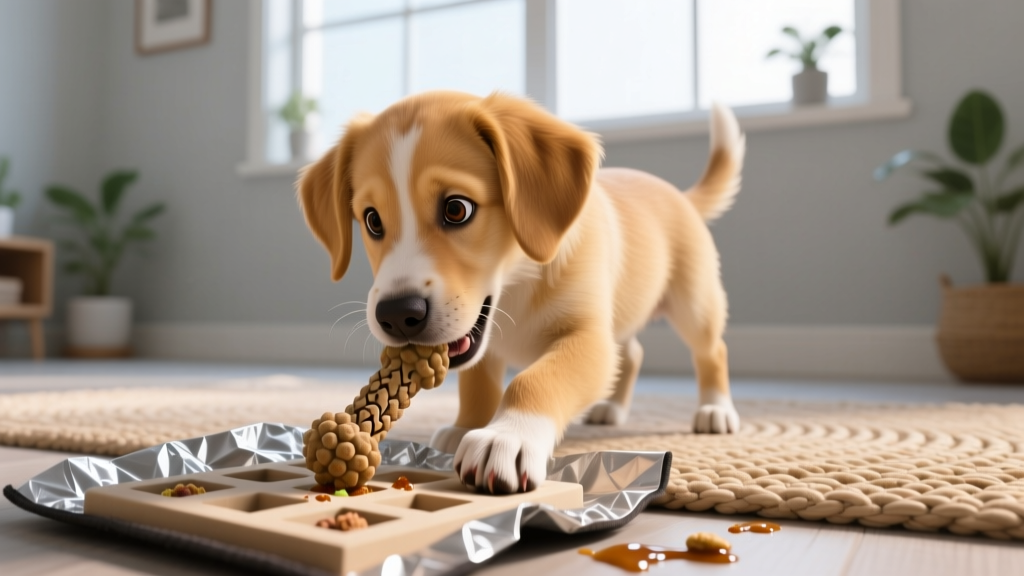
- Frozen Kong Classic (puppy size, then medium): Stuff with plain pumpkin puree, plain yogurt, or soaked kibble and freeze for 4+ hours. Provides 20–40 minutes of soothing relief.
- Wet washcloth twist (frozen): Wet a clean washcloth, twist into a rope, freeze. Supervise use and discard if puppy tears off pieces.
- Nylabone Puppy Chew (Power Chew line): Select the "puppy" hardness level. Replace when worn down to a small piece.
Avoid: Rawhide (choking and intestinal blockage risk), antlers and weight-bearing bones from large animals (tooth fracture risk — the Merck Veterinary Manual notes these are a leading cause of slab fractures in powerful chewers), and cooked bones of any kind (splintering hazard).
Stopping Puppy Biting and Nipping: Dogo-Specific Strategies
Dogo Argentino puppies are mouthy — more so than many breeds. They were bred to grab and hold large game, and that instinct manifests as persistent nipping, ankle-biting, and hand-mouthing during puppyhood. This is not aggression, but it must be managed consistently or it becomes a dangerous habit in an 80-lb adult.
Why Your Dogo Puppy Bites
- Teething discomfort (3–6 months): Chewing relieves gum pain.
- Play behavior: Puppies play with their mouths. Littermates teach bite inhibition — if your puppy was removed before 8 weeks, they missed critical lessons.
- Overstimulation: Dogo puppies often escalate to biting when overtired or overexcited, similar to a toddler's meltdown.
- Herding/prey-drive expression: Ankle-biting and chasing moving hands/feet is breed-typical.
Force-Free Solutions
- Redirect to appropriate chew: When puppy mouths skin, immediately offer a toy. Praise enthusiastically when they chew the toy instead. Keep 4–5 chew toys in rotation in every room.
- "Ouch" + withdraw attention: Say a calm "ouch" or "too bad" and stand up, cross your arms, and look away for 10–15 seconds. This mimics littermate behavior (siblings yelp and stop playing when bitten too hard).
- Time-outs (not punishment): If redirection fails 3 times in a row, calmly place puppy in their crate or a puppy-proofed pen for 2–3 minutes to decompress. This is a reset, not a consequence.
- Manage arousal levels: If biting escalates during play, the puppy is likely overtired. Enforce 16–18 hours of sleep per day (yes, puppies need that much). Use a crate nap.
- Teach "leave it" and "drop it": Start with low-value items and trade up. These cues are essential for a breed that will eventually have the jaw strength to cause serious injury if they grab something dangerous.
Never: Hold the puppy's mouth shut, alpha-roll them, hit their nose, or use any physical punishment. These methods damage trust, increase fear-based aggression, and are particularly counterproductive with a powerful, strong-willed breed like the Dogo Argentino. The American Veterinary Society of Animal Behavior (AVSAB) explicitly recommends against aversive training methods.
When Can My Dogo Argentino Puppy Go Outside and Meet Other Dogs?
This question balances two competing needs: disease protection (parvovirus is lethal and environmentally persistent) and socialization urgency (the critical window closes at 14 weeks).
Safe Outdoor Access Timeline
- 8–10 weeks (after first DHPP): Your own fenced yard is safe if no unknown dogs have access. Carry puppy in public areas. No dog parks, pet stores, or communal grassy areas.
- 10–12 weeks (after second DHPP): Begin short walks on paved surfaces in low-traffic areas. Attend structured puppy kindergarten classes where all puppies are required to show vaccination proof (AVSAB recommends puppy classes begin as early as 7–8 weeks with at least one DHPP dose).
- 14–16 weeks (after final DHPP): Wait 1–2 weeks after the final booster for full immunity to develop. After that, your Dogo puppy can access public parks, trails, and supervised playdates with known-vaccinated dogs.
- 4–6 months (after rabies vaccine): Full public access. Dog parks are technically safe from a disease standpoint but are not recommended for Dogo Argentinos — their play style (body-slamming, grabbing) and developing dog-selectivity make unstructured dog park environments high-risk for conflict.
First-Year Cost Breakdown for a Dogo Argentino Puppy
Budget realistically. Dogo Argentinos are large dogs, and everything costs more — from food to medication to crate size. Here's what to expect in the first 12 months (US averages, 2026 estimates):
| Category | Low Estimate | High Estimate | Details |
|---|---|---|---|
| Puppy purchase/adoption | $500 (rescue) | $3,500 (AKC breeder) | Reputable breeders health-test parents for deafness (BAER test), hip dysplasia (OFA/PennHIP), and cardiac conditions. |
| Veterinary care (first year) | $800 | $1,500 | Includes initial exam, 3 DHPP doses, rabies, deworming (2–3 rounds), fecal tests, heartworm test, spay/neuter ($400–$800 for large breed). |
| Food (large-breed puppy formula) | $600 | $1,200 | Based on 4–6 cups/day of quality large-breed puppy kibble ($1.50–$3.00/lb). Premium and raw diets push costs higher. |
| Supplies | $400 | $800 | 42–48" crate ($80–$150), heavy-duty leash and harness ($50–$100), stainless steel bowls, chew toys, enzymatic cleaner, puppy pen, grooming supplies. |
| Training | $200 | $1,200 | Puppy kindergarten ($150–$250 for 6-week group class). Private sessions with a CPDT-KA or IAABC-certified trainer: $100–$200/session. Highly recommended for Dogo owners. |
| Preventive medications | $250 | $500 | Heartworm prevention (monthly, weight-based — costs increase as puppy grows), flea/tick prevention year-round. |
| Total First Year | $2,750 | $8,700 | Does not include pet insurance ($40–$80/month for large breed), emergency vet visits, or dog walking/daycare. |
Frequently Asked Questions About Dogo Argentino Puppies
Are Dogo Argentino puppies good with children?
Well-bred, well-socialized Dogo Argentinos are typically loyal and protective of their family's children. However, Dogo puppies are energetic, mouthy, and physically powerful — a 40-lb puppy can easily knock over a toddler during play. Always supervise interactions, teach children not to approach the puppy while eating or sleeping, and never leave any dog alone with young children. Early positive exposure to children (calm, supervised) during the socialization window is essential.
How much exercise does a Dogo Argentino puppy need?
Follow the "5 minutes per month of age" rule for structured walks: a 4-month-old gets about 20 minutes of leash walking per day, split into two sessions. Free play in a fenced yard can be longer but should be self-paced — don't force a puppy to run or jog. Avoid repetitive high-impact exercise (jumping, long runs, agility) until growth plates close around 14–18 months to protect developing joints.
Are Dogo Argentinos prone to deafness?
Yes. Congenital sensorineural deafness is the most well-documented health concern in the breed, linked to the white coat pigmentation gene. Approximately 10% of Dogo Argentinos are unilaterally deaf (one ear), and roughly 2% are bilaterally deaf (both ears). Reputable breeders perform BAER (Brainstem Auditory Evoked Response) testing on all puppies before placement. Always request BAER test documentation — a bilateral deaf Dogo requires specialized training considerations.
Should I get pet insurance for my Dogo Argentino puppy?
Strongly recommended. Enroll before any pre-existing conditions are documented (ideally within the first 2–4 weeks of bringing puppy home). Large breeds are predisposed to expensive conditions — hip dysplasia surgery costs $3,000–$7,000 per hip, and bloat (GDV) emergency surgery runs $3,000–$7,000. Look for policies covering hereditary conditions with no breed exclusions. Monthly premiums for a Dogo puppy typically range from $45–$90 depending on deductible and reimbursement level.
What health tests should the breeder have done on the parents?
According to the Orthopedic Foundation for Animals (OFA) and breed-specific health recommendations, responsible Dogo Argentino breeders should provide documentation of: BAER hearing test (puppies), OFA or PennHIP hip evaluation (parents), OFA cardiac evaluation (parents), and ideally OFA elbow and thyroid evaluations. Ask to see OFA certificates by name — not just verbal assurances that "the parents were tested."
Priya Sutaria
All our authors care for dogs every day — read more of their work on the authors page.