How Long Are Dogs Pregnant For? Week-by-Week Puppy
How long are dogs pregnant for?

The Real Answer: How Long Are Dogs Pregnant For?
The average canine pregnancy lasts 63 days (approximately 9 weeks), though normal gestation can range from 58 to 68 days depending on breed size, litter size, and individual variation. Smaller breeds tend to deliver closer to day 60, while giant breeds may carry to day 65 or beyond.
Understanding this 63-day window matters because it sets the starting clock for everything that follows — vaccination timing, socialization windows, and developmental milestones all cascade from the day those puppies are born. According to the Merck Veterinary Manual, counting from the first mating can be misleading since ovulation timing varies; your vet can use ultrasound or progesterone testing to pinpoint a more accurate due date.
- Small breeds (under 20 lb / 9 kg): 58–63 days
- Medium breeds (20–60 lb / 9–27 kg): 61–63 days
- Large breeds (60–100 lb / 27–45 kg): 62–65 days
- Giant breeds (over 100 lb / 45 kg): 63–68 days
Once those puppies arrive, the real work begins. Below is your complete roadmap from newborn through adolescence, with the specific numbers, schedules, and troubleshooting that generic puppy guides leave out.
Puppy Development Milestones: What to Expect Week by Week
| Age Range | Key Milestones | What You Should Do |
|---|---|---|
| Weeks 4–8 | Eyes/ears fully functional; first baby teeth erupt; litter-mate play begins; start weaning onto gruel | Breeder handles puppies daily; introduce textured surfaces; begin name recognition |
| Weeks 8–12 | Primary socialization window opens; fear imprinting possible; bladder control ~1 hour per month of age; rapid brain development | Bring puppy home (8–10 weeks ideal); start positive-reinforcement training; begin potty routine |
| Weeks 12–16 | Socialization window begins closing; baby teeth start loosening; longer attention spans; can learn sit, down, recall basics | Intensify socialization exposures; enroll in puppy kindergarten; establish alone-time practice to prevent separation anxiety |
| Weeks 16–24 | Fear periods may recur; adult teeth erupt (3–6 months); chewing intensity peaks; sexual maturity approaches in small breeds | Provide appropriate chew outlets; discuss spay/neuter timing with your vet; maintain training consistency |
| 6–12 Months | Adolescent regression common; testing boundaries; growth plates still open in large breeds; energy peaks | Continue structured exercise (avoid forced running on hard surfaces for large breeds); reinforce all learned behaviors; consider advanced training classes |
Feeding Schedule: Exact Portions by Age and Weight
Puppy nutritional needs shift rapidly. The AKC recommends feeding a diet that meets AAFCO standards for growth or all-life-stages, with the first ingredient being a named animal protein (chicken, lamb, salmon — not generic "meat meal").
| Puppy Age | Meals Per Day | Small Breed (10–25 lb adult) | Medium Breed (25–60 lb adult) | Large Breed (60–100+ lb adult) |
|---|---|---|---|---|
| 8–12 weeks | 4 meals/day | ½–¾ cup total/day | 1–1½ cups total/day | 1½–2½ cups total/day (large-breed formula) |
| 3–6 months | 3 meals/day | ¾–1 cup total/day | 1½–2½ cups total/day | 2½–4 cups total/day |
| 6–12 months | 2 meals/day | ¾–1¼ cups total/day | 2–3½ cups total/day | 3½–5 cups total/day |
When to transition to adult food: Small breeds can switch at 9–12 months. Medium breeds at 12 months. Large and giant breeds should remain on large-breed puppy food until 18–24 months, as their growth plates close later.
Vaccination Schedule: Core and Non-Core Shots by Week
Vaccination timing is non-negotiable — maternal antibodies from colostrum interfere with early vaccines, which is why puppies need a series rather than a single shot. The AVMA and the American Animal Hospital Association (AAHA) canine vaccination guidelines recommend the following core protocol:
| Age | Vaccines Administered | Notes | Estimated Cost |
|---|---|---|---|
| 6–8 weeks | DHPP (Distemper, Hepatitis/Adenovirus, Parainfluenza, Parvovirus) — 1st dose | Often given by breeder or rescue before you bring puppy home | $20–$40 |
| 10–12 weeks | DHPP — 2nd dose; Bordetella (optional based on lifestyle); Leptospirosis (1st dose if recommended) | First vet visit for most new owners; fecal test and deworming typically done simultaneously | $75–$150 (full visit) |
| 14–16 weeks | DHPP — 3rd dose; Rabies (required by law in all US states); Leptospirosis 2nd dose if started; Lyme if in endemic area | Maternal antibodies typically cleared by 16 weeks — this is the final, critical puppy booster | $80–$160 |
| 12–16 months | DHPP booster; Rabies booster (1-year or 3-year depending on local law) | After this, DHPP typically moves to every 3 years; titers testing is an alternative for some dogs | $60–$120 |
The Socialization Window (Weeks 3–14): Your Puppy's Critical Exposure Checklist
Behavioral research shows that the primary socialization window closes around 12–14 weeks of age. Puppies not exposed to diverse stimuli during this period are statistically more likely to develop fear-based reactivity, anxiety, and aggression later in life. This is not something you can fully "catch up" on later.
Your goal is positive, non-threatening exposure — not flooding. Every new experience should pair with treats and praise. If your puppy shows fear, increase distance, reduce intensity, and let them approach voluntarily.
People:
- ☐ Men with beards, hats, sunglasses
- ☐ Children of various ages (supervised, calm interactions)
- ☐ People in uniforms, wheelchairs, using crutches or walkers
- ☐ People of different ethnicities and body types
- ☐ Veterinarian and staff (schedule a "happy visit" with no procedures)
Surfaces & Environments:
- ☐ Gravel, mulch, metal grates, wet grass, slippery floors
- ☐ Car rides (start with 5 minutes, build up)
- ☐ Elevators, automatic doors, revolving doors
- ☐ Stairs (carried if under 12 weeks to protect joints)
Sounds:
- ☐ Vacuum cleaner, hair dryer, blender (start at low volume, distance)
- ☐ Thunderstorms, fireworks (use recordings at low volume with treats)
- ☐ Traffic, construction noise, sirens
- ☐ Doorbell, knocking
Handling & Body Awareness:
- ☐ Paw handling (5 seconds → 30 seconds over weeks)
- ☐ Ear inspection, mouth opening, tail touching
- ☐ Nail trimming practice (touch clipper to nail, treat, no cutting initially)
- ☐ Wearing a harness, coat, or boots
Other Animals:
- ☐ Fully vaccinated, temperament-tested adult dogs
- ☐ Puppy kindergarten class (after at least one DHPP dose + 7 days)
- ☐ Cats (if available, supervised and controlled)
Potty Training Timeline: Realistic Expectations and Troubleshooting
Let's set realistic expectations: most puppies are not reliably house-trained until 4–6 months of age. Some small breeds take up to 8–12 months due to smaller bladder capacity and faster metabolisms. Anyone promising "potty trained in 3 days" is selling something.
The core rule: A puppy can hold their bladder for approximately one hour per month of age, plus one. So a 3-month-old puppy can manage roughly 4 hours — but that's a maximum during the day, not a target. Overnight, puppies can often hold longer because metabolism slows.
| Puppy Age | Daytime Bathroom Breaks | Overnight Capacity | Common Accidents |
|---|---|---|---|
| 8–10 weeks | Every 1–2 hours + after meals, naps, play | 2–3 hours (expect 1–2 night wakings) | 3–5 per day is normal |
| 3–4 months | Every 2–3 hours | 4–5 hours | 1–2 per day |
| 5–6 months | Every 3–4 hours | 6–8 hours | Occasional regression possible |
| 7–12 months | Every 4–6 hours | 8+ hours (sleeping through the night) | Rare; investigate UTI if accidents resume |
Proven potty training protocol:
- Take puppy to the same spot outside on a leash every time.
- Use a consistent cue word ("go potty," "do your business").
- Reward immediately after elimination — within 1 second — with a high-value treat and verbal praise.
- Supervise 100% of indoor time or confine to a crate/playpen when you cannot watch.
- If you catch an accident mid-act, interrupt calmly ("oops!") and carry outside. Never punish after the fact — dogs don't connect delayed punishment to the action.
- Clean accidents with enzymatic cleaner (Nature's Miracle, Rocco & Roxie) — standard cleaners leave urine salts that attract repeat elimination.
Crate Training Progression and Teething Relief
Crate training serves double duty: it accelerates potty training (dogs avoid soiling their sleeping area) and provides a safe den that reduces anxiety. But time limits matter — overcrating causes distress and setbacks.
- 8–10 weeks: 30–60 minutes at a time
- 11–14 weeks: 1–2 hours
- 15–16 weeks: 2–3 hours
- 4–6 months: 3–4 hours
- 6+ months: 4–5 hours maximum during the day
Overnight crating is different — puppies sleep longer stretches. Remove water 1.5 hours before bedtime and offer a final potty break right before crating for the night.
Teething timeline (3–6 months): Your puppy's 28 baby teeth begin falling out around 12–16 weeks, replaced by 42 adult teeth by roughly 6 months. During this period, chewing intensity peaks and your puppy needs appropriate outlets or your furniture becomes the target.
Safe teething relief strategies:
- Kong Classic (puppy size, pink/blue rubber): Fill with wet puppy food mixed with a teaspoon of plain pumpkin puree, freeze for 2–3 hours. The cold numbs sore gums.
- Benebone Puppy Wishbone: Nylon chew designed for puppies under 6 months — softer than adult versions.
- Frozen washcloth: Wet a clean washcloth, twist into a rope, freeze. Supervise use and discard if pieces tear off.
- Nylabone Puppy Chew Keys: Textured surfaces massage gums. Choose the puppy-specific version (softer polymer).
Common Puppy Problems and First-Year Cost Breakdown
Puppy Biting and Nipping: All puppies mouth — it's how they explore and play. But you need to teach bite inhibition before adult teeth arrive. The protocol: when teeth touch skin, say "ouch!" in a high-pitched voice and immediately withdraw attention for 10–15 seconds (stand up, turn away, or step behind a baby gate). Resume play and redirect to a toy. Never hold the mouth shut, alpha-roll, or use physical punishment — these methods increase fear and can escalate to defensive biting. Most puppies show significant improvement within 2–3 weeks of consistent redirection.
Whining in the Crate: If you've ruled out needing to potty (took them out right before crating), brief whining is normal for the first 1–2 weeks. Wait out short whining sessions (5–10 minutes) before releasing — releasing during whining teaches that noise = freedom. Cover the crate with a breathable blanket to reduce visual stimulation. A Snuggle Puppy (with heartbeat simulator) helps many puppies settle, particularly during the first nights home.
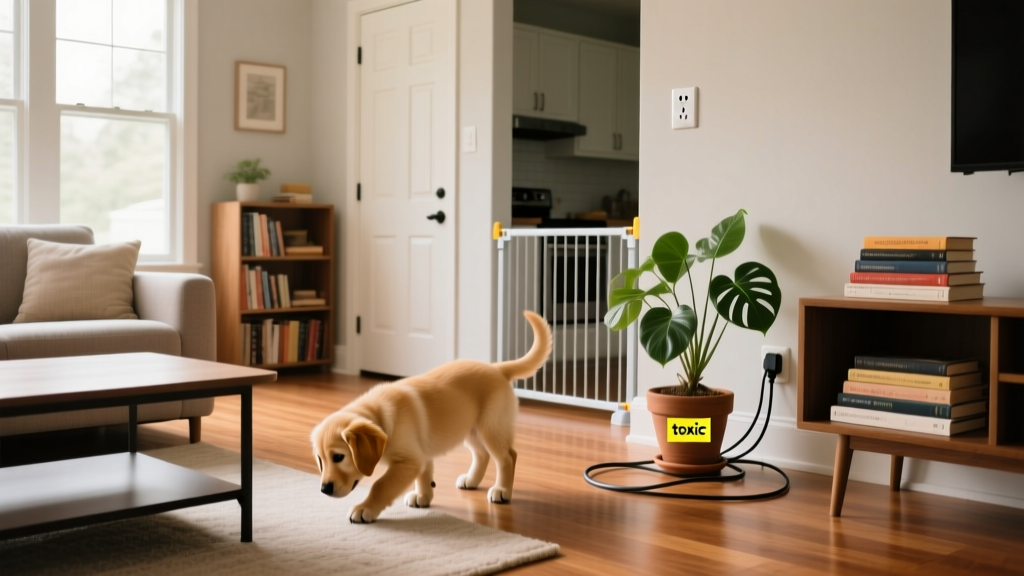
Destructive Chewing: Puppy-proof by removing shoes, cords, and small objects from reach. Provide 4–5 approved chew toys rotated weekly to maintain novelty. Confine to a puppy-safe area when unsupervised. Chewing typically peaks at 4–6 months and again during the 8–10 month adolescent period.
| First-Year Cost Category | Small Breed | Medium Breed | Large/Giant Breed |
|---|---|---|---|
| Veterinary (vaccines, spay/neuter, wellness exams, fecal tests, heartworm prevention) | $600–$1,200 | $700–$1,400 | $900–$1,800 |
| Food (quality kibble meeting AAFCO growth standards) | $250–$450 | $400–$700 | $600–$1,100 |
| Supplies (crate, bed, leash/harness, bowls, toys, gates, enzymatic cleaner) | $200–$400 | $250–$500 | $300–$600 |
| Training (puppy kindergarten, basic obedience group class) | $150–$350 | $150–$350 | $150–$350 |
| Pet Insurance (optional, annual premium) | $300–$600 | $400–$700 | $500–$900 |
| First-Year Total (excluding purchase/adoption fee) | $1,500–$3,000 | $1,900–$3,650 | $2,450–$4,750 |
Emergency vet visits are the budget wildcard — a swallowed sock can cost $2,000–$5,000 for surgery. Setting aside an emergency fund of $1,000–$2,000 or enrolling in pet insurance (ideally before any conditions are documented, as pre-existing conditions are excluded by all major insurers) is strongly recommended.
Frequently Asked Questions
When should I bring my puppy home?
The ideal age to bring a puppy home is 8–10 weeks. Puppies separated before 8 weeks miss critical litter-mate socialization that teaches bite inhibition and canine communication. Some breeders of toy breeds prefer to keep puppies until 10–12 weeks due to their fragility and hypoglycemia risk. If adopting from a rescue, puppies are typically available at 8 weeks once they've been vetted and cleared.
How often should I feed my puppy?
At 8–12 weeks, feed 4 meals per day spaced evenly (roughly every 4 hours during waking hours). At 3–6 months, reduce to 3 meals per day. At 6–12 months, transition to 2 meals per day, which most dogs maintain for life. Free-feeding (leaving food out constantly) leads to overeating, poor potty training predictability, and makes it harder to notice appetite loss — an early illness indicator.
When will my puppy be fully potty trained?
Expect reliable house training between 4–6 months for medium and large breeds, and 6–12 months for small and toy breeds. "Reliable" means fewer than one accident per month with consistent routine. Setbacks are normal during developmental leaps, household changes, or illness. If accidents suddenly increase after a period of success, rule out a urinary tract infection with your vet before assuming it's behavioral.
What vaccines does my puppy need and when?
Core vaccines follow a series: DHPP at 6–8, 10–12, and 14–16 weeks, plus Rabies at 14–16 weeks (legally required). Non-core vaccines — Bordetella (kennel cough), Leptospirosis, Lyme, and Canine Influenza — depend on your geographic area and lifestyle. Discuss these with your veterinarian at the 10–12 week visit. A DHPP booster is needed at 12–16 months, then typically every 3 years.
How do I stop puppy biting and nipping?
Use the redirect-and-withdraw method: when teeth contact skin, give a high-pitched "ouch!" and stop all interaction for 10–15 seconds. Then resume and immediately offer an appropriate chew toy. Pair this with rewarding calm, non-mouthy behavior. Most puppies reduce nipping significantly by 4–5 months as adult teeth come in, provided you're consistent. Avoid physical corrections — they damage trust and can create fear-based biting.
When can my puppy go outside and meet other dogs?
Your puppy can go outside in your own yard immediately. For public spaces, wait until 7 days after the second DHPP vaccine (typically around 11–13 weeks) for controlled, low-risk environments like puppy classes where all attendees are vaccinated. Avoid dog parks, pet stores, and high-traffic dog areas until one week after the final 16-week DHPP booster. Socialization during the 3–14 week window is critical, so carry your puppy in public and arrange playdates with known, vaccinated dogs during the interim.
Beth Carrasco
All our authors care for dogs every day — read more of their work on the authors page.