Dalmatian Puppy Guide: Milestones, Feeding, Training & First-Year Costs
Complete dalmatian puppy guide covering age milestones, feeding schedules, potty training, vaccination timelines, socialization, and first-year cost breakdowns.
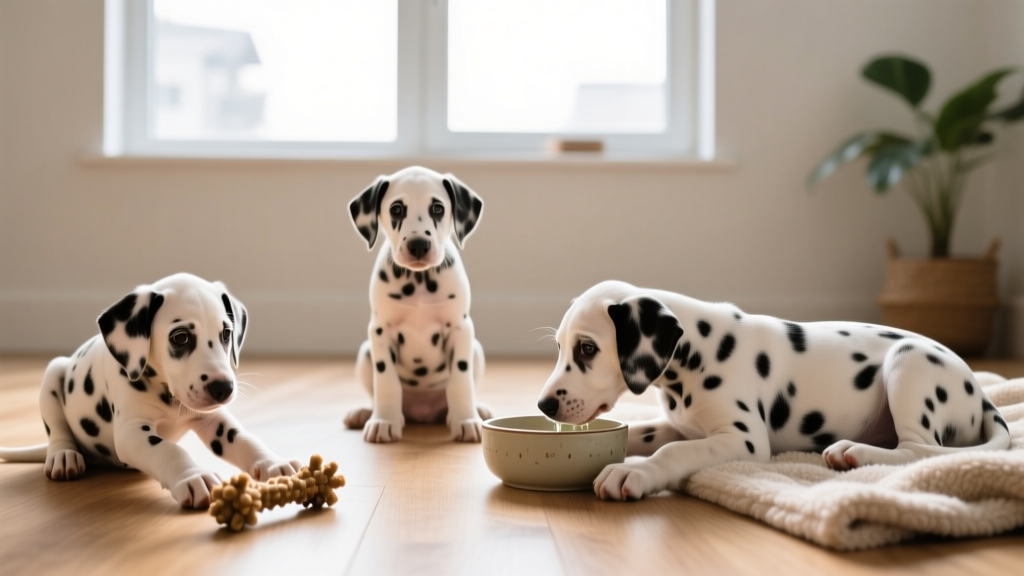
Bringing Home Your Dalmatian Puppy: What Makes This Breed Different
Dalmatian puppies arrive into the world pure white — those iconic spots don't begin appearing until 2-4 weeks of age and continue developing until around 18 months. But the surprises don't stop at their coat. Dalmatians are a high-energy, intelligent, and sometimes strong-willed breed that demands a structured puppyhood to mature into a stable adult. According to the American Kennel Club breed standard, adult Dalmatians stand 19-24 inches tall and weigh 45-70 lb (20-32 kg), meaning your puppy will grow rapidly through the first year and requires precise nutritional management to support healthy joint development.
This guide walks you through every critical stage of your dalmatian puppy's first year with breed-specific expectations, exact feeding amounts, vaccination timing, and real cost numbers so you can plan ahead rather than react to surprises.
Dalmatian Puppy Milestones: Week by Week, Month by Month
Weeks 4-8: The Breeder's Watch (Before You Bring Them Home)
- Physical: Spots begin appearing (2-4 weeks). Eyes fully open by week 3. Baby teeth fully erupted by week 6. Weight approximately 5-8 lb (2.3-3.6 kg) by week 8.
- Behavioral: Primary socialization window opens at week 3. Puppies learn bite inhibition from littermates. Startle responses to loud noises develop around week 5. Breeder should begin introducing varied surfaces, sounds, and gentle handling.
- Health: First deworming typically at 2, 4, 6, and 8 weeks. First DHPP vaccine at 6-8 weeks. BAER (hearing) testing is critical for Dalmatian puppies — approximately 8% of Dalmatians are born completely deaf and 22% have unilateral hearing loss, per the AKC Dalmatian health resources. Reputable breeders BAER-test every puppy before placement.
- What you should receive: BAER test results, health certificate, deworming records, first vaccine record, and a signed contract with a return clause.
Weeks 8-12: The Adjustment Period (Your First Month Together)
- Physical: Weight reaches approximately 10-18 lb (4.5-8.2 kg). Rapid skeletal growth. Sleeping 18-20 hours per day is normal. Coordination improves noticeably week over week.
- Behavioral: Fear imprinting period (8-11 weeks) — negative experiences during this window can create lasting phobias. Keep vet visits positive with treats and gentle handling. Begin name recognition, sit, and short (2-3 minute) training sessions. Expect testing of boundaries.
- Potty training: Bladder control is minimal. Take outside every 1-2 hours during the day, immediately after meals, naps, and play. Accidents are guaranteed — this is normal, not failure.
- Crate training: Introduce crate as a positive space. Maximum crate time at this age: 2 hours during the day (plus overnight with one middle-of-night potty break).
Weeks 12-16: Building Foundations
- Physical: Weight approximately 20-30 lb (9-14 kg). Adult coat texture emerging. Stamina increasing — can handle 15-minute structured walks (follow the 5-minutes-per-month-of-age rule for forced exercise to protect developing joints).
- Behavioral: Socialization window closing around 14-16 weeks. This is your most critical period for exposing your Dalmatian to diverse people, dogs, surfaces, vehicles, and environments. Puppy kindergarten classes should be underway.
- Potty training: Bladder control improving — can hold 3-4 hours during the day. Accidents decrease but still happen. Consistency now prevents regression later.
- Crate training: Maximum crate time: 3-4 hours during the day. Most puppies can sleep 6-7 hours overnight without a potty break by week 14-16.
Weeks 16-24 (4-6 Months): The Adolescent Shift
- Physical: Weight reaches 30-50 lb (14-23 kg). Teething begins around 3.5-4 months (see teething section below). Spots continue darkening and new spots may still appear. Growth plates remain open — avoid repetitive high-impact exercise like long-distance running or excessive stair climbing.
- Behavioral: First fear period may occur around 6-8 months (some dogs hit this earlier). Independence increases. Recall reliability may temporarily decrease. This is normal adolescent behavior, not a training failure — maintain consistency and avoid punishment.
- Potty training: Should be mostly reliable by 5-6 months with consistent training. Occasional accidents during excitement or schedule changes are still normal.
Months 6-12: Adolescence and Maturation
- Physical: Approaching adult size — most Dalmatians reach 90% of adult height by 9 months and fill out through 12-18 months. Weight at 12 months: approximately 40-60 lb (18-27 kg) depending on sex and genetics. Spay/neuter is commonly performed between 6-12 months; discuss timing with your veterinarian, as some evidence suggests waiting until growth plates close (around 12-14 months for medium-large breeds) may reduce orthopedic risks.
- Behavioral: Second fear period possible around 8-11 months. Energy levels are very high — Dalmatians were bred to run alongside carriages for miles, and your adolescent needs a minimum of 60-90 minutes of structured exercise daily, plus mental enrichment. Without adequate outlets, expect destructive chewing, digging, and nuisance barking.
- Training: Can begin more advanced obedience, agility foundations, and canine sports. Dalmatians excel in agility, rally, and endurance activities once growth plates close.
Dalmatian Puppy Feeding Schedule: Exact Portions by Age
Dalmatians have a unique metabolic trait that sets them apart from nearly every other breed: they have a genetic defect in purine metabolism that predisposes them to urate bladder stones (urolithiasis). This affects feeding decisions for life, starting in puppyhood. According to the Merck Veterinary Manual, Dalmatians should be fed diets moderate in purines — avoiding high-organ-meat diets and excessive red meat — and must always have access to fresh water to dilute urine.
For puppy food selection, choose an AAFCO-certified large-breed puppy formula (even though Dalmatians are medium-sized, their rapid growth benefits from the controlled calcium-phosphorus ratios in large-breed formulas). Look for a guaranteed analysis showing 22-26% protein and 8-12% fat for growth stages. Purina Pro Plan Large Breed Puppy, Royal Canin Medium Puppy, and Hill's Science Diet Large Breed Puppy are all commonly recommended by veterinarians.
| Age | Est. Weight | Meals/Day | Total Daily Amount (Dry Kibble) | Per Meal |
|---|---|---|---|---|
| 8-12 weeks | 10-18 lb (4.5-8.2 kg) | 4 meals | 1.5-2.5 cups | ~0.4-0.6 cups |
| 3-4 months | 18-28 lb (8.2-12.7 kg) | 3 meals | 2-3 cups | ~0.7-1 cup |
| 5-6 months | 28-42 lb (12.7-19 kg) | 3 meals | 2.5-3.5 cups | ~0.8-1.2 cups |
| 7-9 months | 42-55 lb (19-25 kg) | 2 meals | 3-4 cups | 1.5-2 cups |
| 10-12 months | 50-65 lb (23-29 kg) | 2 meals | 3-4.5 cups | 1.5-2.25 cups |
Important notes: These are starting estimates. Adjust based on your puppy's body condition score (BCS) — you should be able to feel ribs without pressing hard but not see them prominently. Transition from puppy to adult food between 12-14 months. Always provide unlimited fresh water, which is especially critical for Dalmatians to reduce urate stone risk. Consult your veterinarian for personalized portions based on your puppy's growth curve.
Vaccination Schedule for Your Dalmatian Puppy
Dalmatian puppies follow the standard core vaccination protocol recommended by the American Veterinary Medical Association (AVMA). Your veterinarian may adjust timing based on local disease prevalence and maternal antibody levels.
| Age | Vaccines Administered | Notes |
|---|---|---|
| 6-8 weeks | DHPP (Distemper, Hepatitis/Adenovirus, Parainfluenza, Parvovirus) — 1st dose | Often given by breeder before pickup. Deworming (pyrantel pamoate) typically concurrent. |
| 10-12 weeks | DHPP — 2nd dose. Bordetella (kennel cough) if attending puppy classes. | Leptospirosis vaccine may be started at 12 weeks depending on regional risk. Discuss with your vet. |
| 14-16 weeks | DHPP — 3rd dose. Rabies vaccine (legally required, timing varies by state — commonly 12-16 weeks). | Final DHPP dose should not be given before 16 weeks to ensure maternal antibodies don't interfere. Leptospirosis booster if started. |
| 12-16 months | DHPP booster. Rabies booster (1-year or 3-year depending on product and local law). | After this, DHPP boosters are typically every 3 years. Titers testing is an alternative for subsequent boosters — discuss with your vet. |
Non-core vaccines to discuss with your veterinarian: Lyme disease (if in a tick-endemic area), Canine Influenza (H3N2/H3N8, recommended if boarding or attending group events), and Leptospirosis. Your vet will tailor recommendations based on your location and your puppy's lifestyle.
The Socialization Window: Your Dalmatian Puppy's Critical Period (Weeks 3-14)
The primary socialization window for puppies closes between 12-16 weeks of age, with the most sensitive period between weeks 3-14. For Dalmatians, this window is especially important because the breed can be aloof with strangers and selective with other dogs if not broadly socialized early. Missed socialization during this period is one of the leading causes of leash reactivity and fear-based behaviors in adult Dalmatians.
Before your puppy is fully vaccinated (before 16 weeks), you must balance socialization with disease risk. The AVMA and the American Veterinary Society of Animal Behavior both recommend that puppies begin socialization classes as early as 7-8 weeks — the behavioral risk of under-socialization outweighs the disease risk when classes are held in clean, controlled environments with vaccinated puppies.
Rule of thumb: Every new experience should be paired with high-value treats (small pieces of boiled chicken, cheese, or commercial training treats like Zuke's Mini Naturals). If your puppy shows fear, increase distance from the stimulus and let them approach at their own pace. Never force a frightened puppy into a situation — this creates lasting negative associations.
Potty Training Your Dalmatian Puppy: Realistic Timeline and Troubleshooting
When will my Dalmatian puppy be fully potty trained? With consistent scheduling, most Dalmatian puppies achieve reliable house training between 4-6 months of age. Some individuals take up to 8 months, particularly males and puppies with irregular daily routines. "Fully trained" means fewer than one accident per month under normal circumstances.
Dalmatians are not among the most difficult breeds to house-train — they're intelligent and tend to develop clean habits if given consistent opportunities. However, their high energy means they may have excited urination episodes through 6-8 months. This is a physiological response (incomplete urethral sphincter control), not a behavioral problem, and typically resolves with maturity.
Potty Training Log Template
Track these data points daily for the first 4 weeks to identify your puppy's natural elimination schedule:
| Time | Activity | Eliminated? | Location | Notes |
|---|---|---|---|---|
| 7:00 AM | Wake up → outside | Yes/No | Patio/yard/pad | Urine/stool |
| 7:30 AM | After breakfast → outside | Yes/No | — | — |
| — | — | — | — | — |
Pattern to look for: Most puppies eliminate within 5-15 minutes after eating, 10-20 minutes after vigorous play, and immediately upon waking. Once you identify your puppy's pattern, you can proactively take them out before accidents happen.
Crate training progression for potty training:
- 8-10 weeks: Crate for max 2 hours during day. Overnight: crate beside your bed, set alarm for one middle-of-night potty break (around 2-3 AM).
- 10-12 weeks: Max 2.5-3 hours during day. Overnight: may begin sleeping 5-6 hours between breaks.
- 12-16 weeks: Max 3-4 hours during day. Overnight: most can hold 6-7 hours.
- 4-6 months: Max 4-5 hours during day. Overnight: 8 hours is achievable for most puppies.
Troubleshooting common issues:
- Frequent small accidents: Rule out a urinary tract infection with your vet (especially relevant for Dalmatians given their urate stone predisposition). UTIs cause urgency and frequency.
- Submissive/excited urination: Ignore your puppy for the first 2-3 minutes when arriving home. Greet calmly outside. Do not scold — scolding increases submissive urination.
- Accident in crate: The crate may be too large (use a divider to size it so the puppy can stand, turn, and lie down but not eliminate in one corner and sleep in another). Clean with an enzymatic cleaner like Nature's Miracle — standard cleaners don't break down uric acid crystals, and residual scent invites repeat accidents.
Teething Timeline and Relief Strategies (3-6 Months)
Dalmatian puppies begin losing their 28 deciduous (baby) teeth around 3.5-4 months of age, with the process typically complete by 6-7 months as all 42 adult teeth erupt. The most intense chewing phase occurs between 4-5 months when the canine teeth and premolars are pushing through the gums.
Signs your Dalmatian puppy is teething:
- Increased chewing on furniture, shoes, hands, and leash
- Small amounts of blood on chew toys (normal — a few drops is not concerning)
- Swollen or reddened gums visible when lifting the lip
- Temporary decrease in appetite or preference for softer food
- Finding baby teeth on the floor or in bedding (many puppies swallow them — this is harmless)
Safe teething relief options:
- Kong Classic (puppy size, pink/blue rubber): Stuff with a mixture of plain yogurt and mashed banana, then freeze for 2-3 hours. The cold numbs sore gums. Size Small fits puppies 15-35 lb; Medium for 35-50 lb.
- Nylabone Puppy Chew (Power Chew or Gentle Puppy variety): Choose a size rated for your puppy's current weight. Replace when pieces become small enough to swallow.
- Frozen washcloth: Wet a clean washcloth, twist into a rope, freeze, and supervise chewing. Remove when it begins to shred.
- Benebone Puppy (wishbone shape): Made from nylon infused with bacon or chicken flavor. The ergonomic shape lets puppies grip with their paws. Select the puppy-specific version (softer material).
Common Dalmatian Puppy Problems and Solutions
How do I stop my Dalmatian puppy from biting and nipping?
Dalmatian puppies are mouthy — this is a normal developmental behavior, not aggression. Puppies explore the world with their mouths and haven't yet learned that human skin is completely off-limits. Here's a force-free protocol:
- Redirect: When teeth touch skin, immediately offer an appropriate chew toy. Praise enthusiastically when they chew the toy instead.
- Withdraw attention: If redirecting doesn't work within 2-3 attempts, stand up, cross your arms, and be still for 10-15 seconds (a "time-out" from play). Resume play only when the puppy is calm. This teaches that biting ends fun — no yelling or physical punishment needed.
- Satisfy the need: Puppies bite more when under-exercised, over-tired, or bored. Ensure your Dalmatian puppy gets adequate physical exercise (following the 5-minutes-per-month-of-age guideline for structured walks) and mental stimulation (food puzzles like the Kong Wobbler, Outward Hound Nina Ottosson puzzle toys, or scatter-feeding kibble in the yard).
- Manage the environment: During peak biting times (typically early evening "witching hour"), proactively provide a frozen Kong or long-lasting chew before the behavior starts.
Bite inhibition typically improves significantly by 5-6 months as adult teeth come in and impulse control develops. If biting intensifies after 6 months or is accompanied by growling and stiff body language, consult a certified professional dog trainer (CPDT-KA) or veterinary behaviorist.
Other common Dalmatian puppy challenges:
- Destructive chewing (especially 4-8 months): Dalmatians are athletic, intelligent dogs that become destructive when under-stimulated. Provide 2-3 rotating chew options, at least 60 minutes of daily exercise (split into age-appropriate sessions), and confine to a puppy-proofed area when unsupervised. Kong toys stuffed and frozen can occupy a puppy for 30-45 minutes.
- Whining in the crate at night: For the first 1-2 weeks, place the crate next to your bed so your puppy can hear and smell you. A Snuggle Puppy (with heartbeat simulator and heat pack) can ease the transition from littermates. Cover the crate with a light breathable blanket to create a den-like feel. If whining persists beyond 15 minutes, take puppy out for a quick potty break (on leash, boring, no play), then return to crate.
- Jumping up on people: Dalmatians are an exuberant, athletic breed. Teach "four on the floor" by rewarding all four paws on the ground with treats and attention. Ask visitors to ignore the puppy until all paws are down. Consistency from every person the puppy meets is essential.
- Leash pulling: Start leash training early with a front-clip harness (such as the Ruffwear Front Range or 2 Hounds Design Freedom Harness). When the puppy pulls, stop walking. Resume only when the leash is loose. Reward position at your left side with high-value treats. Dalmatians were bred to run, so pulling is instinctual — patience and consistency are essential.
First-Year Cost Breakdown for a Dalmatian Puppy
Budgeting accurately prevents financial stress and ensures your puppy receives proper care. The following estimates reflect 2025-2026 US pricing and vary by region and provider.
| Category | Items | Estimated Cost |
|---|---|---|
| Puppy Purchase | Responsible breeder (health-tested parents, BAER test, AKC registration) OR rescue/adoption fee | $1,200-$3,000 (breeder) / $200-$600 (rescue) |
| Veterinary Care | 3-4 puppy vaccine visits, spay/neuter, microchip, deworming, flea/tick/heartworm prevention (12 months), wellness exams | $800-$1,800 |
| Food | Large-breed puppy food (12 months), treats for training | $400-$700 |
| Supplies | Crate ($60-$120), bed ($30-$80), harness ($25-$50), leash ($15-$30), bowls ($15-$30), chew toys ($50-$100), grooming tools ($20-$40), enzymatic cleaner ($15-$25), puppy gate ($30-$60) | $260-$535 |
| Training | Puppy kindergarten (6-8 week group class), optional basic obedience follow-up | $150-$400 |
| Pet Insurance | Accident + illness policy (enrolled as puppy — premiums are lower; e.g., Trupanion, Healthy Paws, Lemonade) | $35-$70/month ($420-$840/year) |
| Emergency Fund | Set aside for unexpected illness, foreign body ingestion, or injury | $500-$1,000 (recommended reserve) |
Total with puppy from a breeder: $3,765 - $8,275
Total with rescue puppy: $2,765 - $5,875
Dalmatian-specific cost considerations: Because of the breed's predisposition to urate urolithiasis, some Dalmatians require a prescription diet (such as Royal Canin Urinary SO or Hill's u/d) later in life, which costs $60-$90 per month. Pet insurance enrolled during puppyhood covers hereditary conditions if enrolled before symptoms appear — this is strongly recommended for Dalmatians. Additionally, BAER testing (if not done by the breeder) costs approximately $80-$150.
When Can My Dalmatian Puppy Go Outside and Meet Other Dogs?
This question requires balancing disease risk against behavioral development. Here's a practical framework:
- Immediately (8 weeks+): Carry your puppy in a sling or stroller to observe the world — busy sidewalks, outdoor markets, parks (without setting them on ground where unknown dogs have eliminated). This provides socialization without parvovirus risk.
- 7-8 weeks+: Enroll in puppy kindergarten classes held at veterinary clinics or clean training facilities that require proof of first vaccination. These controlled environments are considered safe by the AVSAB (American Veterinary Society of Animal Behavior).
- Avoid until 1 week after final DHPP (approximately 17 weeks): Public dog parks, pet store floors, high-traffic dog walking areas, and any area where unvaccinated dogs may have been. Parvovirus can survive in soil for months.
- 12 weeks+: Arrange playdates with known, fully vaccinated, dog-friendly adult dogs in private yards. This is one of the safest and most effective socialization strategies.
- 17+ weeks (1 week post-final vaccine): Begin exploring public areas on leash. Introduce dog parks cautiously — observe first without entering, then visit during low-traffic hours.
For Dalmatians specifically, prioritize positive dog-dog encounters during the socialization window. Because Dalmatians can be dog-selective or same-sex aggressive as adults, early positive experiences with diverse, well-mannered dogs help build appropriate social skills. Avoid overwhelming situations (multiple dogs approaching at once) that could create negative associations.
Frequently Asked Questions About Dalmatian Puppies
Are Dalmatian puppies born with spots?
No. Dalmatian puppies are born completely white. Spots typically begin appearing at 2-4 weeks of age and continue to develop and darken through 12-18 months. Some Dalmatians also have "patches" — larger solid-color areas present at birth, usually on the head or ears. The breed standard considers patches a disqualification in the show ring, but they have no health implications.
How much exercise does a Dalmatian puppy need?
Follow the 5-minutes-per-month-of-age rule for structured walks: a 3-month-old gets approximately 15 minutes of leash walking per day, a 4-month-old gets 20 minutes, and so on. This can be split into two sessions. Free play in a fenced yard does not count toward this limit and should be encouraged. Avoid forced running, jogging alongside bicycles, or repetitive jumping until growth plates close (approximately 14-18 months for Dalmatians). Mental exercise — puzzle toys, training sessions, scent games — is equally important and tires puppies without joint stress.
Do Dalmatian puppies shed a lot?
Yes. Despite their short coat, Dalmatians are prolific year-round shedders. Their short, stiff hairs weave into fabrics and are notoriously difficult to remove from clothing and upholstery. Start a grooming routine early: brush 2-3 times per week with a rubber curry brush (like the Kong ZoomGroom, approximately $10-$15) or a deshedding tool. This also conditions your puppy to tolerate grooming for life.
Are Dalmatians good with children?
Dalmatians can be excellent family dogs, but their high energy and exuberant nature make them better suited for families with older children (8+ years) who understand how to interact calmly with dogs. A young Dalmatian puppy may accidentally knock over a toddler during play. All interactions between puppies and children should be actively supervised. Teach children to never approach a sleeping or eating puppy, and to let the puppy come to them rather than chasing or grabbing.
Should I be concerned about deafness in my Dalmatian puppy?
Yes — deafness is the most significant breed-specific health concern in Dalmatian puppies. Approximately 30% of Dalmatians have some degree of hearing loss (8% bilaterally deaf, 22% unilaterally deaf). A BAER (Brainstem Auditory Evoked Response) test is the only definitive way to determine hearing status and should be performed before you bring your puppy home. Unilaterally deaf dogs can live completely normal lives with minimal adaptations. Bilaterally deaf dogs require specialized training (hand signals, vibration collars for recall) and experienced owners. Always request BAER documentation from your breeder.
How do I choose a responsible Dalmatian breeder?
A responsible breeder will: BAER-test all puppies and parents, perform OFA (Orthopedic Foundation for Animals) hip evaluations on breeding stock, provide a written health guarantee and take-back clause, raise puppies in a home environment with early neurological stimulation (ENS), ask you detailed questions about your lifestyle and experience, and allow you to meet the dam (mother). Red flags include: multiple litters available year-round, no health testing documentation, unwillingness to let you visit the property, puppies shipped without a phone conversation, and prices significantly below market ($500-$800 for a "purebred" Dalmatian without health testing is a strong indicator of a backyard breeder or puppy mill). Check the AKC Marketplace and the Dalmatian Club of America's breeder referral list for vetted options.
Disclaimer: This guide provides general educational information about dalmatian puppy care. Every puppy is an individual, and your veterinarian is the best source for personalized health, nutrition, and behavioral advice. Always consult your veterinarian before making changes to your puppy's diet, vaccination schedule, or medical care.
Aaron Whyte
All our authors care for dogs every day — read more of their work on the authors page.