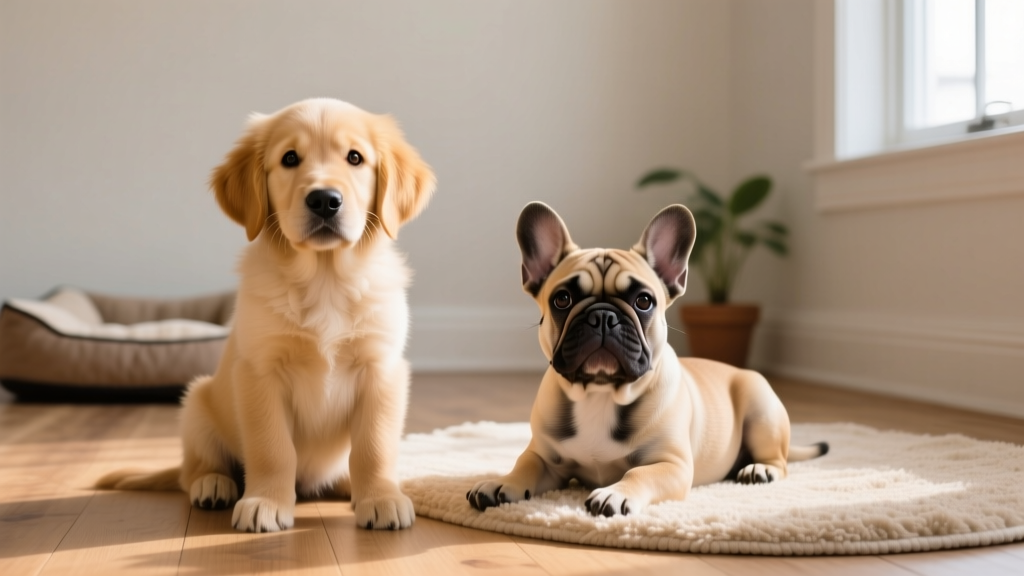
Cute Female Puppy Names & Complete Puppy Care Guide by Age
Browse cute female puppy names and get an age-by-age puppy care guide covering feeding, potty training, vaccines, socialization, and first-year costs.

Choosing one of the many cute female puppy names is only the beginning. Once you have picked a name like Luna, Bella, Daisy, or something more unique like Cleo or Noodle, the real work starts: raising a healthy, confident, well-mannered dog. This guide pairs a curated name list with a detailed, week-by-week puppy care roadmap so you know exactly what to expect from the day you bring her home through her first birthday.
Cute Female Puppy Names: 75 Ideas by Category
Before diving into care schedules, here is a curated list of cute female puppy names organized by style. Pick one that fits her personality — and that you will not mind calling across a dog park for the next 12-plus years.
| Category | Name Ideas |
|---|---|
| Classic & Popular | Luna, Bella, Daisy, Lucy, Sadie, Maggie, Molly, Sophie, Chloe, Bailey |
| Food-Inspired | Mochi, Biscuit, Peanut, Olive, Ginger, Cinnamon, Waffles, Truffle, Honey, Maple |
| Nature & Floral | Willow, Ivy, Poppy, Rosie, Juniper, Hazel, Clover, Fern, Sage, Petunia |
| Short & Punchy | Mia, Dot, Pip, Rue, Lux, Cleo, Bea, Faye, Joy, Tess |
| Unique & Quirky | Noodle, Pixel, Zelda, Sable, Echo, Fable, Juno, Kiki, Scout, Tilly |
| Elegant & Regal | Duchess, Athena, Cleopatra, Stella, Pearl, Freya, Nova, Aria, Celeste, Odette |
| Tough & Spunky | Harley, Roxy, Blaze, Ripley, Jett, Stormy, Rebel, Rogue, Onyx, Vixen |
Naming tip: Dogs respond best to one- or two-syllable names ending in a vowel sound (Luna, Bella, Cleo). Avoid names that sound like common commands — "Kit" can confuse with "sit," and "Bo" can blur with "no." Test the name by calling it aloud three times fast. If it feels natural, it is a keeper.
When Should You Bring Your Puppy Home?
The American Kennel Club and most veterinary behaviorists agree: puppies should stay with their mother and littermates until at least 8 weeks of age. For toy and small breeds (Chihuahuas, Yorkshire Terriers, Pomeranians), many responsible breeders keep puppies until 10-12 weeks because these tiny dogs mature more slowly and benefit from extra socialization time with siblings.
Plan your pickup day carefully. Bring a secure carrier, a towel that smells like the litter (ask the breeder to rub it on siblings), and avoid scheduling a homecoming on a day you need to work. Your puppy will need near-constant supervision for the first 72 hours as she decompresses.
Puppy Milestones: What to Expect Week by Week
Understanding developmental stages prevents you from expecting too much too soon — or missing critical windows.
Weeks 4-8 (Still with Breeder)
- Physical: Baby teeth fully erupted; coordination improving rapidly; weight doubling weekly in many breeds.
- Behavioral: Littermate play teaches bite inhibition; puppies begin learning rudimentary social hierarchies.
- What you can do: If visiting before pickup, handle the puppy gently for short sessions (2-3 minutes) to build human-positive associations.
Weeks 8-12 (Homecoming & Bonding)
- Physical: Rapid growth phase; bladder capacity approximately 1 hour per month of age (a 2-month-old puppy can hold it roughly 2 hours max).
- Behavioral: Peak fear period (8-11 weeks) — negative experiences can create lasting phobias. Keep introductions calm and positive.
- Sleep: Expect 18-20 hours of sleep per 24-hour cycle. Enforce naps in the crate to prevent overtired biting frenzies.
Weeks 12-16 (Confidence Building)
- Physical: Adult coat begins replacing puppy fuzz; growth rate starts to plateau in small breeds but continues steeply in large/giant breeds.
- Behavioral: Secondary fear period may emerge around 12-14 weeks. Previously confident puppies may suddenly startle at trash cans or hats.
- Training: Attention span increases to 5-10 minutes per session. Ideal time to introduce structured positive-reinforcement training.
Weeks 16-24 (Adolescence Begins)
- Physical: Teething peaks (more below); large breeds may reach 50-60% of adult weight.
- Behavioral: Testing boundaries — previously reliable recall may seem to vanish. This is normal developmental regression, not a training failure.
- Social: Dog-dog play style solidifies. Arrange regular playdates with vaccinated, temperament-tested dogs.
Months 6-12 (Young Adult Transition)
- Physical: Small breeds reach near-adult size by 8-10 months; large breeds continue growing until 18-24 months. Spay surgery typically scheduled between 6-12 months depending on breed size (discuss timing with your veterinarian — large-breed dogs may benefit from waiting until after first heat or until growth plates close).
- Behavioral: Energy remains high but focus improves. Excellent window for advanced training, agility foundations, or therapy dog prep.
Feeding Schedule: Exact Portions by Age and Weight
How often should you feed your puppy at each age? The answer depends on her developmental stage and expected adult size. The feeding table below uses a puppy projected to reach 30-40 lb (14-18 kg) as an adult as a baseline. Adjust proportionally for smaller or larger breeds.
| Age | Meals per Day | Approximate Daily Amount (Dry Kibble) | Notes |
|---|---|---|---|
| 8-12 weeks | 4 | 1.0-1.5 cups total (0.25-0.375 cups per meal) | Moisten kibble with warm water if teeth are still settling |
| 12-16 weeks | 3 | 1.5-2.0 cups total (0.5-0.67 cups per meal) | Transition to dry kibble; monitor body condition score (BCS) |
| 16-24 weeks | 3 | 2.0-2.75 cups total (0.67-0.9 cups per meal) | Increase protein for growth; look for AAFCO "growth" statement on label |
| 6-9 months | 2 | 2.5-3.5 cups total (1.25-1.75 cups per meal) | Drop midday meal gradually over 3-4 days |
| 9-12 months | 2 | 2.5-3.5 cups total (transition to adult formula at 10-12 months for small breeds, 12-18 months for large breeds) | Gradual 7-10 day food transition to avoid GI upset |
Key feeding rules:
- Choose a food that carries the AAFCO statement "formulated for growth" or "all life stages."
- Measure with a standard 8 oz measuring cup — do not eyeball portions.
- Pick up the bowl after 15-20 minutes, even if food remains. This builds a healthy eating routine and makes potty timing more predictable.
- Limit treats to no more than 10% of daily caloric intake.
- Never feed grapes, raisins, chocolate, xylitol-containing products, onions, garlic, or macadamia nuts. If your puppy ingests any of these, call the ASPCA Animal Poison Control Center at (888) 426-4435 (a consultation fee applies) or the Pet Poison Helpline at (855) 764-7661.
Vaccination Schedule: What Your Puppy Needs and When
What vaccines does your puppy need and when? The American Veterinary Medical Association outlines core and non-core vaccines. Your veterinarian will tailor the schedule to your region and your puppy's risk profile, but the standard protocol looks like this:
| Age | Vaccine(s) | Type | Notes |
|---|---|---|---|
| 6-8 weeks | DHPP (Distemper, Hepatitis/Adenovirus, Parainfluenza, Parvovirus) — 1st dose | Core | Often administered by breeder or rescue before pickup |
| 10-12 weeks | DHPP — 2nd dose; Bordetella (optional, recommended if attending puppy classes or boarding) | Core + Non-core | Bordetella may be given intranasally or by injection |
| 14-16 weeks | DHPP — 3rd (final puppy) dose; Rabies (required by law in most US states) | Core | Rabies typically given at 12-16 weeks depending on state law |
| 12-16 months | DHPP booster; Rabies booster (1-year or 3-year depending on product and local law) | Core | After this, DHPP boosters typically every 3 years |
Leptospirosis, Lyme, and Canine Influenza are non-core vaccines your veterinarian may recommend based on geography and lifestyle. Discuss these at the 12-week visit.
Socialization Window: The Critical Weeks 3-14 Checklist
The primary socialization window closes between 12-14 weeks of age. After this period, unfamiliar stimuli are more likely to trigger fear rather than curiosity. This does not mean socialization stops — but the ease of building positive associations drops sharply.
Use this checklist to track exposures. Aim for positive, brief encounters — a 30-second happy experience beats a 10-minute stressful one.
Rule of thumb: If your puppy shows fear (tucked tail, flattened ears, freezing, hiding), do not force the interaction. Increase distance, offer high-value treats (boiled chicken, cheese), and let her approach voluntarily. This is classical counter-conditioning — pairing a scary stimulus with something wonderful.
Potty Training Timeline: Realistic Expectations and Troubleshooting
When will your puppy be fully potty trained? For most puppies, reliable house training takes 4-6 months, with some small breeds needing up to 8-10 months due to smaller bladder capacity. Anyone promising a fully trained puppy in 3 days is setting you up for frustration.
| Age | Max Bladder Hold Time (Awake) | Outing Frequency | Realistic Expectation |
|---|---|---|---|
| 8-10 weeks | 1-2 hours | Every 30-60 minutes during active hours | Accidents are the norm — you are training yourself to watch for signals |
| 10-14 weeks | 2-3 hours | Every 60-90 minutes | Beginning to signal (sniffing, circling, heading to door) |
| 14-20 weeks | 3-4 hours | Every 2-3 hours | Noticeable improvement; accidents drop to 1-3 per week |
| 5-6 months | 4-5 hours | Every 3-4 hours | Mostly reliable with occasional setbacks |
| 6-12 months | 6-8 hours (adult capacity) | Every 4-6 hours | Fully reliable for most dogs; adolescent regression possible around 7-9 months |
Potty training protocol:
- Take puppy to the same outdoor spot every time.
- Use a consistent cue word ("go potty," "do your business") while she is eliminating.
- Reward immediately after she finishes — treat within 1-2 seconds, paired with verbal praise.
- Supervise 100% when loose indoors. If you cannot watch her, she goes in the crate.
- If you catch an accident in progress, interrupt calmly ("oops!") and carry her outside. Never punish after the fact — dogs do not connect delayed punishment with the act.
- Use an enzymatic cleaner (Nature's Miracle, Rocco & Roxie) to eliminate odor. Standard household cleaners leave residual scent that draws puppies back.
Crate Training Progression and Teething Relief
Crate Training: Time Limits by Age
A crate is your puppy's den, not a punishment zone. Introduce it gradually:
| Age | Max Crate Time (Daytime) | Overnight | Strategy |
|---|---|---|---|
| 8-10 weeks | 30-60 minutes | 2-3 hours before potty break | Feed meals in crate; cover with breathable blanket; place near your bed at night |
| 10-14 weeks | 1-2 hours | 3-4 hours | Begin short absences from the room while she is crated and calm |
| 14-20 weeks | 2-3 hours | 5-6 hours | Practice leaving the house for 5-15 minutes; return before she becomes distressed |
| 5-6 months | 3-4 hours | 7-8 hours | Transition crate to a quieter area if she sleeps through the night reliably |
Whining troubleshooting: If your puppy whines in the crate, ask yourself: Does she need to eliminate? If you have followed the schedule and she was recently outside, wait for a 3-5 second pause in whining before opening the crate. Opening while she is vocalizing teaches her that noise opens the door.
Teething Timeline: Months 3-6
Puppies have 28 deciduous (baby) teeth that begin falling out around 12-16 weeks, replaced by 42 adult teeth. The most intense chewing phase runs from 3 to 6 months.
Safe chew recommendations:
- KONG Classic (puppy rubber, pink/blue): Stuff with plain yogurt and banana, then freeze for 2 hours. The cold numbs sore gums.
- Benebone Puppy Wishbone: Nylon chew sized to your puppy's current weight. Replace when worn down more than 25%.
- Frozen washcloth: Wet a clean washcloth, twist into a rope, freeze for 1 hour. Supervise to prevent swallowing fabric.
- Carrots (whole, raw, large): Cold and crunchy — a low-calorie teething soother. Supervise to prevent choking on broken pieces.
Avoid: Rawhide (choking and blockage risk), antlers and weight-bearing bones from large animals (tooth fractures), and any chew toy small enough to swallow whole.
Common Puppy Problems: Biting, Chewing, and Solutions
How Do You Stop Puppy Biting and Nipping?
Puppy mouthing is normal — she is exploring the world with her mouth and her baby teeth are sharp. The goal is not to eliminate mouthing entirely but to teach bite inhibition (soft mouth) and then redirect to appropriate items.
- When teeth touch skin: Say "ouch" in a calm, slightly surprised tone. Immediately withdraw attention for 10-15 seconds (stand up, turn away, or step behind a baby gate).
- Redirect: Offer a chew toy. When she bites the toy, praise and resume play.
- Manage arousal: Biting spikes when puppies are overtired or overstimulated. If redirecting fails twice, she likely needs a nap — enforce a crate rest.
- Never: Hold her mouth shut, alpha-roll, yell, or use physical punishment. These methods damage trust and can escalate fear-based aggression. The American Veterinary Society of Animal Behavior explicitly recommends against aversive training techniques.
Destructive Chewing
Puppies chew to relieve teething pain and explore textures. Management is the solution:
- Puppy-proof every room she can access: shoes in closets, cords behind furniture, remote controls on shelves.
- Rotate 4-5 chew toys so novelty stays high.
- When you catch her chewing something off-limits, trade up — offer a higher-value chew (stuffed frozen KONG) and remove the forbidden item without drama.
First-Year Cost Breakdown: Budget Planning
Raising a puppy costs more than most first-time owners anticipate. Below is a realistic first-year budget for a medium-sized dog (30-50 lb / 14-23 kg) in the United States in 2026. Costs vary by region — urban areas like New York City or San Francisco will skew 30-50% higher for veterinary services.
| Category | Estimated Cost (USD) | Details |
|---|---|---|
| Puppy purchase/adoption | $500-$3,500 | Rescue adoption: $200-$600; responsible breeder: $1,500-$3,500+ depending on breed |
| Veterinary (first year) | $600-$1,200 | 3 puppy vaccine visits, rabies, fecal tests, deworming, spay/neuter ($300-$700), microchip |
| Food | $400-$800 | Quality puppy kibble ($50-$80/bag, 25-30 lb bag lasts 4-6 weeks) |
| Supplies | $300-$600 | Crate ($50-$120), bed, leash/harness, bowls, toys, enzymatic cleaner, baby gates, grooming tools |
| Training | $150-$500 | Group puppy class ($150-$250 for 6-week session); private trainer ($80-$150/session) if needed |
| Preventive medications | $200-$400 | Heartworm, flea/tick prevention — monthly, year-round in most US regions |
| Pet insurance (optional) | $350-$700/year | $30-$60/month; enroll before first vet visit to avoid pre-existing condition exclusions |
| Emergency fund | $500-$2,000 | Puppies eat things they should not — budget for at least one urgent vet visit |
Total estimated first-year cost: $2,500-$8,700+ depending on breed source, location, and whether complications arise.
Frequently Asked Questions
When should I bring my puppy home?
No earlier than 8 weeks of age. For toy breeds under 5 lb (2.3 kg) expected adult weight, 10-12 weeks is preferable. Confirm the puppy has received her first DHPP vaccine (typically at 6-8 weeks) before pickup.
How often should I feed my puppy at each age?
Four meals per day from 8-12 weeks, three meals from 12 weeks to 6 months, then two meals per day for life. See the feeding schedule table above for exact portions based on projected adult weight.
When will my puppy be fully potty trained?
Most puppies are reliably house-trained between 4-6 months of age. Small and toy breeds may take 8-10 months due to smaller bladder capacity. Consistency in schedule, supervision, and positive reinforcement for outdoor elimination are the three most important factors.
What vaccines does my puppy need and when?
Core vaccines include DHPP (3 doses at 6-8, 10-12, and 14-16 weeks) and Rabies (at 12-16 weeks per state law). Non-core vaccines like Bordetella, Leptospirosis, and Lyme are based on lifestyle and geography. Consult your veterinarian for a tailored protocol.
How do I stop puppy biting and nipping?
Use the "ouch and redirect" method: say "ouch" when teeth touch skin, withdraw attention for 10-15 seconds, then offer an appropriate chew toy. If biting persists, your puppy is likely overtired — enforce a crate nap. Never use physical punishment. Expect mouthing to decrease significantly by 5-6 months as adult teeth come in.
When can my puppy go outside and meet other dogs?
Your puppy can explore private yards with known-vaccinated dogs immediately. Avoid public dog parks, pet stores, and areas with unknown dog traffic until 7 days after her final DHPP vaccine at 14-16 weeks. Carry her in public to socialize to sights and sounds without disease risk during this vulnerable period.
Choosing a name from your list of cute female puppy names is the fun part. The weeks that follow — the 3 a.m. potty breaks, the chewed shoes, the fear periods — are where the real bond is built. Stick to the schedule, celebrate small wins, and remember that every well-behaved adult dog was once a chaotic puppy who just needed a patient human and a plan.
Jonas Cole
All our authors care for dogs every day — read more of their work on the authors page.