Common Puppy Names for Males: Top Picks & Complete New Puppy Care Guide
Discover the most popular common puppy names for males in 2026 plus a complete first-year care timeline covering feeding, vaccines, potty training, and costs.

Choosing Common Puppy Names for Males: What's Trending and What Sticks
You've done the research, found your breeder or rescue, and your new male puppy is coming home. Now comes one of the surprisingly stressful parts: picking a name. The most common puppy names for males tend to share a few traits — they're short (one or two syllables), end in a vowel or hard consonant, and are easy to call across a dog park without feeling self-conscious. According to AKC registration data, names like Milo, Charlie, Cooper, Max, and Buddy consistently rank among the top male dog names year after year.
Here's a practical breakdown of the most popular common puppy names for males, organized by style, so you can find one that fits your dog's personality — and yours:
| Classic / Timeless | Trending (2024-2026) | Strong / Bold | Food-Inspired | Nature / Outdoorsy |
|---|---|---|---|---|
| Max | Milo | Thor | Biscuit | River |
| Buddy | Teddy | Duke | Nacho | Sage |
| Charlie | Arlo | Titan | Mochi | Cedar |
| Cooper | Finn | Rex | Waffles | Flint |
| Rocky | Ollie | Blaze | Peanut | Hawk |
| Bear | Loki | Zeus | Ginger | Aspen |
| Jack | Bruno | Apollo | Basil | Ridge |
| Tucker | Zeke | King | Cashew | Brooks |
When Should I Bring My Puppy Home?
The ideal age to bring a puppy home is 8 to 10 weeks. Puppies go through a critical socialization period with their littermates between weeks 3 and 8, learning bite inhibition, canine communication, and basic social skills from their mother and siblings. Removing a puppy before 8 weeks can lead to increased fear responses, difficulty reading other dogs' body language, and harder-to-break mouthing habits later.
Some breeders of smaller breeds (Chihuahuas, Yorkshire Terriers, toy Poodles) may recommend waiting until 10-12 weeks because tiny puppies are more fragile and benefit from additional time gaining weight and coordination. If your breeder suggests a later pickup, this is generally a sign of responsible practice, not a red flag.
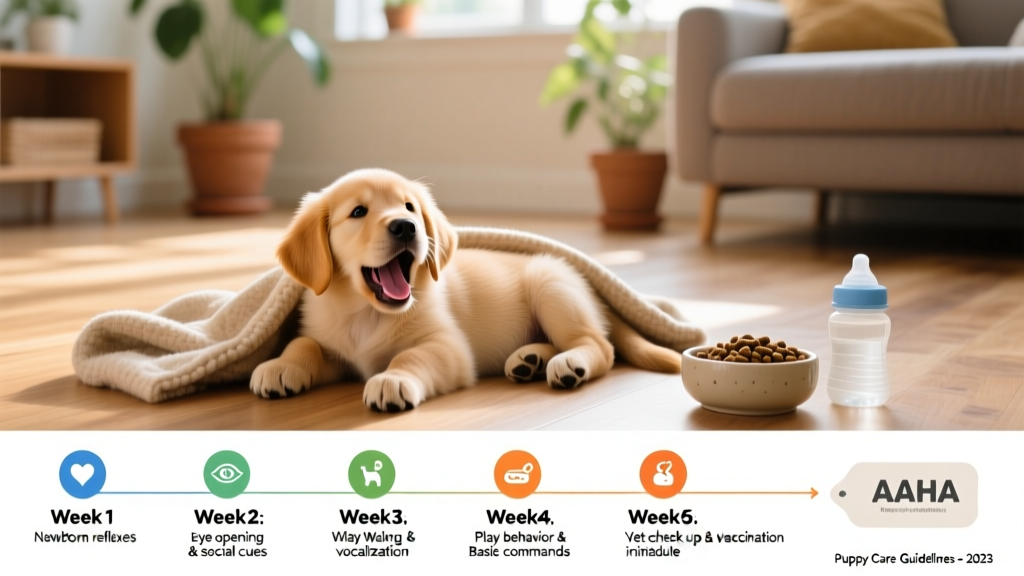
Puppy Milestone Timeline: What to Expect Week by Week
Every puppy develops at their own pace, but these milestones reflect typical expectations for a healthy male puppy from a medium-sized breed (40-60 lb adult weight). Adjust timelines slightly for giant breeds (slower maturation) or toy breeds (faster physical development, slower emotional maturity).
Weeks 4-8 (Breeder/Foster Care Period)
- Physical: Baby teeth fully erupted (28 deciduous teeth), weaning onto solid food, rapid growth — gaining roughly 5-10% of body weight per week
- Behavioral: Learning bite inhibition from littermates, first fear imprint period (weeks 8-10), beginning to respond to human voices and names
- What you can do: If visiting the breeder, handle your puppy daily. Start saying the chosen name consistently. Bring a blanket with your home's scent to leave with the puppy.
Weeks 8-12 (Home Adjustment & Bonding)
- Physical: Sleeping 18-20 hours per day, short bursts of energy (10-15 minutes) followed by crashes, bladder capacity roughly 1 hour per month of age
- Behavioral: Peak fear imprint period — negative experiences during weeks 8-10 can create lasting phobias. Begin recognizing name, learning basic "sit" with food luring.
- What you can do: Keep experiences positive. Avoid overwhelming environments (crowded pet stores, loud events). Limit play sessions to prevent overstimulation.
Weeks 12-16 (Confidence Building & Foundation Training)
- Physical: Noticeable growth spurts, coordination improving, can hold bladder 3-4 hours during the day, beginning to lose baby teeth (incisors first)
- Behavioral: Testing boundaries, increased independence, "second fear period" may emerge around 14-16 weeks causing temporary regression in confidence
- What you can do: Enroll in a positive-reinforcement puppy class (typically $150-250 for 6-8 week sessions). Practice handling exercises — touching paws, ears, mouth — to prepare for grooming and vet visits.
Weeks 16-24 (The "Teenage" Transition)
- Physical: Adult teeth erupting (42 permanent teeth by ~6 months), reaching 60-75% of adult height, growth plates still open — avoid forced high-impact exercise (no jogging, minimal stair climbing for large breeds)
- Behavioral: Increased distraction, may seem to "forget" previously learned commands, chewing intensity peaks as adult teeth settle, sexual maturity beginning in smaller breeds
- What you can do: Maintain training consistency. Increase mental enrichment (snuffle mats, frozen Kongs, training sessions). Discuss spay/neuter timing with your veterinarian — current evidence from AVMA guidelines supports individualized timing based on breed and size.
Months 6-12 (Adolescence)
- Physical: Approaching adult size (80-90% of adult weight by 9-10 months for medium breeds), growth plates closing in smaller breeds first, coat transitioning from puppy to adult texture
- Behavioral: Full adolescent testing phase — leash pulling, selective hearing, potential reactivity emergence, marking behavior in intact males typically begins 6-9 months
- What you can do: Keep training sessions short (5-10 minutes) but frequent. Proof commands in increasingly distracting environments. Consider a second round of group classes for adolescent dogs.
Feeding Schedule: Exact Portions by Age and Weight
Feeding amounts depend on your puppy's projected adult weight, the caloric density of your chosen food, and individual metabolism. The table below assumes a complete-and-balanced puppy food meeting AAFCO growth standards with approximately 350-400 kcal per cup.
| Puppy Age | Meals Per Day | Approximate Daily Amount (Medium Breed, 40-60 lb Adult) | Notes |
|---|---|---|---|
| 8-12 weeks | 4 meals | 1 to 1½ cups total (¼ to ⅜ cup per meal) | Moisten kibble with warm water for easier chewing during transition |
| 12-16 weeks | 3 meals | 1½ to 2 cups total (½ to ⅔ cup per meal) | Switch to dry kibble; use slow-feeder bowl if gulping |
| 16-24 weeks | 3 meals → 2 meals | 2 to 2¾ cups total | Transition to twice-daily feeding around 5-6 months |
| 6-9 months | 2 meals | 2½ to 3½ cups total (1¼ to 1¾ cup per meal) | Monitor body condition score — ribs should be felt but not visible |
| 9-12 months | 2 meals | 3 to 4 cups total | Begin transitioning to adult food at 10-12 months for medium breeds; large/giant breeds stay on puppy food until 12-18 months |
Vaccination Schedule: What Your Puppy Needs and When
Core vaccines protect against life-threatening diseases. The schedule below follows AVMA-recommended guidelines. Your veterinarian may adjust timing based on local disease prevalence and your puppy's individual risk factors.
| Age | Vaccine(s) | What It Protects Against | Estimated Cost (Without Insurance) |
|---|---|---|---|
| 6-8 weeks | DHPP (1st dose) | Distemper, Hepatitis (Adenovirus-2), Parainfluenza, Parvovirus | $20-40 |
| 10-12 weeks | DHPP (2nd dose), Bordetella (optional, recommended if attending puppy classes) | Booster for core viruses; Kennel cough (Bordetella bronchiseptica) | $25-50 |
| 14-16 weeks | DHPP (3rd dose), Rabies (required by law in most states) | Final core booster; Rabies virus | $30-60 |
| 12-16 months | DHPP booster, Rabies booster | First annual boosters; subsequent rabies boosters every 1-3 years depending on local law | $35-70 |
Potty Training Timeline: Realistic Expectations and Troubleshooting
Let's be direct: no puppy is fully potty trained in a weekend. Bladder control develops physically over months, and consistent habits take repetition. Here's what a realistic timeline looks like:
- 8-12 weeks: Accidents every day are normal. Take puppy outside every 1-2 hours, after every meal, after every nap, and after every play session. You're building the habit, not expecting perfection.
- 3-4 months: Accidents drop to 1-3 per week if you've been consistent. Puppy begins going to the door or showing signals (sniffing, circling, whining).
- 4-6 months: Most puppies can hold it 4-5 hours during the day. Accidents become occasional rather than routine.
- 6-8 months: Reliable bladder control for 6-8 hours. Occasional regression may occur during adolescence or environmental changes.
- 9-12 months: Most dogs are considered fully house-trained. Small breeds may take longer due to smaller bladder capacity.
Potty Training Log Template (First 2 Weeks)
Track these data points to identify your puppy's natural patterns:
| Time | Activity | Result | Treat Given? |
|---|---|---|---|
| 7:00 AM | Out after waking | ✅ Pee + poop | Yes — high-value (chicken bit) |
| 8:30 AM | Out after breakfast | ✅ Pee | Yes — kibble piece |
| 9:45 AM | Accident in kitchen | ❌ Pee | N/A — interrupt calmly, carry outside |
| 10:00 AM | Out after nap | ✅ Pee | Yes — verbal praise + treat |
Key insight: If accidents cluster around a specific time, add an extra outdoor trip 15 minutes before that window. You're preventing the accident, not just reacting to it.
Common Potty Training Problems
Submissive urination: Common in young dogs. Don't scold — it makes it worse. Greet your puppy calmly, crouch to their level, and take them outside immediately upon arriving home.
Excitement peeing: Similar to submissive urination but triggered by high arousal. Keep greetings low-key and take puppy outside before exciting activities.
Marking behavior: Intact males may begin lifting their leg and marking indoors as early as 5-6 months. Discuss neuter timing with your vet and manage the environment by restricting access to previously marked areas with enzymatic cleaner treatment.
Socialization Window: The Critical Weeks 3-14 Period
The primary socialization window closes around 14-16 weeks of age. According to the Merck Veterinary Manual, experiences during this period have an outsized impact on a dog's lifelong temperament. Puppies who are not exposed to a variety of stimuli during this window are significantly more likely to develop fear-based reactivity, anxiety, and avoidance behaviors as adults.
This doesn't mean overwhelming your puppy — it means providing positive, controlled exposures to the stimuli they'll encounter throughout life:
Socialization Checklist (Weeks 8-14)
Aim for 2-3 new positive exposures per day. Pair every new experience with high-value treats.
- ☐ Different floor surfaces: gravel, grass, metal grates, wet pavement, stairs
- ☐ Sounds: vacuum cleaner (start distant, gradually closer), thunderstorm recordings (low volume), doorbells, car engines, fireworks audio
- ☐ People: children (supervised), people wearing hats/sunglasses, people with umbrellas, tall people, people in wheelchairs, delivery workers
- ☐ Objects: plastic bags blowing, bicycles, skateboards, shopping carts, lawn equipment
- ☐ Handling: paw touching, ear inspection, mouth opening, nail clipping (just touching), gentle restraint
- ☐ Other animals: fully vaccinated adult dogs (in controlled settings), cats (if household has them), livestock (if rural)
- ☐ Environments: car rides, parking lots, outdoor café patios, friend's houses, groomer's lobby (just visiting, no procedures)
- ☐ Body awareness: walking through tunnels, wobble boards, different-sized doorways
Teething Timeline and Relief Strategies
Puppy teething follows a predictable pattern, and knowing what's coming helps you prepare your home (and your hands):
- 3-4 weeks: Deciduous (baby) incisors erupt
- 4-6 weeks: Baby canines and premolars come in — this is why breeders sometimes describe "sharp little needles"
- 12-16 weeks: Baby incisors begin falling out, adult incisors erupt — you may find tiny teeth on the floor or notice your puppy chewing more intensely
- 4-5 months: Adult canines and premolars erupt — peak chewing intensity
- 5-7 months: Adult molars come in, all 42 permanent teeth should be present by 6-7 months
Safe Chew Recommendations by Age
| Age | Recommended Chews | Avoid |
|---|---|---|
| 8-12 weeks | Wet frozen washcloth (twisted into rope shape), soft rubber toys (Kong Classic, ~$12-18), carrot sticks (supervised) | Hard nylon bones, antlers, rawhide, any chew harder than a fingernail |
| 12-24 weeks | Frozen stuffed Kong (puppy-safe peanut butter, no xylitol), Benebone Puppy (~$15-22), bully sticks (supervised, remove when small) | Cooked bones (splinter risk), hooves, ice cubes (can crack developing teeth) |
| 6-12 months | Yak cheese chews (supervised), rubber puzzle toys, frozen blueberries as treats, Nylabone Power Chew (appropriate size) | Tennis balls (abrasive felt wears enamel), sticks from unknown trees (some wood is toxic) |
Stopping Puppy Biting and Nipping
Mouthing is normal puppy behavior — they explore the world with their mouths and are learning bite inhibition. Here's how to redirect it using positive reinforcement methods:
- Redirect to a toy: When puppy teeth touch skin, say a calm "oops" or "too bad," immediately offer an appropriate chew toy, and praise enthusiastically when they bite the toy instead.
- Time-outs (not punishment): If redirection fails after 2-3 attempts, calmly end the interaction. Stand up, cross your arms, and ignore the puppy for 15-30 seconds. This teaches that biting ends play — not that biting gets attention.
- Manage arousal levels: Puppies bite most when overtired or overstimulated. If nipping escalates, your puppy likely needs a nap, not more training. Crate them with a chew toy for a 30-60 minute enforced rest.
- Reward gentle play: Any time your puppy licks you or plays without teeth on skin, mark it with a "yes!" and give a treat. You're reinforcing the behavior you want, not just correcting what you don't.
Crate Training Progression: Time Limits by Age
A crate is your puppy's safe den — not a punishment space. Introduce it gradually with the door open, meals inside, and high-value chews available only in the crate. Maximum crating time during the day:
| Puppy Age | Maximum Daytime Crate Duration | Nighttime Expectation |
|---|---|---|
| 8-10 weeks | 1-2 hours between potty breaks | 3-4 hours (set an alarm for one overnight potty break) |
| 10-14 weeks | 2-3 hours | 4-5 hours (may still need one overnight break) |
| 14-18 weeks | 3-4 hours | 5-6 hours (many puppies sleep through the night by 14-16 weeks) |
| 4-6 months | 4-5 hours | 7-8 hours |
| 6+ months | 5-6 hours max | 8-9 hours |
Important: No dog of any age should be crated for more than 6-8 consecutive hours during the day on a regular basis. If your work schedule requires longer absences, arrange for a midday dog walker, use a puppy-proofed exercise pen with a potty area, or consider doggy daycare (typically $25-45 per day).
Common Puppy Problems and Breed-Aware Solutions
Chewing Destruction
Peak chewing occurs between 3-6 months during teething, but adolescent chewing (driven by boredom and jaw strengthening) can persist through 12-18 months. Management is key: puppy-proof rooms by removing shoes, cords, and valuables; rotate a selection of 4-5 appropriate chews to maintain novelty; and provide at least 15-20 minutes of structured mental enrichment daily (training sessions, snuffle mats, food puzzles).
Whining and Crying in the Crate
First distinguish between distress whining (needs to potty) and protest whining (wants out to play). Take your puppy out on leash to potty — if they go, great, back in the crate calmly. If they don't go within 5 minutes, return them to the crate and wait for 30 seconds of silence before letting them out. This prevents reinforcing whining as a release mechanism.
Jumping on People
Teach an incompatible behavior: a dog who is sitting cannot be jumping. Ask visitors to ignore your puppy until all four paws are on the floor, then reward with attention. For persistent jumpers, keep your puppy on a leash during greetings until the behavior is extinguished.
First-Year Cost Breakdown: What to Budget
New puppy owners are often surprised by the true cost of the first year. Here's a realistic breakdown for a medium-sized breed in the United States (2025-2026 estimates):
| Category | Low End | Mid Range | High End | Notes |
|---|---|---|---|---|
| Puppy purchase/adoption | $150 (rescue) | $1,500 (responsible breeder) | $3,500+ (specialty breed) | Adoption fees often include initial vaccines and spay/neuter |
| Veterinary (first year) | $500 | $900 | $1,800+ | Includes vaccines, spay/neuter, fecal tests, heartworm prevention, any illness visits |
| Food (12 months) | $350 | $600 | $1,000+ | Depends on brand quality and dog's adult size |
| Supplies (crate, bed, leash, bowls, toys) | $200 | $400 | $800+ | One-time purchases; budget for replacement toys quarterly |
| Training classes | $0 (DIY) | $300 (group classes) | $1,200+ (private sessions) | At minimum, one 6-8 week puppy class is strongly recommended |
| Preventive medications (heartworm, flea/tick) | $200 | $350 | $500 | Year-round prevention recommended in most US regions |
| Pet insurance (optional) | $0 | $480 ($40/month) | $900+ ($75/month) | Enroll before first illness — pre-existing conditions are excluded |
| Grooming (breed-dependent) | $0 (home care) | $400 (quarterly professional) | $1,200+ (monthly for coated breeds) | Short-coated breeds require minimal professional grooming |
| Total First Year | $1,400 | $4,530 | $10,900+ | Does not include emergency vet visits ($1,000-5,000+ per incident) |
Frequently Asked Questions
When should I bring my puppy home?
Between 8 and 10 weeks of age for most breeds. Smaller toy breeds may benefit from staying with the breeder until 10-12 weeks due to fragility. Never bring a puppy home before 8 weeks — they need that critical littermate socialization period.
How often should I feed my puppy at 10 weeks old?
Four meals per day, spaced roughly 4-5 hours apart during waking hours. A typical schedule might be 7 AM, 12 PM, 5 PM, and 9 PM. Adjust portions based on your food's caloric density and your puppy's body condition score. Your vet can provide a specific calorie target at your first wellness visit.
When will my puppy be fully potty trained?
Most puppies achieve reliable house training between 6 and 9 months, though some (especially small breeds) may take up to 12 months. Consistency in schedule, immediate outdoor trips after meals and naps, and enthusiastic rewards for outdoor elimination are the biggest factors in speed of training.
What vaccines does my puppy need and when?
The core vaccine series is DHPP (distemper, hepatitis, parainfluenza, parvovirus) given at 6-8 weeks, 10-12 weeks, and 14-16 weeks. Rabies is given at 14-16 weeks and is legally required. Bordetella is recommended for puppies attending classes or boarding. Your vet may also recommend leptospirosis or Lyme disease vaccines based on your geographic area.
How do I stop puppy biting and nipping?
Redirect to appropriate chew toys every time teeth touch skin. If the puppy continues, implement a calm 15-30 second time-out by withdrawing attention. Ensure your puppy is getting adequate sleep (18-20 hours per day for young puppies) — overtired puppies bite more. Never use physical punishment, which increases fear and aggression.
When can my puppy go outside and meet other dogs?
Your puppy can explore your own private yard immediately. For public spaces and meeting unknown dogs, wait until at least 7 days after the final DHPP booster (typically around 16-17 weeks). However, socialization during the critical window (8-14 weeks) is essential — carry your puppy in public, arrange controlled playdates with known vaccinated dogs, and attend structured puppy classes where vaccination records are required.
Disclaimer: This guide provides general educational information. Always consult your veterinarian for advice specific to your puppy's health, vaccination needs, nutrition, and development. Every puppy is an individual, and professional veterinary guidance should never be replaced by online resources.
Dr. Hannah Wickes
All our authors care for dogs every day — read more of their work on the authors page.