Best Chewing Toys for Puppy Teething: A Breed: by: Breed...
Expert guide to the safest chewing toys for puppy teething stages, breed-specific recommendations, and a full puppy care timeline from 4 weeks to 12 months.

Why the Right Chewing Toys for Your Puppy Matter More Than You Think
Between 12 and 24 weeks of age, your puppy will lose 28 deciduous teeth and gain 42 permanent ones. That process — erupting adult teeth pushing through inflamed gums — drives an almost compulsive need to chew. Pick the wrong chewing toys for your puppy and you risk fractured slab teeth (the carnassials), intestinal blockages from swallowed fragments, or toxic chemical exposure from cheap rubber compounds.
Pick the right ones, and you protect your belongings, your puppy's developing jaw, and your relationship during one of the most frustrating developmental windows in dog ownership. This guide pairs a full puppy care timeline — feeding, vaccines, potty training, socialization — with breed-specific chew toy recommendations so you're prepared at every stage.
Bringing Your Puppy Home: The 8-Week Benchmark
The American Kennel Club recommends puppies remain with their litter until at least 8 weeks (56 days). For toy and small breeds like Chihuahuas or Yorkshire Terriers, many responsible breeders hold puppies until 10–12 weeks due to hypoglycemia risk and slower developmental milestones.
At 8 weeks, your puppy has typically received one DHPP vaccine (given at 6–8 weeks), is eating solid kibble 3–4 times daily, and is in the peak socialization window. This is also when chewing behavior begins in earnest — those needle-sharp deciduous teeth are fully erupted, and your puppy explores the world orally.
First 48 Hours Home: Chewing Toy Starter Kit
Before your puppy arrives, stock these categories:
| Category | Example Product | Price Range (2026) | Best For |
|---|---|---|---|
| Soft rubber teether | Kong Puppy (XS/Small, pink or blue) | $8–$12 | Weeks 8–12, gentle gums |
| Freezable soothe toy | Nylabone Puppy Chew Freezer Bone | $7–$10 | Active teething pain relief |
| Textured nylon | Benebone Puppy Wishbone (Small) | $12–$16 | Power chewers, jaw development |
| Edible chew | Earth Animal No-Hide Chews (Puppy) | $10–$18/pack | Supervised sessions, enrichment |
| Interactive puzzle | Kong Classic stuffed & frozen | $14–$18 | Crate settling, separation training |
Avoid entirely: Rawhide (choking and blockage risk), cooked bones (splinter into sharp fragments), cheap imported rubber toys (phthalates, BPA), and any toy smaller than your puppy's mouth width.
Age-Specific Puppy Milestones: Weeks 4 Through Month 12
Weeks 4–8 (Breeder/Rescue Phase)
Your puppy transitions from mother's milk to gruel to solid kibble. Deciduous incisors erupt around week 3–4, canines by week 4, premolars by week 6. Littermates teach bite inhibition — yelping when a sibling bites too hard. This is why early-separated puppies (before 7 weeks) often have severe nipping problems.
Weeks 8–12 (Adjustment & Bonding)
Fear impact period peaks around 8–11 weeks. Negative experiences — forced handling, loud environments, punishment-based training — can create lasting phobias. Keep chew sessions calm and positive. Introduce toys through play, not by forcing them into your puppy's mouth.
- Sleep: 18–20 hours/day — yes, really
- Attention span: 3–5 minutes per training session
- Chewing intensity: Moderate; exploratory rather than pain-driven
- Recommended toys: Soft Kong Puppy, braided fleece tug toys, frozen washcloths (wet, twisted, frozen — supervise to prevent fabric ingestion)
Weeks 12–16 (Confidence Building)
Second DHPP booster administered. Puppy can begin short, structured outdoor exploration in low-risk areas (your yard, not dog parks). Chewing becomes more purposeful — your puppy is testing material resistance and developing jaw strength.
Weeks 16–24 (The Teething Storm)
This is the window that destroys shoes, furniture legs, and owner patience. Adult incisors erupt first (12–16 weeks), followed by canines (16–20 weeks), premolars (16–24 weeks), and finally molars. You may find tiny teeth on the floor, notice mild bleeding on toys, or see your puppy pawing at their mouth. All normal.
Months 6–12 (Adolescence)
All 42 adult teeth should be in by 6–7 months. Chewing doesn't stop — it shifts from pain-driven to boredom/energy-driven. This is when you transition from puppy-specific teething toys to durable adult chews. Adolescent dogs (especially working breeds like German Shepherds, Labradors, and Belgian Malinois) need 15–20 minutes of dedicated chewing time daily for stress relief and jaw exercise.
Feeding Schedule: Exact Portions by Age and Expected Weight
Portion sizes below assume an AAFCO-approved puppy formula with metabolizable energy (ME) of approximately 380–420 kcal/cup. Your specific food's calorie density matters — always check the label's feeding guide as a starting point, then adjust based on body condition score (BCS). You should be able to feel ribs without pressing hard, and see a visible waist from above.
| Puppy Age | Meals/Day | Small Breed (5–20 lb adult) | Medium Breed (21–50 lb adult) | Large Breed (51–100 lb adult) | Giant Breed (100+ lb adult) |
|---|---|---|---|---|---|
| 8–12 weeks | 4 | ¼–½ cup/meal | ½–¾ cup/meal | ¾–1¼ cup/meal | 1–2 cups/meal |
| 12–16 weeks | 3 | ⅓–⅔ cup/meal | ¾–1 cup/meal | 1–1½ cup/meal | 1½–2½ cups/meal |
| 4–6 months | 3 | ½–¾ cup/meal | 1–1½ cups/meal | 1½–2½ cups/meal | 2½–4 cups/meal |
| 6–9 months | 2 | ¾–1 cup/meal | 1½–2 cups/meal | 2–3 cups/meal | 3–5 cups/meal |
| 9–12 months | 2 | Transition to adult food | Transition to adult food | Continue puppy formula | Continue puppy formula |
Large and giant breeds: Use a large-breed puppy formula with controlled calcium (1.0–1.5% on a dry matter basis) and phosphorus to reduce hip dysplasia and osteochondrosis risk. The Merck Veterinary Manual notes that overfeeding during growth accelerates skeletal problems in predisposed breeds.
Feeding and chewing timing: Offer chewing toys 30–60 minutes after meals, not immediately before (a hungry puppy may be too food-motivated to settle with a toy) or right after (vigorous chewing on a full stomach increases bloat risk in deep-chested breeds).
Vaccination Schedule: What, When, and Why
| Age | Vaccine | What It Protects Against | Notes |
|---|---|---|---|
| 6–8 weeks | DHPP (1st dose) | Distemper, Hepatitis (Adenovirus-2), Parainfluenza, Parvovirus | Often given by breeder/rescue |
| 10–12 weeks | DHPP (2nd dose) | Same as above — booster for maternal antibody gap | Core vaccine series |
| 10–12 weeks | Bordetella (optional) | Kennel cough | Recommended if attending puppy classes |
| 12–16 weeks | Rabies | Rabies virus | Legally required; timing varies by state |
| 14–16 weeks | DHPP (3rd dose) | Final core booster | Critical — given after maternal antibodies wane |
| 14–16 weeks | Leptospirosis (optional, 2-dose series) | Leptospira bacteria (zoonotic — transmissible to humans) | Recommended for dogs exposed to wildlife/standing water |
| 16+ weeks | Lyme (optional, 2-dose series) | Borrelia burgdorferi | Tick-endemic areas only |
The maternal antibody gap: Between 6–16 weeks, antibodies from the mother's colostrum gradually decline. Vaccines given too early get neutralized by these maternal antibodies; given too late, the puppy is unprotected. That's why the DHPP series repeats every 2–4 weeks until 16 weeks — it's a calculated overlap strategy, not arbitrary redundancy. The AVMA's canine vaccination guidelines outline this rationale in detail.
The Socialization Window: Weeks 3–14 (Don't Miss It)
Canine behavioral research consistently identifies weeks 3–14 as the primary socialization period. After week 14, neophobia (fear of novel stimuli) increases sharply. Puppies who miss this window are statistically more likely to develop fear-based aggression, separation anxiety, and reactivity.
Exposure Checklist (Aim for Positive Experiences, Not Volume)
- Surfaces: Grass, gravel, metal grates, wet pavement, carpet, tile, stairs
- People: Children (supervised), people wearing hats/glasses/masks, people of different heights and builds, delivery workers
- Sounds: Vacuum cleaner (start at distance), thunderstorm audio (low volume), car horns, doorbells, clapping
- Objects: Umbrellas opening, plastic bags rustling, bicycles passing, skateboards
- Handling: Paw touching, ear inspection, mouth opening (pair with treats — this makes future teeth brushing and vet exams easier)
- Other animals: Fully vaccinated, calm adult dogs — NOT dog parks until full vaccination series is complete (typically 16–18 weeks)
Chewing toy integration: Bring a familiar chew toy to socialization outings. Letting your puppy chew in a novel environment (a friend's house, an outdoor café patio) builds positive associations and teaches settling in stimulating contexts. A Kong stuffed with frozen puppy food works well — licking and chewing are self-soothing behaviors.
Potty Training Timeline: Realistic Expectations
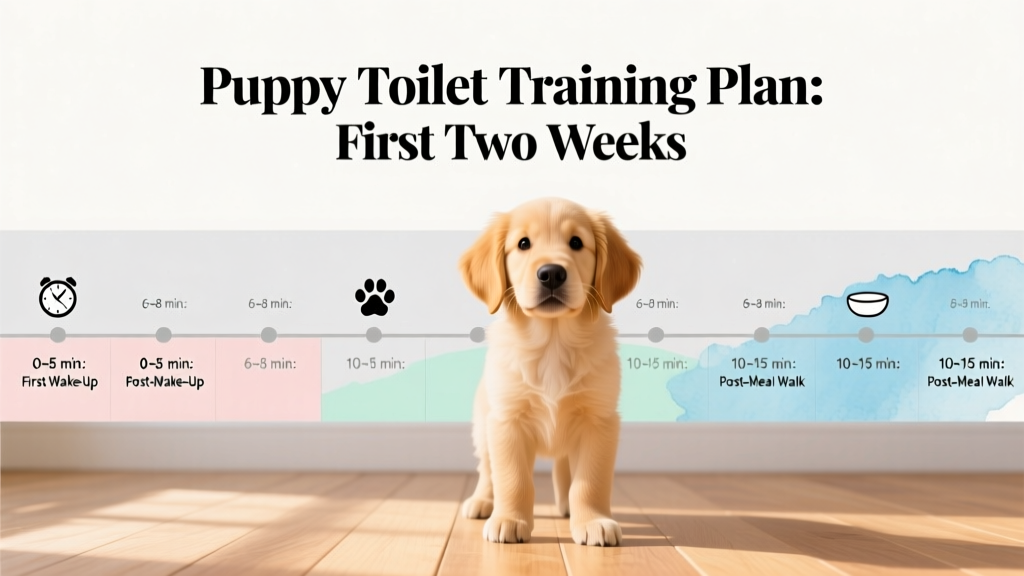
A common and damaging myth: "My puppy should be potty trained in a week." Here's what the data actually shows — bladder control develops physiologically, not just through training. A puppy can typically hold urine for approximately 1 hour per month of age, plus 1. So a 3-month-old puppy maxes out around 4 hours. Overnight control comes later than daytime control.
| Age | Expected Outing Frequency | Accident Expectation | Milestone |
|---|---|---|---|
| 8–10 weeks | Every 30–60 minutes while awake | Multiple daily accidents are normal | Learning the concept of "outside" |
| 10–14 weeks | Every 1–2 hours | 2–4 accidents/week if schedule is consistent | Beginning to signal (sniffing, circling, whining) |
| 3–4 months | Every 2–3 hours | 1–2 accidents/week | Reliable in familiar environments |
| 4–6 months | Every 3–4 hours | Occasional accident with routine disruption | Can hold overnight (6–8 hours) for most puppies |
| 6–9 months | Every 4–6 hours | Rare if schedule maintained | Considered reliably house trained for most breeds |
Troubleshooting regression: Potty regression at 4–6 months is extremely common and usually coincides with teething discomfort, adolescent fear periods, or environmental changes. Return to a tighter schedule (more frequent outings), reward heavily for outdoor elimination, and never punish accidents — punishment teaches puppies to hide elimination, not to eliminate outside.
Crate Training Progression and Time Limits
The crate is your potty training ally — dogs instinctively avoid soiling their sleeping space. But crate time must be age-appropriate to prevent distress and physical harm.
| Puppy Age | Max Daytime Crate Time | Max Overnight Crate Time |
|---|---|---|
| 8–10 weeks | 30–60 minutes | 3–4 hours (set an alarm) |
| 11–14 weeks | 1–2 hours | 4–5 hours |
| 15–16 weeks | 2–3 hours | 5–6 hours |
| 4–6 months | 3–4 hours | 6–8 hours |
| 6+ months | 4–5 hours | 8 hours |
Chewing toy crate protocol: Always provide a safe, indestructible chew toy in the crate — a Kong Classic stuffed and frozen is the gold standard. This creates a positive association (crate = delicious long-lasting chew) and prevents crate-related anxiety and bar chewing. Remove any destructible toys when you're not home — a puppy who shreds a plush toy and ingests stuffing can develop a life-threatening intestinal blockage requiring $3,000–$7,000 surgery.
Breed-Specific Chewing Toy Recommendations
Not all puppies chew the same way. Jaw structure, bite force development, and temperament create dramatically different chew toy needs.
Power Chewers (Labrador Retrievers, Pit Bull Types, Rottweilers, German Shepherds)
These breeds develop significant jaw force early. Standard puppy rubber toys are often destroyed within days. Recommended:
- Goughnuts MaXX 50 Ring ($30–$35) — lifetime guarantee, wear indicator turns red when replacement is needed
- Benebone Wishbone (Large Puppy) ($16–$20) — nylon infused with bacon flavor, ergonomic wishbone shape
- Kong Extreme (black) — transition from Puppy Kong at 6+ months when jaw strength increases
Moderate Chewers (Golden Retrievers, Beagles, Cocker Spaniels, Poodles)
- Kong Puppy (classic red/blue) — versatile, stuffable, appropriately soft for developing teeth
- West Paw Zogoflex Hurley ($14–$18) — buoyant, dishwasher safe, moderate durability
- Nylabone Dura Chew Textured Ring ($8–$12) — satisfies gnawing instinct with raised bristles that help clean teeth
Gentle/Selective Chewers (Greyhounds, Shih Tzus, Cavalier King Charles Spaniels, Bichon Frises)
- Kong Puppy (XS/Small) — softer rubber, smaller diameter
- Braided fleece tug toys — gentle on gums, interactive bonding opportunity
- Chilled carrot sticks or apple slices (no seeds) — natural, edible, low-calorie
Brachycephalic Breeds (French Bulldogs, Pugs, Boston Terriers)
Short muzzles change the mechanics of chewing entirely. Avoid long, narrow toys that can lodge in the throat. Choose:
- Kong Puppy (Small, round shape) — wider diameter prevents accidental swallowing
- Flat, disc-shaped nylon chews — easier to grip with shorter jaws
- Supervised edible chews only — brachycephalic breeds have higher choking risk due to elongated soft palates; always monitor and remove when pieces become small enough to swallow whole
Stopping Puppy Biting and Nipping: A Force-Free Protocol
Puppy nipping is not aggression — it's normal exploratory behavior combined with underdeveloped bite inhibition. Puppies learn to soften their bite through feedback. Here's what works (and what doesn't):
What works:
- Redirect to a chew toy. When teeth touch skin, say "oops" calmly, withdraw attention for 3–5 seconds, then offer an appropriate chewing toy. When puppy chews the toy, praise and engage.
- Time-outs. If nipping persists after redirection, calmly place puppy in a pen or crate with a chew toy for 30–60 seconds. This teaches "teeth on skin = play ends."
- Satisfy the oral need. If your puppy is constantly nipping, they likely need more appropriate chewing outlets. Increase structured chew sessions to 3–4 per day, 10–15 minutes each.
- Exercise and enrichment. Overtired and under-stimulated puppies nip more. Ensure adequate physical exercise (5 minutes per month of age, twice daily is a reasonable guideline) and mental enrichment (snuffle mats, training sessions, food puzzles).
What does NOT work (and causes harm):
- Holding the muzzle shut — increases fear and can damage trust
- Alpha rolls or physical pinning — outdated dominance theory, increases defensive biting
- Bitter sprays on hands — punishes exploration without teaching the correct behavior
- Yelling or physical punishment — puppies interpret this as excitement or become fearful
When Can Your Puppy Go Outside and Meet Other Dogs?
This is the tension between disease risk and socialization need. The AVMA and the American Veterinary Society of Animal Behavior (AVSAB) both recommend starting socialization before the vaccination series is complete — in controlled, low-risk environments.
Safe from 8 weeks:
- Your own yard (if no unknown dogs have access)
- Carrying your puppy in a sling or carrier through public spaces for exposure
- Visiting homes of friends whose dogs are fully vaccinated and healthy
- Puppy kindergarten classes that require proof of first DHPP vaccine and maintain sanitized facilities
Wait until 1–2 weeks after final DHPP (typically 17–18 weeks):
- Dog parks (high parvo risk from unknown vaccination status)
- Public sidewalks in high-dog-traffic areas
- Unstructured playdates with dogs of unknown vaccination history
- Pet store floors (parvovirus can survive in soil and on surfaces for months)
First-Year Cost Breakdown: What to Budget
| Category | Low Estimate | Mid Estimate | High Estimate | Notes |
|---|---|---|---|---|
| Veterinary (vaccines, spay/neuter, exams) | $500 | $900 | $1,500 | Varies by region; emergency visits not included |
| Food (12 months puppy formula) | $300 | $600 | $1,200 | Small vs. giant breed; premium vs. standard |
| Chewing toys and enrichment | $80 | $150 | $300 | Power chewers go through toys faster |
| Supplies (crate, bed, leash, bowls, gate) | $150 | $300 | $600 | Quality investment items vs. budget options |
| Training (puppy class + ongoing) | $100 | $350 | $800 | Group class vs. private sessions |
| Preventive medications (flea/tick/heartworm) | $200 | $400 | $600 | Year-round prevention recommended in most US regions |
| Microchip + registration | $25 | $50 | $75 | Often included in spay/neuter package |
| Total First Year | $1,355 | $2,750 | $5,075 | Excludes purchase/adoption fee and emergency care |
Emergency fund note: Foreign body surgery from ingested toy fragments averages $3,000–$7,000. Investing in appropriate, durable chewing toys from the start is genuinely preventive medicine. Consider pet insurance (average $40–$70/month for puppies) or a dedicated emergency savings account of at least $2,000.
Frequently Asked Questions
When should I bring my puppy home?
8 weeks minimum for most breeds. Toy breeds (under 10 lb adult weight) benefit from staying with the breeder until 10–12 weeks due to blood sugar regulation immaturity. Never accept a puppy younger than 7 weeks — the behavioral damage from premature litter separation is well-documented.
How often should I feed my puppy at each age?
Four meals daily from 8–12 weeks, three meals from 12 weeks to 6 months, then two meals for life. Small breeds may need 4 meals longer to prevent hypoglycemia. See the feeding schedule table above for portion guidance by expected adult weight.
When will my puppy be fully potty trained?
Most puppies achieve reliable daytime control by 5–6 months and overnight control by 6–8 months. Small breeds often take longer (8–12 months) due to smaller bladder capacity. If your puppy is having frequent accidents beyond 6 months despite consistent scheduling, consult your veterinarian to rule out urinary tract infection or anatomical issues.
What vaccines does my puppy need and when?
Core vaccines: DHPP series at 6–8, 10–12, and 14–16 weeks, plus rabies at 12–16 weeks. Optional/lifestyle vaccines: Bordetella, Leptospirosis, Lyme, and Canine Influenza depending on your area and your dog's activities. See the full vaccination table above. Your veterinarian will tailor this schedule to your puppy's risk profile.
How do I stop puppy biting and nipping?
Redirect to appropriate chewing toys, use brief time-outs when teeth contact skin, ensure adequate exercise and chew sessions, and never use physical punishment. Most puppies significantly reduce nipping by 5–6 months as adult teeth come in and bite inhibition solidifies. See the force-free protocol section above for step-by-step guidance.
When can my puppy go outside and meet other dogs?
Controlled socialization can and should begin at 8 weeks — your own yard, vaccinated friend's homes, puppy classes with health requirements. Avoid dog parks, high-traffic public areas, and unknown dogs until 1–2 weeks after the final DHPP booster (around 17–18 weeks). The risk of behavioral damage from under-socialization often exceeds the disease risk when managed carefully.
Are rawhide chews safe for puppies?
No. Rawhide poses three significant risks: choking (large pieces break off), intestinal blockage (swallowed fragments don't digest), and chemical contamination (many rawhides are processed with formaldehyde, bleach, and chromium salts). Opt for alternatives like Kong rubber toys, nylon chews, or digestible options like bully sticks (supervised, as they're calorie-dense) or Earth Animal No-Hide chews.
Priya Sutaria
All our authors care for dogs every day — read more of their work on the authors page.