Can Puppies Have Strawberries? A Complete Puppy Feeding & Care Guide
Can puppies have strawberries safely? Learn age-appropriate serving sizes, feeding schedules, potty training timelines, and essential puppy care milestones.

Can Puppies Have Strawberries? The Short Answer
Strawberries are non-toxic to dogs of all ages, including puppies. However, puppies under 12 weeks should stick to their complete puppy food. After 12 weeks, you can introduce small amounts of strawberry as an occasional treat. Always remove the green stem and leaves, wash thoroughly to remove pesticide residue, and cut into age-appropriate pieces to prevent choking.
The question "can puppies have strawberries" comes up constantly among new puppy parents, and the answer is reassuring: strawberries are listed as non-toxic by the ASPCA. They contain vitamin C, fiber, and antioxidants. But puppies have sensitive, developing digestive systems, so timing and portion control matter far more than they do for adult dogs.
This guide covers everything you need to know about safely introducing strawberries alongside a complete puppy care roadmap — feeding schedules, vaccination timelines, potty training, and socialization windows — so you're never guessing about what your growing dog needs at each stage.
Strawberry Serving Sizes by Puppy Age and Weight
Before offering any human food to a puppy, consider their caloric needs. Treats — including fruit — should never exceed 10% of a puppy's daily caloric intake. One medium strawberry contains roughly 4 calories. Here's a safe serving framework:
| Puppy Weight | Minimum Age | Max Strawberries/Serving | Frequency | Preparation |
|---|---|---|---|---|
| 5–10 lb (2–5 kg) | 12 weeks+ | ½ strawberry | 2–3 times/week | Mashed or finely diced |
| 10–25 lb (5–11 kg) | 12 weeks+ | 1 strawberry | 2–3 times/week | Quartered, stems removed |
| 25–50 lb (11–23 kg) | 12 weeks+ | 2 strawberries | 3–4 times/week | Halved or quartered |
| 50+ lb (23+ kg) | 12 weeks+ | 3–4 strawberries | 3–4 times/week | Halved |
Warning signs to watch for: Loose stools, vomiting, or excessive gas within 12–24 hours of the first serving. If any of these appear, discontinue strawberries and consult your veterinarian. Some puppies have individual sensitivities to the natural sugars and fiber in fruit.
Puppy Feeding Schedule: What to Feed and When
Strawberries are a treat, not a meal. Your puppy's nutritional foundation should be an AAFCO-certified complete and balanced puppy food. Here's how meal feeding should look across the first year:
| Age | Meals Per Day | Portion Guidance (Dry Kibble) | Treats Allowed? |
|---|---|---|---|
| 4–8 weeks | 3–4 (gruel/weaning) | Puppy food softened with warm water or puppy milk replacer — free-choice during weaning | No — mother's milk and weaning food only |
| 8–12 weeks | 3–4 | ¼–½ cup per meal (small breeds); ½–1 cup per meal (large breeds) — follow package guidelines by expected adult weight | Training treats only (single-ingredient, tiny pieces) |
| 12–16 weeks | 3 | ⅓–¾ cup per meal (small breeds); ¾–1½ cups per meal (large breeds) | Yes — strawberries and other safe fruits OK in small amounts |
| 4–6 months | 2–3 | ½–1 cup per meal (small breeds); 1–2 cups per meal (large breeds) | Yes — up to 10% of daily calories |
| 6–12 months | 2 | Transition to adult portions per food label; large breeds may stay on puppy food until 12–18 months | Yes — full variety of safe fruits and vegetables |
Pro tip: Always introduce one new food at a time. If you offer strawberry for the first time, wait 48 hours before introducing another new food. This way, if your puppy develops GI upset, you'll know exactly what caused it.
Puppy Milestones: Week-by-Week Development Timeline
Weeks 4–8: Weaning and Early Socialization
- Teeth begin erupting (incisors first) — puppy can start chewing softened kibble
- Weaning from mother's milk typically completes by week 7
- Primary socialization with littermates teaches bite inhibition
- Eyes and ears fully functional; puppy responds to sounds and movement
- Strawberry note: Do NOT offer any human food during this stage. Digestive system is still adapting to solid food
Weeks 8–12: Homecoming and Foundation Building
- Ideal age to bring puppy home (8–10 weeks for most breeds; some toy breeds benefit from staying until 10–12 weeks)
- First veterinary visit within 48–72 hours of pickup
- Crate training begins — start with 15–30 minute intervals while you're home
- Potty training starts immediately: take outside every 1–2 hours, after every meal, after naps, and before bed
- Begin name recognition and basic "sit" training using tiny food rewards
Weeks 12–16: Expanding the World
- Second and third vaccination rounds provide growing immunity
- Strawberries can be introduced now — start with a tiny piece (pea-sized) and monitor for 24 hours
- Socialization window is at its peak — expose puppy to new surfaces, sounds, people, and environments daily
- Attention span increases to 5–10 minute training sessions
- Chewing intensifies as adult teeth begin loosening baby teeth
Weeks 16–24: Adolescence Begins
- Most puppies reach reliable potty training between 16–24 weeks (small breeds may take longer, up to 6–8 months)
- Teething peaks around 4–5 months — provide frozen washcloths and rubber chew toys
- Spay/neuter typically scheduled between 16–24 weeks (discuss timing with your vet based on breed size)
- May test boundaries — regression in training is normal; stay consistent with positive reinforcement
- Can safely enjoy strawberries and other approved fruits as part of training reward rotation
Months 6–12: Approaching Maturity
- Adult teeth fully in by 6–7 months — dental chews can be introduced
- Large and giant breeds continue growing until 12–24 months
- Transition from puppy food to adult food between 9–12 months (small breeds) or 12–18 months (large breeds)
- Exercise capacity increases — structured walks can lengthen to 5 minutes per month of age (e.g., 30 minutes at 6 months)
- Advanced training cues and off-leash recall work can begin in safe, enclosed areas
Vaccination Schedule and When Your Puppy Can Go Outside
One of the most common questions new owners ask is, "When can my puppy go outside and meet other dogs?" The answer depends entirely on the vaccination timeline. Puppies receive a series of core vaccines because maternal antibodies (received from their mother's colostrum) gradually wane, leaving gaps in immunity that each successive vaccine fills.
| Age | Vaccines | What They Protect Against | Outdoor Access |
|---|---|---|---|
| 6–8 weeks | DHPP (1st dose) | Distemper, Hepatitis (Adenovirus), Parainfluenza, Parvovirus | Carried only in your yard if no unknown dogs have access; no public areas |
| 10–12 weeks | DHPP (2nd dose) + optional Bordetella, Leptospirosis | Same as above + kennel cough, leptospirosis (risk-dependent) | Low-risk outdoor areas OK (your yard, known-vaccinated dog playdates); avoid dog parks |
| 14–16 weeks | DHPP (3rd dose) + Rabies (legally required, timing varies by state) | Full core coverage + rabies | Full public access 1–2 weeks after final DHPP dose (per AVMA guidelines) |
Potty Training: Realistic Timeline and Troubleshooting
Forget "potty trained in 3 days" promises. According to the Merck Veterinary Manual, most puppies develop reliable bladder control between 4 and 6 months of age, with small breeds sometimes taking until 8 months due to their physically smaller bladders.
Potty Training Schedule by Age
| Puppy Age | Max Time Between Potty Breaks | Nighttime Expectations |
|---|---|---|
| 8–10 weeks | Every 1–1.5 hours during the day | 2–3 nighttime wake-ups expected |
| 10–14 weeks | Every 1.5–2 hours | 1–2 nighttime wake-ups |
| 14–20 weeks | Every 2–3 hours | 0–1 nighttime wake-ups |
| 20–28 weeks | Every 3–4 hours | Sleeping through the night (6–8 hours) |
Troubleshooting common setbacks:
- Regression after vaccination: Puppies may have accidents for 24–48 hours post-vaccine due to stress and mild malaise. This is temporary.
- Excitement urination: Common in puppies under 6 months. Don't punish — greet calmly, take outside immediately upon arriving home.
- Submissive urination: Crouching and peeing when greeted or scolded. Build confidence through positive reinforcement; avoid looming over or reaching down quickly.
- Crate accidents: If your puppy consistently soils the crate, the crate may be too large (they'll use one corner as a bathroom). Size it so they can stand, turn, and lie down — no more. Also evaluate if potty breaks are frequent enough.
Socialization Window: The Critical Weeks 3–14
The American Veterinary Society of Animal Behavior (AVSAB) identifies weeks 3–14 as the primary socialization period. Experiences during this window shape your puppy's lifelong responses to the world. Puppies not exposed to novel stimuli during this period are significantly more likely to develop fear-based behaviors later.
Strawberry-Related Socialization Bonus
Introducing novel foods like strawberries during the socialization window serves a dual purpose: it builds food confidence and creates positive associations with new textures and tastes. Offer a tiny piece during a calm training session — if your puppy investigates and accepts it, reward with praise. If they refuse, don't force it; try again in a few days.
Socialization Checklist (Weeks 8–14)
Rule of thumb: Every new experience should end positively. If your puppy shows fear (cowering, tail tucked, freezing), increase distance from the stimulus and offer high-value treats. Never force exposure — that creates negative associations.
Teething, Chewing, and Stopping Puppy Biting
Puppy teething follows a predictable pattern, and understanding it will save your furniture — and your hands.
Teething Timeline
- 3–4 weeks: Deciduous (baby) incisors erupt
- 4–6 weeks: Baby canines and premolars come in
- 8 weeks: Full set of 28 baby teeth — this is why puppies can eat kibble when you bring them home
- 12–16 weeks: Baby incisors fall out; adult incisors replace them
- 16–20 weeks: Adult canines and premolars erupt — peak chewing intensity
- 5–7 months: All 42 adult teeth should be in; baby teeth should all be gone (retained baby teeth require veterinary extraction, common in small breeds)
Safe Chew Recommendations for Teething Relief
- Frozen wet washcloth: Wet, twist into a rope, freeze for 2 hours. Supervise use and remove when pieces start tearing off.
- Kong Classic (puppy rubber, pink/blue): Fill with softened puppy kibble mixed with a small amount of plain pumpkin puree. Freeze for longer-lasting engagement.
- Benebone Puppy Wishbone: Nylon chew designed for puppies under 6 months — softer than adult versions.
- Frozen strawberry in a Kong: Once your puppy is 12+ weeks and has tolerated strawberry, freeze one inside a stuffed Kong for a soothing, safe teething treat.
How to Stop Puppy Biting and Nipping
Puppy biting is normal — they explore the world with their mouths and learn bite inhibition from littermates. When you bring them home, you continue that education. Here's a proven positive reinforcement protocol:
- Redirect: When teeth touch skin, immediately offer a chew toy. When they bite the toy, praise enthusiastically.
- Withdraw attention: If redirecting fails, stand up, fold your arms, and be still for 10–15 seconds. Puppies bite for attention — removing it teaches that teeth on skin = fun stops.
- Time-outs (not punishment): If biting persists after 2–3 redirections, calmly place puppy in their crate or a puppy-proofed pen for 30–60 seconds with a chew toy. This is a cool-down, not a penalty.
- Reward gentle play: When puppy licks or mouths gently without pressure, mark with "yes!" and reward with a treat or continued play.
Crate Training Progression and Time Limits
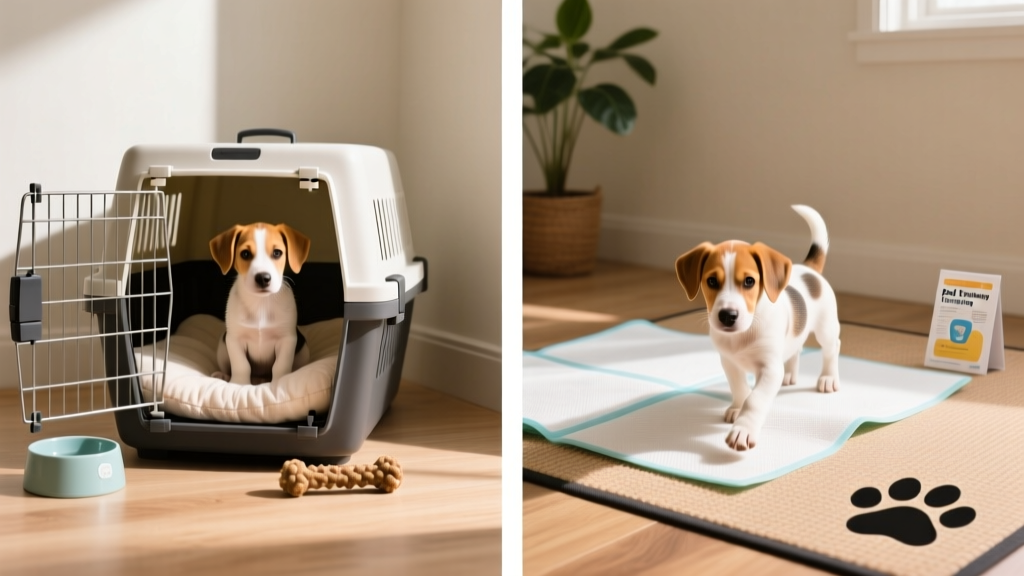
A crate is your puppy's safe den — not a punishment zone. Proper crate training supports potty training (dogs instinctively avoid soiling their sleeping area), prevents destructive chewing when unsupervised, and gives your puppy a retreat when overwhelmed.
Maximum Crate Time by Age
| Puppy Age | Max Daytime Crate Time | Max Nighttime Crate Time | Notes |
|---|---|---|---|
| 8–10 weeks | 30–60 minutes | 2–3 hours (between potty breaks) | Keep crate near your bed at night for reassurance |
| 10–14 weeks | 1–2 hours | 3–4 hours | Begin short absences from the room |
| 14–18 weeks | 2–3 hours | 5–6 hours | Crate can move to a permanent location |
| 4–6 months | 3–4 hours | 6–8 hours | Puppy should enter crate voluntarily for naps |
| 6–12 months | 4–5 hours | 7–8 hours | Begin transitioning to free-roam if reliable |
Crate training steps:
- Leave the crate door open. Toss high-value treats inside. Let puppy enter and exit freely.
- Feed meals inside the crate with the door open.
- Close the door for 30 seconds while puppy eats. Gradually increase to 2 minutes, then 5.
- Leave the room for 1 minute while puppy is crated with a stuffed Kong. Return before they finish.
- Extend absences by 2–5 minutes each session. If puppy whines, wait for a 3-second pause in vocalization before returning — this teaches quiet, not that whining opens the door.
First-Year Cost Breakdown: What to Budget
New puppy owners often underestimate the first-year financial commitment. Here's a realistic breakdown based on 2026 pricing across low, moderate, and high-cost scenarios:
| Category | Budget Range | Mid-Range | Premium |
|---|---|---|---|
| Puppy purchase/adoption | $200–$500 (rescue) | $1,500–$2,500 (responsible breeder) | $3,000–$5,000+ (show-line breeder) |
| Veterinary (vaccines, spay/neuter, wellness) | $400–$600 | $600–$1,000 | $1,000–$1,800 |
| Food (12 months) | $250–$400 | $400–$700 | $700–$1,200 |
| Supplies (crate, bed, leash, bowls, toys) | $150–$250 | $250–$500 | $500–$800 |
| Training (group classes or private) | $100–$200 (group) | $200–$500 | $500–$1,500 (private sessions) |
| Preventive meds (flea/tick, heartworm) | $150–$250 | $250–$400 | $400–$600 |
| Pet insurance (optional) | $300–$500/year | $500–$700/year | $700–$1,000/year |
| TOTAL FIRST YEAR | $1,550–$2,700 | $3,700–$6,300 | $6,800–$11,900 |
Hidden costs many owners miss: Emergency vet visits ($500–$3,000+ per incident), puppy-proofing supplies (baby gates, cord protectors, bitter apple spray), and professional grooming for breeds that require it ($40–$90 per session, every 4–8 weeks).
Frequently Asked Questions
When should I bring my puppy home?
The ideal window is 8–10 weeks for most breeds. Toy breeds (Chihuahuas, Yorkshire Terriers) sometimes benefit from staying with the breeder until 10–12 weeks due to their fragility and risk of hypoglycemia. Puppies should be fully weaned, eating solid food confidently, and have had initial socialization with littermates before going home. Never take a puppy before 7 weeks — early separation is linked to increased behavioral problems including fear, aggression, and difficulty learning.
How often should I feed my puppy at 10 weeks old?
At 10 weeks, feed 3–4 meals per day spaced roughly evenly across waking hours (e.g., 7 AM, 11 AM, 3 PM, 7 PM). Consistent meal timing also helps predict potty timing — most puppies need to eliminate within 15–30 minutes of eating. Keep meal duration to 15–20 minutes; pick up uneaten food to establish a routine and prevent grazing.
When will my puppy be fully potty trained?
Most puppies achieve reliable potty training between 4 and 6 months of age, meaning fewer than 1–2 accidents per month with a consistent schedule. Small breeds (under 15 lb / 7 kg) may take until 8 months due to smaller bladder capacity. "Fully" trained — meaning zero accidents — can take up to 12 months. Consistency is the single biggest predictor of success: puppies on a strict schedule (same feeding times, same potty spot, same cue word) train faster than those on variable routines.
What vaccines does my puppy need and when?
Core vaccines (recommended for all puppies) are DHPP at 6–8, 10–12, and 14–16 weeks, plus Rabies at 14–16 weeks (timing varies by state law). Non-core vaccines — Bordetella, Leptospirosis, Lyme, Canine Influenza — are given based on lifestyle and regional risk. Your veterinarian will design a protocol based on your puppy's exposure risk. Never skip the full DHPP series; parvovirus has a mortality rate of up to 91% in untreated puppies.
How do I stop puppy biting and nipping?
Use a three-step positive reinforcement approach: (1) Redirect to a chew toy every time teeth touch skin, (2) Withdraw attention for 10–15 seconds if biting continues, and (3) Reward gentle mouthing with praise and continued play. Most puppies show significant improvement within 2–4 weeks of consistent application. If biting is intense, causes injury, or doesn't improve after 4 weeks of consistent training, consult a certified professional dog trainer (CPDT-KA) or veterinary behaviorist.
When can my puppy go outside and meet other dogs?
Your puppy can explore your own yard (if no unknown dogs have access) immediately. Public outdoor areas and interactions with unknown dogs should wait until 1–2 weeks after the final DHPP vaccine at 14–16 weeks — typically around 17–18 weeks of age. However, socialization shouldn't wait: carry your puppy in a sling or stroller to experience the outside world, and arrange playdates with known-vaccinated, healthy dogs in private yards starting at 8 weeks. The AVSAB recommends early socialization even before full vaccination, provided exposure is managed and controlled.
Can puppies have strawberries with the leaves on?
Remove the green calyx (leaf cap) and stem before offering strawberry to your puppy. While not toxic, the leaves are fibrous, difficult to digest, and pose a choking risk for small puppies. Always wash strawberries thoroughly — conventionally grown strawberries frequently carry pesticide residue. Organic strawberries reduce this risk but should still be rinsed.
What fruits should puppies NEVER eat?
Grapes and raisins (toxic — can cause acute kidney failure), cherries (pits contain cyanide), avocados (persin is toxic to dogs), and any fruit with pits or seeds that haven't been removed (choking and intestinal blockage risk). If your puppy ingests grapes or raisins, contact the ASPCA Animal Poison Control at (888) 426-4435 immediately (24/7, consultation fee applies) or go to the nearest emergency veterinary clinic.
Aaron Whyte
All our authors care for dogs every day — read more of their work on the authors page.