Can Puppies Get Hiccups? A Complete Puppy Hiccups & Early Care Guide
Can puppies get hiccups? Yes — learn why hiccups happen, when to worry, and get a full puppy care timeline covering feeding, vaccines, potty training, and costs.

If you've ever watched your new puppy's tiny chest jerk rhythmically while they sit perfectly still, you've probably asked yourself: can puppies get hiccups? The answer is a definitive yes — and in most cases, puppy hiccups are completely normal, harmless, and even adorable. But as a new puppy parent, you deserve to know exactly what's happening inside that little body, when hiccups signal something worth a vet call, and how to manage the dozens of other milestones coming your way in the first year.
This guide answers the hiccups question thoroughly and then walks you through every critical stage of puppy development — from the moment you bring them home through adolescence — with specific numbers, schedules, and costs so you can plan with confidence.
Why Puppies Get Hiccups: The Science Behind the Spasms
Hiccups occur when the diaphragm — the dome-shaped muscle separating the chest cavity from the abdomen — contracts involuntarily. Each contraction causes the vocal cords (glottis) to snap shut, producing the characteristic "hic" sound. In puppies, this happens far more frequently than in adult dogs for several reasons:
- Immature diaphragm muscles: A puppy's diaphragm is still developing neuromuscular coordination. Spasms are common until roughly 4–6 months of age.
- Rapid eating and drinking: Puppies tend to gulp food and water, swallowing air (aerophagia) that distends the stomach and irritates the diaphragm.
- Excitement and stress: High arousal states — playing, greeting you at the door, meeting new people — can trigger rapid breathing patterns that set off hiccups.
- Temperature changes: Drinking very cold water or moving from a warm house to cold outdoor air can stimulate the vagus nerve, which controls the diaphragm.
When Puppy Hiccups Warrant a Vet Visit
While hiccups are almost always benign, certain patterns should prompt a call to your veterinarian:
| Symptom Pattern | Possible Cause | Action |
|---|---|---|
| Hiccups lasting over 2 hours continuously | Gastric irritation, respiratory issue | Call vet same day |
| Hiccups with labored breathing, coughing, or wheezing | Heartworm larvae migration, pneumonia, congenital defect | Emergency vet visit |
| Hiccups with vomiting, lethargy, or refusal to eat | GI obstruction, parasite load, infection | Call vet within 24 hours |
| Hiccups persisting past 8 months of age daily | Chronic acid reflux, hiatal hernia | Schedule non-urgent vet exam |
How to Help a Puppy With Hiccups
For routine, harmless hiccups, try these gentle interventions:
- Slow their eating: Switch to a slow-feeder bowl (like the Outward Hound Fun Feeder, ~$12–$18) or place a large, clean golf ball in their food dish to force slower eating.
- Offer room-temperature water: Ice-cold water can trigger spasms. Keep water at ambient temperature.
- Gentle chest rub: Lightly massage the puppy's chest in a circular motion to help relax the diaphragm.
- Redirect with calm activity: A short, gentle walk or a quiet training session can shift their breathing pattern.
- Avoid startling or exciting them during a hiccup episode — let it pass naturally.
Never try to make your puppy hold their breath, cover their nose, or use any human hiccup remedy involving breath-holding. Dogs cannot voluntarily control their breathing this way, and restricting airflow is dangerous.
When to Bring Your Puppy Home: The 8-Week Rule
The American Kennel Club and most veterinary behaviorists agree: puppies should not leave their litter before 8 weeks of age. Some smaller breeds (Chihuahuas, Yorkshire Terriers, Toy Poodles) benefit from staying with the breeder until 10–12 weeks because they mature more slowly and are more fragile during the transition.
During weeks 4–8 with their littermates and mother, puppies learn critical bite inhibition, canine social signals, and emotional regulation. Removing a puppy at 5 or 6 weeks — even if they appear weaned — deprives them of these lessons and significantly increases the risk of behavioral problems like fear-based aggression and separation anxiety later in life.
Puppy Development Milestones: Week-by-Week Expectations
Understanding what's developmentally normal at each stage helps you distinguish between typical puppy behavior and genuine concerns (like whether those hiccups are age-appropriate).
Weeks 4–8 (Still With Breeder)
- Eyes and ears fully functional; coordinated movement developing
- Deciduous (baby) teeth erupting — 28 teeth total by week 8
- Learning bite inhibition from littermates
- First deworming treatments (typically pyrantel pamoate at 2, 4, 6, and 8 weeks)
- First DHPP vaccine at 6–8 weeks (if still with breeder)
- Hiccups very common during this stage due to rapid growth and immature diaphragm
Weeks 8–12 (Home Transition & Bonding)
- Peak fear period — negative experiences can create lasting phobias
- Attention span: 2–5 minutes per training session
- Bladder capacity: roughly 1 hour per month of age (so ~2 hours max for an 8-week-old)
- Sleep needs: 18–20 hours per day
- Weight gain: approximately 5–10% of body weight per week depending on breed
Weeks 12–16 (Confidence Building)
- Second fear period may emerge around week 12
- Can begin short, structured leash walks (5 minutes per month of age, twice daily)
- Bladder control extending to 3–4 hours
- Pre-teething chewing intensifies — provide appropriate outlets
- Can start puppy kindergarten classes after second DHPP vaccine
Weeks 16–24 (Social Expansion & Teething)
- Permanent teeth begin erupting around 12–16 weeks; full set of 42 adult teeth by 6–7 months
- Increased independence and testing boundaries
- Spay/neuter typically scheduled around 6 months (discuss timing with your vet — large breeds may wait until 12–18 months per current AAHA guidelines)
- Hiccups usually decrease significantly by 5–6 months as diaphragm matures
Months 6–12 (Adolescence)
- Sexual maturity: intact females may experience first estrus cycle (6–12 months depending on breed size)
- "Teenage" regression in training — previously reliable commands may be ignored
- Energy levels peak; mental stimulation becomes critical
- Growth plates still open in medium and large breeds — avoid repetitive high-impact exercise
- Transition from puppy food to adult food typically at 10–12 months for small breeds, 18–24 months for giant breeds
Feeding Schedule: Exact Portions by Age and Weight
Puppies need more calories per pound of body weight than adult dogs because they're building bone, muscle, and organ tissue simultaneously. The exact amount depends on the food's caloric density, but here is a framework using a standard AAFCO-approved puppy kibble (approximately 400 kcal/cup, such as Purina Pro Plan Puppy or Royal Canin Puppy).
| Puppy Age | Meals Per Day | Small Breed (10–25 lb adult) | Medium Breed (25–50 lb adult) | Large Breed (50–90 lb adult) |
|---|---|---|---|---|
| 8–12 weeks | 4 meals | ¼–½ cup/day | ¾–1¼ cups/day | 1½–2½ cups/day |
| 3–6 months | 3 meals | ½–¾ cup/day | 1¼–2 cups/day | 2½–4 cups/day |
| 6–12 months | 2 meals | ¾–1 cup/day | 2–3 cups/day | 3½–5½ cups/day |
Important notes: These are starting points. Use your puppy's body condition score (BCS) as your guide — you should be able to feel ribs without pressing hard but not see them prominently. Large and giant breed puppies should eat a food specifically formulated for large-breed growth (look for "growth/large breed" on the AAFCO statement) to prevent rapid bone growth linked to hip dysplasia and osteochondrosis.
Always divide the daily total evenly across meals. A puppy eating 1½ cups/day across 3 meals gets ½ cup per meal. Measure with an actual measuring cup — "a handful" varies wildly and is the leading cause of puppy overfeeding.
Vaccination Schedule: Core and Lifestyle Vaccines
Your puppy receives maternal antibodies through colostrum (first milk) that protect them in early weeks but also interfere with vaccine effectiveness. This is why puppies need a series of boosters — each dose catches the immune system as maternal antibodies wane. According to the American Veterinary Medical Association, the core schedule looks like this:
| Age | Vaccine | What It Protects Against | Typical Cost |
|---|---|---|---|
| 6–8 weeks | DHPP (1st dose) | Distemper, Hepatitis (Adenovirus-2), Parainfluenza, Parvovirus | $25–$45 |
| 10–12 weeks | DHPP (2nd dose) + Bordetella (optional) | Same as above; Bordetella adds kennel cough protection | $30–$55 |
| 14–16 weeks | DHPP (3rd dose) + Rabies | Full DHPP immunity; Rabies (legally required in most US states) | $40–$75 |
| 12–16 weeks | Leptospirosis (2-dose series, 2–4 weeks apart) | Bacterial infection from contaminated water/wildlife urine (zoonotic) | $25–$40 per dose |
| 12+ weeks | Lyme disease (2-dose series, if in endemic area) | Borrelia burgdorferi from tick bites | $30–$45 per dose |
When can your puppy go outside and meet other dogs? The traditional advice was to wait until the full DHPP series was complete (around 16–18 weeks). However, the American Veterinary Society of Animal Behavior now recommends that puppies begin controlled socialization outings as early as 7–8 days after their first DHPP vaccine — typically around 9–10 weeks of age. The behavioral risk of under-socialization outweighs the disease risk when you manage exposure carefully (see the socialization checklist below).
Avoid dog parks, pet store floors, and areas with unknown vaccination histories until the full DHPP series is complete. Puppy kindergarten classes held at veterinary clinics (where all attendees show proof of vaccination) are ideal early socialization venues.
The Critical Socialization Window: Weeks 3–14
Puppies have a neurologically defined sensitive period for socialization that closes around 12–14 weeks of age. Experiences during this window — positive, neutral, or negative — disproportionately shape lifelong temperament. A puppy who never encounters a person wearing a hat before week 14 may develop a permanent fear of hats.
Your goal is not to overwhelm your puppy but to provide brief, positive exposures to as many novel stimuli as possible. Pair every new experience with high-value treats (small pieces of boiled chicken, cheese, or commercial training treats).
Socialization Exposure Checklist
People (aim for 100 different people by 14 weeks):
- ☐ Children of various ages (supervised, gentle interactions)
- ☐ People wearing hats, sunglasses, hoodies, uniforms
- ☐ People of different heights, body types, skin tones
- ☐ People using mobility aids (wheelchairs, crutches, canes)
- ☐ People with beards, facial hair, long hair
Surfaces and environments:
- ☐ Grass, gravel, sand, wet pavement, metal grates
- ☐ Car rides (start with 2-minute sessions, engine off, then short drives)
- ☐ Elevators, automatic doors, revolving doors (carry puppy initially)
- ☐ Stairs (small sets, non-slip surface)
Sounds (play recordings at low volume, pair with treats):
- ☐ Thunderstorms, fireworks, sirens, vacuum cleaners
- ☐ Doorbells, knocking, clapping, loud laughter
Handling exercises:
- ☐ Paw handling (prepares for nail trims)
- ☐ Ear inspection and gentle cleaning
- ☐ Mouth opening (prepares for dental care and medication)
- ☐ Collar grabs (pair with treat so collar grab = good things)
- ☐ Gentle restraint on side (prepares for vet exams)
Other animals:
- ☐ Fully vaccinated, friendly adult dogs
- ☐ Other puppies in structured class settings
- ☐ Cats (if household has cats — supervised, cat has escape route)
Rule of thumb: If your puppy shows fear (cowering, tail tucking, freezing, trying to flee), do not force the interaction. Increase distance, offer treats, and let them approach at their own pace. Flooding a puppy with a feared stimulus creates a stronger negative association, not habituation.
Potty Training Timeline and Troubleshooting
Realistic potty training expectations save enormous frustration. A puppy is not "stubborn" — their bladder and sphincter muscles are literally not developed enough for full control until 4–6 months of age.
Realistic Bladder Capacity by Age
- 8–10 weeks: 30–60 minutes between eliminations during the day
- 10–14 weeks: 1–2 hours
- 14–18 weeks: 2–3 hours
- 4–6 months: 3–4 hours
- 6–12 months: 4–6 hours (adult-level control developing)
Add 15–30 minutes after every meal, nap, and play session as mandatory potty trip times. Puppies have a gastrocolic reflex — eating stimulates the colon — so post-meal eliminations are physiologically driven, not optional.
When Will Your Puppy Be Fully Potty Trained?
Most puppies achieve reliable house training (fewer than 1–2 accidents per month) between 4–6 months of age with consistent management. Some small breeds (Chihuahuas, Dachshunds) may take 8–10 months due to smaller bladder capacity and a higher metabolic rate. Complete reliability — zero accidents for months — typically emerges by 8–12 months.
Troubleshooting common problems:
- Puppy pees inside right after coming back from outside: Your puppy was distracted outside and didn't actually eliminate. Use a consistent potty cue word ("go potty"), stand in one spot, and wait up to 5 minutes. Reward immediately with a treat and praise when they go. Do not give them free playtime outside until after they've eliminated.
- Puppy sneaks away to pee in hidden spots: Increase supervision. Use a 6-foot leash tethered to your belt indoors, or confine them to your room with a baby gate. Hidden elimination means they've learned that peeing in front of you leads to punishment — switch to positive reinforcement immediately.
- Regression after progress: Common at 4–5 months and again during adolescence (8–10 months). Go back to basics: more frequent potty trips, higher-value rewards, and zero punishment for accidents.
Crate Training Progression: Time Limits and Methods
A crate, introduced properly, becomes your puppy's den — a safe space where they relax and sleep. It also leverages a dog's natural instinct not to soil their sleeping area, making it one of the most effective potty training tools available.
Maximum crate time guidelines (during the day):
- 8–10 weeks: 30–60 minutes max while you're home and awake
- 10–14 weeks: 1–2 hours
- 14–16 weeks: 2–3 hours
- 4–6 months: 3–4 hours
At night, puppies can typically hold it 1–2 hours longer than daytime limits because metabolism slows during sleep. An 8-week-old puppy will likely need one overnight potty break; by 12–14 weeks, most puppies sleep 6–7 hours through the night.
Progressive introduction:
- Week 1: Leave crate door open. Feed all meals inside the crate. Toss treats in for the puppy to retrieve. Never force them inside.
- Week 2: Close the door during meals, then open immediately after. Begin closing for 1–2 minutes while you sit beside the crate.
- Week 3: Extend closed-door time to 5–10 minutes while you remain in the room. Begin briefly stepping out of sight (30 seconds, then return).
- Week 4+: Gradually increase duration and your distance. If the puppy whines, wait for a 3-second pause in vocalization before opening the door — this teaches that quiet, not noise, opens the crate.
Use only positive reinforcement methods. Never use the crate as punishment, and never respond to whining by yelling, banging on the crate, or using a shock collar. These methods create crate anxiety that can last a lifetime.
Teething Timeline: Relief Strategies and Safe Chews
Puppies have 28 deciduous teeth that erupt between 3–6 weeks of age. These begin falling out around 12–16 weeks, replaced by 42 permanent teeth. The teething process — when teeth loosen and adult teeth push through the gums — lasts roughly from 3 to 6 months of age and is uncomfortable, which drives the intense chewing behavior you'll observe.
Safe Chew Recommendations by Stage
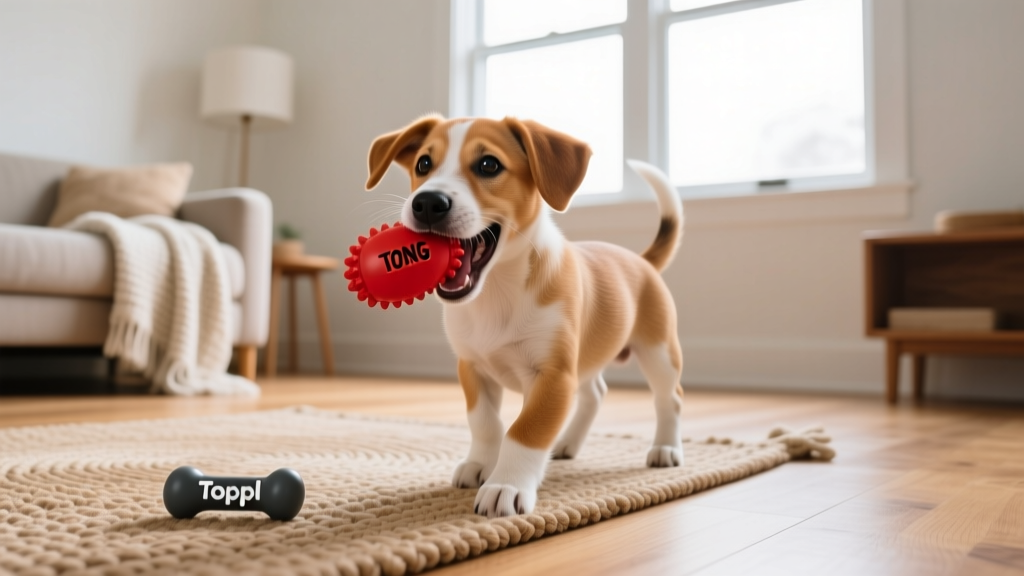
- 3–4 months: Frozen, wet washcloths (twist, soak in water, freeze — supervise use); rubber puppy teething toys like the KONG Puppy (size-appropriate, ~$8–$14); Nylabone Puppy Chew (soft formula)
- 4–5 months: Bully sticks (single-ingredient, sourced from US/Canada/EU; supervise to prevent choking on small ends); frozen carrots (large whole carrots, not baby carrots which are a choking risk)
- 5–6 months: Benebone puppy line; yak cheese chews (soak in water first to soften); continue KONG stuffed with frozen puppy-safe peanut butter (xylitol-free — always check the label)
Avoid: Rawhide (choking and GI blockage risk), cooked bones (splinter into sharp shards), antlers (too hard — can fracture puppy teeth), and any chew toy harder than your fingernail. If you can't indent the material with your thumbnail, it's too hard for developing teeth.
If you notice a retained deciduous tooth (a baby tooth that hasn't fallen out while the adult tooth is erupting alongside it — often called "shark teeth"), mention it at your next vet visit. Retained baby teeth, common in small breeds, may need surgical extraction to prevent misalignment of the permanent tooth.
Common Puppy Problems and Solutions
Puppy Biting and Nipping
Mouthing is normal puppy behavior — they explore the world with their mouths and are learning bite inhibition. It typically peaks between 8–16 weeks and diminishes as adult teeth come in and they learn appropriate chew targets.
How to stop puppy biting using positive reinforcement:
- When teeth touch skin, say "oops" or "ouch" in a calm, neutral tone (not a dramatic yelp, which can excite some puppies more).
- Immediately redirect to an appropriate chew toy.
- When they chew the toy, praise calmly and offer a treat.
- If biting persists after 2–3 redirections, the puppy is likely overstimulated or tired. End the play session with a calm crate rest or nap — puppies need 18–20 hours of sleep per day and overtired puppies bite more, not less.
Never hold the puppy's mouth shut, alpha-roll them, or use physical punishment. These methods increase fear and can escalate to defensive biting. The AVSAB's position statement on punishment clearly states that aversive techniques carry significant risks and are not recommended.
Whining in the Crate
Nighttime crate whining in the first 1–2 weeks home is normal — your puppy has been separated from their littermates for the first time. Strategies that help:
- Place a Snuggle Puppy (a plush toy with a simulated heartbeat, ~$30–$45) in the crate
- Keep the crate in your bedroom for the first 2–3 weeks so the puppy can hear and smell you
- Cover the crate with a breathable blanket to create a den-like feel
- Ensure the puppy has eliminated right before crating
- Distinguish between "I'm lonely" whining and "I need to pee" whining — the latter is more urgent, persistent, and often accompanied by scratching at the crate door
Destructive Chewing
Puppies chew because it relieves teething discomfort, provides mental stimulation, and is a natural canine behavior. Management is more effective than correction:
- Puppy-proof rooms by removing shoes, cords, remotes, and small objects
- Provide 5–8 appropriate chew toys of varying textures, rotated weekly to maintain novelty
- Use bitter apple spray (e.g., Grannick's Bitter Apple, ~$8–$12) on furniture legs and baseboards as a deterrent
- Ensure adequate physical exercise and mental enrichment (food puzzles, snuffle mats, training sessions)
First-Year Cost Breakdown
Budgeting realistically prevents financial stress and ensures your puppy gets the care they need. Here are estimated first-year costs for a typical puppy in the US (2026 pricing):
| Category | Low Estimate | High Estimate | Notes |
|---|---|---|---|
| Puppy purchase/adoption | $200 (rescue) | $3,500+ (breeder) | Varies enormously by breed and source |
| Veterinary (vaccines, exams, spay/neuter, heartworm test, fecal exams) | $500 | $1,200 | Higher if emergency visits or illness occur |
| Food (quality puppy kibble) | $250 | $600 | Large breeds cost significantly more to feed |
| Preventive medications (heartworm, flea/tick) | $200 | $450 | Products like Simparica Trio, Interceptor Plus |
| Supplies (crate, bed, leash, collar, bowls, toys, gates) | $200 | $500 | One-time purchases; replace toys regularly |
| Training (puppy kindergarten, group classes) | $150 | $500 | Private sessions cost $80–$150/hour |
| Pet insurance (optional but recommended) | $350 | $700 | Enroll at 8 weeks for lowest premiums and no pre-existing condition exclusions |
| Total first year | $1,850 | $7,450+ | Excluding purchase price; emergencies can add $1,000–$5,000+ |
Frequently Asked Questions
Can puppies get hiccups while sleeping?
Yes. Puppies frequently get hiccups during sleep, particularly during REM (dreaming) phases when breathing patterns change. Sleep hiccups are harmless and usually resolve within minutes without waking the puppy. You don't need to wake them — let them sleep through it.
How often should I feed my puppy at 10 weeks old?
Four meals per day, spaced roughly 4–5 hours apart during waking hours (e.g., 7 AM, 12 PM, 5 PM, 9 PM). Remove uneaten food after 15–20 minutes to establish a feeding routine, which also makes potty training more predictable.
Is it normal for my puppy to have hiccups every day?
Daily hiccups are very common in puppies under 4 months old. Multiple short episodes per day (lasting 2–10 minutes each) are within the normal range. If episodes are lasting longer than 30 minutes or occurring alongside other symptoms (coughing, vomiting, lethargy), consult your veterinarian.
What vaccines does my puppy need and when?
The core vaccine series is DHPP at 6–8 weeks, 10–12 weeks, and 14–16 weeks, plus Rabies at 14–16 weeks. Lifestyle vaccines (Bordetella, Leptospirosis, Lyme) depend on your geographic area and your dog's expected activities. Your veterinarian will tailor the protocol to your puppy's risk profile.
How do I stop my puppy from biting my hands?
Redirect to an appropriate chew toy every time teeth touch skin. If the puppy persists, calmly end the interaction by standing up and leaving for 30 seconds (a "time-out" from attention, not a punitive isolation). Consistency from every family member is essential — mixed messages (sometimes allowing mouthing, sometimes scolding) confuse puppies and prolong the behavior. Most puppies outgrow intense mouthing by 5–6 months.
When can my puppy meet other dogs?
Controlled exposure to fully vaccinated, known-healthy dogs can begin 7–10 days after the first DHPP vaccine (around 9–10 weeks of age). Avoid high-risk areas like dog parks, pet stores, and boarding facilities until the full DHPP series is complete (after 16 weeks). Structured puppy kindergarten classes at veterinary clinics are the safest early socialization option.
My puppy has hiccups and is also coughing — should I be worried?
Hiccups combined with coughing, gagging, or wheezing warrant a veterinary evaluation. In puppies, this combination could indicate respiratory infection (kennel cough, pneumonia), congenital heart defect, or tracheal collapse (common in toy breeds). Contact your vet promptly — this is not a normal hiccup presentation.
This article provides general educational information and is not a substitute for professional veterinary care. Always consult your veterinarian for diagnosis and treatment decisions specific to your puppy's health.
Robin Maitland
All our authors care for dogs every day — read more of their work on the authors page.