Can Puppies Get Concussions? A Puppy Head Safety & Care Guide
Can puppies get concussions? Learn the signs, risks, prevention strategies, and complete puppy care milestones from weeks 4 through 12 months.

Can Puppies Get Concussions? What Every New Puppy Owner Needs to Know
Yes, puppies can get concussions. Their skulls are thinner and their brains are still developing, making them more vulnerable to traumatic brain injury (TBI) than adult dogs. A fall from a couch, a collision with a door frame, or an accidental step can all deliver enough force to cause a concussion in a puppy under six months of age.
According to the Merck Veterinary Manual, traumatic brain injuries in dogs can range from mild concussions to severe intracranial hemorrhage. Puppies, due to their small size, high energy, and still-developing coordination, face a uniquely elevated risk during their first year.
Recognizing Concussion Symptoms in Puppies
| Symptom Severity | Signs to Watch For | Timeline After Injury | Action Required |
|---|---|---|---|
| Mild | Temporary disorientation, brief lethargy (10-30 min), slight loss of appetite | Within 1-2 hours | Monitor closely for 24 hours; call vet if symptoms persist beyond 4 hours |
| Moderate | Vomiting (1-2 episodes), stumbling, dilated pupils, whining when head is touched | Within 30-60 minutes | Contact your veterinarian within 1 hour |
| Severe | Loss of consciousness, seizures, unequal pupils, bleeding from nose/ears, paralysis | Immediate to 15 minutes | Emergency veterinary care — call ahead while transporting |
Always consult your veterinarian after any head impact, even if your puppy seems fine. Delayed-onset symptoms can appear 12-24 hours post-injury, and a veterinary neurological exam can catch issues you might miss at home.
Age-Specific Puppy Milestones: Weeks 4 Through 12 Months
Understanding what's developmentally normal at each stage helps you protect your puppy from injury while meeting their evolving needs. Here's a concrete milestone timeline:
Weeks 4-8: Neonatal Transition to Early Socialization
- Physical: Eyes fully open (by week 4), deciduous teeth erupting, weight gain of 5-10% body weight daily
- Neurological: Rapid cerebellar development — puppies are wobbly and prone to falls. This is a high-risk concussion window.
- Behavioral: Learning bite inhibition from littermates, first exposure to solid food (gruel consistency at week 4, softened kibble by week 6)
- Head safety note: Keep puppies on floor-level surfaces only. A fall from even 18 inches can cause injury at this weight (typically 1-3 lb / 0.5-1.4 kg depending on breed)
Weeks 8-12: The Critical Socialization Window Opens
- Physical: Coordination improving but still clumsy. Growth rate peaks — expect 2-4 lb / 0.9-1.8 kg weight gain per week in medium breeds
- Neurological: Fear imprinting period begins around week 8. Negative experiences (including painful injuries) can create lasting phobias
- Behavioral: Mouthing and nipping peak, curiosity drives exploration of elevated surfaces (couches, beds, stairs)
- Head safety note: Block stair access with baby gates. Carry your puppy up/down furniture rather than allowing jumps. Couch falls are the #1 cause of puppy head injuries in the home
Weeks 12-16: Vaccination Completion and Confidence Building
- Physical: Baby teeth begin loosening (incisors first). Adult body proportions becoming visible
- Neurological: Improved spatial awareness — fewer collisions with objects, but zoomies episodes increase fall risk
- Behavioral: Second fear imprinting period possible around week 12. Socialization outings should be positive and controlled
- Head safety note: Rough play with larger dogs becomes a concussion risk. Supervise all inter-dog play and intervene if your puppy is being knocked over repeatedly
Weeks 16-24 (4-6 Months): Teething and Adolescence Begins
- Physical: Adult teeth fully erupting by month 6. Growth plates still open — high-impact activities (agility jumps, frisbee) should be avoided
- Neurological: Improved proprioception but hormonal changes (if intact) can cause distracted, impulsive behavior
- Behavioral: Chewing intensifies due to teething discomfort. Testing boundaries with selective hearing on recall
- Head safety note: Chewing on hard objects (antlers, hooves, ice cubes) can cause tooth fractures that radiate pain to the jaw and skull. Stick to veterinary-approved chew toys
Months 6-12: Adolescence and Maturation
- Physical: Approaching adult height (80-90% by month 9). Growth plates closing between 10-18 months depending on breed size
- Neurological: Prefrontal cortex still developing — impulse control remains limited. Spay/neuter typically performed in this window
- Behavioral: Regression in training is normal. Increased independence and environmental distraction
- Head safety note: Outdoor activities increase (hiking, dog parks). Head collisions with other dogs during play remain a risk, especially for brachycephalic breeds whose skull structure offers less brain cushioning
Feeding Schedule: Exact Portions by Age and Weight
Puppies require frequent, measured meals to fuel rapid growth. Overfeeding can accelerate growth rates beyond what developing bones and joints can handle, while underfeeding compromises brain development and immune function.
| Age Range | Meals Per Day | Daily Portion (Small Breeds 5-20 lb) | Daily Portion (Medium Breeds 20-50 lb) | Daily Portion (Large Breeds 50-100 lb) |
|---|---|---|---|---|
| 8-12 weeks | 4 meals | ½ – 1 cup/day | 1 – 2 cups/day | 2 – 3½ cups/day |
| 12-16 weeks | 3-4 meals | ¾ – 1¼ cups/day | 1½ – 2½ cups/day | 3 – 5 cups/day |
| 4-6 months | 3 meals | 1 – 1½ cups/day | 2 – 3½ cups/day | 4 – 6 cups/day |
| 6-9 months | 2-3 meals | 1 – 1½ cups/day | 2½ – 4 cups/day | 4 – 7 cups/day |
| 9-12 months | 2 meals | ¾ – 1¼ cups/day (transitioning to adult food) | 2 – 3½ cups/day | 3½ – 6 cups/day |
Key feeding guidelines: Use a food labeled as AAFCO-complete for growth or all life stages. Large breed puppies (expected adult weight over 70 lb / 32 kg) should eat a formula specifically labeled for large breed growth to control calcium and phosphorus ratios. Measure food with a standard 8 oz measuring cup — estimating by eye leads to 20-30% overfeeding in most households.
If your puppy vomits after a head injury, do not feed them for 4-6 hours and contact your veterinarian. Post-concussion nausea is common and food in the stomach increases aspiration risk if seizures occur.
Vaccination Schedule: Weeks 6 Through 16
The American Veterinary Medical Association (AVMA) recommends a core vaccination series timed to coincide with the gradual decline of maternal antibodies. Here is the standard protocol:
| Age | Vaccine Name | What It Protects Against | Typical Cost Per Visit |
|---|---|---|---|
| 6-8 weeks | DHPP (1st dose) | Distemper, Hepatitis (Adenovirus-2), Parainfluenza, Parvovirus | $75 – $100 |
| 10-12 weeks | DHPP (2nd dose) + Bordetella (optional) | Same as above + Kennel Cough | $85 – $120 |
| 14-16 weeks | DHPP (3rd dose) + Rabies | Same as above + Rabies (legally required in most US states) | $90 – $150 |
| 12-16 months | DHPP booster + Rabies booster | Long-term immunity establishment | $80 – $130 |
Non-core vaccines your veterinarian may recommend based on lifestyle: Leptospirosis (outdoor/water exposure), Lyme disease (tick-endemic regions), and Canine Influenza H3N2/H3N8 (dog parks, boarding facilities). Discuss your puppy's specific risk factors at the first wellness visit.
Socialization Window (Weeks 3-14): Your Exposure Checklist
The primary socialization period closes between 12-14 weeks of age, according to the American Kennel Club (AKC). What your puppy experiences — or doesn't experience — during this window shapes their lifelong behavioral responses. Critically, head injuries during this period can create fear associations that compound socialization deficits.
Positive Exposure Checklist
- Surfaces: Grass, gravel, tile, carpet, metal grates, wet pavement (carry puppy if surface is hot — over 125°F / 52°C can burn paw pads)
- Sounds: Vacuum cleaner, doorbell, thunderstorm recordings (start at low volume, 40-50 dB), children playing, traffic noise
- People: Adults of varying heights, children (supervised), people wearing hats/sunglasses/hoodies, people using mobility aids
- Animals: Fully vaccinated adult dogs (known health status), cats (if household has cats), livestock (if rural setting)
- Handling: Paw touching, ear examination, mouth opening, gentle restraint, being lifted and carried (critical for vet visits)
- Environments: Car rides (start with 5-minute trips), pet store visits (carry puppy until fully vaccinated), outdoor café patios
- Objects: Umbrellas opening, plastic bags rustling, bicycles passing, skateboards
Head safety during socialization: Avoid dog parks until 1 week after the final DHPP dose (typically week 17). Unvaccinated and unknown dogs pose both disease and injury risks. Arrange controlled playdates with known, gentle adult dogs instead. One rough collision during a fear imprinting period can set back weeks of socialization progress.
Potty Training Timeline: Realistic Expectations
Potty training is a marathon, not a sprint. A puppy's bladder capacity develops at a predictable rate: roughly one hour of holding capacity per month of age, plus one. So a 3-month-old puppy can typically hold urine for about 4 hours maximum.
Potty Training Log Template
Track these data points daily for the first 8 weeks home:
- Time of outing (every 1-2 hours for puppies under 12 weeks)
- Result: Urinated (Y/N), Defecated (Y/N)
- Location: Designated outdoor spot or accident location
- Trigger noted: After eating, after waking, after play, spontaneous
- Reward given: Treat type and timing (within 3 seconds of elimination for maximum association)
| Puppy Age | Expected Accident Frequency | Outing Frequency Needed | Training Milestone |
|---|---|---|---|
| 8-10 weeks | 2-4 accidents/day is normal | Every 1-2 hours + after every meal, nap, play session | Learning to associate outdoor surface with elimination |
| 10-14 weeks | 1-2 accidents/day | Every 2-3 hours | Beginning to signal (sniffing, circling, going to door) |
| 14-20 weeks | 0-1 accidents/day | Every 3-4 hours | Reliable signaling; mostly accident-free with supervision |
| 5-6 months | Rare accidents (1-2 per week) | Every 4-5 hours | Can hold overnight (6-8 hours) in most cases |
| 6-12 months | Occasional marking behavior (especially intact males) | Every 4-6 hours | Fully reliable with established routine |
Troubleshooting common issues:
- Submissive urination: Common in puppies under 6 months. Not a housetraining failure — it's an involuntary response. Avoid direct eye contact and crouch sideways when greeting.
- Regression at 4-5 months: Often coincides with teething discomfort or a developmental leap. Return to more frequent outings for 1-2 weeks.
- Post-injury accidents: If a recently potty-trained puppy begins having accidents after a head injury, this can indicate neurological disruption. Report this to your veterinarian promptly.
Crate Training Progression: Time Limits by Age
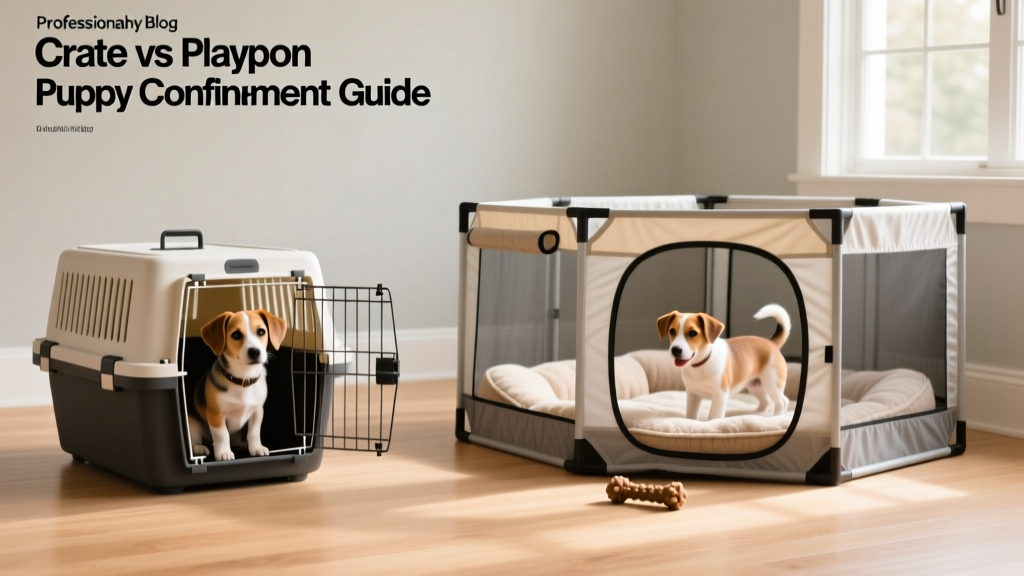
A crate is your puppy's safest space when unsupervised — and it also protects them from environmental hazards that could lead to head injuries (falling off furniture, chewing electrical cords, getting trapped behind appliances).
| Puppy Age | Maximum Crate Time (Daytime) | Maximum Crate Time (Overnight) | Crate Size Guideline |
|---|---|---|---|
| 8-10 weeks | 1-2 hours | 3-4 hours (set alarm for potty break) | Just large enough to stand, turn, lie down — use divider panel in larger crate |
| 10-14 weeks | 2-3 hours | 4-5 hours | Same — adjust divider as puppy grows |
| 14-20 weeks | 3-4 hours | 6-7 hours | Expand divider to allow stretching room |
| 5-6 months | 4-5 hours | 7-8 hours | Full crate size appropriate for adult dimensions |
| 6-12 months | 5-6 hours maximum | 8-9 hours | Adult crate size; consider removing crate if dog is fully house-trained and non-destructive |
Head safety in the crate: Remove collars (especially martingale and choke-style) before crating to prevent snagging. Use a flat, washable pad rather than elevated cot beds that a puppy could flip and hit their head on. If your puppy panics and throws themselves against crate walls, consult a certified positive-reinforcement trainer — forcing a panicked puppy to "cry it out" can escalate to self-injury.
Teething Timeline (3-6 Months): Relief Strategies and Safe Chews
Puppy deciduous teeth begin falling out around 12-16 weeks, with all 42 adult teeth typically erupted by 6 months. This process causes significant gum inflammation and drives the intense chewing behavior that leads many puppies to gnaw on inappropriate — and potentially dangerous — objects.
Safe Chew Recommendations by Age
- 8-12 weeks: Soft rubber toys (Kong Classic, size XS or S), frozen washcloth twisted into a rope, Nylabone Puppy Chew (soft formula)
- 12-16 weeks: Kong Classic stuffed with soaked kibble and frozen, Benebone Puppy (flexible formula), carrot sticks (supervised)
- 4-6 months: Kong Classic (medium, frozen with peanut butter — xylitol-free only), West Paw Zogoflex Hurley, Bullymaxx Junior
Chews to avoid entirely: Raw bones (splintering risk, tooth fractures), antlers and hooves (hardness exceeds tooth enamel, causing slab fractures), cooked bones of any kind, ice cubes (tooth cracking risk for small breeds), and any toy harder than your fingernail. The AVMA recommends the "fingernail test" — if you can't indent the chew toy with your thumbnail, it's too hard for puppy teeth.
Head safety during teething: Puppies with oral pain may become head-shy (flinching when touched near the face) and may snap if you reach toward their mouth. This is pain-driven, not aggression. Offer chews on the floor rather than holding them — a puppy lunging for a held chew can miss and hit their jaw on your hand or a nearby surface.
Common Puppy Problems and Solutions
Puppy Biting and Nipping
Mouthing peaks between 8-16 weeks and gradually decreases with consistent training. This is normal developmental behavior, not aggression.
- Redirect: When teeth touch skin, immediately offer a chew toy. Reward chewing on the toy with calm praise.
- Time-out protocol: If nipping continues after two redirects, calmly place puppy in a pen or crate for 30-60 seconds (not as punishment — as a reset). Release and re-engage with a toy.
- Teach "leave it": Start with treats on the floor under your hand. Reward for backing away. Progress to open palm, then to items on the ground.
- Never do: Hold the mouth shut, alpha roll, tap the nose, or use bitter sprays on your hands. These methods increase fear and can trigger defensive biting.
Excessive Whining and Crying
- Night whining (first 1-2 weeks home): Place crate near your bed. A Snuggle Puppy (with heartbeat simulator) or a warm water bottle wrapped in a towel can ease the transition. Expect 3-7 nights of adjustment.
- Demand whining: Ignore completely (no eye contact, no verbal response). Reward the first 3 seconds of silence with attention. This typically resolves within 5-10 days of consistency.
- Pain-related whining: If whining is accompanied by head-tilting, ear-scratching, or reluctance to be touched on the head/neck, consider ear infection, dental pain, or post-injury discomfort. Schedule a veterinary exam.
Destructive Chewing
- Management first: Puppy-proof one room at a time. Use exercise pens to limit access. Store shoes, cords, and remote controls in closed containers.
- Provide alternatives: Rotate 4-6 appropriate chew toys every 2-3 days to maintain novelty. Frozen Kongs provide 20-30 minutes of engagement.
- Exercise adequacy: A puppy with pent-up energy chews more. Follow the 5-minutes-per-month-of-age exercise guideline (e.g., a 4-month-old puppy gets ~20 minutes of structured activity twice daily).
First-Year Cost Breakdown
Budgeting accurately prevents surprises. These ranges reflect 2026 US averages for a medium-breed puppy (20-50 lb adult weight):
| Category | Low Estimate | Typical Range | High Estimate | Notes |
|---|---|---|---|---|
| Veterinary (wellness visits, vaccines, spay/neuter) | $600 | $800 – $1,500 | $2,500+ | Includes 3-4 puppy visits, fecal tests, heartworm prevention start. Emergency visits add $300-$1,500 each. |
| Food (quality kibble, AAFCO growth formula) | $300 | $400 – $700 | $1,000+ | Based on $1.50-$3.50/lb for mid-range to premium brands. Raw diets run $3-$7/day. |
| Supplies (crate, bed, leash, harness, bowls, gates, toys) | $200 | $300 – $500 | $800+ | One-time purchases. Replace toys every 2-3 months ($15-$30/cycle). |
| Training (group classes, private sessions) | $100 | $200 – $500 | $1,200+ | Group puppy class: $150-$300 for 6-week session. Private trainer: $80-$150/hour. |
| Preventive medications (heartworm, flea/tick) | $150 | $200 – $400 | $600+ | Year-round prevention recommended in most US regions. |
| Pet insurance (optional but recommended) | $350 | $400 – $700 | $1,000+ | Enroll before 6 months to avoid pre-existing condition exclusions. Typical: $35-$60/month for accident+illness. |
| Total First Year | $1,700 | $2,300 – $4,300 | $6,100+ | Excludes purchase/adoption fee ($0-$3,000+ depending on source). |
Head injury cost context: An emergency veterinary visit for a suspected concussion typically involves a neurological exam ($80-$150), possible skull radiographs ($200-$400), and in severe cases, a CT scan ($1,200-$2,500) or MRI ($2,000-$4,000). Hospitalization for monitoring runs $150-$300 per night. Pet insurance with accident coverage typically reimburses 70-90% of these costs after deductible.
Frequently Asked Questions
When should I bring my puppy home?
The optimal age is 8-10 weeks. Puppies separated before 8 weeks miss critical littermate socialization (bite inhibition, canine communication). Puppies from reputable breeders are typically available at 8-12 weeks. Some breeders of toy breeds retain puppies until 10-12 weeks due to their fragility and hypoglycemia risk.
How often should I feed my puppy?
At 8-12 weeks: 4 meals per day. At 12-16 weeks: 3-4 meals per day. At 4-6 months: 3 meals per day. At 6-12 months: 2 meals per day. Never free-feed (leave food out all day) — this makes potty training unpredictable and increases obesity risk. See the feeding table above for exact portions by weight class.
When will my puppy be fully potty trained?
Most puppies achieve reliable housetraining between 4-6 months of age with consistent management. Small breeds may take 6-8 months due to smaller bladder capacity. "Fully trained" means fewer than 1 accident per month under normal conditions. Setbacks are normal during developmental transitions and environmental changes.
What vaccines does my puppy need and when?
Core vaccines: DHPP at 6-8 weeks, 10-12 weeks, and 14-16 weeks, plus Rabies at 14-16 weeks. Non-core vaccines (Bordetella, Leptospirosis, Lyme, Canine Influenza) depend on your puppy's lifestyle and regional disease prevalence. Your veterinarian will tailor the protocol. See the vaccination table above for details and costs.
How do I stop puppy biting and nipping?
Redirect to appropriate chew toys every time teeth touch skin. Use 30-60 second calm time-outs if nipping persists after two redirects. Ensure adequate exercise (5 minutes per month of age, twice daily). Provide frozen chew toys during teething (3-6 months). Expect gradual improvement over 4-8 weeks of consistent training. If biting breaks skin or is accompanied by growling and stiff body language, consult a certified force-free trainer or veterinary behaviorist.
When can my puppy go outside and meet other dogs?
Your puppy can explore your own yard immediately (assuming no parvo-positive dogs have been there in the past year). Public areas (parks, sidewalks, pet stores) should be limited until 1 week after the final DHPP dose at 14-16 weeks — typically around 17 weeks of age. Controlled playdates with fully vaccinated, known-healthy adult dogs are acceptable from 8 weeks onward. Avoid dog parks until at least 17 weeks and ideally until 6 months, when your puppy has better physical coordination and social skills to navigate group play safely.
Can puppies get concussions from normal play?
Normal, supervised play with similarly-sized puppies rarely causes concussions. The risk increases significantly with: falls from heights over 12 inches (for puppies under 12 weeks), collisions with larger dogs (>2x the puppy's weight), impacts with hard surfaces (concrete, tile, hardwood), and being stepped on by humans. Brachycephalic breeds (French Bulldogs, Pugs, Boston Terriers) have less cranial cushioning and may be at slightly higher risk. Always supervise play and separate puppies who are being repeatedly knocked over or body-slammed.
Anouk Beaumont
All our authors care for dogs every day — read more of their work on the authors page.