Best Calming Aid for Puppy Anxiety: A Complete First-Year Guide
Discover the best calming aid for puppy anxiety alongside age-specific milestones, feeding schedules, vaccination timelines, and potty training expectations.

Bringing a new puppy home is thrilling — until the crying starts at 2 a.m. and your pup can’t settle for more than five minutes. If you’ve been searching for a calming aid for puppy stress, you’re not alone. Puppy anxiety is one of the most common reasons first-time owners call their vet in the first month. But calming aids work best when paired with a solid understanding of your puppy’s developmental stage. A supplement that helps a 16-week-old may be inappropriate for an 8-week-old, and behavioral interventions change dramatically as your dog matures.
This guide covers calming strategies alongside the critical first-year milestones every puppy parent needs to know — feeding, vaccinations, potty training, socialization, and teething — so you can address anxiety at its root rather than just masking symptoms.
Understanding Puppy Anxiety: When Calming Aids Help Most
Puppy anxiety typically falls into three categories: separation distress (crying when left alone), environmental fear (reacting to noises, surfaces, new people), and overstimulation (biting, zoomies, inability to settle). Each peaks at different developmental stages and responds to different interventions.
Calming aids for puppies include pheromone diffusers (like Adaptil, which mimics maternal dog-appeasing pheromones), L-theanine supplements (such as Virbac Anxitane), melatonin (typically 1–3 mg depending on weight, per VCA Animal Hospitals), pressure wraps (Thundershirt), and white noise machines. Prescription options like trazodone or gabapentin exist but require veterinary oversight and are generally reserved for severe cases in puppies over 12 weeks.
Age-Specific Milestones: What to Expect Each Month
Puppy development follows a predictable sequence. Understanding these stages helps you distinguish normal behavior from genuine anxiety that might warrant a calming aid.
Weeks 4–8: Neonatal to Transitional
Puppies are still with their littermates and breeder during this window. They learn bite inhibition from siblings and begin solid food transition. Your role: If you’re evaluating breeders, ask about early neurological stimulation (ENS) protocols, which research from the U.S. Military’s Bio Sensor Program showed improves stress resilience later in life. Do not bring a puppy home before 8 weeks unless medically necessary.
Weeks 8–12: Primary Socialization Window
This is the most critical fear-imprinting period. Puppies are highly receptive to new experiences but also vulnerable to lasting negative associations. Expect crying in the crate at night (normal for 3–5 nights), mouthing/biting everything, and short attention spans of 2–5 minutes. Calming aid recommendation: Adaptil Junior collar or diffuser is safe from 8 weeks. Place near the crate. Avoid oral supplements without vet approval at this age.
Weeks 12–16: Fear Impact Period
Around 12–14 weeks, puppies enter a secondary fear period where single traumatic events can create lasting phobias. You may notice your previously confident pup suddenly spooking at garbage cans or strangers. Calming aid recommendation: L-theanine chews (Virbac Anxitane or Solliquin) can be introduced with vet guidance. Typical puppy dose: 50–100 mg for dogs under 22 lb (10 kg). Use 30–60 minutes before known stressors (vet visits, car rides).
Weeks 16–24: Juvenile Exploration
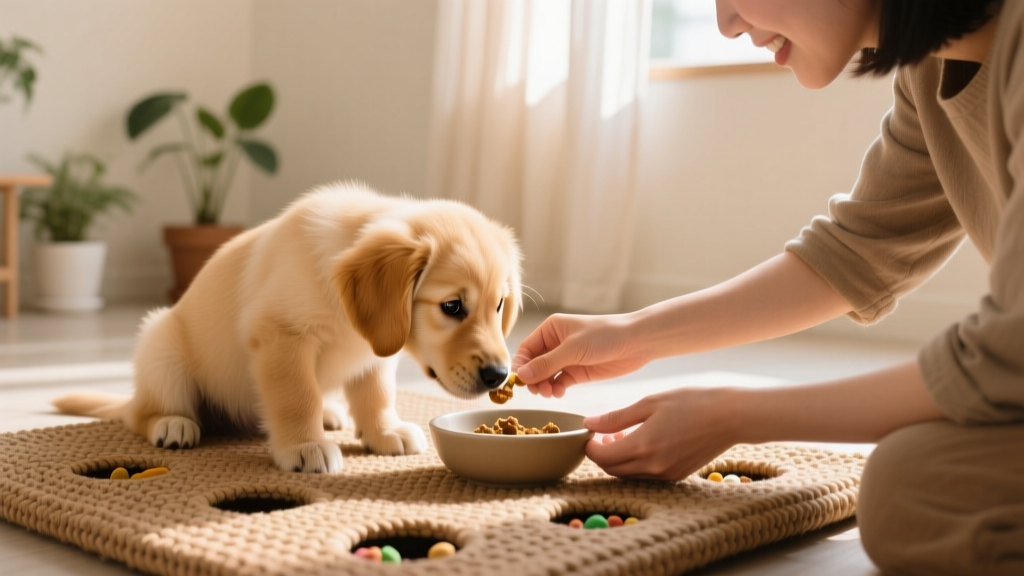
Energy levels surge, independence grows, and “selective hearing” emerges. Puppies test boundaries and may regress in potty training. Teething begins around 16 weeks. Calming aid recommendation: Food puzzle toys (Kong Classic, Outward Hound Nina Ottosson puzzles) provide mental stimulation that naturally reduces anxious energy. Snuffle mats for meal feeding burn mental energy equivalent to a 30-minute walk.
6–12 Months: Adolescent Challenges
Sexual maturity arrives (if not yet spayed/neutered), fear periods may recur around 6–10 months, and some breeds show early guarding behaviors. Separation anxiety often first appears during this stage. Calming aid recommendation: Calming supplements like Zesty Paws Calming Bites or VetriScience Composure can be used daily for adolescents with chronic anxiety. For severe cases, ask your vet about a behavioral referral and whether short-term fluoxetine (Prozac) is appropriate.
Feeding Schedule: Exact Portions by Age and Weight
Nutrition directly impacts behavior. Puppies fed irregularly or with blood sugar crashes are more prone to anxiety, irritability, and excessive biting. Use this schedule as a baseline — adjust based on your specific food’s caloric density and your puppy’s body condition score (BCS).
| Age | Meals Per Day | Portion Guide (Dry Kibble, ~350 kcal/cup) | Notes |
|---|---|---|---|
| 8–12 weeks | 4 meals | Small breeds (under 15 lb expected): ¼–½ cup/day total Medium breeds (15–50 lb): ½–¾ cup/day Large breeds (50+ lb): ¾–1¼ cups/day |
Soften kibble with warm water if teeth are still emerging |
| 12–16 weeks | 3 meals | Small: ¼–½ cup/day Medium: ¾–1 cup/day Large: 1–1½ cups/day |
Transition to dry kibble fully; monitor stool consistency |
| 16–24 weeks | 3 meals | Small: ½–¾ cup/day Medium: 1–1½ cups/day Large: 1½–2½ cups/day |
Switch to large-breed puppy formula if expected adult weight exceeds 55 lb |
| 6–12 months | 2 meals | Small: ½–1 cup/day Medium: 1½–2½ cups/day Large: 2–4 cups/day |
Small breeds transition to adult food at 9–12 months; large breeds at 12–18 months |
Look for an AAFCO statement on your food label confirming “complete and balanced for growth.” Feed at consistent times daily — this predictability alone reduces anxiety in many puppies. Remove uneaten food after 15–20 minutes to establish routine.
Vaccination Schedule: Protecting Your Puppy Week by Week
Your puppy’s immune system is developing, and vaccine timing is precise. Missing a window or giving vaccines too close together can reduce efficacy. The following schedule aligns with the AVMA and AAHA canine vaccination guidelines.
| Age | Vaccines Administered | What It Protects Against | Estimated Cost (Per Visit) |
|---|---|---|---|
| 6–8 weeks | DHPP (1st dose) Bordetella (optional, if going to group classes) |
Distemper, Hepatitis (Adenovirus), Parainfluenza, Parvovirus | $75–$120 |
| 10–12 weeks | DHPP (2nd dose) Leptospirosis (1st dose, recommended for most dogs) Lyme (1st dose, if in tick-endemic area) |
Booster for core diseases; Leptospirosis covers bacterial infection from wildlife/water | $85–$140 |
| 14–16 weeks | DHPP (3rd/final dose) Leptospirosis (2nd dose) Lyme (2nd dose, if applicable) Rabies (required by law, timing varies by state) |
Final core booster completes initial immunity; Rabies legally required | $90–$160 |
| 12–16 months | DHPP booster Rabies booster (1-year or 3-year depending on product) All lifestyle vaccines boosted annually |
Maintenance of immunity | $100–$200 |
Calming tip for vet visits: Bring high-value treats (boiled chicken, cheese), practice handling exercises at home (touching paws, ears, mouth), and consider an Adaptil spray on a bandana 30 minutes before the appointment. For puppies with severe vet anxiety, ask your vet about a single pre-visit dose of trazodone (typically 5–10 mg/kg).
Socialization Window: The Critical Weeks 3–14
The American Veterinary Society of Animal Behavior (AVSAB) states that the primary socialization period — roughly weeks 3 through 14 — is the single most important developmental window in a dog’s life. Puppies that don’t receive adequate positive exposure during this period are significantly more likely to develop fear-based aggression and anxiety disorders. This is where calming aids serve a dual purpose: reducing stress enough that your puppy can actually form positive associations rather than fear memories.
- People: Children, elderly individuals, people wearing hats/sunglasses/uniforms, people of different ethnicities and heights, people using wheelchairs or crutches
- Surfaces: Grass, gravel, metal grates, wet pavement, carpet, tile, wooden stairs
- Sounds: Vacuum cleaner, doorbell, thunderstorms (use recordings at low volume), traffic, construction noise, fireworks recordings
- Objects: Umbrellas opening, plastic bags rustling, bicycles, skateboards, strollers, trash cans
- Handling: Nail trims, ear cleaning, mouth examination, being gently restrained, being lifted
- Animals: Fully vaccinated, temperament-tested adult dogs; cats (if household has them); livestock (if rural)
- Environments: Car rides, pet-friendly stores, outdoor seating areas, friend’s homes, groomer visits (just for positive exposure, not full grooming yet)
Rule of thumb: Aim for 100 positive exposures by 16 weeks. Every new experience should be paired with treats and praise. If your puppy shows fear, increase distance, lower intensity, and let them approach at their own pace.
When can my puppy go outside and meet other dogs? You can carry your puppy in public spaces immediately — exposure to the world doesn’t require all paws on the ground. For direct contact with other dogs, wait until at least 7 days after the second DHPP vaccine (typically around 12 weeks) and only interact with known, vaccinated dogs. Puppy socialization classes that require proof of first vaccination are generally considered safe per the AVSAB position statement. Avoid dog parks until the full vaccination series is complete at 16 weeks.
Potty Training: Realistic Timelines and Troubleshooting
When will my puppy be fully potty trained? Most puppies achieve reliable house training between 4 and 6 months of age, though small breeds (under 15 lb / 7 kg) often take 6–8 months due to smaller bladder capacity. “Fully trained” means fewer than one accident per month with consistent routine.
Bladder capacity rule of thumb: a puppy can hold urine for approximately one hour per month of age (a 3-month-old holds for roughly 3 hours). Overnight capacity is slightly longer due to reduced activity.
Potty Training Log Template
Track these data points for the first 4 weeks to identify patterns:
Date | Time Out | Time In | Location | Success? | Notes
-----|----------|---------|----------|----------|------
3/15 | 7:00 AM  | 7:03 AM | Yard     | Yes      | Right after waking
3/15 | 9:15 AM  | 9:18 AM | Yard     | Yes      | 20 min after eating
3/15 | 11:30 AM | ---     | Kitchen  | No       | Was playing, missed cue
Common troubleshooting:
- Circling or sniffing intensely: Immediately carry or leash-walk to potty spot. Reward with a treat within 3 seconds of elimination.
- Accidents indoors: Clean with enzymatic cleaner (Nature’s Miracle or Rocco & Roxo) — ammonia-based cleaners attract puppies back to the same spot. Never punish after the fact; dogs cannot connect delayed consequences to past actions.
- Submissive/excitement urination: Common in puppies under 6 months. Greet calmly, avoid direct eye contact initially, crouch sideways, and take them outside immediately after greeting.
- Regression at 4–5 months: Often coincides with a fear period or teething discomfort. Return to more frequent potty breaks and higher-value rewards for 1–2 weeks.
Crate Training Progression: Time Limits by Age
A crate provides a den-like safe space that naturally calms many puppies — but exceeding age-appropriate time limits creates the very anxiety you’re trying to prevent.
| Age | Max Daytime Crate Duration | Max Overnight Duration | Calming Aid Pairing |
|---|---|---|---|
| 8–10 weeks | 30–60 minutes | 3–4 hours (expect 1–2 potty breaks) | Adaptil diffuser nearby, heartbeat toy (Snuggle Puppy) |
| 10–12 weeks | 1–2 hours | 4–5 hours (1 potty break) | Frozen Kong with puppy food, white noise machine |
| 12–16 weeks | 2–3 hours | 5–6 hours | Calming music (Through a Dog’s Ear playlist), covered crate |
| 16–24 weeks | 3–4 hours | 6–8 hours | Long-lasting chew (bully stick, yak cheese) for settling |
| 6–12 months | 4–5 hours | 8–10 hours | Transition to leaving crate door open; offer as voluntary retreat |
Never use the crate as punishment. Feed meals inside the crate during the first 8 weeks to build positive association. If your puppy cries, wait for a 3-second pause in vocalization before opening the door — this teaches that silence, not noise, earns freedom.
Teething Timeline and Relief Strategies (3–6 Months)
Puppies have 28 deciduous (baby) teeth that begin erupting around 3–4 weeks and are fully in by 6–8 weeks. Between 12 and 24 weeks, these are replaced by 42 permanent adult teeth. The peak discomfort period is 14–20 weeks, which coincides with the most intense chewing and nipping behavior owners report.
Safe chew recommendations by age:
- 8–12 weeks: Wet frozen washcloth (twist, soak in water or low-sodium chicken broth, freeze), rubber puppy teethers (Kong Puppy, Nylabone Puppy)
- 12–16 weeks: Carrot sticks (frozen), Benebone Puppy, earth animal parts (dried lamb lung, beef esophagus)
- 16–24 weeks: Bully sticks (supervise closely, remove when under 3 inches to prevent choking), yak cheese chews, frozen stuffed Kongs
- 6+ months: Antlers (split, not whole — less fracture risk), durable rubber toys (GoughNuts, West Paw Zogoflex)
How do I stop puppy biting and nipping? Mouthing is normal developmental behavior, not aggression. Use the “redirect and replace” method: when teeth touch skin, say “oops” in a neutral tone, immediately offer a chew toy, and praise when they bite the toy instead. For persistent hard biting (common in herding breeds), implement brief “time-outs” — calmly step over a baby gate for 10–15 seconds, then return. This teaches that biting ends play. Never hold the mouth shut, yell, or use physical punishment — these methods increase fear and can escalate biting.
First-Year Cost Breakdown: Budgeting Realistically
Puppy ownership costs more in year one than any subsequent year. Here’s a realistic breakdown based on 2026 pricing across low, moderate, and high spending tiers:
| Category | Budget Tier | Mid-Range | Premium |
|---|---|---|---|
| Puppy purchase/adoption | $50–$300 (rescue) | $1,000–$2,500 (responsible breeder) | $3,000–$5,000+ (show/preservation breeder) |
| Veterinary (vaccines, spay/neuter, wellness) | $600–$900 | $900–$1,500 | $1,500–$2,500 |
| Food (12 months) | $250–$400 | $400–$700 | $700–$1,200 |
| Supplies (crate, bed, leash, bowls, toys, gates) | $150–$250 | $300–$500 | $500–$900 |
| Training (puppy class, private sessions) | $150–$300 (group classes) | $400–$800 (group + 2–3 private) | $1,000–$2,500 (board-and-train or intensive) |
| Calming aids and supplements | $50–$100 | $100–$200 | $200–$400 |
| Pet insurance (annual premium) | $400–$600 | $600–$900 | $900–$1,400 |
| TOTAL FIRST YEAR | $1,650–$2,850 | $3,700–$7,100 | $7,800–$13,900 |
Pet insurance premiums are lowest when enrolled at 8–10 weeks (before any conditions are documented as pre-existing). Companies like Trupanion, Healthy Paws, and Pumpkin offer puppy-specific plans. Factor in a $500–$1,000 emergency fund for unexpected illness — parvo treatment alone can cost $2,000–$5,000.
Common Puppy Problems and Solutions
Excessive Whining and Crying
Most common in the first 2 weeks home. Distinguish between needs-based crying (potty, hunger, pain) and attention-seeking crying. Address needs first, then ignore attention-seeking vocalization while rewarding quiet. A Snuggle Puppy with a warming pack and simulated heartbeat reduces first-night crying by an estimated 60–70% based on owner reports.
Destructive Chewing
Peak chewing occurs at 3–6 months (teething) and again at 7–10 months (adolescent exploration). Puppy-proof by removing accessible shoes, cords, and remote controls. Provide 8–12 approved chew options rotated weekly to maintain novelty. Bitter Apple spray on furniture legs deters some puppies but isn’t universally effective.
Separation Distress
Build alone-time tolerance gradually: leave the room for 30 seconds, return before crying starts, increase by 30-second increments daily over 2–3 weeks. Pair departures with a special food puzzle (frozen Kong) that only appears when you leave. If your puppy injures themselves trying to escape a crate or shows prolonged panic (drooling, destroying bedding, self-harm), consult a veterinary behaviorist — this may indicate clinical separation anxiety requiring medication.
Frequently Asked Questions
When should I bring my puppy home?
Between 8 and 10 weeks of age is ideal. Puppies removed before 8 weeks miss critical littermate socialization that teaches bite inhibition and canine communication. Some breeders of toy breeds prefer to keep puppies until 10–12 weeks due to fragility and hypoglycemia risk. Avoid any breeder offering puppies younger than 7 weeks.
How often should I feed my puppy at 10 weeks old?
Four meals per day, spaced roughly 4–5 hours apart during waking hours (e.g., 7 a.m., 11 a.m., 3 p.m., 7 p.m.). Consistent feeding times regulate digestion and make potty training significantly easier since puppies typically need to eliminate 15–30 minutes after eating.
What vaccines does my puppy need and when?
Core vaccines: DHPP at 6–8, 10–12, and 14–16 weeks, plus Rabies at 14–16 weeks. Lifestyle vaccines (based on exposure risk): Bordetella, Leptospirosis, Lyme, and Canine Influenza. Your veterinarian will tailor the schedule to your geographic area and lifestyle.
Are calming aids safe for 8-week-old puppies?
Pheromone-based products (Adaptil) and pressure wraps (Thundershirt) are safe from 8 weeks. Oral supplements containing L-theanine, melatonin, or hemp-derived ingredients should be discussed with your vet before use in puppies under 12 weeks. Never give human anxiety medications (benzodiazepines, SSRIs) to a puppy without veterinary prescription and dosing.
How do I know if my puppy needs a calming aid versus more exercise?
If your puppy is physically tired after adequate exercise (breed-appropriate walks plus play) but still pacing, whining, and unable to settle, a calming aid may help. If your puppy is destructive and hyperactive but hasn’t had structured activity that day, increase exercise and mental enrichment first. Most puppies need both physical exercise and mental stimulation (training sessions, puzzle toys, sniff walks) to truly decompress.
When can my puppy go to the dog park?
Wait until at least 7 days after the final DHPP booster at 14–16 weeks — so roughly 16–17 weeks minimum. Even then, dog parks carry risks of disease exposure and uncontrolled interactions. Structured puppy playgroups with vaccinated, temperament-screened dogs are a safer socialization option for puppies under 6 months.
If your puppy ingests a toxic substance (chocolate, xylitol, grapes, human medications), call ASPCA Animal Poison Control: (888) 426-4435 (24/7, consultation fee applies) or Pet Poison Helpline: (855) 764-7661. For seizures, difficulty breathing, collapse, or suspected bloat, go to your nearest emergency veterinary hospital immediately.
Marcus Aldridge
All our authors care for dogs every day — read more of their work on the authors page.