Brussels Griffon Puppies: Week-by-Week Growth, Training & Care Guide
Complete guide to Brussels Griffon puppies covering milestones, feeding, potty training, vaccines, socialization, and first-year costs for new owners.
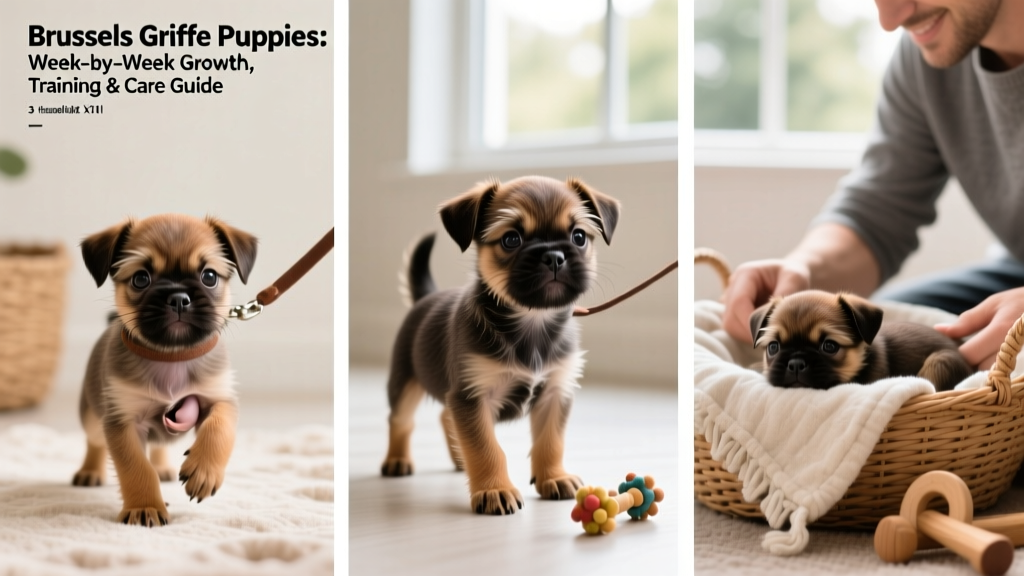
Brussels Griffon puppies pack an outsized personality into a 4-to-10-pound frame. Known for their almost-human expressions, wiry coats, and devoted temperament, these toy dogs develop differently than larger breeds. Their small size means faster metabolisms, slower bladder control, and a socialization window that closes earlier than you might expect. This guide gives you breed-specific, week-by-week expectations so you can raise a confident, well-adjusted Griffon.
When Should You Bring Your Brussels Griffon Puppy Home?
The AKC recommends puppies stay with their littermates and dam until at least 8 weeks of age. For Brussels Griffons, many responsible breeders prefer waiting until 10–12 weeks. The extra weeks allow toy breeds to gain weight, develop stronger immune responses from maternal antibodies, and learn bite inhibition from siblings.
Bringing a Griffon puppy home at 8 weeks is acceptable if the breeder has initiated early socialization and the puppy weighs at least 1.5 lb (0.7 kg). If the puppy is under 1 lb (0.45 kg) or showing signs of fading (lethargy, poor weight gain), discuss a later pickup with your breeder and your veterinarian.
- Set up a confined space (exercise pen or small room) with crate, water, potty pads, and toys
- Feed the exact food the breeder provided — transition over 7–10 days minimum
- Schedule your first vet visit within 3 days of pickup
- Limit visitors to immediate household for the first week to reduce stress
Brussels Griffon Puppy Milestones: Week by Week
| Age Range | Physical Milestones | Behavioral Milestones | Weight Range (Approx.) |
|---|---|---|---|
| Weeks 4–8 (with breeder) | Eyes/ears fully functional; deciduous teeth erupting; weaning onto gruel then solid kibble | Learning bite inhibition from littermates; startle reflex to loud noises; first play bows and tail wags | 0.8–2.0 lb (0.4–0.9 kg) |
| Weeks 8–12 | Rapid growth phase; full set of 28 baby teeth; coat texture emerging (smooth vs. rough) | Peak socialization receptivity; fear periods begin (~8–10 weeks); name recognition developing | 2.0–3.5 lb (0.9–1.6 kg) |
| Weeks 12–16 | Growth rate begins to slow; adult proportions emerging; jaw strengthening | Testing boundaries; second fear period possible (~12–14 weeks); reliable recall to name in low-distraction settings | 3.5–5.5 lb (1.6–2.5 kg) |
| Weeks 16–24 | Baby teeth shedding begins (~16 weeks); adult coat coming in; approaching adult height | Increased independence; may challenge house rules; chewing peaks during teething | 5.5–8.0 lb (2.5–3.6 kg) |
| Months 6–12 | All 42 adult teeth in by ~7 months; near adult weight; rough-coated Griffons may need first professional groom | Adolescent regression in training; sexual maturity (spay/neuter typically recommended 6–9 months); settling into adult temperament patterns | 7.0–11.0 lb (3.2–5.0 kg) |
Feeding Schedule: Portions by Age and Weight
Brussels Griffons have high metabolic rates relative to their size and are prone to hypoglycemia (low blood sugar) as young puppies. Consistent meal timing is non-negotiable. Feed a AAFCO-complete small-breed puppy formula — look for kibble pieces sized for toy breeds (under 8 mm diameter).
| Age | Meals Per Day | Daily Amount (Dry Kibble) | Notes |
|---|---|---|---|
| 8–12 weeks | 4 meals | ¼ to ⅓ cup/day (split into 4 portions) | Moisten kibble with warm water if puppy struggles to chew; always have fresh water available |
| 12–16 weeks | 3 meals | ⅓ to ½ cup/day | Transition to dry kibble fully; monitor body condition score (BCS) — ribs should be palpable but not visible |
| 16–24 weeks | 3 meals | ½ to ⅔ cup/day | Increase if puppy is underweight per vet assessment; reduce if BCS exceeds 5/9 |
| 6–12 months | 2 meals | ½ to ¾ cup/day | Transition to adult small-breed formula at 9–12 months; consult your veterinarian for exact timing |
Vaccination Schedule for Brussels Griffon Puppies
The AVMA and the American Animal Hospital Association (AAHA) recommend core vaccines for all puppies. Because Brussels Griffons are small, your vet may opt for a modified schedule to reduce the risk of adverse vaccine reactions, which are slightly more common in toy breeds.
| Age | Vaccine | Type | Notes |
|---|---|---|---|
| 6–8 weeks | DHPP (Distemper, Hepatitis, Parainfluenza, Parvovirus) | Core | First dose; breeder may have administered this before you pick up puppy |
| 10–12 weeks | DHPP booster + optional Bordetella | Core + Non-core | Bordetella recommended if attending puppy classes or boarding |
| 14–16 weeks | DHPP final booster + Rabies (at 16 weeks per state law) | Core | Rabies is legally required; some states mandate 12 weeks, others 16 weeks |
| 12–16 months | DHPP + Rabies booster | Core | First annual boosters; after this, DHPP may move to 3-year intervals |
Typical cost: $80–$150 per visit for puppy vaccine packages at a general practice; $150–$300 for the full puppy series at a private clinic. Low-cost vaccine clinics (often run by shelters or mobile services) may offer packages for $50–$100.
Socialization Window: Weeks 3–14
The primary socialization period for puppies closes between 12–14 weeks of age. For Brussels Griffons — a breed that can be reserved with strangers and sensitive to environmental changes — maximizing this window is essential. The goal is positive exposure, not overwhelming the puppy.
- People: At least 10 different people (varying ages, genders, heights, wearing hats/glasses/coats) — reward with treats for calm behavior
- Surfaces: Walk on grass, gravel, tile, carpet, metal grates, wet pavement
- Sounds: Vacuum cleaner (start from another room, gradually closer), doorbell, thunderstorm audio at low volume, car engine, hair dryer
- Handling: Daily practice touching ears, paws, mouth, tail base — pair with treats to build tolerance for grooming and vet exams
- Other dogs: Controlled meetings with fully vaccinated, calm adult dogs in private settings (avoid dog parks until vaccine series is complete)
- Objects: Umbrellas opening, shopping carts, bicycles, children's toys with sounds
- Environments: Car rides (start with 5-minute loops), pet-friendly store visits (carried in a sling or carrier), outdoor café patios
Aim for 3–5 new positive experiences per day. If puppy shows fear (cowering, tucked tail, freezing), increase distance from the stimulus and reward calm behavior — never force interaction.
When Can My Puppy Go Outside and Meet Other Dogs?
Your Griffon puppy can explore your own yard (if enclosed and not shared with unknown dogs) immediately. Public areas — sidewalks, parks, pet stores — carry parvovirus risk until the puppy is fully vaccinated. The general rule: wait 5–7 days after the final DHPP booster (given at 14–16 weeks) before high-traffic areas. However, the AKC and the American Veterinary Society of Animal Behavior (AVSAB) recommend controlled socialization outings during the vaccine series — carry your puppy in a sling or stroller, visit homes of friends with known-vaccinated dogs, and attend well-managed puppy classes that require proof of at least one DHPP dose.
Potty Training Timeline: Realistic Expectations
Brussels Griffons are notoriously difficult to housebreak. Their tiny bladders (holding roughly 1 ounce of urine per month of age, plus 1 ounce) and occasional stubbornness mean you should plan for 4–6 months of consistent training — not the "3-day" methods marketed online.
| Age | Max Bladder Hold Time | Potty Break Frequency | Milestone Expectation |
|---|---|---|---|
| 8–10 weeks | 1–1.5 hours | Every 1–2 hours + after meals, naps, play | Learning the concept of "outside = potty"; expect 2–4 accidents/day |
| 10–14 weeks | 2–3 hours | Every 2 hours during active periods | Beginning to signal (sniffing, circling); accidents drop to 1–2/day |
| 14–20 weeks | 3–4 hours | Every 3 hours + overnight (set one alarm) | Reliably going outside if taken on schedule; occasional indoor accidents |
| 5–7 months | 4–6 hours | Every 4 hours during the day | Near-reliable with supervision; may still have accidents when unsupervised or during excitement |
| 7–12 months | 6–8 hours | 3–4 outings per day | Most Griffons are reliably housebroken by 8–10 months with consistent training |
- Rain/cold refusal: Many Griffons despise wet or cold weather. Try a covered potty area, a dog raincoat, or indoor pee-pad training as a weather backup.
- Submissive urination: Common in young Griffons. Avoid excited greetings — ignore the puppy for the first 30 seconds when arriving home, then greet calmly at floor level.
- Marking behavior (males): Typically emerges at 6–9 months. Neuter discussion with your vet and consistent interrupt-and-redirect when sniffing vertical surfaces indoors.
Teething, Crate Training, and Common Puppy Problems
Teething Timeline (3–6 Months)
Brussels Griffon puppies begin losing their 28 deciduous teeth around 14–16 weeks, with all 42 adult teeth typically erupted by 6–7 months. Toy breeds are at higher risk for retained deciduous teeth — baby teeth that don't fall out as adult teeth emerge, leading to crowding and dental disease.
Relief strategies:
- Offer frozen (not rock-hard) rubber chew toys like the KONG Puppy (size XS or S) filled with softened kibble and frozen
- Wet a clean washcloth, twist it into a rope shape, freeze for 30 minutes, and supervise chewing sessions (10–15 minutes max)
- Rotate 4–5 different textured chews to maintain interest — avoid rawhide, cooked bones, and antlers (tooth fracture risk)
- Check weekly for double teeth (adult erupting behind baby); if a baby tooth hasn't fallen out within 2 weeks of the adult appearing, consult your vet for extraction
Crate Training Progression
A properly sized crate for an adult Brussels Griffon is approximately 24" L × 18" W × 19" H. For puppies, use a divider panel to reduce the space — the puppy should be able to stand, turn around, and lie down, but not have room to eliminate in one corner and sleep in another.
| Age | Max Daytime Crate Duration | Overnight Expectation | Training Focus |
|---|---|---|---|
| 8–10 weeks | 30–60 minutes | 2–3 hours before needing a potty break | Building positive association — feed meals in crate, leave door open, use treat tosses |
| 10–14 weeks | 1–2 hours | 3–4 hours (one overnight alarm may be needed) | Closing door for short periods while you're visible; begin brief absences from the room |
| 14–20 weeks | 2–3 hours | 5–6 hours | Extending duration; practicing departures (pick up keys, leave for 5 minutes, return calmly) |
| 5–7 months | 3–4 hours | 7–8 hours (full night) | Reliable settling; crate becomes a voluntary retreat space |
Never use the crate as punishment. Brussels Griffons are sensitive dogs and crate aversion can develop quickly if the space becomes associated with isolation or scolding.
Stopping Puppy Biting and Nipping
Griffon puppies use their mouths to explore and communicate — this is normal, but the needle-sharp baby teeth need redirecting. Use these force-free methods:
- Redirect to a toy: When teeth touch skin, say "oops" in a neutral tone, withdraw attention for 3–5 seconds, then offer an appropriate chew toy. Reward chewing the toy with praise.
- Time-outs: If biting persists after 2–3 redirects, calmly place the puppy in a playpen or safe area for 30–60 seconds. This teaches that biting ends play — not that biting gets a reaction.
- Manage arousal levels: Puppies bite most when overtired. Enforce nap schedules (puppies need 18–20 hours of sleep per day at 8–12 weeks). A cranky, biting puppy often just needs a crate nap.
- Teach "leave it": Begin at 10–12 weeks using a closed fist with a treat inside. Reward the puppy for backing away from your hand. Progress to open palm, then floor items.
Whining and Chewing
Whining in the crate is common the first 2–3 weeks. Rule out potty needs (take puppy out before crating), then wait for 3–5 seconds of silence before opening the crate or offering attention. Rewarding silence — not the whining — builds quiet crate behavior.
Destructive chewing peaks between 4–7 months during teething. Puppy-proof your home by removing shoes, cords, and small objects. Provide a rotation of 5–7 chew toys with varying textures. Brussels Griffons particularly enjoy soft rubber toys and rope toys (supervised only — ingestible fiber can cause intestinal blockage).
First-Year Cost Breakdown
| Category | Estimated Cost (Low) | Estimated Cost (High) | Details |
|---|---|---|---|
| Puppy Purchase | $2,000 | $4,500 | From a responsible breeder with health testing (OFA patella, cardiac, eye); rescue/adoption: $200–$600 |
| Veterinary (Year 1) | $600 | $1,200 | Vaccine series, spay/neuter ($300–$600), fecal tests, heartworm prevention, microchip |
| Food | $250 | $500 | High-quality small-breed puppy then adult formula; Griffons eat ~15–20 lb of kibble/year |
| Supplies | $300 | $700 | Crate ($40–$80), harness ($20–$45), leash, bowls, bed, toys, grooming tools, puppy pen |
| Training | $150 | $600 | Puppy socialization class ($150–$250 for 6-week session); optional private trainer for specific issues |
| Grooming | $200 | $600 | Rough-coated Griffons need professional grooming every 6–8 weeks ($40–$75/session); smooth-coated: occasional baths at home |
| Pet Insurance | $350 | $600 | Monthly premiums $30–$50 for toy breed puppy; recommended given breed-specific dental and cardiac risks |
| Total First Year | $3,850 | $8,700 | Excluding emergency veterinary care; set aside $500–$1,000 emergency fund |
Frequently Asked Questions
How often should I feed my Brussels Griffon puppy at 10 weeks old?
Feed 4 meals per day, totaling ¼ to ⅓ cup of high-quality small-breed puppy kibble. Space meals roughly 4 hours apart during waking hours (e.g., 7 AM, 11 AM, 3 PM, 7 PM). Consistent feeding times also help predict potty timing — most puppies need to eliminate within 15–30 minutes of eating.
When will my Brussels Griffon be fully potty trained?
Most Brussels Griffons achieve reliable housebreaking between 8–10 months of age, though some take up to 12 months. This is later than many breeds due to their small bladder capacity and occasional stubbornness. Consistency, supervision, and positive reinforcement for outdoor elimination are the biggest factors in faster training.
What vaccines does my Brussels Griffon puppy need and when?
Core vaccines include DHPP (Distemper, Hepatitis, Parainfluenza, Parvovirus) at 6–8 weeks, 10–12 weeks, and 14–16 weeks, plus Rabies at 16 weeks. Non-core vaccines like Bordetella (kennel cough) and Leptospirosis may be recommended based on your lifestyle and region. Your veterinarian will tailor the schedule to your puppy's size and risk factors.
How do I stop my Brussels Griffon puppy from biting my hands?
Redirect biting to appropriate chew toys, use brief time-outs (30–60 seconds in a playpen) when biting persists, and ensure your puppy is getting 18–20 hours of sleep per day. Never hit, yell at, or hold the puppy's mouth shut — these methods damage trust and can increase fear-based biting. Most nipping diminishes significantly by 5–6 months as adult teeth come in and the puppy matures.
Are Brussels Griffons good with children?
Griffons can do well with respectful, calm children over age 6–7. Their small size makes them fragile — a toddler dropping or squeezing a 5-pound puppy can cause serious injury. Always supervise interactions and teach children to pet gently, avoid the face, and never pick up the dog without adult help.
Do Brussels Griffon puppies shed?
Both coat types (rough/wire and smooth) are considered low-shedding. Rough-coated Griffons require hand-stripping or clipping every 6–8 weeks to maintain coat health. Smooth-coated Griffons need weekly brushing with a rubber grooming mitt. Neither coat type is truly hypoallergenic, but both produce less dander than heavy-shedding breeds.
Disclaimer: This guide provides general educational information about raising Brussels Griffon puppies. Every puppy is an individual. Always consult your veterinarian for personalized health, nutrition, and vaccination advice tailored to your specific puppy's needs, weight, and medical history.
Jonas Cole
All our authors care for dogs every day — read more of their work on the authors page.