Beabull Puppies: The Complete First-Year Care & Training Guide
Everything you need to know about raising beabull puppies — feeding schedules, vaccination timelines, potty training milestones, and first-year costs.

The Beabull — a deliberate cross between the Beagle and the English Bulldog — is one of those designer breeds that catches people off guard. You get the Beagle's curious nose and playful energy wrapped in the Bulldog's stocky, wrinkled charm. But raising beabull puppies comes with a unique set of challenges that neither purebred parent's guide will fully prepare you for. Their brachycephalic tendencies (inherited from the Bulldog side) combine with a scent hound's stubborn streak, creating a puppy that needs breed-specific handling from day one.
This guide walks you through every developmental stage of your beabull puppy's first year, with concrete timelines, feeding portions, vaccination schedules, and the real-world costs you should budget for. Whether you're waiting on a litter or just brought your puppy home, here's your roadmap.
When Should You Bring Your Beabull Puppy Home?
The ideal age to bring a beabull puppy home is 8 to 10 weeks. While some breeders release puppies at 8 weeks, the Bulldog lineage makes a case for waiting until 10 weeks. Here's why: English Bulldogs mature more slowly than many breeds, and beabull puppies often benefit from an extra two weeks of littermate socialization and maternal nursing. The American Kennel Club notes that small-to-medium breeds are generally ready at 8 weeks, but brachycephalic-influenced puppies may need the additional developmental time.
- Completed the puppy's first DHPP vaccination (given at 6-8 weeks)
- Administered first deworming (typically at 2, 4, 6, and 8 weeks)
- Provided a written health guarantee covering common breed-specific conditions
- Supplied a blanket or toy with littermate scent for the transition
If you're adopting from a rescue, puppies may come home at varying ages. Adjust the timelines below based on your puppy's actual age, not the assumed 8-week starting point.
Beabull Puppy Development: Age-Specific Milestones
Understanding what's normal at each stage prevents unnecessary panic and helps you set realistic expectations. Beabull puppies tend to follow Bulldog-timed physical growth (slower to mature, heavier bone structure) with Beagle-timed cognitive development (alert, scent-driven, and mouthy early on).
| Age Range | Weight Range (lb/kg) | Key Milestones | What to Expect |
|---|---|---|---|
| Weeks 4–8 | 3–8 lb / 1.4–3.6 kg | Eyes fully open, weaning complete, first socialization window opens, littermate play peaks | Puppy learns bite inhibition from siblings. Fear imprint period begins around week 8 — avoid traumatic experiences. |
| Weeks 8–12 | 8–15 lb / 3.6–6.8 kg | Peak socialization window, bonding with humans, crate training begins, first vet visit | Nighttime whining is normal. Puppy will mouth and nip constantly. Short attention spans (5–10 minutes max for training). |
| Weeks 12–16 | 15–22 lb / 6.8–10 kg | Bladder control improves, second fear period may hit, basic commands take hold | Puppy may suddenly seem "forgetful" with commands — this is developmental, not regression. Keep sessions positive. |
| Weeks 16–24 | 22–35 lb / 10–15.9 kg | Teething begins, adult teeth emerge, spay/neuter window, longer walks possible | Destructive chewing peaks. Puppy can hold bladder 4–5 hours. Pre-adolescent testing of boundaries starts. |
| Months 6–12 | 30–50 lb / 13.6–22.7 kg | Approaching adult size, sexual maturity, advanced training readiness, energy stabilizes | Beagle scent drive fully activates — recall becomes harder outdoors. Bulldog stubbornness may surface in training. |
Adult Beabulls typically land between 30–50 lb (13.6–22.7 kg) and stand 12–16 inches (30–40 cm) at the shoulder, though individual variation is significant in mixed breeds. The Bulldog parent's influence means your puppy will be denser and more muscular than a pure Beagle of the same height.
Feeding Your Beabull Puppy: Schedule and Portions
Beabull puppies need a small-to-medium breed puppy formula that meets AAFCO nutritional standards for growth. Avoid large-breed puppy food — the Bulldog side already predisposes them to joint issues, and overly rapid growth worsens this risk. Look for a kibble with minimum 22% protein and 8% fat for puppy growth stages.
Because of their brachycephalic tendencies, beabull puppies often eat quickly and gulp air. Use a slow-feeder bowl (the Outward Hound Fun Feeder is a reliable option at around $12–$18) from day one to prevent bloat and improve digestion.
| Puppy Age | Meals Per Day | Daily Portion (cups) | Notes |
|---|---|---|---|
| 8–12 weeks | 4 meals | ¾ – 1 cup total | Soften kibble with warm water if puppy struggles with hard pieces. Space meals 3–4 hours apart. |
| 12–16 weeks | 3 meals | 1 – 1¼ cups total | Transition to dry kibble fully. Monitor body condition — ribs should be palpable but not visible. |
| 16–24 weeks | 3 meals | 1¼ – 1¾ cups total | Growth spurts may increase appetite. Adjust portions based on weight gain, not hunger cues alone. |
| 6–9 months | 2 meals | 1½ – 2 cups total | Reduce to twice daily. Morning and evening feedings, 10–12 hours apart. |
| 9–12 months | 2 meals | 1¾ – 2¼ cups total | Begin transitioning to adult formula around 10–12 months. Mix 75/25 puppy-to-adult over 7 days. |
Vaccination Schedule for Beabull Puppies
Your beabull puppy's vaccination timeline follows the standard protocol recommended by the American Veterinary Medical Association, but with one breed-specific consideration: Bulldogs and brachycephalic crosses sometimes have stronger inflammatory responses to vaccines. Your vet may recommend spacing vaccines or using a specific manufacturer known for lower reaction rates. Always discuss your puppy's breed mix with the veterinarian before the first appointment.
| Age | Vaccines Administered | Estimated Cost |
|---|---|---|
| 6–8 weeks | DHPP (Distemper, Hepatitis, Parainfluenza, Parvovirus) — 1st dose. Optional: Bordetella (kennel cough). | $25–$45 |
| 10–12 weeks | DHPP — 2nd dose. Optional: Leptospirosis, Lyme (depending on region and lifestyle). Bordetella booster if given initially. | $35–$60 |
| 14–16 weeks | DHPP — 3rd dose. Rabies (required by law in all US states). Optional: Leptospirosis booster. | $45–$75 |
| 12–16 months | DHPP booster. Rabies booster (1-year or 3-year depending on local law). Core boosters established for adult schedule. | $50–$90 |
After the final DHPP dose at 14–16 weeks, your puppy is considered fully vaccinated against core diseases. Until then, avoid dog parks, pet store floors, and unvaccinated dog contact. You can still socialize your puppy in controlled environments — carry them, use a stroller, or visit friends' homes with known-vaccinated dogs.
The Critical Socialization Window (Weeks 3–14)
The Merck Veterinary Manual identifies the primary socialization period in puppies as weeks 3 through approximately 14. For beabull puppies, this window is especially important because both parent breeds carry traits that can become problematic without proper exposure: Beagle anxiety/separation distress and Bulldog territorial behavior.
Your goal during this period isn't to overwhelm your puppy — it's to create positive, brief exposures to as many novel stimuli as possible. Aim for 5–10 new experiences per week, always paired with high-value treats (small pieces of boiled chicken or commercial training treats like Zuke's Mini Naturals).
Check off each item as your puppy has a positive encounter:
People:
- ☐ Children (ages 4–12, supervised and calm)
- ☐ Tall men with deep voices
- ☐ People wearing hats, sunglasses, and hoodies
- ☐ Person in a wheelchair or using crutches
- ☐ Delivery driver at the door
Environments:
- ☐ Car ride (start with 5 minutes, engine off, then short drives)
- ☐ Different floor surfaces: tile, gravel, grass, metal grates
- ☐ Elevator or automatic sliding doors
- ☐ Busy sidewalk (carry puppy if pre-vaccination complete)
- ☐ Quiet room with white noise or vacuum running at distance
Sounds:
- ☐ Thunderstorm recording played at low volume with treats
- ☐ Doorbell and knocking
- ☐ Fireworks audio at very low volume, paired with play
- ☐ Other dogs barking (at a distance, positive association)
Handling:
- ☐ Paw handling (5 seconds per paw, daily — critical for nail trims)
- ☐ Ear inspection and gentle cleaning (Beagle ears are prone to infection)
- ☐ Mouth opening and teeth inspection (brachycephalic dental crowding)
- ☐ Being gently restrained/held (prep for vet visits)
- ☐ Wrinkle cleaning if puppy inherited Bulldog facial folds
Potty Training Your Beabull Puppy: Timeline and Troubleshooting
Let's set realistic expectations: most beabull puppies are reliably potty trained between 4 and 6 months of age. Some catch on by 3 months; others — especially those with a stronger Beagle stubborn streak — may take until 7 or 8 months. "Fully trained" means fewer than one accident per month with consistent routine.
Beabull puppies face two breed-specific potty training challenges:
- Small bladders relative to body size — inherited from the Bulldog's compact build, meaning more frequent outings early on.
- Scent distraction — the Beagle nose means your puppy may get so absorbed in sniffing outside that they forget why they went out, then come inside and have an accident.
| Puppy Age | Max Bladder Hold Time | Outing Frequency | Nighttime Expectations |
|---|---|---|---|
| 8–10 weeks | 1–1.5 hours | Every 60–90 minutes while awake; immediately after eating, playing, and napping | 2–3 overnight wake-ups expected. Set alarms. |
| 10–14 weeks | 2–3 hours | Every 2 hours while awake | 1–2 overnight wake-ups. Last outing at 11 PM, first at 5–6 AM. |
| 14–20 weeks | 3–4 hours | Every 2.5–3 hours while awake | 0–1 overnight wake-ups. Most puppies can sleep 6–7 hours by 16 weeks. |
| 5–6 months | 5–6 hours | Every 4 hours while awake | Sleeping through the night (8 hours) consistently. |
- "Sniff and forget" syndrome: Take puppy to the SAME spot each time. Use a cue word like "go potty" while they eliminate, then reward immediately after. Don't let them roam and sniff first — leash them to the spot.
- Excitement urination: Common in Bulldog-influenced puppies. Keep greetings low-key — ignore puppy for 30 seconds when you enter, then calmly pet. Never punish this behavior; it's involuntary.
- Regression at 4–5 months: Normal developmental phase. Return to more frequent outings for 1–2 weeks. Do not punish — it will create fear of eliminating in front of you.
Crate Training Progression and Time Limits
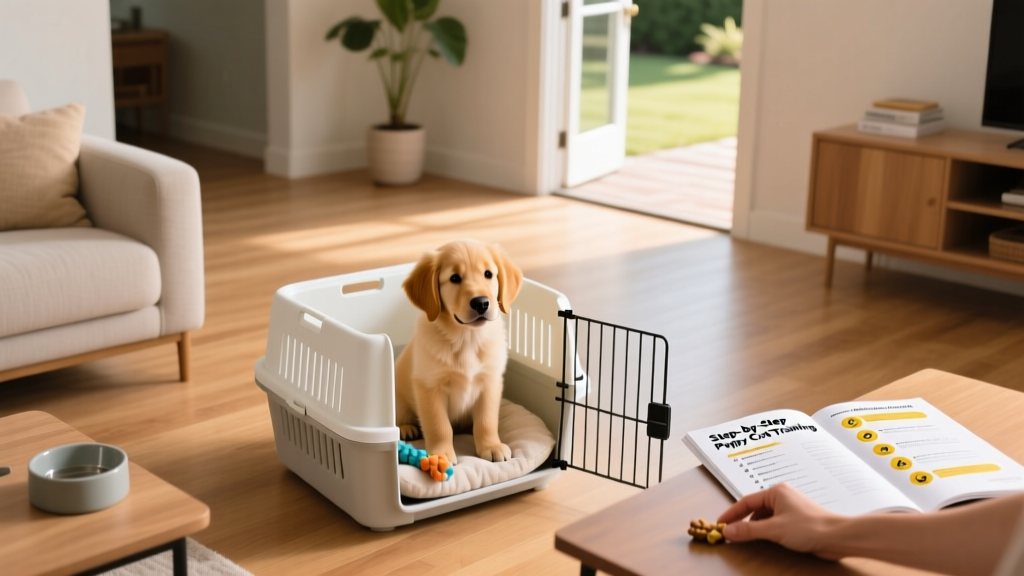
Crate training is essential for beabull puppies. The Beagle's tendency toward separation anxiety and the Bulldog's potential for destructive boredom-chewing mean unsupervised freedom too early will cost you furniture, shoes, and possibly your puppy's safety (chewed electrical cords are a leading cause of household pet emergencies).
Use a 36-inch wire crate (MidWest iCrate or similar, approximately $45–$65) with a divider panel. Beabulls typically fit a 36-inch crate as adults, and the divider lets you adjust space as they grow. The crate should be large enough for your puppy to stand, turn around, and lie down — but no larger, or they'll designate one corner as a bathroom.
| Age | Max Daytime Crate Time | Max Nighttime Crate Time | Training Goal |
|---|---|---|---|
| 8–10 weeks | 30–60 minutes | 2–3 hours (with potty breaks) | Positive association — feed meals in crate, door open. Short closed-door sessions while you're visible. |
| 10–14 weeks | 1–2 hours | 4–5 hours (with 1 potty break) | Puppy enters crate voluntarily for treats/chews. Begin leaving room briefly. |
| 14–20 weeks | 2–3 hours | 6–7 hours | Puppy naps in crate without protest. Can handle brief alone time (30 min) without distress barking. |
| 5–6 months | 3–4 hours | 8 hours | Full nighttime sleep. Daytime crating while you work, with a midday potty break. |
| 7–12 months | 4–5 hours max | 8–9 hours | Begin testing puppy-proofed room freedom for short periods. Some beabulls earn house freedom by 10–12 months; others need longer. |
Never use the crate as punishment. Your beabull puppy should view it as a safe den. Provide a stuffed Kong (frozen with peanut butter and banana) for longer sessions to prevent boredom. If your puppy whines after being settled for 15+ minutes, they likely need a potty break — take them out calmly, then return to crate.
Teething Timeline and Relief Strategies (3–6 Months)
Beabull puppies begin losing their 28 deciduous (baby) teeth around 12–16 weeks, with the process completing by approximately 6–7 months when all 42 adult teeth have erupted. Because of the Bulldog parent's brachycephalic jaw structure, beabull puppies are at higher-than-average risk for retained deciduous teeth — where baby teeth fail to fall out as adult teeth push through. This causes crowding, misalignment, and trapped food that leads to early dental disease.
Have your vet check for retained teeth at every visit between 3 and 7 months. Extraction of stubborn baby teeth (typically the canines) is a quick procedure often done during spay/neuter surgery.
Teething phases and what to do:
- Weeks 12–16: Incisors loosen first. Puppy gums may look red and swollen. Offer chilled (not frozen solid) carrot sticks and rubber teething toys like the KONG Puppy teething stick ($8–$12).
- Weeks 16–20: Canines and premolars erupt — this is peak chewing intensity. Your puppy will target furniture legs, shoes, and baseboards. Provide 4–5 approved chew options rotated daily to maintain novelty. Bully sticks (6-inch, $4–$7 each) are excellent for this stage but supervise to prevent choking on small end pieces.
- Weeks 20–28: Molars come in at the back. Chewing intensity decreases. You may find tiny teeth in bedding or toys — this is normal. Continue providing appropriate chews to establish lifelong dental habits.
Common Beabull Puppy Problems and Solutions
Every breed mix has its signature puppy challenges. Here are the issues beabull owners report most frequently, with solutions grounded in positive reinforcement training methods:
Puppy Biting and Nipping
Beabull puppies are mouthy — the Beagle was bred to grab and hold game, and Bulldog puppies play-wrestle with their mouths. Expect persistent nipping from 8 weeks through about 5 months. How to stop it:
- When teeth touch skin, say "ouch" in a flat tone and immediately withdraw attention (stand up, turn away) for 10–15 seconds. This mimics how littermates teach bite inhibition.
- Redirect to an appropriate chew toy every time. Keep toys within arm's reach during play sessions.
- Never hold the puppy's mouth shut, tap their nose, or use physical punishment — these methods increase fear-based biting and damage trust.
- If biting intensifies during the evening ("witching hour"), your puppy is likely overtired. Guide them to their crate for a nap with a chew toy.
Whining and Crying (Especially in Crate)
Nighttime whining typically lasts 1–3 weeks after bringing your puppy home. The Beagle side contributes vocal tendencies — Beagles are among the most vocal breeds. Solutions:
- Place the crate in your bedroom for the first 2–3 weeks so your puppy can hear and smell you. Gradually move it to the desired permanent location.
- Use a white noise machine or a Snuggle Puppy (a plush toy with a heartbeat simulator, ~$30–$40) to provide comfort.
- Distinguish protest whining (short, intermittent) from distress whining (continuous, escalating). Wait out protest whining; respond to distress by taking puppy out for a potty break.
Destructive Chewing
Peak destructive chewing hits between 4 and 7 months, coinciding with teething and increasing jaw strength. Beabull puppies with the Bulldog's powerful bite can destroy toys that would last other breeds weeks. Invest in heavy-duty options: Goughnuts Maxx 50 ($30–$35) or West Paw Zogoflex Hurley ($15–$20). Puppy-proof by removing shoes, remote controls, and children's toys from floor level.
Stubbornness in Training
The Beagle's "selective hearing" (following their nose instead of your commands) combined with the Bulldog's "what's in it for me?" attitude means beabull puppies require high-value motivation. Use real meat treats (not just kibble) for training sessions, keep sessions under 10 minutes, and end on a success. If your puppy disengages, they're tired or bored — try again later, not harder.
First-Year Cost Breakdown for a Beabull Puppy
Budgeting accurately prevents sticker shock. Here's a realistic first-year cost range based on 2025–2026 US pricing data. Costs vary by region — urban areas (NYC, San Francisco) will trend toward the high end, while rural areas will be lower.
| Category | Low Estimate | High Estimate | Details |
|---|---|---|---|
| Puppy Purchase/Adoption | $300 (rescue) | $2,500 (breeder) | Responsible breeders health-test both parents. Rescue fees often include initial vetting. |
| Veterinary Care | $400 | $900 | Includes puppy vaccine series, spay/neuter ($200–$500), fecal tests, heartworm prevention, microchip. |
| Food | $300 | $600 | Quality puppy food ($45–$70/bag, 25–30 lb). Beabulls eat less than large breeds but more than toy breeds. |
| Supplies | $250 | $500 | Crate, bed, leash/harness, bowls, slow feeder, toys, grooming tools, enzymatic cleaner, baby gates. |
| Training | $0 (DIY) | $600 | Group puppy class ($150–$250 for 6 weeks). Private sessions ($80–$150/session) if behavioral issues arise. |
| Pet Insurance | $360/yr | $720/yr | $30–$60/month for puppy enrollment. Highly recommended given Bulldog-related health predispositions. |
| Total First Year | $1,610 | $5,820 | Excluding emergency vet visits. Set aside a $500–$1,000 emergency fund. |
Ongoing annual costs after year one typically range from $1,200–$2,500 for food, preventive care, insurance, and supplies.
Frequently Asked Questions About Beabull Puppies
When can my beabull puppy go outside and meet other dogs?
Your puppy can go outside in your own yard immediately (assuming no parvo risk from previous dogs). For public spaces and meeting unfamiliar dogs, wait until 7 days after the final DHPP vaccine at 14–16 weeks — so approximately 15–17 weeks of age. Before that, carry your puppy on walks, use a stroller, or arrange playdates with known-vaccinated, healthy dogs in private yards. The socialization window closes around 14 weeks, so safe, controlled exposure during this period is critical.
How do I stop my beabull puppy from biting my hands and ankles?
Use the "ouch and withdraw" method described above, consistently applied by every household member. Pair it with redirection to appropriate chew toys. For ankle-biting specifically (common when puppies herd children or chase movement), stop walking immediately when bitten — movement reinforces the behavior. Once puppy releases, redirect to a tug toy. If biting is intense and persistent past 5 months, consult a certified positive-reinforcement trainer (look for CPDT-KA or KPA-CTP credentials).
How often should I feed my beabull puppy at 10 weeks old?
At 10 weeks, feed 4 meals per day, spaced approximately 3–4 hours apart during waking hours. A typical schedule: 7 AM, 11 AM, 3 PM, and 7 PM. Each meal should be roughly ¼ of the daily total (about 3–4 tablespoons per meal for most beabull puppies at this age). Remove uneaten food after 15 minutes to establish a routine and monitor appetite changes, which can signal illness.
What health issues should I watch for in beabull puppies?
Key breed-specific concerns include:
- Brachycephalic Obstructive Airway Syndrome (BOAS): If your puppy inherited a shortened muzzle, watch for noisy breathing, exercise intolerance, and overheating. Keep walks short in warm weather and never leave your puppy in a hot car — even briefly.
- Ear infections: The Beagle's floppy, pendulous ears trap moisture. Clean weekly with a vet-approved ear cleanser (Epi-Otic Advanced, ~$12–$18) and dry thoroughly after baths or swimming.
- Hip dysplasia: Both Beagles and Bulldogs carry genetic risk. Avoid excessive stair-climbing and jumping from furniture during the first year while growth plates are open. Ask your breeder for proof of OFA or PennHIP hip screening on both parents.
- Cherry eye: A prolapsed gland of the third eyelid, common in Bulldogs. Appears as a red mass in the inner corner of the eye. Requires surgical correction — consult your vet promptly.
- Allergies and skin fold dermatitis: If your puppy has Bulldog wrinkles, clean folds daily with a damp cloth and dry thoroughly. Watch for redness, odor, or excessive scratching.
Always consult your veterinarian if you notice any sudden behavioral changes, persistent vomiting or diarrhea, difficulty breathing, or refusal to eat for more than 12 hours. Early intervention prevents minor issues from becoming emergencies.
When will my beabull puppy calm down?
Most beabulls begin settling into a more predictable energy pattern between 10 and 14 months. The Beagle side keeps them playful well into adulthood, but the Bulldog influence means they're generally not high-energy dogs long-term. Expect a puppy who needs 30–45 minutes of structured exercise daily (two 15–20 minute walks plus play sessions) and who will happily nap 14–16 hours a day during puppyhood. Mental stimulation — scent games, puzzle feeders, short training sessions — tires a beabull puppy faster than physical exercise alone.
Raising a beabull puppy is a rewarding but demanding commitment. Their mixed heritage means you're navigating two very different breed temperaments simultaneously. Patience, consistency, and positive reinforcement will get you through the challenging months — and the result is a loyal, affectionate companion with one of the most endearingly goofy personalities in the designer dog world.
Tom Renshaw
All our authors care for dogs every day — read more of their work on the authors page.