Aussie Shepherd Puppy: The Complete First-Year Care Guide
Everything you need to raise an Aussie Shepherd puppy: age milestones, feeding schedules, potty training timelines, vaccinations, and first-year costs.

Bringing home an Aussie Shepherd puppy — whether an Australian Shepherd purebred or an Aussie mix — is one of the most rewarding and demanding things you'll do as a dog owner. These dogs are whip-smart, high-energy herding breeds that need structured guidance from day one. Without it, that intelligence turns into destructive boredom fast.
This guide walks you through every stage of your Aussie Shepherd puppy's first year with specific timelines, portion sizes, vaccine schedules, and realistic cost expectations. No fluff — just the data and frameworks you need to raise a well-adjusted, healthy dog.
When Should You Bring Your Aussie Shepherd Puppy Home?
The ideal window is 8 to 10 weeks of age. Before 8 weeks, puppies are still learning critical bite inhibition and social cues from their mother and littermates. The American Kennel Club and most veterinary behaviorists agree that removing a puppy earlier than 7 weeks increases the risk of fear-based behaviors and poor social skills later in life.
For Australian Shepherds specifically, some responsible breeders hold puppies until 10–12 weeks. This is common in working-line Aussies where the breeder conducts temperament testing (such as the Volhard Puppy Aptitude Test at 49 days) and wants to ensure proper early socialization before placement. Don't view a 10-week start as a disadvantage — you're actually getting a puppy with a stronger behavioral foundation.
Aussie Shepherd Puppy Milestones: Week by Week
Understanding what's developmentally appropriate at each stage prevents frustration and helps you set realistic expectations. Here's what to expect:
Weeks 4–8 (Still With Breeder)
- Socialization peak begins — puppy learns play behavior, bite inhibition from littermates
- Sensory development: full vision and hearing established by week 4
- Weaning: transition from mother's milk to gruel/puppy mush starts around week 4, fully weaned by week 7
- First deworming typically at 2, 4, 6, and 8 weeks (pyrantel pamoate)
- Temperament indicators emerge: bold vs. cautious, high-drive vs. moderate energy
Weeks 8–12 (Home Transition)
- Fear imprint period (8–11 weeks): traumatic experiences during this window can create lasting phobias. Avoid forced interactions, loud environments, or painful procedures if possible
- Attachment bonding: puppy forms primary bond with caregivers — this is your relationship-building window
- Attention span: roughly 2–5 minutes per training session
- Sleep needs: 18–20 hours per day (yes, really)
- Bladder capacity: approximately 1 hour per month of age (so a 2-month-old puppy needs out every 2 hours)
Weeks 12–16 (Foundation Building)
- Fear period typically ends around week 11–12; confidence increases
- Second fear period may begin around 12–14 weeks in some puppies
- Training capacity expands: can learn sit, down, recall, and leash walking basics
- Herding instincts may surface: nipping at heels, circling, staring — normal for the breed, needs redirection
- Teething discomfort begins as baby teeth start loosening around 12–16 weeks
Weeks 16–24 (Adolescent Entry)
- Adult teeth fully in by 6–7 months (42 teeth)
- Energy surges: Aussie Shepherds entering adolescence need 45–60+ minutes of structured activity daily
- Testing boundaries: "forgetting" commands is normal — maintain consistency
- Sexual maturity begins: discuss spay/neuter timing with your vet (many recommend waiting until 12–18 months for medium-to-large breeds to allow proper joint development)
- Height growth: approaching adult height; Australian Shepherds typically reach 18–23 inches at the shoulder
Months 6–12 (Adolescence)
- Second fear period often hits between 6–14 months — sudden fear of previously familiar things is normal
- Energy plateau: your Aussie will need 60–90 minutes of physical exercise plus 20–30 minutes of mental stimulation daily
- Weight trajectory: Australian Shepherds reach approximately 40–65 lb (18–29 kg) by 12 months, with males trending larger
- Advanced training readiness: agility foundations, advanced recall, off-leash work (in safe areas) become feasible
- Coat transition: puppy coat sheds, adult double coat fills in — expect increased grooming needs
Feeding Schedule: Exact Portions by Age and Weight
Aussie Shepherd puppies grow rapidly and need consistent, measured nutrition. Free-feeding leads to obesity and makes potty training significantly harder. Use this schedule as a starting point and adjust based on your puppy's body condition score (BCS) — you should be able to feel ribs without pressing hard, and see a visible waist from above.
| Age | Meals/Day | Portion Per Meal (Approx.) | Daily Total | Notes |
|---|---|---|---|---|
| 8–12 weeks | 4 meals | ½–¾ cup | 2–3 cups | Large-breed puppy formula; 22–28% protein |
| 3–6 months | 3 meals | ¾–1 cup | 2¼–3 cups | Increase as weight gains; monitor BCS |
| 6–12 months | 2 meals | 1–1¾ cups | 2–3½ cups | Transition to adult food around 12 months |
Food selection criteria: Look for an AAFCO statement confirming the food is "complete and balanced for growth" or "for all life stages." For Australian Shepherds (a medium-large breed), choose a formula labeled for large-breed puppies to ensure appropriate calcium-to-phosphorus ratios (1.1:1 to 1.4:1) that support proper bone development. Brands like Purina Pro Plan Large Breed Puppy, Royal Canin Medium Puppy, and Hill's Science Diet Large Breed Puppy all meet these standards.
Transition tip: When switching foods, use a 7-day gradual transition — 25% new food on days 1–2, 50% on days 3–4, 75% on days 5–6, and 100% on day 7. Sudden diet changes cause GI upset in 60–70% of puppies.
Vaccination Schedule for Your Aussie Shepherd Puppy
The American Veterinary Medical Association outlines core vaccine protocols that protect against life-threatening diseases. Your veterinarian will customize this schedule based on local disease prevalence and your puppy's risk factors, but expect something close to this:
| Age | Vaccines Administered | Purpose | Estimated Cost |
|---|---|---|---|
| 6–8 weeks | DHPP (1st dose) | Distemper, Hepatitis (Adenovirus), Parainfluenza, Parvovirus | $25–$45 |
| 10–12 weeks | DHPP (2nd dose), Bordetella (optional), Leptospirosis (1st, if recommended) | Booster immunity; kennel cough protection; bacterial infection prevention | $40–$75 |
| 14–16 weeks | DHPP (3rd dose), Rabies, Leptospirosis (2nd, if applicable) | Final puppy DHPP booster; legally required rabies protection | $50–$90 |
| 12–16 months | DHPP booster, Rabies booster (1-year or 3-year depending on local law) | Adult immunity maintenance | $45–$80 |
Non-core vaccines to discuss with your vet: Lyme disease (especially relevant if you live in the Northeast or Upper Midwest), Canine Influenza (H3N2/H3N8 — recommended if your dog will attend daycare or group training), and Leptospirosis (increasingly common in suburban areas with wildlife exposure).
Titers testing: After the puppy series is complete, you can ask your vet about a titers test (such as the VacciCheck panel, approximately $55–$85) to measure antibody levels before committing to annual boosters. Some dogs maintain immunity for years without re-vaccination.
Potty Training Timeline: Realistic Expectations
Let's set expectations clearly: most Aussie Shepherd puppies are reliably house-trained between 4 and 6 months of age, with occasional accidents until 8–10 months. Australian Shepherds are intelligent and typically pick up the routine faster than many breeds, but their high energy and distractibility can work against them in the early weeks.
The core schedule:
- 8–12 weeks: Take puppy out every 1–2 hours, immediately after meals, after naps, and after play sessions. Expect 8–12 outings per day.
- 3–4 months: Extend to every 2–3 hours. Puppy should start signaling (going to door, whining, circling).
- 4–6 months: Every 3–4 hours. Accidents should be rare if schedule is maintained.
- 6+ months: Every 4–6 hours during the day; most puppies can hold overnight (8 hours) by 5–6 months.
Common troubleshooting:
- Submissive urination (peeing when greeted): Don't scold — it's involuntary. Greet calmly at puppy's level, avoid direct eye contact initially, and take puppy outside immediately upon arriving home.
- Excitement urination: Similar to submissive; reduce stimulation during greetings. This typically resolves by 6–8 months as bladder control matures.
- Regression at 4–5 months: Common during teething and developmental leaps. Return to more frequent outings for 1–2 weeks.
Socialization Window: Weeks 3–14 Critical Period
The Merck Veterinary Manual identifies the primary socialization period as approximately 3 to 14 weeks of age. During this window, your Aussie Shepherd puppy's brain is primed to form positive associations with new experiences. After this window closes, unfamiliar stimuli trigger fear responses instead of curiosity.
For a herding breed like the Australian Shepherd, early socialization is non-negotiable. Under-socialized Aussies are disproportionately prone to fear-based reactivity, resource guarding, and hyper-vigilance.
Socialization Exposure Checklist
Key principle: Socialization means positive exposure. If your puppy shows fear, increase distance, reduce intensity, and pair the experience with high-value treats (freeze-dried liver, boiled chicken). Never force a frightened puppy to "face their fears" — this creates lasting negative associations.
When can your puppy go outside and meet other dogs? You can carry your puppy in public spaces immediately. For ground-level exposure and dog-to-dog interaction, wait until at least 7 days after the second DHPP vaccine (typically around 12–13 weeks). Puppy classes that require proof of first vaccination are generally considered safe by the American Veterinary Society of Animal Behavior, which recommends starting socialization classes as early as 7–8 weeks provided the first vaccine was administered at least 7 days prior.
Crate Training Progression and Time Limits
A crate is essential for house training, safety, and giving your Aussie Shepherd puppy a decompression space. Australian Shepherds generally adapt well to crates because they're den-oriented, but the key is gradual acclimation.
Maximum crate time guidelines (while awake and during the day):
- 8–10 weeks: 30–60 minutes maximum during the day
- 11–14 weeks: 1–2 hours maximum
- 15–16 weeks: 2–3 hours maximum
- 4–6 months: 3–4 hours maximum
- 6+ months: 4–5 hours maximum (not including overnight sleep)
Overnight expectations: At 8–10 weeks, expect to set an alarm for one middle-of-the-night potty break. By 12–14 weeks, most Aussie puppies can sleep 6–7 hours overnight. By 16 weeks, 8 hours is achievable.
Progression steps:
- Days 1–3: Crate door open, feed meals inside, toss treats in. Puppy enters and exits freely.
- Days 4–7: Close door during meals, open immediately after. Add a chew toy (Kong stuffed with frozen peanut butter).
- Week 2: Close door for 5–10 minutes while you're in the room. Gradually extend.
- Week 3: Step out of the room for 1–2 minutes. Return before puppy becomes distressed. Extend absence gradually.
- Week 4+: Begin using crate for short absences (30–60 minutes). Always exercise puppy before crating.
Whining protocol: If your puppy whines in the crate, first determine if they need to eliminate. If you've just taken them out and they're whining for attention, wait for 3–5 seconds of silence before opening the crate. This teaches that quiet earns freedom, not noise.
Teething Timeline and Relief Strategies
Aussie Shepherd puppies go through two teething phases, and both are intense for a breed that already wants to mouth everything.
- 3–6 weeks: 28 deciduous (baby) teeth erupt — you likely won't deal with this stage as the breeder has the puppy
- 12–16 weeks: Baby teeth begin loosening; puppy chews aggressively to relieve gum pressure
- 4–6 months: Peak teething — all 42 adult teeth erupt. You may find baby teeth on the floor (or puppy swallows them, which is harmless)
- 6–7 months: Teething complete; all adult teeth should be in place
Safe chew recommendations by age:
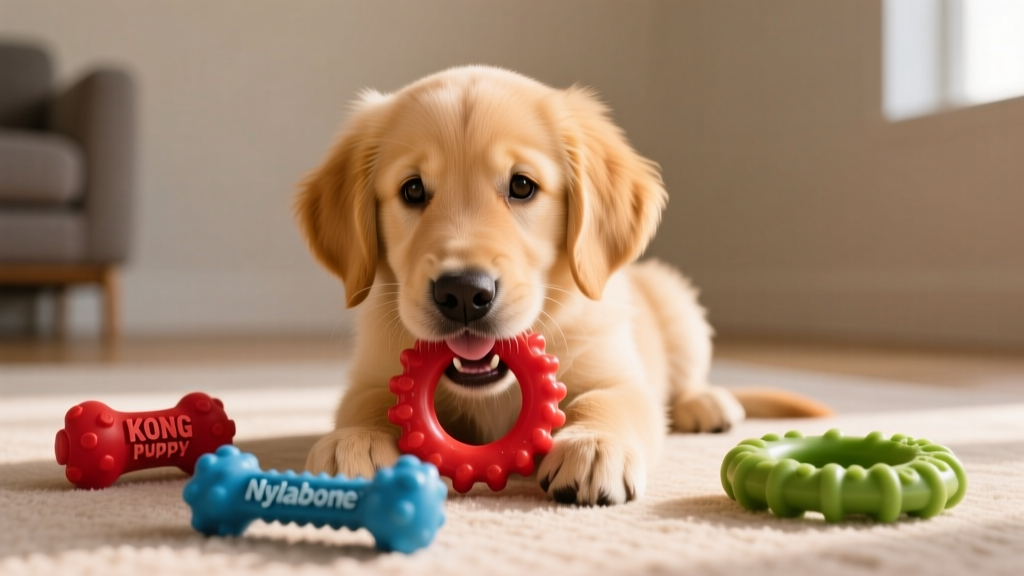
- 8–12 weeks: Soft rubber toys (Kong Puppy, Nylabone Puppy), frozen damp washcloth twisted into a rope
- 3–5 months: Medium-firm rubber (Kong Classic, West Paw Zogoflex), bully sticks (supervised), frozen carrot sticks
- 5–7 months: Harder chews (Benebone, Yak cheese chews), but avoid antlers and weight-bearing bones — these fracture puppy teeth and adult teeth alike
Common Aussie Shepherd Puppy Problems and Solutions
Puppy Biting and Nipping
Australian Shepherds are herding dogs — nipping at moving targets (ankles, hands, children) is hardwired genetic behavior, not aggression. However, it must be redirected early.
How to stop puppy biting/nipping:
- Redirect to a toy: When puppy mouths skin, immediately offer an appropriate chew toy. Praise enthusiastically when they take it.
- "Ouch" protocol: Give a calm, medium-volume "ouch" or "too bad" and withdraw attention for 10–15 seconds (stand up, turn away). Resume interaction when puppy is calm.
- Time-outs: If biting persists after 2–3 redirects, calmly place puppy in a playpen or crate for a 30–60 second cool-down. This teaches that biting ends play.
- Exercise deficit check: Aussie puppies that bite excessively are often under-exercised or under-stimulated mentally. Add a 10-minute training session or puzzle feeder before the problem times of day.
Never hold the puppy's mouth shut, alpha roll, or use physical punishment. These methods increase fear and can escalate biting. The American Veterinary Society of Animal Behavior explicitly advises against dominance-based training methods due to their association with increased aggression and anxiety.
Destructive Chewing
A bored Aussie Shepherd puppy will dismantle your home. Prevention framework:
- Management: Puppy-proof rooms by removing shoes, cords, and small objects. Use baby gates to restrict access.
- Appropriate outlets: Provide 4–6 approved chew toys of varying textures. Rotate them every 3–4 days to maintain novelty.
- Mental stimulation: Puzzle feeders (Kong Wobbler, Outward Hound Nina Ottosson puzzles), snuffle mats, and scatter feeding reduce destructive behavior by satisfying the breed's problem-solving drive.
Herding Behaviors (Circling, Stalking, Heel-Nipping)
These are normal breed behaviors that need channeling, not suppressing:
- Enroll in herding instinct tests (offered by ASCA — Australian Shepherd Club of America) once your puppy is 6+ months and fully vaccinated
- Use Treibball (urban herding with exercise balls) as a home alternative
- Redirect herding of children with a strong "leave it" cue and an incompatible behavior like "go to your mat"
First-Year Cost Breakdown for an Aussie Shepherd Puppy
Budget realistically. Here's what first-year ownership actually costs based on 2025–2026 pricing data from veterinary practices and pet supply retailers across the US:
| Category | Items | Estimated Cost Range |
|---|---|---|
| Puppy Purchase/Adoption | Responsible breeder ($1,200–$2,500) or rescue/adoption ($200–$500) | $200–$2,500 |
| Veterinary Care | Puppy vaccine series, spay/neuter, microchip, fecal tests, heartworm prevention, wellness exams | $600–$1,200 |
| Food | Puppy food (12 months), treats, supplements if recommended | $400–$800 |
| Supplies | Crate ($60–$120), bed, leash/harness, bowls, toys, grooming tools, baby gates, enzymatic cleaner | $250–$500 |
| Training | Puppy class ($150–$300), optional private sessions ($75–$150/session) | $150–$600 |
| Preventive Medications | Flea/tick (NexGard, Simparica Trio), heartworm (Heartgard Plus), dewormer | $200–$400 |
| Pet Insurance | Monthly premium (optional but recommended) | $350–$600/year |
Total first-year cost: $2,150–$6,600 depending on acquisition method and your choices on insurance, training, and food quality. Ongoing annual costs after year one typically range from $1,200–$2,500.
Frequently Asked Questions
How often should I feed my Aussie Shepherd puppy at each age?
Feed 4 meals per day from 8–12 weeks, 3 meals per day from 3–6 months, and transition to 2 meals per day from 6 months onward. Consistency matters — feed at the same times daily and remove uneaten food after 15–20 minutes to establish a routine that also supports potty training.
When will my Aussie Shepherd puppy be fully potty trained?
Most Aussie Shepherd puppies are reliably house-trained between 4 and 6 months with a consistent schedule. However, occasional accidents are normal until 8–10 months, particularly during excitement, routine changes, or developmental regressions. Full bladder control matures around 12 months.
What vaccines does my Aussie Shepherd puppy need and when?
Core vaccines include DHPP (Distemper, Hepatitis, Parainfluenza, Parvovirus) at 6–8 weeks, 10–12 weeks, and 14–16 weeks, plus Rabies at 14–16 weeks. Non-core vaccines like Bordetella, Lyme, Leptospirosis, and Canine Influenza depend on your area and lifestyle. Your veterinarian will tailor the protocol to your puppy's specific risk profile.
How do I stop my Aussie Shepherd puppy from biting?
Redirect to appropriate chew toys, use a calm "ouch" marker followed by brief attention withdrawal (10–15 seconds), and implement 30–60 second cool-down time-outs if biting persists. Ensure your puppy gets adequate physical exercise and mental stimulation — under-stimulated Aussie puppies bite significantly more. Never use physical punishment, which increases fear-based aggression.
When can my puppy go outside and meet other dogs?
You can carry your puppy in public immediately for socialization exposure. For ground-level walks and direct dog-to-dog interaction, wait until at least 7 days after the second DHPP vaccine (around 12–13 weeks). Puppy socialization classes that require proof of first vaccination are considered safe starting at 7–8 weeks according to the American Veterinary Society of Animal Behavior.
How much exercise does an Aussie Shepherd puppy need?
Follow the "5 minutes per month of age, twice daily" guideline as a baseline: a 3-month-old gets roughly 15 minutes of structured exercise twice daily, a 6-month-old gets 30 minutes twice daily. Supplement with mental stimulation (training sessions, puzzle toys, scent work) which tires an Aussie more effectively than physical exercise alone. Avoid forced running, jumping, or repetitive fetch on hard surfaces until growth plates close around 12–18 months.
Should I get pet insurance for my Aussie Shepherd puppy?
Yes, strongly recommended. Australian Shepherds are predisposed to conditions like hip dysplasia, epilepsy, and certain eye diseases (including hereditary cataracts and progressive retinal atrophy) that can cost $2,000–$8,000+ to treat. Enrolling at 8–10 weeks locks in the lowest premium and ensures pre-existing condition exclusions don't apply. Companies like Trupanion, Healthy Paws, and Lemonade offer plans ranging from $30–$55/month for puppy enrollment.
Priya Sutaria
All our authors care for dogs every day — read more of their work on the authors page.