Aussie Shepherd Puppies: The Complete Week-by-Week Care Guide
Everything you need to raise Aussie Shepherd puppies: milestone timelines, feeding schedules, vaccination charts, potty training, and first-year costs.

If you've just brought home an Aussie Shepherd puppy — or you're preparing to — you're signing up for one of the most rewarding and demanding experiences in dog ownership. Australian Shepherd puppies are whip-smart, endlessly energetic, and wired to work. That combination makes them extraordinary companions, but it also means their puppyhood requires more structure, more mental stimulation, and more deliberate socialization than many other breeds.
This guide walks you through every critical stage of your Aussie Shepherd puppy's first year, with breed-specific expectations, exact feeding portions, vaccination timelines, and real-world troubleshooting for the problems Aussie owners actually face. Whether your pup is a purebred Australian Shepherd or an Aussie mix, the developmental milestones and care protocols below will keep you on track.
When Should You Bring Your Aussie Shepherd Puppy Home?
The optimal window to bring an Aussie Shepherd puppy home is between 8 and 10 weeks of age. While some breeders release puppies at 8 weeks, many reputable Australian Shepherd breeders prefer to hold pups until 10 weeks — and there's a sound behavioral reason for this.
Australian Shepherds are a herding breed with strong environmental sensitivity. The extra two weeks spent with littermates and the dam teaches bite inhibition, canine social cues, and emotional resilience that are harder to replicate in a human household. According to the American Kennel Club, puppies removed before 8 weeks show higher rates of fear-based behaviors and poor impulse control later in life.
Red flags from breeders: Anyone offering a puppy before 7 weeks, unable to show health clearances for both parents (OFA hips, elbows, and CERF eye exams), or unwilling to let you visit the whelping environment should be avoided. A responsible Aussie breeder will have started early neurological stimulation (ENS) and initial socialization protocols before your puppy leaves.
Aussie Shepherd Puppy Milestones: Week by Week
Australian Shepherds develop rapidly, but their emotional maturity lags behind their physical growth. Understanding what's normal at each stage prevents unnecessary panic and helps you set realistic expectations.
Weeks 4–8 (At the Breeder)
- Physical: Eyes fully open, baby teeth fully erupted, beginning to explore solid food alongside nursing. Weight typically 3–6 lb (1.4–2.7 kg).
- Behavioral: Critical socialization period begins. Puppies learn bite inhibition through littermate play, develop startle/recovery responses, and begin forming attachments to humans.
- What the breeder should be doing: Introducing novel surfaces (tarps, grates, wobble boards), beginning crate exposure with open-door feeding, exposing pups to household sounds, and starting early handling exercises (ear touching, paw handling, mouth opening).
Weeks 8–12 (Home Transition)
- Physical: Rapid growth phase. Expect weight gain of roughly 1–1.5 lb (0.5–0.7 kg) per week. Coordination improves but clumsiness is normal.
- Behavioral: Fear imprint period (8–11 weeks) — negative experiences during this window can create lasting phobias. Your Aussie pup will follow you everywhere, mouth everything, and have an attention span of roughly 2–4 minutes per training session.
- Sleep: 18–20 hours per day is normal. Puppies this age cannot stay awake for more than 45–60 minutes between naps.
- Key task: Build positive associations with handling, grooming tools, car rides, and new people. Keep all experiences voluntary and reward-based.
Weeks 12–16 (Foundation Building)
- Physical: Weight reaches approximately 15–25 lb (7–11 kg) depending on projected adult size. Adult coat begins replacing puppy fuzz. Energy levels surge.
- Behavioral: Second fear period may begin around 14–16 weeks. Previously confident puppies may suddenly become cautious about new objects or people. This is normal — do not force interactions.
- Training: Can now hold attention for 5–8 minute sessions. Ideal time to introduce name recognition, sit, down, recall foundations, and impulse control games (wait for food, leave-it).
- Herding instinct: You may notice your puppy circling, nipping at heels, or staring intensely at moving children or other pets. This is breed-typical and should be redirected, not punished.
Weeks 16–24 (The Adolescent Transition)
- Physical: Growth rate slows. Puppy reaches roughly 60–70% of adult weight. Baby teeth begin falling out (see teething section below). Spay/neuter discussions with your vet typically happen in this window.
- Behavioral: Independence increases. Recall reliability often drops. Your Aussie may "forget" previously learned cues — this is developmental, not defiance. Continue training with patience.
- Exercise: Structured exercise (leash walks, controlled play) should follow the 5-minute-per-month-of-age rule: a 4-month-old gets roughly 20 minutes of structured activity per session, twice daily. Avoid repetitive high-impact exercise (long runs, agility jumps, frisbee) until growth plates close at 12–18 months.
Months 6–12 (Adolescence)
- Physical: Approaching adult height; filling out in chest and musculature. Expected adult weight for Australian Shepherds: males 50–65 lb (23–29 kg), females 40–55 lb (18–25 kg). Height at shoulder: males 20–23 inches, females 18–21 inches.
- Behavioral: Sexual maturity arrives (if intact). Same-sex aggression may emerge, particularly in males. Herding behaviors intensify. Mental stimulation becomes non-negotiable — a bored adolescent Aussie will invent their own "job," which usually involves destructive behavior.
- Training milestone: This is the ideal window to enroll in intermediate obedience, nose work, trick training, or introductory herding clinics. Aussie Shepherds thrive with structured cognitive challenges.
Feeding Schedule: Exact Portions for Aussie Shepherd Puppies
Australian Shepherds are medium-sized, active dogs with specific nutritional needs during growth. Overfeeding accelerates growth rate and increases the risk of hip and elbow dysplasia — conditions the breed is already predisposed to. Underfeeding compromises immune development and coat quality.
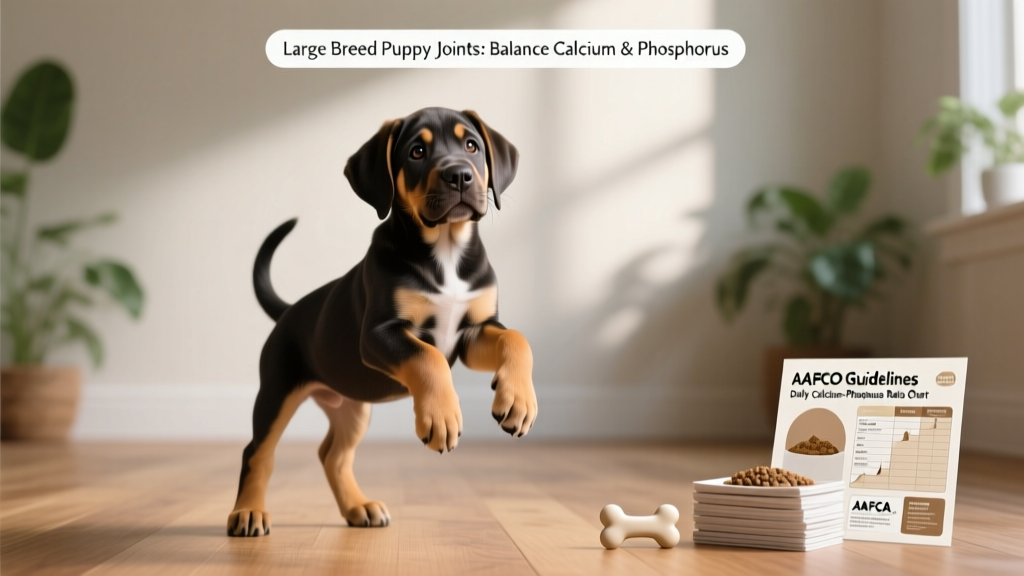
Feed a large-breed puppy formula (AAFCO-approved for growth/all life stages) until approximately 12 months of age, then transition to an adult formula. The "large-breed" designation matters even for medium breeds like Aussies because these formulas control calcium-to-phosphorus ratios and caloric density to support steady, joint-safe growth.
| Age | Meals Per Day | Daily Total (Dry Kibble) | Calorie Target (kcal/day) |
|---|---|---|---|
| 8–12 weeks | 4 meals | ¾ – 1¼ cups | 350–500 |
| 3–4 months | 3 meals | 1¼ – 1¾ cups | 500–700 |
| 5–6 months | 2–3 meals | 1¾ – 2½ cups | 700–900 |
| 7–12 months | 2 meals | 2 – 3 cups | 850–1,100 |
How to calibrate portions: These ranges assume a kibble with approximately 375–425 kcal/cup (typical for brands like Purina Pro Plan Large Breed Puppy, Royal Canin Medium Puppy, or Orijen Puppy Large). Check your specific food's caloric density and adjust accordingly. Use body condition scoring — you should feel ribs without pressing hard, and see a visible waist when viewed from above. A body condition score (BCS) of 4–5 out of 9 is ideal for growing puppies.
Transition tip: When you bring your puppy home, feed the exact food the breeder used for at least 7–10 days. Then transition gradually: 25% new food for 2 days, 50% for 2 days, 75% for 2 days, then 100%. This prevents GI upset during an already stressful life change.
Vaccination Schedule for Aussie Shepherd Puppies
Your puppy's immune system is partially protected by maternal antibodies received through colostrum, but these antibodies wane at unpredictable rates between 6 and 16 weeks. The vaccination series is designed to "catch" immunity as maternal protection drops. According to the American Veterinary Medical Association, core vaccines are essential for all puppies regardless of lifestyle.
| Age | Vaccines | Notes |
|---|---|---|
| 6–8 weeks | DHPP (Distemper, Hepatitis/Adenovirus, Parainfluenza, Parvovirus) — 1st dose | Often given by breeder before pickup |
| 10–12 weeks | DHPP — 2nd dose; Bordetella (kennel cough) optional | Bordetella recommended if attending puppy classes or boarding |
| 14–16 weeks | DHPP — 3rd dose; Rabies (required by law) | Rabies timing varies by state — some require 12 weeks, others 16 |
| 12–16 months | DHPP booster; Rabies booster | After this, DHPP typically moves to 3-year intervals |
Non-core vaccines to discuss with your vet: Leptospirosis (increasingly common in suburban areas with wildlife), Lyme disease (if you live in tick-endemic regions like the Northeast or Upper Midwest), and Canine Influenza (if your dog will be frequently boarded or attend dog shows). Your veterinarian will determine which non-core vaccines are appropriate based on your geographic area and lifestyle.
When can your puppy go outside and meet other dogs? Full vaccination protection is typically achieved 1–2 weeks after the final puppy DHPP dose at 14–16 weeks. Until then, avoid dog parks, pet store floors, and areas with unknown dog traffic. However, controlled socialization with known, fully vaccinated adult dogs in private yards is generally safe and critically important during the socialization window.
The Socialization Window: Weeks 3–14
The primary socialization period for puppies closes around 12–14 weeks of age. After this window, unfamiliar stimuli are more likely to trigger fear responses than curiosity. For Australian Shepherds — a breed prone to environmental sensitivity and wariness of strangers — this window is arguably the most important developmental period of their lives.
Research published in the Journal of Veterinary Behavior demonstrates that puppies with inadequate socialization during this period are significantly more likely to develop fear-based aggression, noise phobias, and separation anxiety. The goal is not to overwhelm your puppy, but to provide a wide variety of positive, low-pressure exposures.
Critical rule: Never force an interaction. If your Aussie puppy backs away, cowers, or tucks their tail, increase distance and let them observe from a comfortable range. Toss treats toward the scary thing. This is called counter-conditioning — you're teaching your puppy that novel stimuli predict good outcomes. Forcing a fearful puppy into an interaction can create a permanent negative association.
Potty Training Timeline & Troubleshooting
Australian Shepherd puppies are generally quick learners when it comes to housebreaking — their intelligence and desire to please work in your favor. However, "quick" still means 4–6 months for reliable house training, with occasional accidents possible until 8–10 months. Anyone promising faster results is setting you up for frustration.
Realistic Potty Training Timeline
- 8–12 weeks: Puppy needs to eliminate every 30–60 minutes during active hours. Expect 1–3 accidents per week even with diligent management. You are essentially a potty escort service.
- 3–4 months: Bladder control improves. Can hold for 2–3 hours during the day, 5–6 hours overnight. Accidents drop to roughly 1 per week if you maintain a schedule.
- 5–6 months: Most Aussies begin signaling (going to the door, whining, ringing a bell) when they need to go out. Overnight holding reaches 7–8 hours. Accidents become rare (1–2 per month).
- 7–10 months: Reliable house training for most puppies. Occasional regression may occur during adolescence — this is normal and temporary. Maintain your routine.
Potty Training Protocol That Works for Aussies
- Establish a fixed schedule: Take your puppy out immediately upon waking, after every meal, after every play session, after every nap, and before bed. For an 8–12 week old, this means roughly 12–15 trips outside per day.
- Use a consistent cue word: Say "go potty" (or your chosen phrase) while they eliminate, then reward with a high-value treat immediately after they finish — not when they come back inside.
- Supervise or confine: When you cannot actively watch your puppy, they should be in a crate or exercise pen. Unsupervised roaming is the #1 cause of prolonged potty training setbacks.
- Never punish accidents: Rubbing a puppy's nose in urine or yelling after the fact teaches them to hide when they eliminate, not to eliminate outside. If you catch them mid-accident, interrupt calmly ("oops!") and carry them outside to finish.
- Enzymatic cleaner only: Use a product like Nature's Miracle or Rocco & Roxie to fully break down urine proteins. Standard household cleaners leave residual scent that attracts repeat elimination.
Potty Training Log Template (First 2 Weeks)
Track these data points to identify your puppy's natural rhythm:
- Time of outing | Location | Result (pee/poop/both/nothing) | Cue used | Reward given
- Time of any indoor accident | Location | What happened 30 min prior (eating, playing, sleeping)
After 7–10 days of logging, you'll see clear patterns — most Aussies need to go out within 10–15 minutes of eating and 5–10 minutes after vigorous play.
Crate Training Progression for Australian Shepherd Puppies
Australian Shepherds are velcro dogs — they bond intensely and often develop separation-related distress if not taught independent confidence early. Crate training is not just a housebreaking tool; it's a foundation for emotional regulation.
Crate Time Limits by Age
| Puppy Age | Maximum Crate Time (Daytime) | Maximum Overnight |
|---|---|---|
| 8–10 weeks | 30–45 minutes | 3–4 hours (set an alarm) |
| 11–14 weeks | 1–1.5 hours | 4–5 hours |
| 3–4 months | 1.5–2 hours | 5–6 hours |
| 5–6 months | 2–3 hours | 7–8 hours |
Crate training steps:
- Feed all meals in the crate with the door open for the first week.
- Introduce a cue word ("crate" or "kennel") and toss treats inside. Let puppy enter and exit freely.
- Begin closing the door for 10-second intervals while you sit nearby. Gradually extend to 1 minute, 5 minutes, 15 minutes.
- Step out of the room for 30 seconds, then return before puppy becomes distressed. Build duration gradually.
- Provide a food-stuffed enrichment toy (Kong Classic frozen with peanut butter, or a West Paw Toppl) every time puppy enters the crate. This creates a positive association.
Crate size for a growing Aussie: Purchase a 42-inch wire crate with a divider panel (brands like MidWest Homes iCrate or Frisco). Adjust the divider as your puppy grows so the space is large enough to stand, turn, and lie down — but not so large they can eliminate in one corner and sleep in another.
Teething Timeline & Relief Strategies (3–6 Months)
Australian Shepherd puppies begin losing their 28 deciduous (baby) teeth around 12–16 weeks, with the process typically completing by 6–7 months when all 42 adult teeth have erupted. During this window, your puppy's gums are inflamed, their jaw aches, and their compulsion to chew becomes intense.
Teething Phase Breakdown
- 12–16 weeks: Incisors (front teeth) loosen and fall out first. You may find tiny teeth on the floor, or your puppy may swallow them (harmless). Mild bleeding from gums is normal.
- 16–20 weeks: Canine teeth (fangs) and premolars begin erupting. This is peak chewing intensity. Your puppy will target furniture legs, shoes, baseboards, and your hands.
- 20–28 weeks: Molars erupt in the back. Chewing intensity gradually decreases. By 7 months, all adult teeth should be in place.
Safe Chew Recommendations
- Frozen Kongs: Stuff a Kong Classic (size Medium for puppies under 30 lb, Large for puppies over 30 lb) with plain yogurt and mashed banana, then freeze for 4 hours. The cold numbs sore gums.
- Benebone Wishbone (Puppy line): Made from softer nylon designed for developing teeth. The wishbone shape allows puppies to grip with their paws.
- Frozen carrot sticks: A low-calorie, fully digestible option. Supervise to prevent choking on large pieces.
- Wet washcloth (frozen): Wet a clean washcloth, twist into a rope shape, freeze for 2 hours, and let puppy chew under supervision. Remove once thawed.
Avoid: Hard antlers, weight-bearing bones from large animals, and hard nylon chews designed for adult dogs — these can fracture puppy teeth (specifically the carnassial teeth), leading to painful and expensive dental surgery. Rawhide is a choking and blockage hazard for puppies who gulp rather than chew.
Common Aussie Shepherd Puppy Problems & Solutions
Every breed has its puppyhood challenges. Australian Shepherds come with a specific set of behavioral tendencies rooted in their herding heritage and high intelligence. Here's how to handle the most common issues.
Puppy Biting and Nipping
Aussie puppies are mouthy — this is a herding breed that was selected for generations to use their mouths to control livestock. Nipping at heels, hands, and clothing is not aggression; it's instinct. However, it must be redirected before it becomes an ingrained habit.
Solution protocol:
- Redirect to a toy: Every time teeth touch skin, say "oops" in a neutral tone, withdraw your hand, and immediately present an appropriate chew toy. Reward chewing the toy with praise.
- Reverse time-outs: If redirecting fails, stand up, cross your arms, and ignore the puppy for 15–20 seconds. This teaches that biting ends interaction — the opposite of what they want.
- Teach "gentle": Hold a treat in a closed fist. Let puppy nose and lick at your hand. The instant they stop using teeth, open your hand and give the treat. Progress to offering treats from flat palm.
- Satisfy the herding drive: Provide herding balls (Jolly Ball, 10-inch size), flirt poles with tug attachments, or structured games like "find it" (scatter treats in grass for them to sniff out). These channel the mouth-and-movement drive appropriately.
Excessive Whining and Vocalization
Aussies are a vocal breed. Puppy whining in the crate, especially at night and during your first weeks together, is nearly universal. The key is distinguishing distress from demand.
If puppy needs to eliminate: Take them out immediately, then return to crate. Keep this interaction boring — no play, no talking, lights low.
If puppy is protesting confinement: Wait for a 3–5 second pause in whining before opening the crate or approaching. Releasing a puppy while they're vocalizing teaches that noise opens doors. If whining persists beyond 15–20 minutes despite having been exercised, fed, and toileted, the crate may be in an isolating location. Aussies do better with the crate in a common area where they can see and hear the family.
Destructive Chewing
An under-stimulated Aussie puppy will dismantle your home. This breed needs both physical exercise and mental work. A 20-minute walk is not enough — pair it with a 10–15 minute training session or puzzle feeder meal.
Management strategy: Puppy-proof one room completely rather than trying to protect the entire house. Use baby gates. Provide a rotation of 5–7 chew toys (rotate every 2–3 days to maintain novelty). Use bitter apple spray (Grannick's Bitter Apple) on furniture legs as a deterrent, but understand that roughly 20% of dogs are not bothered by the taste — management and redirection are more reliable than taste deterrents alone.
First-Year Cost Breakdown for an Aussie Shepherd
Budgeting accurately prevents unpleasant surprises. The following ranges reflect 2026 pricing for a medium-sized, active-breed puppy in the United States. Costs vary by region — expect urban areas (NYC, San Francisco, Seattle) to run 20–40% higher than rural averages.
| Category | Low Estimate | Mid Estimate | High Estimate |
|---|---|---|---|
| Puppy purchase (responsible breeder) | $1,200 | $2,000 | $3,500 |
| Veterinary care (vaccines, spay/neuter, microchip, wellness exams) | $600 | $1,000 | $1,800 |
| Food (12 months, quality kibble) | $400 | $600 | $900 |
| Supplies (crate, leash, harness, bowls, toys, grooming tools) | $200 | $400 | $650 |
| Training (puppy class + intermediate obedience) | $200 | $500 | $1,200 |
| Pet insurance (annual premium) | $400 | $700 | $1,100 |
| Flea/tick/heartworm prevention (12 months) | $150 | $250 | $400 |
| Total First Year | $3,150 | $5,450 | $9,550 |
Adoption alternative: If you adopt an Aussie Shepherd puppy or young adult from a breed-specific rescue (such as Aussie Rescue & Placement Services), expect adoption fees of $300–$600, which typically include initial veterinary care, spay/neuter, and microchipping. This significantly reduces first-year costs while giving a deserving dog a home.
Emergency fund recommendation: Set aside an additional $1,000–$2,000 for unexpected veterinary emergencies. Australian Shepherds are generally healthy, but puppies are prone to ingesting foreign objects, and the breed carries genetic risks for conditions like MDR1 drug sensitivity, epilepsy, and hip dysplasia that may require early intervention.
Frequently Asked Questions About Aussie Shepherd Puppies
How often should I feed my Aussie Shepherd puppy at each age?
At 8–12 weeks, feed 4 meals per day. At 3–4 months, reduce to 3 meals per day. At 5–6 months, you can transition to 2–3 meals. From 7 months onward, 2 meals per day is standard. Never feed a single large meal — this breed has a moderate risk of gastric dilatation-volvulus (bloat), and multiple smaller meals reduce that risk.
When will my Aussie Shepherd puppy be fully potty trained?
Most Australian Shepherd puppies achieve reliable house training between 5 and 7 months of age, with occasional accidents possible until 8–10 months. Consistency with schedule, supervision, and positive reinforcement accelerates the process. If your puppy is still having frequent accidents after 6 months, consult your veterinarian to rule out urinary tract infections or anatomical issues.
How do I stop my Aussie Shepherd puppy from biting and nipping?
Redirect every bite to an appropriate chew toy, use reverse time-outs (withdrawing attention for 15–20 seconds when teeth touch skin), and provide adequate outlets for the herding drive — flirt poles, herding balls, and scent work games. Never use physical punishment, alpha rolls, or holding the mouth shut — these methods damage trust and can escalate fear-based aggression. Positive reinforcement and redirection are the only methods recommended by certified behaviorists.
When can my Aussie Shepherd puppy go to dog parks?
Wait until at least 1–2 weeks after the final DHPP vaccination, typically around 16–18 weeks of age. Even then, dog parks carry risks — unvaccinated dogs, rough play, and disease exposure. Many Aussie owners prefer structured puppy socialization classes, arranged playdates with known vaccinated dogs, or off-leash hiking in low-traffic areas as safer alternatives to dog parks.
Are Australian Shepherd puppies good with children?
Aussies can be excellent family dogs, but their herding instinct means they may nip at running children's heels or try to "herd" toddlers. Early socialization with children and teaching kids to interact calmly with the puppy (no tail pulling, no approaching while eating) is essential. Supervision is non-negotiable until both the child and dog have demonstrated consistent, appropriate behavior — typically around age 8–10 for the child and 18+ months for the dog.
How much exercise does an Aussie Shepherd puppy need daily?
Follow the 5-minute-per-month-of-age guideline for structured exercise: a 3-month-old puppy gets approximately 15 minutes of leash walking per session, twice daily. Supplement with mental stimulation — training sessions, puzzle feeders, and sniffing walks — which tire an Aussie's brain more effectively than physical exercise alone. Avoid repetitive jumping, long-distance running, or forced exercise on hard surfaces until growth plates close (confirmed by your vet via X-ray, typically 14–18 months).
Raising an Aussie Shepherd puppy is a significant investment of time, patience, and resources — but the result is a brilliantly intelligent, deeply loyal companion who will excel at whatever activities you pursue together. The foundation you build in these first 12 months shapes the next 12–15 years of your dog's life. When in doubt about any health or behavioral concern, consult your veterinarian or a certified professional dog trainer (CPDT-KA or IAABC-certified) for personalized guidance.
Priya Sutaria
All our authors care for dogs every day — read more of their work on the authors page.