AKC S.T.A.R. Puppy Guide: Training, Milestones & First-Year Care Plan
Complete AKC S.T.A.R. Puppy guide covering enrollment requirements, age milestones, feeding schedules, vaccination timelines, potty training, and first-year costs.

If you've just brought home a new puppy—or are counting down the days until pickup—you've probably heard about the AKC S.T.A.R. Puppy program. Standing for Socialization, Training, Activity, and Responsibility, this American Kennel Club certification gives first-time and experienced owners a structured roadmap through the chaotic first year of puppyhood. Unlike the Canine Good Citizen (CGC) test, which evaluates trained adult dogs, the S.T.A.R. Puppy program is designed specifically for puppies under one year old and focuses as much on owner education as it does on puppy skills.
This guide walks you through every developmental stage from weeks 4 through 12 months, aligns your puppy's care schedule with AKC S.T.A.R. Puppy requirements, and gives you the concrete numbers—portions, timeframes, costs—that generic puppy articles leave out. As always, consult your veterinarian for decisions specific to your puppy's breed, size, and health status.
When Should I Bring My Puppy Home?
The consensus among veterinary behaviorists and the American Kennel Club is clear: puppies should remain with their littermates and dam until at least 8 weeks of age, with 10-12 weeks being preferable for toy and small breeds. During weeks 4-8, puppies learn bite inhibition, canine social cues, and stress coping mechanisms from their mother and siblings—skills that are nearly impossible to replicate in a human household.
Reputable breeders following AKC Breeder of Merit standards typically keep puppies until 8-10 weeks, begin early neurological stimulation (ENS) from days 3-16, and start basic crate and potty routines before placement. If a breeder offers you a puppy at 5-6 weeks, consider it a red flag.
Age-Specific Puppy Milestones: Weeks 4 Through 12 Months
Every puppy develops on their own timeline, but breed-specific expectations help you distinguish normal behavior from potential concerns. Below is a milestone framework organized around the critical windows that the AKC S.T.A.R. Puppy program emphasizes.
Weeks 4-8: Litter Learning Phase (Typically with Breeder)
- Social: Play-fighting with littermates, learning bite inhibition, responding to dam's correction
- Physical: Baby teeth fully erupted, coordination improving rapidly, weight gain of 5-10% daily
- Sensory: Full hearing by week 4, vision maturing, startle reflex to loud noises developing
- Training readiness: Can begin responding to name, introduced to soft surfaces and novel textures
Weeks 8-12: Primary Socialization Window Opens
- Social: Fear imprint period begins around week 8—negative experiences can create lasting phobias
- Physical: Bladder capacity roughly 1 hour per month of age (so ~2 hours max at 8 weeks)
- Sleep: 18-20 hours per day is normal; overtired puppies bite more and learn less
- Training: Can learn sit, name recognition, and begin leash introduction indoors
- AKC S.T.A.R. focus: Begin keeping socialization log (required documentation for evaluation)
Weeks 12-16: Confidence Building & Vaccine Completion
- Social: Secondary fear period may emerge around 12 weeks; keep exposures positive
- Physical: Adult teeth begin loosening baby incisors; chewing intensity increases sharply
- Training: Can learn down, stay (2-3 seconds), come with low distraction, loose-leash basics
- AKC S.T.A.R. focus: Puppy should tolerate handling of ears, paws, and mouth without aggression
Weeks 16-24: Adolescence Begins
- Social: Testing boundaries, may "forget" previously learned commands temporarily
- Physical: Peak teething discomfort (4-5 months), growth plates still open in large breeds
- Training: Can begin S.T.A.R. Puppy class curriculum: sit for petting, accept stranger handling, walk on leash past distractions
- AKC S.T.A.R. focus: Enroll in AKC-approved training class (minimum 6 sessions required)
6-12 Months: Refinement & Evaluation Readiness
- Social: Sexual maturity (if intact); potential same-sex aggression emergence in some breeds
- Physical: Most breeds reach 70-80% of adult weight by 6 months; giant breeds continue growing to 18-24 months
- Training: Full S.T.A.R. Puppy test eligibility—must demonstrate 20 evaluation items including sitting politely for greeting, walking through a door on leash, and staying with owner when a distraction is presented
Feeding Schedule: Exact Portions by Age and Weight
One of the most common questions new puppy owners ask is "how much and how often?" The answer depends on your puppy's current weight, expected adult size, and the caloric density of the food you choose. The following table assumes an AAFCO-approved puppy formula providing approximately 350-400 kcal per cup (check your specific bag's guaranteed analysis).
| Puppy Age | Meals/Day | Small Breed (10-25 lb adult) cups/meal |
Medium Breed (25-60 lb adult) cups/meal |
Large Breed (60-100+ lb adult) cups/meal |
|---|---|---|---|---|
| 8-12 weeks | 4 | ¼ - ⅓ | ½ - ¾ | ¾ - 1 |
| 12-16 weeks | 3 | ⅓ - ½ | ¾ - 1 | 1 - 1½ |
| 4-6 months | 3 | ½ - ¾ | 1 - 1½ | 1½ - 2½ |
| 6-12 months | 2 | ¾ - 1 | 1½ - 2 | 2 - 3½ |
Large breed note: Puppies expected to exceed 70 lb at maturity should be fed a large-breed puppy formula with controlled calcium (1.1-1.8% on a dry matter basis) and caloric density to prevent rapid growth linked to developmental orthopedic diseases like hip dysplasia and osteochondrosis. The Merck Veterinary Manual provides detailed guidance on growth-rate management.
Transition tip: When switching foods, mix 25% new food with 75% old food for days 1-3, then 50/50 for days 4-6, then 75% new for days 7-9. Sudden diet changes cause diarrhea in 40-60% of puppies.
Vaccination Schedule: What Your Puppy Needs and When
The AKC S.T.A.R. Puppy program requires that your puppy is current on vaccinations as determined by your veterinarian. The following schedule aligns with the AAHA Canine Vaccination Guidelines used by most US veterinary practices. Always consult your veterinarian for a schedule tailored to your puppy's risk profile and local disease prevalence.
| Age | Vaccine | Purpose | Typical Cost |
|---|---|---|---|
| 6-8 weeks | DHPP (Distemper, Hepatitis, Parainfluenza, Parvovirus) — 1st dose | Core protection against fatal viral diseases | $20-$40 |
| 10-12 weeks | DHPP — 2nd dose + Bordetella (optional) | Booster immunity; kennel cough prevention for class environments | $25-$50 |
| 14-16 weeks | DHPP — 3rd dose + Rabies (12-16 weeks per state law) | Final core booster; legal requirement | $30-$60 |
| 12-16 months | DHPP booster + Rabies booster (1-year or 3-year) | Long-term immunity establishment | $40-$75 |
When can my puppy go outside and meet other dogs? The traditional advice was to wait until all vaccines were complete (around 16 weeks). However, the American Veterinary Society of Animal Behavior (AVSAB) recommends that puppies begin controlled socialization outings as early as 7-8 weeks, provided they interact only with fully vaccinated, healthy dogs in clean environments. Avoid dog parks, pet store floors, and high-traffic areas until the full DHPP series is complete. Carry your puppy or use a stroller for neighborhood exposure during the partial-immunity window.
Socialization Window: The Weeks 3-14 Exposure Checklist
The primary socialization period closes around 14 weeks—this is a neurological deadline, not a suggestion. Research published in the Journal of Veterinary Behavior demonstrates that puppies with fewer than 6 novel positive experiences per week during this window are significantly more likely to develop fear-based aggression later in life. The AKC S.T.A.R. Puppy evaluation directly tests socialization outcomes: your puppy must allow a stranger to approach, accept petting, and interact calmly with another dog.
Socialization Exposure Checklist (Target: 100 Experiences by 16 Weeks)
Surfaces (10+): Grass, gravel, tile, carpet, wet pavement, metal grate, wobbly board, sand, mulch, elevator floor
People (10+): Children ages 4-12, elderly adults, people wearing hats/sunglasses, people in uniforms, people using wheelchairs or crutches, tall men, people carrying umbrellas, delivery workers
Sounds (10+): Vacuum, doorbell, thunderstorms (recorded), traffic, clapping, dropping a pan, lawn mower, fireworks (recorded at low volume), hair dryer, children screaming
Objects (10+): Open umbrella, trash bag blowing, bicycle, skateboard, balloon, fluttering flag, rolling suitcase, bouncing ball, fluttering tarp
Handling (10+): Ear examination, paw manipulation, mouth opening, nail clipping simulation, being held on back, collar grab, towel drying, being lifted onto table, toothbrush introduction, gentle restraint
Potty Training Timeline and Troubleshooting
Realistic expectation setting is essential: most puppies achieve reliable house training between 4-6 months of age, with some toy breeds taking up to 8-10 months due to smaller bladder capacity. The AKC S.T.A.R. Puppy test does not directly evaluate house training, but evaluators expect puppies to be clean during the class and evaluation session.
Potty Training Log Template
| Time | Trigger (wake/eat/play) |
Location | Result (pee/poop/both/none) |
Accident? (Y/N + location) |
|---|---|---|---|---|
| 6:30 AM | Wake | Backyard | Both | N |
| 7:15 AM | Post-meal | Backyard | Poop | N |
| 8:00 AM | Post-play | — | None | Y — kitchen rug |
Bladder capacity formula: A puppy can typically hold urine for approximately (age in months + 1) hours during the day. An 8-week-old puppy (2 months) has a maximum daytime hold of about 2-3 hours. Overnight, puppies can often hold slightly longer due to reduced activity, but plan for at least one nighttime potty break until 12-14 weeks.
Common troubleshooting:
- Submissive urination when greeted: This is involuntary, not a training failure. Greet your puppy calmly, crouch sideways rather than looming over them, and avoid direct eye contact during greetings. Most puppies outgrow this by 6-8 months.
- Regression at 4-5 months: Often coincides with teething discomfort and adolescent hormonal changes. Return to more frequent potty breaks (every 1.5 hours instead of 2.5) for 1-2 weeks.
- Accidents in the crate: The crate is likely too large. Use a divider to size it so your puppy can stand, turn, and lie down—but not eliminate in one corner and sleep in another.
Crate Training Progression and Time Limits by Age
Crate training supports potty training, prevents destructive chewing during unsupervised periods, and gives your puppy a safe retreat. The AKC S.T.A.R. Puppy program views crate training as part of responsible ownership. Follow these maximum confinement times:
| Puppy Age | Max Daytime Crate Time | Max Overnight Crate Time | Notes |
|---|---|---|---|
| 8-10 weeks | 1-2 hours | 3-4 hours (with 1 break) | Expect whining; keep crate near your bed at night |
| 10-14 weeks | 2-3 hours | 5-6 hours | Begin moving crate to permanent location |
| 14-16 weeks | 3-4 hours | 6-7 hours | Nighttime sleep stretches lengthen |
| 4-6 months | 4-5 hours | 7-8 hours | Can begin leaving crate door open as optional retreat |
| 6-12 months | 5-6 hours | 8 hours | Transition to puppy-proofed room if reliable |
Never use the crate as punishment. Feed meals inside the crate with the door open during early training, and provide a food-stuffed enrichment toy (such as a Kong Classic sized appropriately for your puppy) to build positive association. If your puppy cries after being settled and having had a potty break, wait for 3-5 seconds of silence before opening the door—this prevents reinforcing vocalization.
Teething Timeline and Relief Strategies
Puppy teething follows a predictable pattern that catches many first-time owners off guard with its intensity.
- 3-4 weeks: Deciduous (baby) incisors erupt
- 4-6 weeks: Baby canines and premolars emerge
- 12-16 weeks: Baby incisors fall out, adult incisors replace them
- 16-20 weeks: Adult canines erupt—peak chewing and discomfort period
- 5-6 months: Adult premolars and molars complete eruption; all 42 adult teeth should be in place by 6-7 months
Safe chew recommendations during peak teething (3-6 months):
- Frozen damp washcloth twisted into a rope (supervise; discard if threads unravel)
- Kong Puppy teething rubber toys (softer formula than adult Kongs)
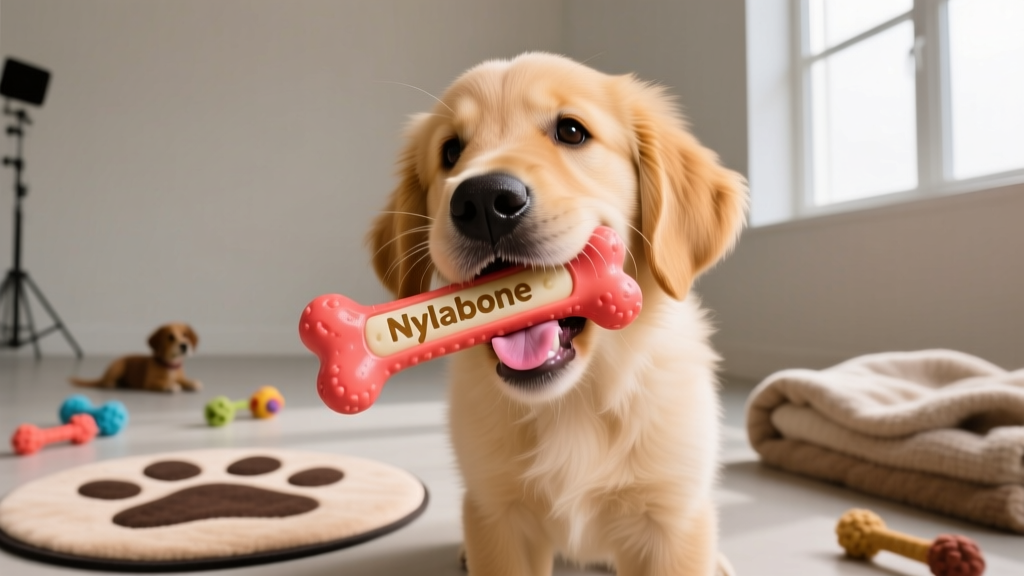
- Benebone Puppy Wishbone (nylon, sized by weight class)
- Frozen carrot sticks or green beans (low calorie, natural)
- bully sticks (single-ingredient, fully digestible; supervise to prevent choking on small ends)
Avoid: Rawhide chews (choking and intestinal blockage risk), cooked bones (splintering), ice cubes for toy breeds (tooth fracture risk), and any chew smaller than your puppy's muzzle width.
Stopping Puppy Biting and Nipping
Mouthing is normal canine behavior—puppies explore the world with their mouths just as human babies use their hands. However, the AKC S.T.A.R. Puppy evaluation requires that your puppy does not jump on or mouth people during the test. Here is a progressive protocol:
- Redirect (8-12 weeks): When teeth touch skin, immediately offer an appropriate chew toy. Praise enthusiastically when the puppy mouths the toy instead.
- Reverse time-out (12-16 weeks): If redirecting fails, stand up and turn away for 10-15 seconds the instant teeth contact skin. This mimics littermate behavior (play stops when biting is too hard). Return and resume play only when the puppy is calm.
- Structured play rules (16+ weeks): Teach "take it" and "drop it" with toys. Only engage in tug with rules: puppy must sit before the game starts, and must release on cue. If teeth touch hands, game ends for 30 seconds.
Never use physical punishment, muzzle grabbing, or alpha rolls. These methods increase fear and can escalate to defensive biting. The American Veterinary Society of Animal Behavior explicitly advises against dominance-based training techniques, which have been shown to increase aggression in peer-reviewed studies.
First-Year Cost Breakdown
Budgeting accurately prevents the sticker shock that contributes to puppy surrenders. The following ranges reflect 2025-2026 US pricing across small, medium, and large breeds.
| Category | Small Breed | Medium Breed | Large Breed |
|---|---|---|---|
| Veterinary (vaccines, wellness exams, spay/neuter) | $500-$900 | $600-$1,100 | $700-$1,400 |
| Food (puppy formula, 12 months) | $200-$400 | $350-$600 | $500-$900 |
| Supplies (crate, bed, leash, bowls, toys, gates) | $200-$350 | $250-$450 | $300-$600 |
| Training (AKC S.T.A.R. Puppy class + evaluation) | $150-$300 | $150-$300 | $150-$300 |
| Preventives (heartworm, flea/tick, 12 months) | $150-$250 | $200-$350 | $250-$400 |
| Pet insurance (annual premium) | $300-$600 | $350-$700 | $400-$900 |
| Total Estimated First Year | $1,500-$2,800 | $1,900-$3,500 | $2,300-$4,500 |
AKC S.T.A.R. Puppy class costs: Most AKC-approved training clubs charge $120-$250 for a 6-8 week group class. The evaluation itself typically costs $15-$30 and is administered by an AKC-approved evaluator at the end of the course. Some clubs bundle the evaluation fee into the class tuition.
Frequently Asked Questions
What exactly does the AKC S.T.A.R. Puppy test evaluate?
The evaluation consists of 20 items split between owner behaviors (such as maintaining a healthy diet, providing proper veterinary care, and bringing the puppy to class) and puppy behaviors (including allowing handling, walking on a loose leash, sitting for petting, and responding to basic commands like sit and down). Your puppy does not need to score perfectly—this is a pass/fail assessment of foundational skills, not a competition.
Can mixed-breed puppies earn the AKC S.T.A.R. Puppy title?
Yes. The AKC opened the S.T.A.R. Puppy program and Canine Good Citizen test to all dogs, including mixed breeds and dogs not registered with the AKC. Your puppy can participate through the AKC's Canine Partners program, which enrolls mixed-breed dogs for event eligibility.
How do I find an AKC-approved S.T.A.R. Puppy class near me?
Visit the AKC's training club directory at akc.org and search by zip code. AKC-approved evaluators are listed by state. Many independent trainers also offer S.T.A.R. Puppy preparation courses, but only evaluations administered by approved AKC evaluators result in the official certification.
Is the AKC S.T.A.R. Puppy title a prerequisite for Canine Good Citizen?
No, it is not required. However, the S.T.A.R. Puppy program builds the foundational skills that make CGC preparation significantly easier. Dogs who complete S.T.A.R. Puppy typically have an advantage when advancing to CGC, AKC Urban CGC, or therapy dog certification programs.
My puppy is almost 12 months old—can we still do S.T.A.R. Puppy?
The program is open to dogs under one year of age. If your puppy is approaching their first birthday, enroll immediately. Dogs older than 12 months should pursue the Canine Good Citizen evaluation instead, which tests similar skills at a more advanced level.
Aaron Whyte
All our authors care for dogs every day — read more of their work on the authors page.