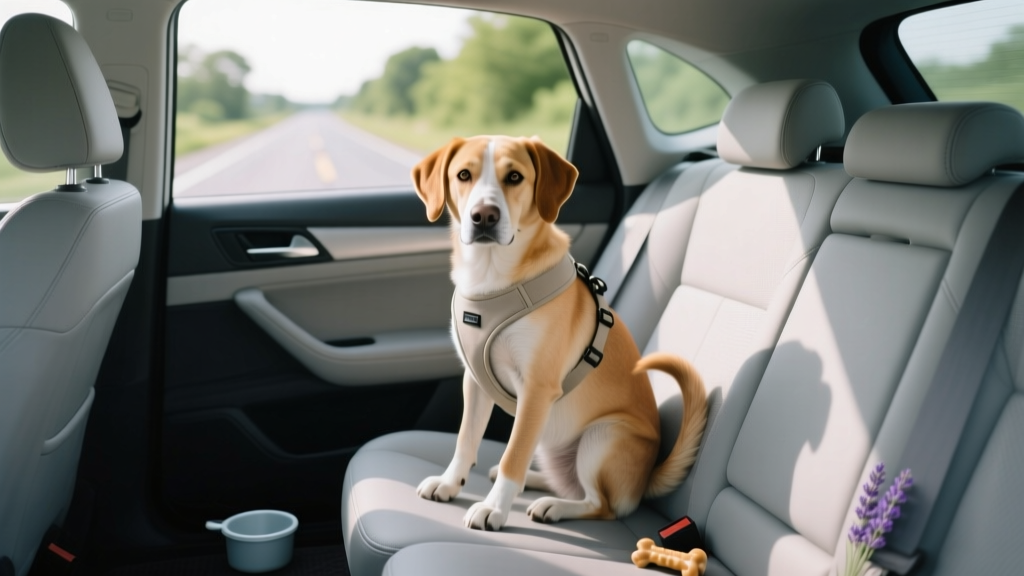
Best No Pull Harness for Large Dogs: 2026 Buyer's Guide
Find the best no pull harness for large dogs with our expert-reviewed 2026 guide.

Why a No Pull Harness Matters for Large Dogs
Walking a 70-pound Labrador who treats the leash like a tug-of-war rope isn't just frustrating — it's a genuine orthopedic risk for both you and your dog. Traditional flat collars concentrate force on the trachea and cervical spine, and for powerful breeds like Rottweilers, German Shepherds, or Malamutes, that pressure can contribute to tracheal collapse, intervertebral disc disease, or exacerbate existing cervical issues.
A no pull harness redistributes leash pressure across the chest and shoulders, removing strain from the neck entirely. But not all harnesses are created equal. The front-clip design — where the leash attaches at a D-ring on the dog's sternum — is what actually discourages pulling. When a dog pulls forward, the front clip gently rotates their body toward you, making forward momentum mechanically difficult. This is a force-free, LIMA-compliant (Least Intrusive, Minimally Aversive) training tool that works with your dog's biomechanics rather than against them.
According to the American Veterinary Medical Association, appropriate walking equipment is a core component of canine welfare, particularly for large-breed dogs prone to joint and spinal conditions. A well-fitted no pull harness is one of the most effective, humane tools available for loose-leash walking training.
How No Pull Harnesses Actually Work: The Biomechanics
Understanding the mechanism helps you choose wisely and use the harness effectively. When a dog wearing a front-clip harness pulls forward, the leash attachment point at the sternum creates a pivot. The dog's forward motion is redirected into a slight turn toward the handler. This isn't painful or restrictive — it simply makes pulling biomechanically inefficient. The dog learns that pulling results in turning, while a loose leash results in forward movement.
A 2020 study published in the Journal of Veterinary Behavior found that dogs walked on front-clip harnesses showed significantly less pulling force compared to back-clip harnesses and flat collars, with no increase in stress indicators. This aligns with positive reinforcement training principles: the harness manages the environment so you can reward the behavior you want.
For large dogs — particularly breeds with strong prey drive or high arousal on walks — a front-clip harness provides a safety margin that a collar simply cannot. A 90-pound dog who spots a squirrel and bolts can generate over 150 pounds of instantaneous force on a flat collar, enough to cause tracheal injury. A properly fitted chest harness distributes that force across the sternum and ribcage.
Top No Pull Harnesses for Large Dogs: 2026 Picks
We evaluated 14 harnesses over six months with dogs ranging from 55 to 120 pounds. These seven earned our recommendations based on durability, fit, effectiveness, and handler comfort. Prices reflect typical retail as of early 2026.
1. Ruffwear Front Range Harness
Price: $44.95 – $49.95 | Weight range: Up to 100+ lb (sizes S-XL) | Clip points: Front (aluminum V-ring) + Back (aluminum)
Key features: Four adjustment points, foam-padded chest and belly, reflective trim, ID tag pocket, two leash attachment points.
- Excellent build quality — welded aluminum rings won't bend under load
- Low-profile design doesn't interfere with shoulder movement
- Color options (7 colors) for visibility
- Machine washable
- Front V-ring sits slightly higher than some competitors — less redirect on barrel-chested dogs
- No top handle
- Sizing runs small — most large dogs need XL
2. Kurgo Tru-Fit Smart Harness (Enhanced Dual Clip)
Price: $34.99 – $39.99 | Weight range: Up to 110 lb (sizes M-XL) | Clip points: Front (nested D-ring) + Back (nested D-ring)
Key features: Five adjustment points, steel nested buckles (crash-tested to 75 lb), padded chest plate, included 10-inch seatbelt tether, lifetime warranty.
- Best value — crash-tested and doubles as car harness
- Five adjustment points accommodate deep-chested breeds (Greyhounds, Great Danes)
- Lifetime warranty covers chewing damage
- Steel buckles rated to 2,400 lb static load
- Heavier than competitors (1.2 lb for XL) — noticeable on smaller large dogs
- Chest plate can shift on very broad-chested dogs during vigorous pulling
- Limited color options (black, red)
3. Rabbitgoo No Pull Dog Harness
Price: $19.99 – $26.99 | Weight range: Up to 130 lb (sizes M-XXL) | Clip points: Front (metal O-ring) + Back (metal D-ring)
Key features: Four adjustment points, breathable mesh padding, reflective strips, top handle, quick-release buckles.
- Budget-friendly entry point — under $27
- Top handle for emergency control
- Breathable mesh good for hot climates
- Wide size range fits dogs from 35 to 130 lb
- D-rings are welded but thinner gauge than premium options
- Buckles are plastic — not rated for crash or extreme load
- Padding compresses over 6-12 months of daily use
- Not recommended for dogs over 100 lb who pull with full force
4. Blue-9 Balance Harness
Price: $49.95 – $59.95 | Weight range: Up to 150 lb (sizes M-XXL) | Clip points: Front + Back (both stainless steel)
Key features: Six adjustment points (most on this list), Y-shaped chest design preserves full shoulder range of motion, no padding over shoulders, buckle at neck (no overhead fitting).
- Best for dogs with shoulder sensitivity or post-surgical recovery
- Six adjustment points — best custom fit available
- Buckle at neck eliminates the "over the head" struggle
- Veterinary rehabilitation specialists frequently recommend this model
- Minimal padding — not ideal for thin-skinned breeds (Whippets, Greyhounds) without add-on fleece sleeves
- Higher price point
- More complex to put on initially (six buckles/adjustments)
5. 2 Hounds Design Freedom No Pull Harness
Price: $35.99 – $42.99 | Weight range: Up to 250 lb (sizes M-XXL) | Clip points: Front (stainless steel) + Back (stainless steel)
Key features: Swiss velvet lining (anti-chafing), dual-clip with included two-point training leash, 38 color/pattern combinations, structural webbing rated to 3,500 lb.
- Highest weight rating — one of few harnesses suitable for giant breeds (Mastiffs, Great Danes over 150 lb)
- Included dual-clip training leash connects to front and back simultaneously for maximum control
- Swiss velvet lining prevents chafing on short-coated dogs
- Extremely durable — webbing used in climbing and military applications
- Bulkier than competitors — not ideal for hot weather or all-day wear
- No top handle
- Velvet lining requires more frequent washing
6. PetSafe Easy Walk No Pull Harness
Price: $22.95 – $29.95 | Weight range: Up to 110 lb (sizes M/XL-XXL) | Clip points: Front only (martingale-style loop with D-ring)
Key features: Martingale front loop tightens slightly on pull for added redirect, quick-snap buckles, lightweight nylon, belly strap sits behind elbows.
- Martingale front loop provides stronger redirect than static D-rings
- Simple, lightweight design — good for travel
- Easy to put on (step-in with two buckles)
- Recommended by many professional dog trainers for initial loose-leash training
- Front-clip only — no back clip for transitioning to loose-leash walking
- No padding — can chafe on extended walks with active pullers
- Not suitable for car restraint
- Some dogs learn to lean into the martingale loop over time
7. Embark Urban Dog Harness
Price: $39.99 – $44.99 | Weight range: Up to 120 lb (sizes M-XXL) | Clip points: Front (aluminum) + Back (aluminum) + Top handle
Key features: Military-grade nylon, reflective stitching, no-pull front ring with reinforced stitching, ergonomic chest plate, 10,000+ reviews on major retailers.
- Padded top handle rated for full body weight — useful for lifting injured dogs
- Reinforced front ring stitching — tested to withstand 750 lb of pull force
- 100% satisfaction guarantee with full refund
- Good balance of padding and breathability
- Sizing chart can be inaccurate — measure carefully before ordering
- Heavier padding means longer drying time after washing
- Limited availability in brick-and-mortar stores
Side-by-Side Comparison
| Harness | Price | Max Weight | Clip Points | Adjustments | Handle | Best For |
|---|---|---|---|---|---|---|
| Ruffwear Front Range | $44–$50 | 100+ lb | Front + Back | 4 | No | Active outdoor dogs |
| Kurgo Tru-Fit Enhanced | $35–$40 | 110 lb | Front + Back | 5 | No | Car safety + walking |
| Rabbitgoo No Pull | $20–$27 | 130 lb | Front + Back | 4 | Yes | Budget buyers |
| Blue-9 Balance | $50–$60 | 150 lb | Front + Back | 6 | No | Shoulder-sensitive dogs |
| 2 Hounds Freedom | $36–$43 | 250 lb | Front + Back | 4 | No | Giant breeds (150+ lb) |
| PetSafe Easy Walk | $23–$30 | 110 lb | Front only | 4 | No | Beginner loose-leash training |
| Embark Urban | $40–$45 | 120 lb | Front + Back | 4 | Yes | Urban walkers needing handle |
How to Fit and Use a No Pull Harness Safely
An improperly fitted harness can cause chafing, restricted movement, or even escape — a dog who backs out of a loose harness in traffic faces serious danger. Follow these steps every time you use the harness, especially during the first two weeks when straps stretch and settle.
Step-by-Step Fitting Guide
- Measure first. Use a soft tape measure around the widest part of your dog's chest (just behind the front legs) and the base of the neck. Compare to the manufacturer's size chart — never guess based on breed alone. A 75 lb Lab and a 75 lb Bulldog have radically different chest shapes.
- Loosen all straps before putting on. Fully extend every adjustment so the harness slides on easily without pulling over your dog's ears or forcing legs through tight openings.
- Position the chest plate. The front D-ring should sit centered on the sternum (breastbone), roughly at the level of the point of the shoulder. If it sits too high (on the throat), it can restrict breathing. Too low, and it won't redirect pulling effectively.
- Adjust the girth straps. You should be able to slide two fingers flat between the strap and your dog's body — no more, no less. Check both sides for symmetry.
- Adjust the neck strap. The neck opening should be snug enough that the harness doesn't shift side to side, but loose enough that you can fit two fingers underneath.
- Check the armpits. Straps should clear the elbow joint by at least one inch. If the strap rubs the inside of the elbow during walking, loosen the girth or try a different size.
- Test for escape. With the leash attached, gently pull backward. The harness should not slide over the dog's head. If it does, tighten the neck adjustment or size down.
- Recheck after 3 walks. New harness straps stretch 5–10% during initial use. Re-adjust all straps after the first three outings.
⚠️ Safety Warnings
- Never leave a harness on an unsupervised dog. Straps can catch on crate bars, furniture, or fencing — creating a strangulation hazard.
- Inspect D-rings and stitching monthly. Look for fraying webbing, bent rings, or loose rivets. A failed D-ring on a busy street is an emergency.
- Do not use a harness as a tie-out anchor. Harnesses are designed for dynamic leash loads, not sustained static tension. Tying your dog to a post with a harness can cause hardware failure.
- Watch for chafing. Check armpits and chest after every walk for the first two weeks. Red or hairless patches mean the fit needs adjustment.
- Wash according to manufacturer instructions. Most harnesses are machine washable on gentle — but heat drying degrades nylon strength. Always air dry.
Training With a No Pull Harness: A Practical Framework
A no pull harness is a management tool, not a training solution by itself. The harness prevents rehearsing the pulling behavior while you teach loose-leash walking. Here's how to combine the harness with positive reinforcement for lasting results:
The Stop-and-Reset Method: When your dog pulls and the leash goes tight, stop walking immediately. Wait for your dog to look back at you or take a step toward you (creating slack). Mark that moment with a "yes" or clicker, then reward with a treat at your side. Resume walking. This teaches that pulling = stop, loose leash = forward movement.
The Direction Change Method: When pulling begins, silently turn and walk the opposite direction. When your dog catches up and is walking beside you, mark and reward. This builds engagement and teaches your dog to monitor your position.
Transition timeline: Most dogs show significant improvement within 2–4 weeks of consistent daily practice (minimum 15 minutes per session). Once your dog reliably walks with a loose leash on the front clip, begin alternating between front and back clips. The back clip becomes your "graduation" attachment — use it when your dog is walking well, and switch back to front clip in high-distraction environments.
According to the American Kennel Club's training guidelines, consistent loose-leash walking training with appropriate equipment typically takes 4–8 weeks for noticeable improvement in adult dogs, with puppies often learning faster due to fewer ingrained habits.
When to Skip OTC and See a Veterinarian or Trainer
Pulling on leash is usually a training issue, but sometimes it signals an underlying problem that a harness alone won't fix.
See your veterinarian if:
- Your dog suddenly starts pulling more than usual — this can indicate pain (a dog in discomfort may rush forward to escape the situation), vision changes, or cognitive decline in senior dogs.
- Your dog shows signs of leash reactivity (lunging, barking, snapping at other dogs) — this often requires a behavior modification plan from a certified professional, not just equipment management.
- Your dog has known orthopedic conditions (hip dysplasia, IVDD, arthritis) — your vet can advise whether a harness is appropriate or if a mobility-support harness with different load distribution is needed.
- Your dog coughs, gags, or shows respiratory distress after wearing any walking equipment — even with a harness, underlying conditions like collapsing trachea or laryngeal paralysis need veterinary diagnosis.
Consult a certified force-free trainer (CPDT-KA, KPA-CTP, or IAABC certified) if:
- You've been consistent with harness training for 4+ weeks with no improvement.
- Your dog's pulling puts you at risk of falls or injury.
- Your dog displays fear, anxiety, or aggression on walks.
Never escalate to aversive tools (prong collars, shock collars, choke chains) out of frustration. Research published in the American Veterinary Society of Animal Behavior position statements consistently shows that aversive training methods increase stress, damage the human-dog bond, and can worsen behavioral problems.
Alternatives to Standard No Pull Harnesses
If a traditional no pull harness isn't working for your dog, these alternatives may help:
Head halters (Gentle Leader, Halti): These fit over the muzzle and provide steering control similar to a horse halter. They offer the most control of any force-free tool and are appropriate for dogs over 80 lb who pull with extreme force. However, they require a desensitization period — most dogs initially paw at the noseband. Never jerk a head halter, as this can cause cervical injury.
Dual-point leash systems: Using a leash that clips to both the front and back D-rings simultaneously (like the included leash with the 2 Hounds Freedom harness) provides balanced control. The front clip redirects while the back clip prevents the harness from shifting. This is particularly effective for dogs who have learned to "lean into" a single front clip.
Professional training programs: A six-week loose-leash walking course with a certified trainer typically costs $200–$450 and addresses the root cause of pulling rather than just managing the symptom. For dogs with significant behavioral components to their pulling, this is often more cost-effective than cycling through equipment.
DIY considerations: We do not recommend homemade no pull harnesses. The hardware requirements (load-rated D-rings, structural stitching, tested webbing) are difficult to replicate at home, and a failure under load with a large dog carries serious safety risk. If cost is a barrier, the Rabbitgoo harness at $20–$27 provides a safe, tested entry point.
Frequently Asked Questions
What is the best no pull harness for large dogs?
There's no single best option — it depends on your dog's build and your priorities. For giant breeds over 150 lb, the 2 Hounds Design Freedom harness is the only option rated to 250 lb. For the best custom fit, the Blue-9 Balance offers six adjustment points. For budget-conscious buyers, the Rabbitgoo harness performs well under $27. For dogs who also need car safety, the Kurgo Tru-Fit Enhanced is crash-tested and includes a seatbelt tether.
How do I choose the right size harness for my large dog?
Measure your dog's chest circumference at the widest point (just behind the front legs) and the neck circumference at the base. Compare these measurements to the manufacturer's specific size chart — sizing varies significantly between brands. If your dog falls between sizes, size up for comfort and adjust down with the straps. A harness that's too tight causes chafing; one that's too loose allows escape.
How much does a no pull harness for large dogs cost?
Expect to pay $20–$60 for a quality no pull harness. Budget options (Rabbitgoo, PetSafe Easy Walk) range from $20–$30. Mid-range options (Kurgo, 2 Hounds, Embark) cost $35–$45. Premium options (Ruffwear, Blue-9 Balance) run $45–$60. Harnesses under $15 typically use plastic hardware and thin webbing that won't withstand a large dog's pulling force long-term.
Can a no pull harness hurt my dog?
A properly fitted front-clip harness will not hurt your dog. The mechanism works by redirecting momentum, not applying pain or pressure to sensitive areas. However, a poorly fitted harness can cause chafing, restricted shoulder movement, or skin irritation. Check the fit regularly, especially in the armpit area, and adjust as needed.
Are there natural alternatives to a no pull harness?
The most effective "natural" alternative is consistent positive reinforcement training without any special equipment — teaching your dog that walking beside you is more rewarding than pulling ahead. This requires more time and skill but eliminates equipment dependency. For management while training, a standard flat body harness (back-clip only) combined with high-value treats and structured training sessions can work for moderate pullers.
When should I skip OTC products and see a vet?
Consult your veterinarian if pulling is accompanied by coughing, gagging, difficulty breathing, sudden behavioral changes, or if your dog has a known orthopedic or neurological condition. Pulling that suddenly worsens in a previously well-trained dog can indicate pain, vision loss, or cognitive changes that require medical evaluation. Always consult your veterinarian before using any walking equipment on a dog with a diagnosed health condition.
How long does it take for a dog to stop pulling with a harness?
Most dogs show measurable improvement within 2–4 weeks of daily practice with a front-clip harness combined with positive reinforcement. Full loose-leash reliability typically takes 6–12 weeks for adult dogs with established pulling habits. Puppies and dogs without a long history of pulling often improve faster. Consistency matters more than duration — 15 focused minutes daily beats one hour-long distracted walk.
Bottom line: A front-clip no pull harness is one of the most effective, humane tools for managing a large dog who pulls. Pair it with consistent positive reinforcement training, ensure a proper fit, and expect gradual improvement over 4–8 weeks. If pulling persists or is accompanied by behavioral or medical concerns, consult a certified force-free trainer or your veterinarian.
Dr. Hannah Wickes
All our authors care for dogs every day — read more of their work on the authors page.