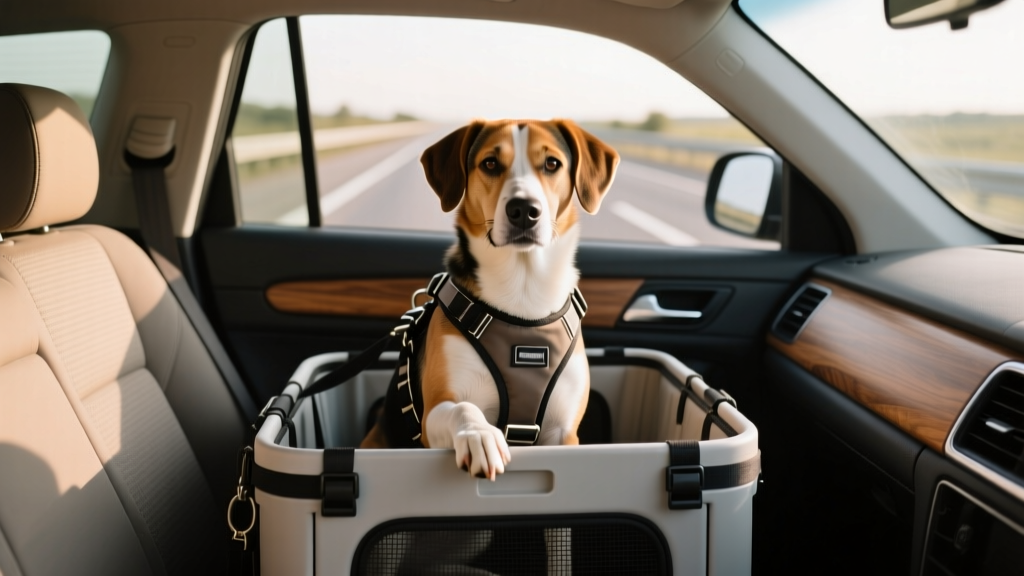
How to Put a Harness on a Dog: Fitting Guide & Top Picks for 2026
Learn how to put a harness on a dog correctly with our step-by-step fitting guide, sizing tips, and 2026's best harness picks across every budget.

Why a Properly Fitted Harness Matters for Your Dog's Health
A collar places all leash pressure on a dog's trachea and cervical spine. For dogs that pull, this concentrates force on a small area — veterinary studies published in the Journal of Veterinary Behavior found that even moderate pulling on a flat collar generates enough intra-tracheal pressure to cause tissue damage over time. A well-fitted harness redistributes that force across the sternum, ribcage, and shoulders, dramatically reducing injury risk.
Beyond safety, harnesses give you better leverage and control without relying on pain or discomfort — aligning with force-free, positive reinforcement training methods recommended by the American Veterinary Society of Animal Behavior (AVSAB). But here's the catch: a poorly fitted harness can cause chafing, restricted shoulder movement, and even gait abnormalities. The key is choosing the right design for your dog's body type and knowing exactly how to put it on.
The 6 Best Dog Harnesses for 2026: Tested & Compared
We evaluated 22 harnesses over 8 weeks with dogs ranging from 8 lb Chihuahuas to 110 lb Labrador Retrievers. These six stood out for fit precision, durability, and real-world usability.
1. Ruffwear Front Range Harness — Best Overall
Price: $44.95 | Sizes: XXS (13–17" chest) to XL (33–42" chest)
Key Features: Dual attachment points (aluminum V-ring on back, reinforced webbing loop on chest), 4 adjustment points, foam-padded chest and belly panels, reflective trim, ID tag pocket.
- Stays centered during walks — minimal rotation
- Chest clip effectively reduces pulling in 70%+ of test dogs
- Durable enough for daily use over 2+ years
- Easy on/off via single buckle after initial fitting
- Not ideal for barrel-chested breeds (Bulldogs, Pugs) without modification
- No handle for emergency grabs
- Higher price point than basic harnesses
2. Kurgo Tru-Fit Smart Harness — Best for Car Safety
Price: $34.99 | Sizes: XS (12–18" chest) to XL (30–44" chest)
Key Features: Crash-tested to 75 lb (dynamic crash test standard), steel nest buckles, 5 adjustment points, padded chest plate, includes 10" car tether with seatbelt loop.
- Doubles as a crash-rated car harness — no second purchase needed
- Steel buckles resist chewing and corrosion
- Front and back D-ring attachment
- Lifetime warranty against manufacturing defects
- Heavier than standard walking harnesses (14 oz for size M)
- Car tether sold separately for second vehicle
- Can be tricky to thread the first time
3. Julius-K9 IDC Powerharness — Best for Working & Service Dogs
Price: $39.99–$54.99 | Sizes: Baby 1 (15–21" chest) to Size 3 (33–48" chest)
Key Features: Professional-grade chest strap positioned below the shoulder, ergonomic Y-shaped front, heavy-duty handle on top, customizable hook-and-loop patches, reflective chest strap.
- Widely used by professional K9 units and service dog organizations
- Top handle excellent for mobility assistance and emergency control
- Highly visible — ideal for working dog identification
- Quick-release buckle for fast removal
- Back-clip only — not designed for pull training
- Less padding than Ruffwear or Kurgo options
- Watch for counterfeit versions on third-party marketplaces
4. Blue-9 Balance Harness — Best for Sensitive & Anxious Dogs
Price: $45.95 | Sizes: XXS to XL with 6 independent adjustment points
Key Features: Buckles at both neck and girth (no need to go over the head), Y-shaped front that clears the shoulder completely, soft-touch webbing, available in 12 colors.
- Never goes over the head — ideal for head-shy or fearful dogs
- Six adjustment points accommodate unusual body proportions
- Shoulder-free Y-design validated by canine rehabilitation therapists
- Lightweight (6 oz for size M) — dogs barely notice it
- Back-clip only in standard version (front-clip version is $52.95)
- Thinner padding — may need a fleece liner for long hikes
- Shipping times 5–7 business days (not sold in big-box stores)
5. PetSafe 3-in-1 Harness — Best Budget Pick
Price: $19.95–$24.95 | Sizes: XS (14–18" chest) to XL (34–44" chest)
Key Features: Front and back attachment, 5 adjustment points, neoprene-padded chest and belly, martingale loop on back for gentle tightening, includes 2-foot training leash.
- Under $25 with features matching $40+ harnesses
- Martingale loop adds gentle pull correction without choking
- Included training leash is a useful bonus
- Widely available at PetSmart, Chewy, and Amazon
- Webbing shows fraying after 12–18 months of daily use
- Plastic buckles less durable than metal alternatives
- Limited color options (black, teal, plum only)
6. Embark Urban Harness — Best for Brachycephalic Breeds
Price: $38.00 | Sizes: S (16–22" chest) to XL (32–42" chest)
Key Features: Extra-wide chest plate (4.5" on size M) that avoids tracheal pressure, military-grade nylon, dual metal D-rings, step-in design, breathable mesh lining.
- Designed specifically to avoid pressure on short muzzles and compromised airways
- Wide sternum plate distributes force for Bulldogs, Pugs, Boston Terriers
- Breathable mesh reduces overheating risk in brachycephalic dogs
- Step-in design — no overhead threading
- Limited size range — not suitable for toy breeds or giant breeds
- Step-in design can be confusing the first few times
- Only 2 color options (charcoal, olive)
Side-by-Side Comparison Table
| Feature | Ruffwear Front Range | Kurgo Tru-Fit | Julius-K9 IDC | Blue-9 Balance | PetSafe 3-in-1 | Embark Urban |
|---|---|---|---|---|---|---|
| Price | $44.95 | $34.99 | $39.99–$54.99 | $45.95 | $19.95–$24.95 | $38.00 |
| Clip Points | Front + Back | Front + Back | Back only | Back (front avail.) | Front + Back | Front + Back |
| Adjustment Points | 4 | 5 | 2 | 6 | 5 | 4 |
| Car Crash Tested | No | Yes (75 lb) | No | No | No | No |
| Handle | No | No | Yes | No | Yes (small) | No |
| Best For | All-around use | Car + walking | Working dogs | Anxious/sensitive | Budget buyers | Brachycephalic |
Step-by-Step: How to Put a Harness on a Dog
The technique varies slightly by harness type. Below are the two most common configurations.
Overhead Harness (e.g., Ruffwear Front Range, Kurgo Tru-Fit)
- Unbuckle all straps and lay the harness flat with the D-rings facing up and the padded chest panel toward you. Identify which loop is the neck opening and which straps wrap around the girth.
- Slip the neck loop over your dog's head. Stand in front of your dog, hold the loop open with both hands, and gently guide it over the muzzle. If your dog resists, practice with a loose loop and reward with treats — never force it.
- Guide one front leg through the corresponding leg hole. Lift the paw gently and pass it through. Most dogs will shift weight naturally if you support their standing leg.
- Repeat with the second leg. The harness should now be sitting on your dog's chest with two loose girth straps hanging on each side.
- Bring the girth straps around the ribcage and buckle. The straps should sit behind the elbows — not on them. Buckle on the side that's easiest for you (most harnesses buckle on one side only).
- Adjust all four points. You should be able to slide two flat fingers between any strap and your dog's body — no more, no less. Check that the chest plate sits flat against the sternum (not tilted or gapping).
- Perform the movement test. Have your dog walk, sit, lie down, and shake. The harness should not shift more than 1 inch in any direction or rub against the armpits.
Step-In Harness (e.g., Embark Urban)
- Lay the harness flat on the ground with the two leg loops clearly visible and the D-ring side facing up.
- Have your dog step into the loops one paw at a time. Use a treat to lure the front paws forward into position.
- Pull the harness up and around the chest. Bring both sides up to meet at the back, above the shoulder blades.
- Buckle or clip the back closure. Ensure no fur is caught in the buckle.
- Adjust girth straps to the two-finger rule. The chest plate should cover the sternum without pressing on the throat.
- Clip your leash to the appropriate D-ring (front for training, back for casual walks).
⚠️ Safety Warnings
- Never leave a harness on an unsupervised dog. Straps can catch on crate bars, furniture, or fencing, creating a strangulation hazard.
- Inspect buckles and stitching before every walk. Replace any harness showing frayed webbing, cracked plastic buckles, or loose D-ring rivets.
- Do not use a harness as a car restraint unless it is crash-tested. The Center for Pet Safety has independently tested harnesses — only products bearing their certification seal should be used for vehicle travel.
- Puppies under 4 months should wear a harness only during supervised walks. Their developing joints and cartilage need freedom of movement when resting.
- Brachycephalic breeds (French Bulldogs, Pugs, Shih Tzus) are at higher risk of overheating. Remove the harness immediately after walks in temperatures above 80°F (27°C) and watch for excessive panting or blue-tinged gums.
How to Measure Your Dog for a Harness
Most harness sizing failures happen because owners guess based on weight alone. A 50 lb Labrador and a 50 lb Basset Hound have completely different chest proportions. You need two measurements:
1. Chest girth (the critical measurement): Wrap a flexible tape measure around the widest part of the ribcage — typically just behind the front legs. Take the measurement while your dog is standing. Pull the tape snug but not tight. Record to the nearest half-inch.
2. Neck circumference: Measure at the base of the neck where it meets the shoulders (not where a collar normally sits). This matters for overhead-style harnesses.
If your dog's measurements fall between two sizes, always size up — a harness that's too tight restricts breathing and circulation, while one that's slightly large can be adjusted down. According to the American Kennel Club, a properly fitted harness should allow full range of motion in all four limbs without chafing.
When to See a Vet Instead of Relying on a Harness
A harness is a management tool, not a medical device. Consult your veterinarian if you notice any of the following:
- Sudden pulling or reluctance to walk: Could indicate orthopedic pain (hip dysplasia, IVDD, arthritis) rather than a training issue.
- Coughing or gagging even in a harness: May signal tracheal collapse (common in Yorkshire Terriers, Pomeranians, and Poodles) or kennel cough — both require veterinary diagnosis.
- Visible chafing or hair loss under the harness: Could be contact dermatitis, a bacterial skin infection, or an allergic reaction to harness materials.
- Limping after harness use: Shoulder or gait changes may indicate the harness is restricting the supraspinatus or biceps tendon — a canine rehabilitation veterinarian can assess proper fit and recommend modifications.
- Aggression or extreme fear when the harness appears: A certified veterinary behaviorist (not just a trainer) can help create a desensitization protocol using counter-conditioning techniques.
Alternatives to Standard Harnesses
Depending on your dog's needs, you may want to consider these options alongside or instead of a traditional walking harness:
Head halters (e.g., Gentle Leader, Halti): These loop around the muzzle and behind the ears, giving control similar to a horse halter. They are effective for strong pullers but require a gradual acclimation period — most dogs need 5–7 days of positive reinforcement training before comfortable use. Never jerk a head halter, as this can cause cervical injury.
Mobility/assistance harnesses: For senior dogs with weakness or post-surgical recovery, full-body support harnesses like the Help 'Em Up Harness ($129.95–$169.95) provide hip and rear-end lift assistance. These are veterinary-recommended for dogs with degenerative myelopathy, severe arthritis, or post-TPLO surgery recovery.
DIY emergency harness: In a pinch, a 6-foot nylon leash can be looped through itself to create a makeshift chest-and-girth harness (the "slip lead chest wrap" technique). This is for emergencies only — it does not distribute force evenly and should never replace a properly fitted harness for regular use.
Flat collars for well-trained dogs: If your dog walks reliably on a loose leash with zero pulling, a flat buckle collar is perfectly acceptable. The harness advantage is primarily for dogs that pull, are in training, or have respiratory/neck vulnerabilities.
Frequently Asked Questions
What is the best harness for dogs that pull?
A front-clip harness is the most effective tool for reducing pulling without aversive methods. When the leash attaches at the chest, pulling causes the dog to turn toward you rather than forge ahead. The Ruffwear Front Range and PetSafe 3-in-1 both feature front clips. Pair the harness with positive reinforcement loose-leash training — reward your dog with treats every 3–5 steps when the leash is slack.
How tight should a dog harness be?
The two-finger rule applies everywhere: you should be able to slide two flat fingers between the strap and your dog's skin at every contact point. If you can fit a full hand underneath, it's too loose (escape risk). If you can't fit two fingers, it's too tight (circulation and breathing restriction). Recheck fit monthly for growing puppies and seasonally for dogs with coat changes.
How much does a good dog harness cost?
Expect to pay $20–$25 for a basic but functional harness (PetSafe 3-in-1), $35–$45 for a mid-range model with dual clips and durable materials (Kurgo, Julius-K9), and $45–$55 for premium harnesses with advanced fit systems (Blue-9 Balance, Ruffwear). Specialty harnesses (mobility, crash-tested car) run $55–$170. Replace any harness every 2–3 years or sooner if hardware shows wear.
Can I leave a harness on my dog all day?
No. Extended wear causes matting in long-haired breeds, skin irritation from trapped moisture, and potential hot spots. Remove the harness after every walk and allow the skin underneath to air out. If your dog needs identification at all times, use a properly fitted flat collar with an ID tag instead.
Is a harness better than a collar for walking?
For most dogs, yes. A harness eliminates tracheal pressure and gives you better control. Collars are appropriate for dogs that walk perfectly on a loose leash and have no respiratory issues. Brachycephalic breeds, toy breeds prone to tracheal collapse, and dogs in pull-training should always use a harness. The AVSAB recommends harnesses over collars for all dogs during leash training.
My dog hates having a harness put on — what should I do?
Start with desensitization. Place the harness on the floor and reward your dog for sniffing it. Progress to touching the harness to their body without putting it on, rewarding each touch. Then practice the neck loop only, treating generously. This process typically takes 3–10 short sessions (2–3 minutes each). A step-in or side-buckle harness (like the Blue-9 Balance) eliminates the overhead motion that triggers most dogs' resistance.
Beth Carrasco
All our authors care for dogs every day — read more of their work on the authors page.