Best Small Dogs for Kids: Top Breeds + Essential Gear Guide
Discover the best small dogs for kids, including breed comparisons, temperament data, and the essential products every family needs for safe dog-child interactions.

Why Small Dogs and Kids Need the Right Setup
Pairing a small dog with children can be one of the most rewarding family decisions you make — but it also comes with unique challenges that larger-dog families rarely face. Small breeds (generally under 25 lb / 11 kg) are more fragile, more easily startled, and more prone to injury from well-meaning but clumsy toddlers. According to the American Kennel Club, the key to success isn't just picking the right breed — it's equipping your household with the right products, training tools, and safety systems from day one.
This guide covers the best small dog breeds for families with children, then walks you through the essential products that keep both kids and dogs safe, happy, and well-adjusted. We've structured our product recommendations around the specific needs of small-breed, kid-friendly households — not generic dog gear lists.
The Best Small Dog Breeds for Kids: A Quick Comparison
Before investing in products, you need to know which breed you're working with. Not all small dogs tolerate children equally. Here's a data-driven comparison of the top family-friendly small breeds, based on AKC breed standards and temperament assessments.
| Breed | Weight (lb/kg) | Kid-Friendliness | Energy Level | Best For Ages | Key Health Risk |
|---|---|---|---|---|---|
| Cavalier King Charles Spaniel | 13-18 lb / 6-8 kg | Excellent | Low-Moderate | 5+ | Mitral valve disease (MVD) |
| Beagle | 20-30 lb / 9-14 kg | Excellent | High | 4+ | Epilepsy, hip dysplasia |
| Bichon Frise | 12-18 lb / 5-8 kg | Very Good | Moderate | 6+ | Patellar luxation |
| French Bulldog | 16-28 lb / 7-13 kg | Very Good | Low | 6+ | BOAS (breathing issues) |
| Havanese | 7-13 lb / 3-6 kg | Excellent | Moderate | 5+ | Cataracts, deafness |
| Coton de Tulear | 9-15 lb / 4-7 kg | Excellent | Low-Moderate | 5+ | Cardiac issues |
| Boston Terrier | 12-25 lb / 5-11 kg | Very Good | Moderate-High | 6+ | BOAS, eye injuries |
Important note on breeds to approach with caution: Chihuahuas, Pomeranians, and toy Yorkies, while popular, tend to score lower on tolerance for unpredictable child behavior. They're better suited for families with children aged 10+ who understand gentle handling. Always meet the individual dog — temperament varies even within breeds.
Essential Product Category 1: Harnesses for Small Dogs Around Children
Why a harness and not just a collar? Small dogs are prone to tracheal collapse — a condition where the windpipe weakens and narrows, making breathing difficult. The Merck Veterinary Manual notes that tracheal collapse is most common in toy and small breeds, and pressure from a collar can accelerate the problem. A well-fitted harness distributes force across the chest, protecting the neck entirely.
For families with kids, a harness also gives adults a secure handle to gently guide the dog away from a child who's getting too rough — without choking or hurting the dog.
Top 5 Harness Picks for Small Family Dogs
1. Ruffwear Front Range Harness (XS/S)
Price: $39.95 - $44.95
Key Features: Dual clip (front + back), padded chest, 4 adjustment points, reflective trim, ID tag pocket
- Pros: Excellent build quality, front clip reduces pulling, easy on/off, machine washable
- Cons: Higher price point, XS may still be large for dogs under 8 lb
2. Puppia Soft Harness (Authentic)
Price: $15.99 - $19.99
Key Features: Air-mesh breathable fabric, padded chest, step-in design, Velcro + D-ring closure
- Pros: Extremely lightweight, ideal for tiny breeds under 10 lb, affordable, many color options
- Cons: Velcro wears over time, not escape-proof for determined wigglers, back-clip only
3. Kurgo Tru-Fit Smart Harness (XS)
Price: $24.99 - $29.99
Key Features: 5 adjustment points, steel nesting buckles, front + back clip, crash-tested (with carabiner)
- Pros: Doubles as car safety harness, secure buckles kids can't undo, lifetime warranty
- Cons: Slightly bulky for very small dogs, takes practice to fit correctly
4. Blue-9 Balance Harness
Price: $33.00 - $38.00
Key Features: 6 adjustment points, no-pull front ring, Y-shaped chest strap (no shoulder restriction), buckle neck
- Pros: Best-in-class fit customization, Y-design preserves gait, recommended by veterinary behaviorists
- Cons: Limited color options, shipping directly from manufacturer only
5. Gooby Comfort X Soft Harness
Price: $14.99 - $18.99
Key Features: Soft mesh body, D-ring on back, step-in style, lightweight at under 2 oz
- Pros: Budget-friendly, ideal for puppies and very small breeds (3-10 lb), gentle on skin
- Cons: Not suitable for dogs that pull, less durable for daily heavy use, no handle
How to Fit a Harness on a Small Dog (Step-by-Step)
- Measure the girth: Wrap a soft tape measure around the widest part of your dog's ribcage, just behind the front legs. Record in inches and cm.
- Measure the neck: Measure where a collar would sit — base of the neck, not the throat.
- Check the manufacturer's size chart: Never assume "small" means the same across brands. Ruffwear's XS fits 13-21" girth; Puppia's XS fits 8.5-11" girth — a 5-inch difference.
- Test the two-finger rule: Once fitted, you should be able to slide two flat fingers between the harness and your dog's body at every strap point. Not three fingers (too loose) and not zero (too tight).
- Check for chafing after 30 minutes: Remove the harness and inspect the armpit and chest area for redness. Adjust or size up if you see irritation.
- Supervise kids during harness use: Teach children never to grab the harness to "ride" or drag the dog. The harness is a safety tool, not a handle for children to pull.
Essential Product Category 2: Safe Spaces — Crates, Playpens, and Retreat Zones
The single most important product for preventing dog bites in families with children is a designated safe space where the dog can retreat and be left completely alone. The AVMA's dog bite prevention guidelines emphasize that dogs need a place where they won't be disturbed — especially critical for small breeds that children can easily corner or pick up without permission.
For small dogs, this means a properly sized crate or a playpen with a covered bed inside. The dog must learn that this space is inviolable — and children must learn the same rule.
Top 4 Crate and Playpen Picks
1. MidWest iCrate (Small, 24" or 30")
Price: $34.99 - $49.99
Key Features: Wire construction, divider panel, double-door access, composite plastic pan, fold-and-carry
- Pros: Affordable, divider panel grows with puppy, excellent visibility for dog, easy to clean
- Cons: Wire can feel less den-like, heavier breeds may rattle it, not aesthetically pleasing
2. Frisco Double Door Furniture-Style Crate
Price: $119.99 - $169.99
Key Features: Wood-and-wire design doubles as end table, cushion included, latch closure, 24" and 30" sizes
- Pros: Blends into living room, feels like furniture not a cage, sturdy construction
- Cons: Expensive, heavier to move, wood can be chewed by puppies
3. IRIS USA Exercise Pen (4-Panel or 8-Panel)
Price: $39.99 - $64.99
Key Features: Modular plastic panels, 24" or 34" height, door panel option, indoor/outdoor use
- Pros: Creates larger play area than crate, lightweight, easy to reconfigure, good for multiple small dogs
- Cons: Agile dogs can climb or push panels, not suitable as unsupervised containment
4. Snuggle Puppy Heartbeat Stuffed Toy
Price: $39.95 - $44.95
Key Features: Simulated heartbeat, heat pack, soft plush, machine washable cover — for crate comfort
- Pros: Reduces crate anxiety in puppies, mimics littermate warmth, drug-free calming
- Cons: Heat packs are single-use (replacements ~$12/6-pack), some dogs destroy the plush
⚠️ Safety Warning: Crate Rules for Families with Children
- NEVER allow a child to open the crate door. Use a carabiner clip or child-proof latch if needed.
- NEVER allow a child to put fingers, toys, or food through the crate bars. This can trigger resource guarding.
- The crate is the dog's bedroom. If the dog goes into the crate, the child must leave the dog alone — no exceptions.
- Maximum crate time: Puppies under 6 months: 3 hours max. Adult small dogs: 4-6 hours max during the day.
- Remove collars before crating to prevent strangulation on crate bars. Harnesses should also be removed.
Essential Product Category 3: Interactive Toys That Teach Kids and Dogs Together
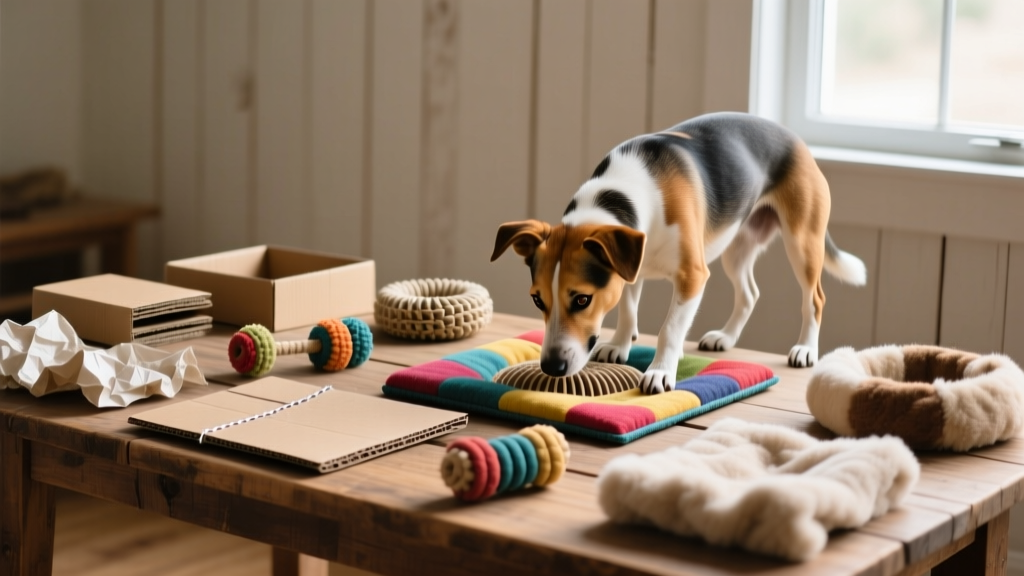
Structured play is one of the best ways to build a positive bond between children and small dogs. But the right toys matter — small dogs have smaller jaws and more delicate teeth, and toys must be sized appropriately to prevent choking. Additionally, interactive toys that require cooperation (rather than competition) help teach children appropriate play behavior.
Top 6 Interactive Toy Picks
1. Kong Classic (XS or Small)
Price: $7.99 - $11.99
Key Features: Natural rubber, stuffable, unpredictable bounce, dishwasher safe
- Pros: Virtually indestructible, keeps dogs occupied 20-40 min, kids can help stuff it
- Cons: Can get messy with peanut butter, strong rubber smell initially
2. Outward Hound Nina Ottosson Dog Brick
Price: $12.99 - $16.99
Key Features: Puzzle toy with sliding/flip compartments, 3 difficulty levels, BPA-free plastic
- Pros: Teaches problem-solving, kids and dogs can work on it together, adjustable difficulty
- Cons: Supervision required (small parts), some dogs flip it over instead of solving
3. West Paw Zogoflex Bumi Tug Toy (Small)
Price: $14.95 - $17.95
Key Features: Flexible Zogoflex material, floats, S-shaped for tug, dishwasher safe, recyclable
- Pros: Great for supervised tug between child and dog, gentle on small jaws, floats for water play
- Cons: Only for supervised tug (teach "drop it" first), not a chew toy
4. Snuffle Mat (PAW5 Wooly)
Price: $38.00 - $45.00
Key Features: Fleece strips hide kibble/treats, machine washable, 18" x 12" size
- Pros: Calming enrichment, kids can hide treats for the dog, slows eating, no training needed
- Cons: Higher price for a fabric mat, dogs who shred fabric may destroy it
5. Chuckit! Indoor Fetch (Fumble Fetch)
Price: $9.99 - $13.99
Key Features: Soft BounceFlex core, lightweight, safe for indoor play, bright colors
- Pros: Safe for indoor fetch with kids, won't damage walls or furniture, easy for small mouths
- Cons: Not durable for heavy chewers, outdoor use will wear it quickly
6. Lick Mat (Hyper Pet IQ)
Price: $8.99 - $14.99
Key Features: Silicone mat with textured patterns, spreadable treat surface, freezer-safe, suction cups
- Pros: Calming activity for dog while kids are busy, suction cups keep it in place, easy to clean
- Cons: Messy if dog carries it around, suction cups don't work on all surfaces
Essential Product Category 4: Training Tools for Kid-Dog Households
Training isn't optional when kids and small dogs share a home — it's a safety requirement. Both the dog and the children need training, and the right tools make the process smoother and more effective. We only recommend positive reinforcement and force-free methods. The American Veterinary Society of Animal Behavior (AVSAB) has published position statements against aversive training tools, and we follow their guidance.
Top 4 Training Essentials
1. Karen Pryor Clicker (i-Click)
Price: $5.99 - $8.99
Key Features: Raised button for easy pressing, quiet click sound, wrist strap, compact size
- Pros: Kids as young as 5 can use it, precise timing for marking good behavior, extremely affordable
- Cons: Requires learning clicker training methodology, not useful without treat pairing
2. PetSafe Treat Pouch (Sport Dog Trainer Pouch)
Price: $12.99 - $17.99
Key Features: Magnetic closure, belt clip + shoulder strap, multiple pockets, easy-clean liner
- Pros: Kids can wear it during training sessions, magnetic closure is fast one-hand access, washable
- Cons: Can be bulky on small children, treat smell lingers in fabric
3. Baby Gate: Regalo Easy Step Walk-Through (with Small Dog Door)
Price: $34.99 - $44.99
Key Features: Pressure-mounted, 29-39" width range, walk-through door, optional small pet door
- Pros: Creates physical separation between dog and child when needed, no drilling, portable
- Cons: Very small dogs may squeeze through bars, pressure mounts can slip on smooth floors
4. "Be a Tree" Dog Safety Card Game (Doggone Safe)
Price: $9.99 - $14.99
Key Features: Teaches children to stand still ("be a tree") when an unfamiliar or overexcited dog approaches
- Pros: Teaches critical bite-prevention behavior, engaging for kids ages 4-10, evidence-based program
- Cons: Requires parent involvement to practice, not a substitute for supervision
Product Comparison Table: At-a-Glance Decision Guide
Here's how our top picks compare across the attributes that matter most for small-dog, kid-friendly households:
| Product | Category | Price Range | Dog Size Fit | Kid Age Suitability | Durability |
|---|---|---|---|---|---|
| Ruffwear Front Range | Harness | $40-$45 | 10-25 lb | Adults manage | Excellent |
| Puppia Soft Harness | Harness | $16-$20 | 3-15 lb | Adults manage | Good |
| MidWest iCrate 24" | Crate | $35-$50 | 11-25 lb | No child access | Excellent |
| IRIS Exercise Pen | Playpen | $40-$65 | 5-25 lb | Supervised only | Good |
| Kong Classic XS | Toy | $8-$12 | Under 15 lb | Ages 5+ | Excellent |
| Nina Ottosson Dog Brick | Puzzle Toy | $13-$17 | All small breeds | Ages 6+ | Good |
| Karen Pryor i-Click | Training Tool | $6-$9 | All breeds | Ages 5+ | Good |
| Regalo Baby Gate | Safety Gate | $35-$45 | All small breeds | Creates separation | Very Good |
How to Use These Products Safely: A Family Protocol
Having the right products is only half the equation. How your family uses them determines whether your small dog and kids thrive together or develop problems. Here's the protocol we recommend based on veterinary behaviorist guidance:
Week 1-2: Setup and Introduction
- Set up the crate or playpen in a common area (living room or kitchen) at least 3 days before the dog arrives. Let it become part of the furniture.
- Establish the "dog zone" rule with children: when the dog is in the crate/pen, it's invisible. No talking to it, no touching it, no eye contact.
- Fit the harness and let the dog wear it for 15-minute sessions indoors before any walks. Pair with treats.
- Introduce one toy at a time. Let the dog explore it alone first, then add the child to the play session.
Ongoing: Daily Routine
- Morning: Adult puts harness on dog for walk. Child can watch but not hold the leash (under age 8).
- Midday: Dog gets crate rest (2-3 hours) with a stuffed Kong. Children do quiet activities.
- Afternoon: Structured play session with puzzle toy or tug (supervised, 15 min max).
- Evening: Training session (5-10 min) with clicker and treats. Child can be the trainer with adult coaching.
- Bedtime: Dog goes to crate. Child helps place a treat inside (positive association).
🚨 When to Skip Products and See a Professional
Products alone cannot fix these situations. Seek help from a certified professional dog trainer (CPDT-KA) or veterinary behaviorist if you observe:
- Growling, snapping, or biting directed at children — at any level, even if no skin contact
- Resource guarding of food, toys, crate, or people
- Fear-based behaviors: cowering, trembling, hiding, lip licking, or whale eye around children
- The dog avoids children entirely or leaves every room a child enters
- A child has been bitten — even a minor nip requires immediate professional assessment
Consult your veterinarian for a referral to a veterinary behaviorist. The AVSAB professional directory can help you find qualified experts in your area.
Natural and DIY Alternatives to Commercial Products
Not every family product needs to be store-bought. Here are effective DIY and natural alternatives that work well in small-dog, kid-friendly homes:
| Commercial Product | DIY/Natural Alternative | Cost Savings | Considerations |
|---|---|---|---|
| Snuffle Mat ($38-45) | Rubber sink mat + fleece strips tied through holes | ~$8-12 total | Ensure fleece strips are knotted securely to prevent ingestion |
| Kong Stuffing ($5-8/jar) | Plain Greek yogurt + mashed banana, frozen in Kong | ~$2-3 per session | Check for dairy sensitivity first; limit banana to 1-2 Tbsp for small dogs |
| Puzzle Toys ($13-17) | Muffin tin + tennis balls over treat wells | ~$0 (use existing items) | Supervise to prevent tennis ball chewing; use mini tennis balls for small breeds |
| Lick Mat ($9-15) | Silicone baking mat with spread peanut butter (xylitol-free) | ~$3-5 | ALWAYS check peanut butter label for xylitol — highly toxic to dogs |
| Calming Supplements ($20-40) | Increased exercise + structured routine + classical music | Free | Consult your veterinarian before using any supplement, including natural ones |
Budget Breakdown: What It Actually Costs to Set Up
Here's a realistic budget for equipping your home for a small dog and kids, based on 2026 retail pricing:
| Item | Budget Option | Mid-Range | Premium |
|---|---|---|---|
| Harness | $15 (Gooby/Puppia) | $28 (Kurgo) | $44 (Ruffwear) |
| Crate or Playpen | $35 (MidWest wire) | $55 (IRIS pen) | $165 (Frisco furniture) |
| Toys (3-5 pieces) | $20 | $40 | $75 |
| Training Tools | $8 (clicker only) | $25 (clicker + pouch) | $60 (clicker + pouch + gate) |
| Safety Gate | $0 (use existing door) | $35 (Regalo) | $55 (Carlson) |
| TOTAL STARTUP | $78 | $183 | $399 |
Where to buy: Most of these products are available through Chewy, Amazon, Petco, and Petsmart. The Ruffwear and Blue-9 harnesses are also sold through independent pet retailers and directly from manufacturer websites. Prices fluctuate seasonally — look for sales around Memorial Day, Black Friday, and Amazon Prime Day.
Frequently Asked Questions
What is the best small dog for a family with toddlers?
The Cavalier King Charles Spaniel and Havanese consistently rank highest for families with young children (ages 3-6). Both breeds are gentle, patient, and less likely to react defensively to unpredictable toddler behavior. However, no dog — regardless of breed — should be left unsupervised with children under 7. The AKC's family dog recommendations also highlight the Bichon Frise and Beagle as excellent choices, though Beagles need more exercise than Cavaliers.
How do I choose the right harness for my small dog?
Measure your dog's girth (widest part of ribcage) and neck circumference, then match to the manufacturer's specific size chart — never assume sizing is consistent across brands. For dogs under 10 lb, the Puppia Soft Harness offers the best fit. For dogs 10-25 lb that pull on leash, the Ruffwear Front Range with its front-clip option provides better control. Always choose a Y-shaped chest strap design that doesn't restrict shoulder movement.
How much does it cost to set up a home for a small dog and kids?
Expect to spend between $78 (budget setup) and $399 (premium setup) on initial gear. This doesn't include the cost of the dog itself (adoption: $50-$300; responsible breeder: $1,500-$4,000+ depending on breed), veterinary startup costs ($200-$500 for initial exam, vaccines, spay/neuter), or ongoing monthly expenses ($80-$150/month for food, preventives, and supplies).
Are there natural alternatives to commercial calming products?
Yes. Before reaching for supplements, try these evidence-based approaches: increase daily exercise to 30-45 minutes (split into two sessions), establish a predictable daily routine, play classical music or white noise during stressful times, and provide enrichment through snuffle mats and puzzle feeders. If these aren't sufficient, consult your veterinarian about options like Adaptil (dog-appeasing pheromone diffuser, ~$25-$35) or L-theanine supplements. Never use essential oils without veterinary guidance — many are toxic to dogs.
When should I skip over-the-counter products and see a vet or trainer?
Products cannot replace professional help when you see: any aggression toward children (growling, snapping, biting), resource guarding, extreme fear behaviors, or if a child has been bitten. Additionally, if your dog shows sudden behavioral changes (previously calm dog becomes reactive), a veterinary exam is needed to rule out pain or illness as the cause. Ask your vet for a referral to a veterinary behaviorist or certified professional dog trainer (CPDT-KA) who uses force-free methods.
Can small dogs really be safe around young children?
Yes — with the right breed selection, proper socialization, consistent training, and appropriate products. The key risk factor isn't the dog's size but the lack of supervision and structure. Small dogs are more physically vulnerable to injury from children (being dropped, stepped on, or squeezed), which is why safe-space products (crates, gates) are non-negotiable. With proper setup, breeds like the Cavalier, Havanese, and Bichon Frise thrive in families with children as young as 4-5 years old.
Priya Sutaria
All our authors care for dogs every day — read more of their work on the authors page.