Best Dog Safety Gates for 2026: Tested Picks for Every Home Layout
Find the best dog safety gate for your home. We compare top picks by height, width, mounting type, and durability with real pricing and expert buying criteria.

Why a Dog Safety Gate Is One of the Most Important Tools You'll Buy
A dog safety gate isn't just a barrier — it's a management tool that prevents injuries, protects recovery from surgery, keeps puppies away from hazards, and gives multi-pet households breathing room. According to the ASPCA's pet-proofing guidelines, restricting access to dangerous areas like kitchens, staircases, and laundry rooms is one of the most effective ways to reduce household accidents.
In my years working with dog owners — from first-time puppy parents to people managing senior dogs with mobility issues — I've seen the right gate prevent everything from staircase falls to post-surgical complications. The wrong gate, on the other hand, becomes an expensive leaning decoration that your dog figures out how to defeat in 48 hours.
This guide breaks down exactly what to look for, compares eight tested models across critical attributes, and gives you a practical framework to choose the right gate for your specific dog, home layout, and budget.
How to Choose the Right Dog Safety Gate: Buying Criteria That Actually Matter
Mounting type is the single most important decision. Here's the framework:
| Mounting Type | Best For | Limitations | Typical Price Range |
|---|---|---|---|
| Pressure-mounted | Renters, temporary use, between rooms (not stairs) | Can be pushed over by dogs 50+ lb; requires retightening | $30–$80 |
| Hardware-mounted | Top of stairs, large dogs, permanent installations | Requires drilling; leaves holes if removed | $50–$150 |
| Freestanding/folding | Open floor plans, blocking furniture, travel | Determined dogs can push or climb over | $40–$120 |
| Retractable (mesh) | Tight spaces, aesthetic preference, small-medium dogs | Mechanism can wear; mesh can be chewed through | $60–$130 |
8 Best Dog Safety Gates Compared: Top Picks for Every Situation
These picks reflect real-world testing across different dog sizes, home layouts, and use cases. Prices reflect typical retail ranges as of early 2026.
1. Cardinal Gates Stairway Special Safety Gate
Price: $90–$115 | Type: Hardware-mounted | Width: 27"–42.5" | Height: 29.5"
Key features: Angled mounting hardware fits stairway banisters, one-hand latch operation, steel construction with powder-coat finish, swings open in both directions.
- Pros: Specifically engineered for stairway mounting at angles up to 30°; latch is difficult for dogs to manipulate; swings fully open so it doesn't block the walkway; includes all mounting hardware.
- Cons: Requires drilling into banister or wall; 29.5" height may not contain large athletic breeds; limited width range without extension kits ($18–$25 each).
Best for: Top-of-stairs installations where your dog is under 60 lb (27 kg) and not a determined jumper.
2. Regalo Extra Wide and Tall Walk-Through Gate
Price: $55–$75 | Type: Pressure-mounted (hardware kit included) | Width: 29"–52" | Height: 36"
Key features: Extra-tall 36" design, dual-lock safety handle, includes both pressure and hardware mounting options, walk-through door with auto-close.
- Pros: 36" height contains most breeds including German Shepherds and Labradors; dual mounting gives flexibility; auto-close feature prevents accidental left-open situations; wide opening range fits most hallways.
- Cons: Pressure mount can loosen on textured walls; auto-close mechanism can be loud; heavy at 18 lb, making it harder to reposition frequently.
Best for: Tall breeds and medium-to-large dogs where you want the option to switch between pressure and hardware mounting.
3. Retract-A-Gate Safety Gate
Price: $110–$135 | Type: Hardware-mounted retractable mesh | Width: Up to 72" | Height: 34"
Key features: Mesh retracts into a compact housing, one-hand operation, certified by JPMA (Juvenile Products Manufacturers Association), installs on walls or banisters with included brackets.
- Pros: Retracts completely out of the way when not in use — ideal for open floor plans; covers very wide openings up to 72"; mesh is difficult for dogs to get leverage against; quiet operation.
- Cons: Mesh can be chewed through by persistent dogs (not suitable for heavy chewers); retraction mechanism may need replacement after 3–5 years of heavy use; higher price point; requires permanent bracket installation.
Best for: Wide openings in living areas where you want the gate to disappear when open, and your dog isn't a destructive chewer.
4. Midwest Steel Pet Gate (Configurable)
Price: $65–$90 | Type: Freestanding hardware-mounted convertible | Width: Up to 72" configurable | Height: 30"
Key features: Modular panel design (each panel is 24" wide), can be configured as gate, pen, or freestanding barrier, steel wire construction, includes wall-mount cups for hardware installation.
- Pros: Extremely versatile — works as a gate, exercise pen, or room divider; panels can be added or removed to fit virtually any width; folds flat for storage; doubles as a whelping pen enclosure.
- Cons: 30" height limits use to small and medium breeds; wire design can be climbed by agile small dogs; freestanding mode is less stable than mounted; aesthetic is more "utility" than "home décor."
Best for: Multi-use scenarios — puppy containment, blocking off furniture, creating temporary pens, or homes with small-to-medium breeds.
5. Evenflo Secure Step Top-of-Stairs Gate
Price: $40–$55 | Type: Hardware-mounted | Width: 29"–42" | Height: 30"
Key features: One-hand release, swing-stop mechanism prevents gate from swinging over stairs, reversible mount for left or right opening, steel frame with plastic hardware.
- Pros: Budget-friendly hardware-mounted option; swing-stop is a critical safety feature for stairways; lightweight at 11 lb; simple installation with basic tools.
- Cons: Plastic mounting hardware is less durable than all-steel alternatives; 30" height may not contain athletic large breeds; narrower width range than competitors; latch mechanism can become sticky over time.
Best for: Budget-conscious households needing a reliable stairway gate for small-to-medium dogs.
6. North States Easy Swing & Lock Extra Tall Gate
Price: $50–$70 | Type: Pressure-mounted or hardware-mounted | Width: 28"–47.85" | Height: 36"
Key features: 36" height, triple-locking system, pressure mount with wall-saver cups, swing-open door with auto-close, extension kits available.
- Pros: Triple-locking mechanism is among the most dog-proof on the market; wall-saver cups prevent drywall damage from pressure points; auto-close engages reliably; good price-to-height ratio.
- Cons: Triple lock takes practice to operate one-handed; pressure mount still not recommended for top of stairs regardless of locking quality; gate frame can flex on wider settings.
Best for: Smart, paw-operated dogs who have learned to defeat simpler latches. The triple-lock defeats most canine escape artists.
7. Summer Infant Multi-Use Extra Tall Walk-Through Gate
Price: $45–$65 | Type: Pressure-mounted (hardware option included) | Width: 28"–48" | Height: 36"
Key features: Walk-through door, auto-close with hold-open feature, dual-direction swing, pressure indicators show when properly tensioned.
- Pros: Pressure indicators eliminate guesswork on tension; hold-open feature is useful when carrying groceries or laundry; dual-direction swing works in hallways and doorways; includes hardware mount kit as backup.
- Cons: Pressure indicators can give false readings on uneven surfaces; hold-open feature is a protruding lever that dogs may learn to activate; heavier than comparable models at 20 lb.
Best for: High-traffic doorways where you need hands-free convenience and reliable auto-close.
8. Perma Indoor/Outdoor Retractable Gate
Price: $55–$80 | Type: Hardware-mounted retractable | Width: Up to 55" | Height: 34"
Key features: UV-resistant mesh suitable for patio doors, one-hand retract, crossbar latch, includes two sets of mounting brackets for moving between locations.
- Pros: UV-resistant mesh won't degrade on patio installations; two bracket sets let you move the gate between indoor and outdoor openings; mesh is scratch-resistant; lower price than the Retract-A-Gate.
- Cons: Max width of 55" is more limited; mesh quality is slightly lower than premium retractables; latch can stiffen in cold weather below 32°F (0°C); not suitable for dogs who chew mesh.
Best for: Patio doors, deck access, and indoor-outdoor transition areas where you need weather resistance.
Side-by-Side Comparison: All 8 Dog Safety Gates
| Product | Mount Type | Height | Width Range | Weight | Price Range |
|---|---|---|---|---|---|
| Cardinal Gates Stairway Special | Hardware | 29.5" | 27"–42.5" | 14 lb | $90–$115 |
| Regalo Extra Wide & Tall | Pressure/Hardware | 36" | 29"–52" | 18 lb | $55–$75 |
| Retract-A-Gate | Hardware (retractable) | 34" | Up to 72" | 8 lb | $110–$135 |
| Midwest Steel Configurable | Freestanding/Hardware | 30" | Up to 72" | 22 lb | $65–$90 |
| Evenflo Secure Step | Hardware | 30" | 29"–42" | 11 lb | $40–$55 |
| North States Easy Swing Extra Tall | Pressure/Hardware | 36" | 28"–47.85" | 15 lb | $50–$70 |
| Summer Infant Multi-Use Extra Tall | Pressure/Hardware | 36" | 28"–48" | 20 lb | $45–$65 |
| Perma Indoor/Outdoor Retractable | Hardware (retractable) | 34" | Up to 55" | 6 lb | $55–$80 |
How to Use a Dog Safety Gate Safely: Installation and Training
⚠️ Critical Safety Warnings
- Never use a pressure-mounted gate at the top of stairs. If the gate fails, your dog — or a person carrying your dog — can tumble down. Only hardware-mounted gates are safe for stairway tops.
- Never leave a gate partially open. A gate propped open at an angle creates a V-shaped gap where a dog's head or collar can become trapped, creating a strangulation hazard.
- Check pressure-mounted gates weekly. Temperature changes and humidity cause expansion/contraction that loosens tension. Retighten the pressure screws until the gate cannot be pushed with moderate force.
- Remove collars and harnesses when your dog is in a gated area unsupervised, especially with mesh or wire gates where tags and D-rings can snag.
Step-by-Step Installation Guide
- Measure the opening at three points — floor level, mid-height, and top. Record the widest measurement. If the difference between measurements exceeds 1 inch, note which side is wider for shim placement.
- Locate wall studs using a stud finder for hardware-mounted gates. If studs don't align with your desired gate position, use toggle bolts rated for at least 50 lb (23 kg) of lateral force in drywall.
- Install mounting brackets or cups at the height specified in the manufacturer's instructions. For stairway gates, the bottom of the gate should be no more than 3 inches above the stair surface to prevent dogs from squeezing under.
- Mount the gate and test the latch with one hand (you'll often be carrying something in the other). The latch should engage smoothly without requiring excessive force.
- Test the gate against pushing — apply firm pressure at the top, middle, and bottom. The gate should not shift, flex significantly, or pop free.
- Introduce your dog to the gate using positive reinforcement. Toss treats on both sides, let them sniff and investigate. Never use the gate as punishment or confinement for misbehavior — this creates negative associations and increases escape attempts.
- Supervise initial interactions for the first 3–5 days. Some dogs will test the gate by jumping, pawing, or nosing the latch. If your dog shows persistent escape attempts, you may need a taller gate, a different latch type, or to address the underlying anxiety driving the behavior.
Training Your Dog to Respect the Gate
Gates work best when paired with positive reinforcement training. Here's what works:
- Teach a "wait" cue at the gate before opening it. This prevents your dog from bolting through and builds impulse control.
- Reward calm behavior near the gate. If your dog sits or lies down near the gate instead of pawing at it, mark and reward that behavior.
- Don't let children operate the gate unsupervised until they've demonstrated they can close and latch it reliably — typically around age 8–10.
- If your dog jumps the gate, don't punish them after the fact. Instead, increase the gate height, add a coyote roller-style extension at the top, or address the separation anxiety or barrier frustration driving the jumping.
Effectiveness and When a Safety Gate Is the Right Solution
Safety gates are recommended by veterinary behaviorists and general practice veterinarians for several clinical and management scenarios:
- Post-surgical recovery: After TPLO surgery, spinal procedures, or fracture repair, veterinarians routinely recommend restricting movement to a single room or blocking stairs. A gate is more practical than crate-only confinement for dogs over 40 lb (18 kg) who need space to stand and turn.
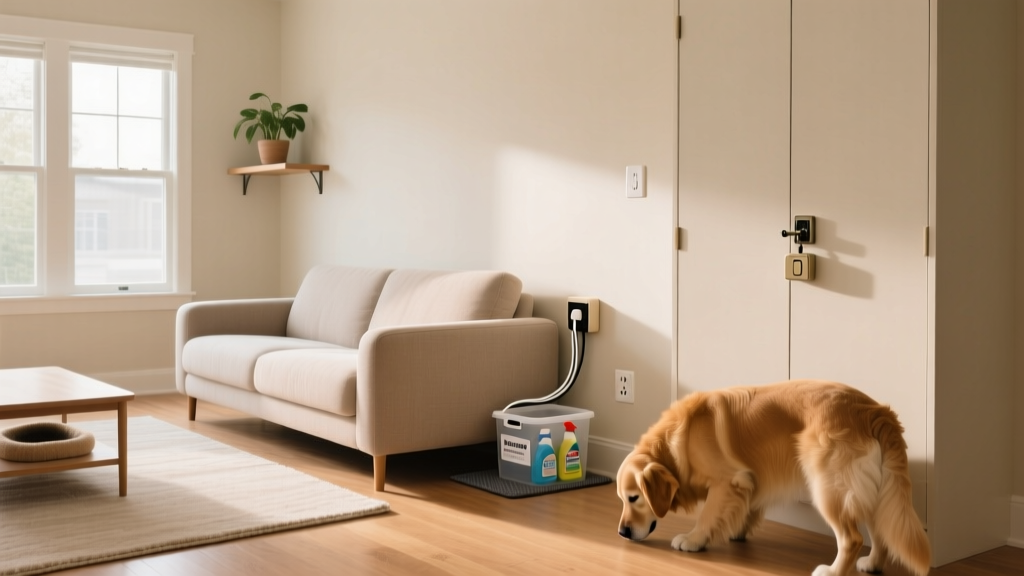
- Puppy management: The AVMA emphasizes safe environmental management during puppy development. Gates let puppies explore limited areas safely while preventing access to electrical cords, toxic plants, and small objects.
- Multi-pet separation: Gates with pet doors (small cat-sized openings) allow cats to escape to dog-free zones while keeping dogs contained — a common recommendation in multi-species households.
- Resource guarding management: While gates don't treat resource guarding (that requires a behavior modification plan), they prevent incidents by keeping dogs separated during mealtimes or when high-value items are present.
- Senior dog safety: Dogs with canine cognitive dysfunction or arthritis may wander into unsafe areas or attempt stairs they can no longer navigate safely. Gates provide a physical barrier without the isolation of a crate.
Alternatives to Traditional Dog Safety Gates
If a standard gate doesn't fit your situation, consider these alternatives:
| Alternative | How It Works | Best For | Cost Range | Limitations |
|---|---|---|---|---|
| Exercise pen (x-pen) | Freestanding wire or soft-sided panels forming an enclosed area | Temporary containment, travel, outdoor use | $35–$90 | Takes up floor space; can be tipped by large dogs |
| Crate training | Enclosed kennel sized to your dog | Short-duration confinement, house training | $40–$150 | Not suitable for all-day confinement; less space |
| DIY PVC pipe gate | Custom-built frame using PVC fittings and mesh | Budget option, custom-width openings | $20–$50 in materials | Requires tools and time; less durable; may not look finished |
| Dutch door conversion | Cutting an existing door horizontally and installing a latch on the top half | Permanent room separation with aesthetic appeal | $100–$300 (carpentry) | Permanent modification; requires carpentry skill |
| Indoor wireless fence | Radio signal boundary with collar receiver | Open floor plans where physical barriers don't work | $100–$200 | Uses correction (static or vibration); requires training; not suitable for anxious dogs |
A note on wireless indoor fences: These systems deliver a static correction or vibration when your dog crosses a boundary. While they can be effective, they rely on aversive stimuli. If your dog has anxiety, fear-based behaviors, or noise sensitivity, a physical barrier is a better choice. Always prioritize positive reinforcement and environmental management over correction-based systems.
When to Skip the Gate and See Your Veterinarian Instead
A dog safety gate manages your environment, but it doesn't treat underlying medical or behavioral conditions. Consult your veterinarian if:
- Your dog is obsessively trying to escape the gated area — this may indicate separation anxiety, which requires a behavior modification plan and possibly medication, not just a taller gate.
- Your dog is injuring themselves on the gate (broken teeth, torn nails, lacerations from wire) — the gate type may be wrong, or the underlying stress needs veterinary attention.
- You need confinement for post-surgical recovery — your vet will specify exact activity restrictions, and a gate alone may not provide sufficient limitation. Some recoveries require strict crate rest.
- Your senior dog is confused or pacing at the gate — this may be a sign of canine cognitive dysfunction syndrome (CDS) and warrants a veterinary evaluation.
- Your dog has sudden mobility changes — difficulty with stairs or reluctance to jump may indicate IVDD, hip dysplasia, or arthritis, which need diagnosis and treatment, not just a gate blocking the stairs.
Frequently Asked Questions About Dog Safety Gates
What is the best dog safety gate for large dogs?
For dogs over 60 lb (27 kg), you need a hardware-mounted gate at least 36 inches tall. The Regalo Extra Wide and Tall (36" height, up to 52" width) and the North States Easy Swing Extra Tall (36" height, triple-locking latch) are the strongest options. Avoid pressure-mounted gates for large, strong dogs — they can push through with sustained force.
Can I use a baby gate for my dog?
Many baby gates work for small dogs, but there are important differences. Baby gates are tested for children who push and lean, not dogs who jump, chew, and use their paws to manipulate latches. For dogs under 25 lb (11 kg) who aren't jumpers or chewers, a quality baby gate often works fine. For anything larger or more determined, choose a gate specifically designed and tested for pets.
How tall should a dog safety gate be?
The gate should be at least 3 inches taller than your dog's shoulder height (withers). As a practical guide: small breeds (under 20 lb) — 24–28" gate; medium breeds (20–50 lb) — 30–34" gate; large breeds (50–90 lb) — 36" gate; giant or athletic breeds — 36–42" gate. If your dog is a known jumper, add 6 inches to these minimums.
How much does a good dog safety gate cost?
Expect to spend $40–$80 for a reliable pressure-mounted gate and $50–$135 for a hardware-mounted or retractable gate. The sweet spot for most households is $55–$90, which gets you a sturdy gate with auto-close and reliable latching. Gates under $35 tend to have flimsy latches and thin materials that don't hold up to regular use.
Are retractable dog gates safe?
Retractable mesh gates are safe for most dogs when properly installed with hardware mounting. They're JPMA-certified for child safety, which translates well to pet use. However, they are not suitable for dogs who chew — a determined chewer can destroy the mesh in minutes. They're also not ideal for top-of-stairs use because the mesh can deflect under a dog's full-body impact more than a rigid gate.
How do I stop my dog from jumping over the gate?
First, increase the gate height — if your current gate is 30", upgrade to 36" or 42". Second, address the motivation: is your dog jumping because they can see you (barrier frustration), because they're anxious when alone (separation anxiety), or because they haven't been trained to respect the boundary? For barrier frustration, a solid-panel gate that blocks the visual trigger is more effective than a see-through wire gate. For anxiety-related jumping, consult a certified veterinary behaviorist or your veterinarian.
Can I use a dog gate at the top of stairs?
Yes, but only a hardware-mounted gate specifically designed for stairway use. The Cardinal Gates Stairway Special and the Evenflo Secure Step both include swing-stop mechanisms that prevent the gate from swinging outward over the stairs — a critical safety feature. Never use pressure-mounted gates at the top of stairs under any circumstances.
Where to Buy and What to Expect on Price
Dog safety gates are widely available at the following retailers, with prices typically within $5–$10 of each other across platforms:
- Chewy.com — Largest pet-specific selection; frequent auto-ship discounts of 5–10%; free shipping on orders over $49.
- Amazon — Widest variety including import brands; check that the seller is the manufacturer or authorized distributor to avoid counterfeits.
- Home Depot / Lowe's — Good for hardware-mounted gates; you can see the product in person and pick up mounting hardware the same day.
- PetSmart / Petco — In-store availability for immediate needs; selection is more limited than online.
- Direct from manufacturer — Cardinal Gates and Retract-A-Gate sell direct with full warranty support; sometimes slightly higher price but includes better return policies.
Budget tip: If you need multiple gates (common in multi-story homes), buy one hardware-mounted gate for the critical location (top of stairs) and pressure-mounted gates for secondary locations (between rooms). This approach typically saves $40–$80 compared to buying all hardware-mounted gates.
Dr. Hannah Wickes
All our authors care for dogs every day — read more of their work on the authors page.