Best Apartments for Dogs: 2026 Pet-Friendly Rental Guide & Essentials
Find the best apartments for dogs with our 2026 guide covering breed restrictions, pet fees, amenities, and must-have products for apartment-dwelling pups.

What Makes an Apartment Truly Dog-Friendly?
Searching for the best apartments for dogs goes far beyond finding a unit that simply allows pets. A genuinely dog-friendly rental considers square footage, flooring type, noise insulation, proximity to green space, and community policies that affect your dog's daily quality of life. With approximately 45 million U.S. households renting with pets as of 2025, the competition for quality pet-friendly units is fierce — and the details matter enormously.
According to AVMA pet ownership data, roughly 65 million households own at least one dog, and a significant percentage of those renters report struggling to find adequate housing. This guide breaks down exactly what to evaluate, what questions to ask leasing offices, and the products that make apartment life with dogs safer and more comfortable.
Buying Criteria: How to Evaluate Pet-Friendly Apartments
Before signing a lease, score every prospective apartment against these criteria. Each factor directly impacts your dog's wellbeing and your wallet.
Essential Evaluation Checklist
- Pet Policy Specifics: Breed restrictions, weight limits (many cap at 25 lb / 11 kg or 50 lb / 23 kg), maximum number of pets allowed, required documentation (vaccination records, spay/neuter proof, liability insurance)
- Cost Breakdown: Pet deposit ($200–$500 typical), monthly pet rent ($25–$75 per pet), non-refundable pet fees ($150–$400)
- Flooring: Hardwood, luxury vinyl plank (LVP), or tile preferred over carpet (traps allergens, odors, and flea eggs)
- Unit Layout: Ground-floor units with direct outdoor access eliminate elevator/stair stress; open layouts give larger dogs room to move
- Noise Insulation: Shared walls transmit barking — ask about sound ratings (STC 50+ is ideal for pet households)
- Outdoor Access: On-site dog parks, nearby trails, or designated relief areas within 2–3 minutes walking distance
- Climate Control: Individual thermostat control is critical — central systems that shut off during certain hours can create dangerous temperature swings for dogs left alone
- Emergency Egress: Ground-floor or balcony access matters for rapid evacuation with a panicked dog during fire or severe weather
Breed Restrictions and Weight Limits: What You Need to Know
Many apartment complexes and their insurance providers maintain breed restriction lists. Commonly restricted breeds include Pit Bull Terriers, Rottweilers, German Shepherds, Doberman Pinschers, Akitas, Chow Chows, and wolf-hybrids. Some properties also restrict Huskies, Malamutes, and Dalmatians.
Weight limits are equally common. A 2024 survey by the Humane Society of the United States found that 53% of rental properties with pet policies enforce weight caps, typically at 25 lb (11 kg), 40 lb (18 kg), or 50 lb (23 kg). This effectively excludes many medium and large breeds regardless of temperament.
If your dog falls on a restricted list, consider these strategies:
- Canine Good Citizen (CGC) certification: Some properties waive breed restrictions for AKC CGC-certified dogs
- Pet resume: Provide veterinary references, training certificates, and a behavioral history letter
- Additional liability insurance: Offer to carry a renter's policy with $100,000+ pet liability coverage (typically $10–$20/month through providers like Lemonade or State Farm)
- Private landlords: Independent property owners often have more flexible policies than corporate-managed complexes
Top Products for Apartment Dogs: Our 2026 Picks
Living in an apartment with a dog requires specialized gear that addresses space constraints, noise management, indoor enrichment, and potty logistics. Here are the top products we recommend based on real-world testing across multiple apartment layouts.
| Product | Category | Price Range | Best For | Key Feature | Dog Size |
|---|---|---|---|---|---|
| Furbo 360° Dog Camera | Monitoring | $169–$199 | Separation anxiety | 360° rotation + treat toss | All sizes |
| PetSafe Easy Walk No-Pull Harness | Walking | $25–$35 | Hallway/elevator control | Front-clip chest leash attachment | S–XL (14–110 lb) |
| Petlinks Scratch-Off Corrugate Scratcher | Enrichment | $12–$18 | Indoor boredom relief | Replaceable corrugated inserts | All sizes |
| Outward Hound Nina Ottosson Dog Brick Puzzle | Mental Stimulation | $15–$22 | Rainy-day enrichment | 3 difficulty levels, BPA-free | All sizes |
| Petloft Artificial Grass Pee Pad (23"×35") | Potty | $35–$50 | High-rise potty breaks | Drainage tray + reusable grass | Small–Medium |
| LectroFan High Output White Noise Machine | Noise Control | $40–$55 | Bark-triggered reactivity | 20 fan sounds + 10 white noise variants | All sizes |
| KONG Classic Dog Toy (Red) | Enrichment | $12–$18 | Alone-time occupation | Stuffable, freezer-safe rubber | XS–XL (varies) |
| Ruffwear Front Range Harness | Walking | $40–$45 | All-day comfort | Dual clip points + padded chest | XXS–XL (13–42" girth) |
Furbo 360° Dog Camera — Best for Separation Anxiety Monitoring
Price: $169–$199 | Subscription: Furbo Dog Nanny at $6.99/month
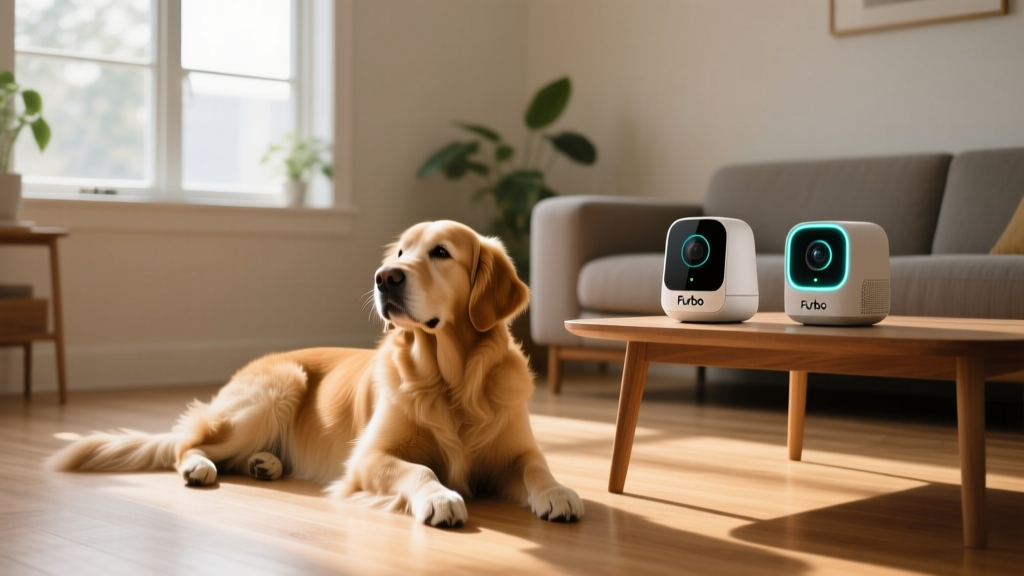
The Furbo 360° rotates to follow your dog's movement, sends bark alerts to your phone, and dispenses treats remotely. For apartment dogs prone to separation anxiety or noise-triggered barking (common in buildings with thin walls), the ability to check in and redirect behavior in real time is invaluable.
- 360° auto-rotation tracks movement
- Two-way audio for voice soothing
- Bark alerts with 15-second video clips
- Treat tossing up to 6 feet
- Requires stable WiFi (5 GHz recommended)
- Treat hopper holds ~30 small treats
- Subscription needed for cloud recording
- Not ideal for dogs that resource-guard food
PetSafe Easy Walk No-Pull Harness — Best for Hallway & Elevator Control
Price: $25–$35 | Sizes: Petite (8–14 lb / 4–6 kg) through XL (70–110 lb / 32–50 kg)
In apartment buildings, you navigate narrow hallways, crowded elevators, and shared entryways. A front-clip harness redirects pulling force sideways, giving you immediate control without choking. This is a force-free solution aligned with AVSAB's position on humane training.
- Front-clip stops pulling instantly
- Martingale loop prevents escape
- Quick-snap buckles for easy on/off
- Machine washable nylon
- Sizing runs small — measure girth carefully
- No padding on chest strap
- Front clip can twist on barrel-chested breeds
- Not suitable for car travel (no seatbelt loop)
Petloft Artificial Grass Pee Pad — Best for High-Rise Potty Solutions
Price: $35–$50 for the tray + grass mat | Replacement grass: $18–$25 each
For dogs in high-rise apartments (floors 5+), elevator trips for every potty break become impractical — especially for puppies, seniors, or dogs with urinary urgency. A balcony-installed artificial grass system provides an immediate relief option. The drainage tray collects liquid for easy disposal, and the grass mat is hose-washable.
- Realistic grass texture encourages use
- Drainage tray prevents mess on balcony
- Reusable — saves money vs. disposable pads
- Works for emergency potty during storms
- Requires daily cleaning to prevent odor
- Not suitable for large dogs (23"×35" surface)
- Some dogs refuse synthetic grass initially
- Balcony must have drainage or disposal plan
How to Set Up Your Apartment for Dog Success
Once you've secured the right unit, strategic setup prevents common apartment-dog problems like noise complaints, destructive chewing, and potty accidents.
Step-by-Step Apartment Dog Setup
- Designate a "safe zone" — Choose a corner or alcove away from the front door and shared walls. Place a crate or bed here with familiar blankets. This becomes your dog's retreat during stress.
- Install white noise near shared walls — Position a LectroFan or similar sound machine 2–3 feet from the wall you share with neighbors. Set to a consistent fan sound at 50–60 dB to mask hallway noise and neighbor sounds that trigger barking.
- Set up a potty station — If you're on an upper floor, place an artificial grass pad or pee pad holder on your balcony or near the entryway. Consistency in location is critical — dogs develop spatial potty habits within 2–3 weeks.
- Secure windows and balcony doors — Install child-safe locks on sliding doors at 18" and 36" heights. For balcony setups, ensure railings have gaps no wider than 4" (10 cm) to prevent small dogs from slipping through.
- Create an enrichment station — Dedicate a shelf or basket to puzzle toys, KONGs, and chew items. Rotate toys every 3–4 days to maintain novelty. A mentally stimulated dog is a quieter dog.
- Establish a walking routine — Map out 2–3 different walking routes from your building. Vary routes to provide novel scent stimulation. Aim for minimum 30 minutes of leash walking twice daily for medium-large breeds, 15–20 minutes for small breeds.
Safety Considerations for Apartment Dogs
Critical Safety Warnings
- Balcony falls: Dogs can fall from balconies — a condition veterinarians call "high-rise syndrome." Never leave a dog unsupervised on a balcony without pet-proofed railings and screened enclosures.
- Toxic building materials: Older apartment buildings (pre-1978) may contain lead paint chips, asbestos-containing floor tiles, or rodenticide bait stations in common areas. If your dog ingests any unknown substance, call ASPCA Animal Poison Control at (888) 426-4435 (24/7, consultation fee applies) or Pet Poison Helpline at (855) 764-7661.
- Temperature emergencies: Apartments without individual climate control can reach dangerous temperatures. Dogs begin experiencing heat stress at ambient temperatures above 80°F (27°C). Always leave water accessible and consider a cooling mat for brachycephalic breeds.
- Leash in hallways: Always leash your dog before opening your apartment door. Hallway encounters with other dogs can escalate rapidly in confined spaces.
- Fire evacuation: Keep a slip lead and collapsible water bowl near your front door. Practice fire evacuation with your dog quarterly. According to the AKC, approximately 500,000 pets are affected by house fires annually.
Cost Breakdown: Apartment Living with Dogs
Budget realistically. Here's what apartment dog ownership actually costs in 2026:
| Expense Category | Low Range | Medium Range | High Range |
|---|---|---|---|
| Pet rent (monthly) | $25 | $50 | $75 |
| Pet deposit (one-time) | $200 | $350 | $500 |
| Renter's insurance with pet liability (monthly) | $10 | $18 | $30 |
| Dog walking/daycare (monthly, if needed) | $100 | $300 | $600 |
| Food (monthly, medium dog 30–50 lb) | $40 | $70 | $120 |
| Routine vet care (annual, prorated monthly) | $30 | $55 | $90 |
| Total monthly (excluding one-time deposit) | $205 | $493 | $915 |
When to Consult Your Veterinarian About Apartment Stress
Apartment living can trigger or worsen certain behavioral and physical conditions. Consult your veterinarian if your dog displays any of the following:
- Excessive vocalization lasting more than 20 minutes when alone (potential separation anxiety requiring behavioral medication)
- Destructive behavior focused on doors, windows, or walls (escape-seeking behavior linked to anxiety disorders)
- House-soiling regression in a previously house-trained dog (could indicate UTI, cognitive decline in seniors, or stress-induced colitis)
- Panting, pacing, or trembling triggered by building noises (noise phobia may benefit from prescription medications like trazodone or Sileo)
- Weight loss or appetite changes after moving to a new apartment (environmental stress can suppress appetite for 3–7 days; beyond that warrants a vet visit)
A certified veterinary behaviorist (DACVB) or a fear-free certified trainer can develop a desensitization and counter-conditioning plan tailored to apartment-specific triggers. Your primary vet can refer you to a specialist through the American Veterinary Society of Animal Behavior.
Alternatives to Traditional Apartment Living with Dogs
If standard apartment complexes don't meet your dog's needs, consider these alternatives:
- Townhouse/rowhouse rentals: Typically offer private entries (no shared hallways), small yards, and fewer breed restrictions. Monthly rent averages 15–25% higher than comparable apartments.
- Accessory dwelling units (ADUs): Backyard cottages and basement apartments from private landlords often have more flexible pet policies. Search platforms like Furnished Finder or local Facebook housing groups.
- Co-living communities: Some purpose-built co-living spaces (Common, Outsite) now offer pet-friendly floors with shared dog-walking schedules and on-site pet amenities.
- House-sitting exchanges: Platforms like TrustedHousesitters connect dog owners with homeowners who need pet care, providing free housing in exchange for pet-sitting services.
Frequently Asked Questions
What is the best apartment layout for dogs?
Ground-floor units with direct patio or yard access are ideal. If ground-floor isn't available, prioritize units near elevators (fewer hallway encounters), with open floor plans (minimum 600 sq ft / 56 sq m for medium-large dogs), and hardwood or LVP flooring. Avoid units directly adjacent to laundry rooms, gyms, or lobbies where noise and foot traffic are constant.
How much does it cost to have a dog in an apartment?
Expect $200–$500 in upfront pet deposits and fees, plus $25–$75/month in pet rent. Total monthly costs for a medium dog in an apartment range from $205 (budget-conscious, no daycare) to $915 (premium food, daycare, insurance). Annual costs typically fall between $3,000 and $11,000 depending on your city, dog size, and care choices.
Are there natural alternatives for apartment dog anxiety?
Yes. Adaptil (dog-appeasing pheromone) diffusers cost $25–$35 and cover 700 sq ft — they mimic the calming pheromones nursing mothers produce. L-theanine supplements (such as Virbac Anxitane, $25–$35 for 60 tablets) have clinical evidence supporting anxiety reduction in dogs. Calming music playlists designed for dogs (Through a Dog's Ear, available on streaming platforms) reduce cortisol levels in shelter and home environments. Always discuss supplements with your veterinarian before starting, especially if your dog takes other medications.
How do I prevent my apartment dog from barking at hallway noises?
Use a three-pronged approach: (1) White noise machine positioned near the shared wall at 50–60 dB to mask trigger sounds. (2) Desensitization training — record hallway sounds at low volume, play while feeding high-value treats, gradually increase volume over 2–3 weeks. (3) Provide a "quiet" cue trained with positive reinforcement: reward silence on cue with treats, never punish barking (punishment increases anxiety and worsens the problem).
When should I skip OTC anxiety products and see a vet?
If your dog shows physical signs of distress (excessive drooling, self-injury from escape attempts, refusal to eat for 24+ hours, diarrhea lasting more than 48 hours) or if behavioral interventions show no improvement after 4–6 weeks of consistent implementation, consult your veterinarian. Prescription anti-anxiety medications (fluoxetine, clomipramine, trazodone) combined with a behavior modification plan have significantly higher success rates than OTC products alone for moderate-to-severe anxiety.
Jonas Cole
All our authors care for dogs every day — read more of their work on the authors page.