How Many Times a Day Feed a Dog?
How many times a day should you feed a dog? Learn ideal meal frequencies by age, breed size, and health condition, plus exact portion sizes and schedules.
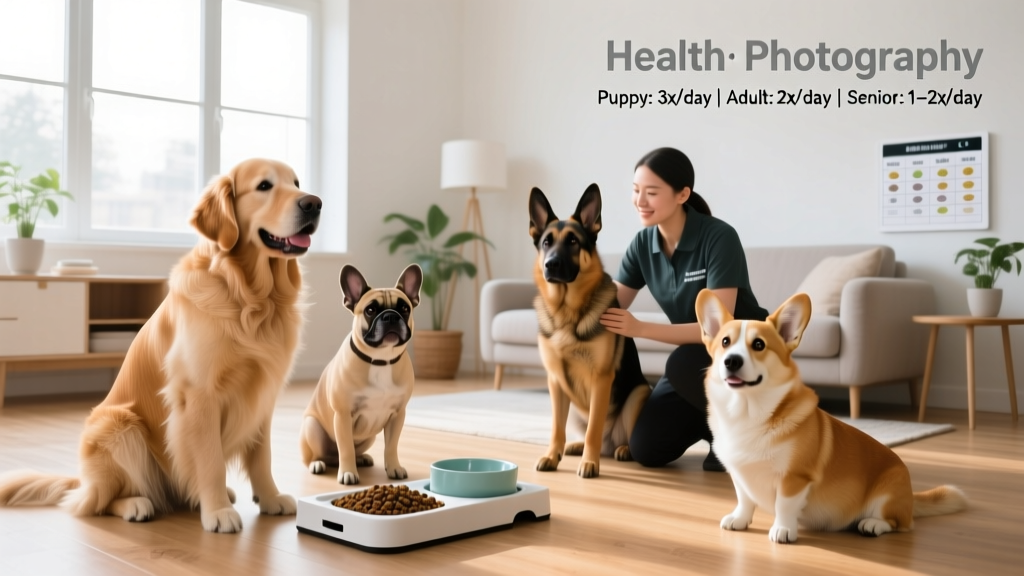
If you've ever stood in your kitchen wondering how many times a day should you feed a dog, you're not alone. The answer isn't one-size-fits-all — it depends heavily on your dog's age, size, health status, and activity level. Feeding frequency affects digestion, energy stability, weight management, and even behavior.
Getting this right matters more than most owners realize. Underfeeding frequency can lead to bilious vomiting (yellow foam from an empty stomach), while overfeeding in large meals puts deep-chested breeds at risk for gastric dilatation-volvulus (GDV or bloat), a life-threatening emergency.
This guide breaks down exactly how many meals your dog needs per day, how much to serve at each meal, and when to adjust the schedule — backed by veterinary nutrition guidelines.
Quick Answer: How Many Times a Day Should You Feed a Dog?
Most adult dogs do best with 2 meals per day (morning and evening). Puppies under 6 months need 3-4 meals daily. Senior dogs and those with medical conditions may benefit from 2-3 smaller meals. Feeding once daily is generally not recommended for most dogs due to risks of hunger, bile vomiting, and in large breeds, bloat.
Feeding Frequency by Life Stage
Dogs have dramatically different metabolic demands at each life stage. Here's what veterinary nutritionists recommend:
| Life Stage | Age Range | Meals Per Day | Why |
|---|---|---|---|
| Neonatal | 0-3 weeks | Every 2-3 hours (8-12x) | Mother's milk; orphaned puppies need bottle/tube feeding |
| Weaning | 3-6 weeks | 4-6x | Transitioning to gruel; tiny stomachs need frequent refills |
| Young Puppy | 6-12 weeks | 4x | Rapid growth phase; blood sugar regulation critical |
| Older Puppy | 3-6 months | 3x | Growth continues; can handle slightly larger portions |
| Adolescent | 6-12 months | 2x | Transition to adult schedule; monitor body condition |
| Adult | 1-7 years | 2x | Maintains stable energy; prevents bilious vomiting |
| Senior | 7+ years | 2-3x | Smaller meals ease digestion; manage conditions like kidney disease |
According to the World Small Animal Veterinary Association (WSAVA) Global Nutrition Guidelines, meal frequency should always be paired with total daily caloric needs — not treated as a separate decision.
How Much Should Each Meal Be? Portion Guide by Weight
Knowing how many times a day to feed a dog is only half the equation. The other half is calculating how much food goes in the bowl at each meal. This depends on your dog's weight, body condition score (BCS), activity level, and the caloric density of their specific food.
The table below provides total daily amounts for a typical commercial dry kibble (approximately 350-400 kcal/cup). Divide this total by the number of meals per day.
| Dog Weight | Total Daily Kibble | Per Meal (2x/day) | Daily Calories (approx.) |
|---|---|---|---|
| 5 lb / 2.3 kg (Toy) | ½ cup | ¼ cup | 175-200 kcal |
| 10 lb / 4.5 kg (Small) | ¾ cup | ⅜ cup | 260-300 kcal |
| 20 lb / 9 kg (Small-Med) | 1¼ cups | ⅝ cup | 440-500 kcal |
| 40 lb / 18 kg (Medium) | 2¼ cups | 1⅛ cups | 790-900 kcal |
| 60 lb / 27 kg (Med-Large) | 3 cups | 1½ cups | 1,050-1,200 kcal |
| 80 lb / 36 kg (Large) | 3⅔ cups | 1⅞ cups | 1,280-1,460 kcal |
| 100+ lb / 45+ kg (Giant) | 4¼+ cups | 2⅛+ cups | 1,500-1,800+ kcal |
Critical note: These are starting estimates. Your dog's actual needs depend on their body condition score (1-9 scale, where 4-5 is ideal), whether they're spayed/neutered (reduces caloric needs by roughly 20-30%), and activity level. Always consult your veterinarian to determine the right caloric target for your individual dog.
Breed Size Matters: Why Small and Giant Breeds Need Different Schedules
Not all dogs process food at the same rate, and breed size plays a significant role in optimal feeding frequency.
Toy and Small Breeds (Under 20 lb / 9 kg)
Chihuahuas, Yorkshire Terriers, Pomeranians, and similar tiny breeds have disproportionately high metabolic rates relative to their body mass. They burn through calories fast and are prone to hypoglycemia (low blood sugar) if meals are spaced too far apart.
- Puppies under 4 months: Feed 4 meals daily — never let a toy-breed puppy go more than 4-5 hours without eating during waking hours
- Adults: 2 meals minimum; some toy breeds do better with 3 smaller meals to prevent hypoglycemic episodes
- Red flag: If your small dog becomes lethargic, trembles, or seems disoriented between meals, offer a small amount of food immediately and contact your vet
Large and Giant Breeds (Over 60 lb / 27 kg)
Great Danes, German Shepherds, Standard Poodles, and other deep-chested breeds face a specific danger: gastric dilatation-volvulus (GDV). This occurs when the stomach fills with food and gas, then twists on itself. It's a surgical emergency with a fatality rate of 10-30% even with treatment.
- Never feed one large meal: Split daily food into 2-3 smaller meals to reduce stomach distension
- Use a slow-feeder bowl: Dogs that inhale food swallow excess air, increasing bloat risk
- Rest before and after meals: Avoid vigorous exercise for 60 minutes before and 90 minutes after eating
- Elevated bowls — debatable: Earlier studies suggested elevated feeders reduced bloat risk, but a Purdue University study published in JAVMA found elevated bowls may actually increase GDV risk in large breeds. Most veterinarians now recommend floor-level feeding
How to Calculate Your Dog's Exact Daily Calorie Needs
Veterinary nutritionists use the Resting Energy Requirement (RER) formula to calculate baseline caloric needs, then multiply by a lifestyle factor:
RER = 70 × (body weight in kg)^0.75
Example: A 20 kg (44 lb) dog → 70 × (20)^0.75 = 70 × 9.46 = 662 kcal/day
Step 2 — Multiply by activity factor:- Neutered adult, moderate activity: RER × 1.6 = 1,059 kcal/day
- Intact adult, moderate activity: RER × 1.8 = 1,192 kcal/day
- Weight loss plan: RER × 1.0 = 662 kcal/day
- Light activity/senior: RER × 1.2-1.4 = 794-927 kcal/day
- Highly active/working dog: RER × 2.0-5.0 = 1,324-3,310 kcal/day
Once you have the daily total, divide by the number of meals. For our 20 kg dog eating 2 meals per day at 1,059 kcal/day: each meal should contain approximately 530 kcal.
Check your dog food label for kcal/cup (or kcal per can) to convert this into an actual portion. A typical premium dry kibble ranges from 350-450 kcal/cup, so this dog would get roughly 1.2-1.5 cups per meal.
Free-Feeding vs. Scheduled Meals: Which Is Better?
Some owners leave food out all day (free-feeding or "ad libitum" feeding). Others use strict scheduled meals. Here's how the two approaches compare:
| Factor | Scheduled Meals | Free-Feeding |
|---|---|---|
| Weight control | ✓ Excellent — precise portions | ✗ Poor — most dogs overeat |
| Appetite monitoring | ✓ Easy to detect changes | ✗ Hard to notice decreased intake |
| House training | ✓ Predictable bathroom schedule | ✗ Unpredictable elimination |
| Multi-dog homes | ✓ Controls who eats what | ✗ One dog may dominate |
| Bloat risk | ✓ Smaller, controlled meals | ✗ Grazing may increase air intake |
| Convenience | ✗ Requires owner presence | ✓ Low effort |
For the vast majority of dogs, scheduled meals are the superior approach. Free-feeding may work for a small subset of highly active, self-regulating dogs (some working breeds, for example), but according to the American Veterinary Medical Association (AVMA), obesity affects over 50% of pet dogs in the U.S., and free-feeding is a major contributing factor.
If your work schedule makes midday feeding difficult, consider an automatic timed feeder (brands like PetSafe Eatwell or WOPET offer programmable portion-controlled dispensers in the $50-$120 range). These allow you to maintain a 3-meal schedule even during long workdays.
Special Situations That Change Feeding Frequency
Dogs with Diabetes
Diabetic dogs require strictly timed meals coordinated with insulin injections. Most protocols involve feeding exactly 2 meals per day, 12 hours apart, with insulin administered immediately after eating. Skipping or delaying a meal after giving insulin can cause dangerous hypoglycemia. Your veterinarian will establish a specific protocol — never adjust it independently.
Dogs with Kidney Disease
Chronic kidney disease (CKD) often causes nausea and appetite loss. Offering 3-4 small meals throughout the day is typically better tolerated than 2 large ones. Warming food slightly (to body temperature, about 101°F / 38°C) can improve palatability.
Pregnant and Nursing Dogs
During the last trimester of pregnancy and throughout lactation, a dam's caloric needs can increase by 2-4x her normal intake. She physically cannot consume enough in 2 meals — offer 3-4 meals daily of a calorie-dense, AAFCO-approved puppy or all-life-stages formula.
Dogs with Bilious Vomiting Syndrome
If your dog vomits yellow foam (bile) in the early morning hours, this often indicates an empty stomach irritating the gastric lining. The solution: add a small bedtime snack — about 10-15% of their daily food portion given right before sleep — to keep the stomach from sitting empty too long overnight. Consult your veterinarian to rule out other causes first.
Sample Daily Feeding Schedules
Here are practical templates you can adapt to your household routine:
Adult Dog — 2 Meals Per Day (Most Common)
- 7:00 AM — Breakfast (50% of daily food)
- 12:30 PM — Midday walk (no food)
- 6:00 PM — Dinner (50% of daily food)
- 9:00 PM — Last bathroom break
Puppy Under 6 Months — 3 Meals Per Day
- 7:00 AM — Breakfast (33% of daily food)
- 12:00 PM — Lunch (33% of daily food)
- 5:30 PM — Dinner (34% of daily food)
Large/Giant Breed Adult — 3 Meals Per Day (Bloat Prevention)
- 7:00 AM — Breakfast (33% of daily food)
- 12:30 PM — Lunch (33% of daily food)
- 6:30 PM — Dinner (34% of daily food)
- No exercise 60 min before or 90 min after each meal
When to Call the Vet About Feeding Issues
- Sudden refusal to eat for more than 24 hours (12 hours for puppies under 6 months)
- Vomiting yellow or green bile repeatedly between meals
- Eating ravenously but losing weight (possible parasites, diabetes, or exocrine pancreatic insufficiency)
- Drinking excessively and urinating frequently alongside increased appetite (diabetes or Cushing's disease warning sign)
- Distended abdomen, restlessness, and unsuccessful attempts to vomit — call your emergency vet immediately, this may be bloat (GDV)
- Any change in appetite lasting more than 2-3 days
ASPCA Animal Poison Control: (888) 426-4435 (24/7, consultation fee applies) — call if your dog ingests something toxic between meals.
Frequently Asked Questions
Can I feed my adult dog just once a day?
While some dogs tolerate once-daily feeding, it's not ideal for most. A single large meal increases bloat risk in large breeds, leaves the stomach empty for 24 hours (triggering bilious vomiting in prone dogs), and causes energy spikes and crashes. Two meals per day is the veterinary consensus for adult dogs. If your schedule absolutely requires once-daily feeding, choose the evening meal and leave a small portion of daily kibble in a puzzle toy for morning enrichment.
Should I feed my dog at the same time every day?
Yes, consistency helps regulate your dog's digestive system, bathroom schedule, and circadian rhythm. Aim to feed within a 30-minute window of the same times daily. This is especially important for dogs on medications tied to meals (e.g., insulin, certain antibiotics) and for house-training puppies.
How do I know if I'm feeding my dog too much or too little?
Use the body condition score (BCS) system rather than relying solely on the bag's feeding chart (which tends to overestimate). You should be able to feel your dog's ribs without pressing hard, see a visible waist when viewed from above, and observe an abdominal tuck from the side. A BCS of 4-5 out of 9 is ideal. If your dog scores 6+, reduce portions by 10-15% and reassess in 2 weeks. If below 4, increase by 10-15%.
My dog begs for food between meals — should I give in?
Begging is a learned behavior, not a sign of hunger. If your dog is at a healthy BCS and eating appropriate portions, they're not starving — they're opportunistic. Ignore begging completely (no eye contact, no verbal response) and reward calm behavior away from the kitchen. If you want to offer enrichment between meals, use a portion of their daily kibble allowance in a snuffle mat or Kong toy — don't add extra calories on top of their meals.
Should puppies eat more frequently than adult dogs?
Absolutely. Puppies under 6 months need 3-4 meals per day because their stomachs are small, their growth rate is rapid, and they're vulnerable to hypoglycemia. Toy-breed puppies (Chihuahuas, Yorkies) are especially at risk and should never go more than 4-5 hours without eating during the day. Transition from 3 meals to 2 meals between 6-12 months depending on breed size — giant breeds may stay on 3 meals longer.
Does wet food change how often I should feed my dog?
Feeding frequency stays the same regardless of food type. However, wet food is roughly 70-80% water and less calorie-dense per volume than kibble, so the portion size will be larger to meet the same caloric target. Check the can's guaranteed analysis for kcal per can and calculate accordingly. Wet food spoils faster — don't leave it out for more than 20-30 minutes at room temperature.
This article provides general feeding guidance. Your dog's individual needs may differ based on health conditions, medications, breed, and lifestyle. Always consult your veterinarian before making significant changes to your dog's feeding schedule or diet.
Priya Sutaria
All our authors care for dogs every day — read more of their work on the authors page.


