Can You Feed Cats Dog Food? A Complete Nutrition Safety Guide
Can you feed cats dog food? Learn the nutritional differences, health risks, and what to do if your cat eats dog food. Vet-backed guidance inside.
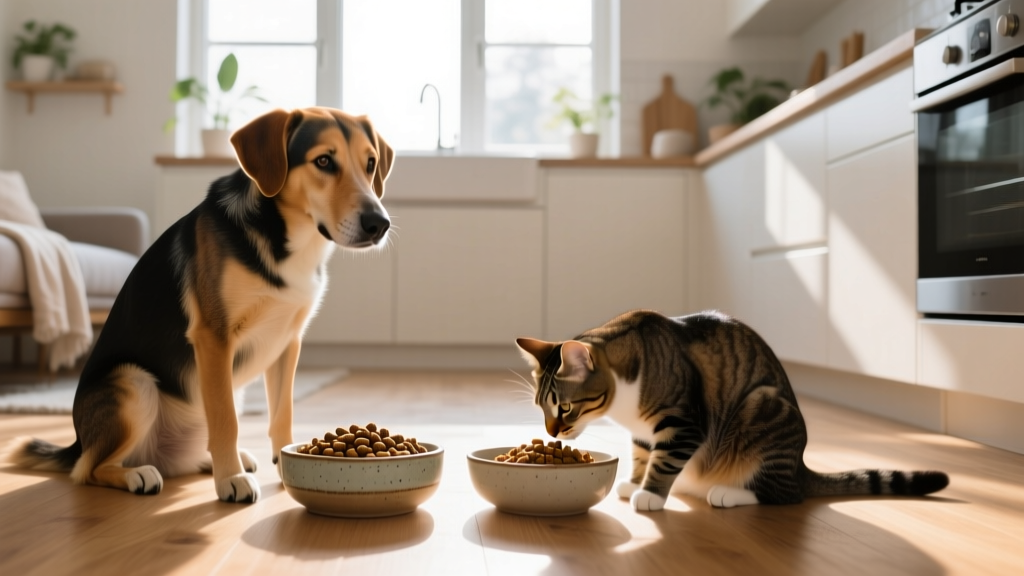
If you share your home with both a dog and a cat, you've probably witnessed the inevitable: your cat sneaking a mouthful from the dog's bowl, or your dog vacuuming up the cat's kibble. It happens in millions of multi-pet households every day. But is it actually safe? The short answer is no — cats and dogs have fundamentally different nutritional needs, and feeding a cat dog food, even occasionally, can lead to serious health consequences over time.
This guide breaks down exactly why cat food and dog food are not interchangeable, what happens nutritionally when a cat eats dog food, and how to manage feeding in a multi-pet household. While our site focuses on dog care, understanding the feline side of the equation helps dog owners keep both pets safe and properly nourished.
Why Dog Food Is Nutritionally Incomplete for Cats
Cats are obligate carnivores — meaning they require nutrients found almost exclusively in animal tissue. Dogs, by contrast, are omnivorous scavengers that have evolved alongside humans for roughly 15,000 years and can derive nutrition from a wider range of plant and animal sources. This evolutionary divergence means their commercial diets are formulated to entirely different AAFCO (Association of American Feed Control Officials) nutrient profiles.
Here's where the numbers reveal the problem. AAFCO sets minimum nutrient levels for both species, and the gaps are significant:
| Nutrient | Cat Minimum | Dog Minimum | Why It Matters for Cats |
|---|---|---|---|
| Crude Protein | 26% dry matter | 18% dry matter | Cats cannot efficiently synthesize amino acids from plant proteins |
| Crude Fat | 9% dry matter | 5.5% dry matter | Cats rely on fat for concentrated energy and fat-soluble vitamin absorption |
| Taurine | 0.1% (extruded) / 0.2% (canned) | Not required | Cats cannot synthesize taurine — deficiency causes fatal heart disease (DCM) and blindness |
| Arginine | 1.04% | 0.51% | Cats are extremely sensitive to arginine deficiency — can cause ammonia toxicity within hours |
| Vitamin A (preformed) | 3,332 IU/kg | 1,500 IU/kg | Cats cannot convert beta-carotene to vitamin A — they need preformed retinol from animal sources |
| Niacin | 60 mg/kg | 11.4 mg/kg | Cats cannot synthesize niacin from tryptophan the way dogs can |
| Arachidonic Acid | 0.02% | Not required | Essential fatty acid cats cannot produce — needed for skin, coat, and inflammatory response |
The most critical difference is taurine. Dog food contains no guaranteed taurine because dogs produce it endogenously from the amino acids cysteine and methionine. Cats cannot. A cat eating only dog food will develop taurine deficiency within weeks to months, leading to dilated cardiomyopathy (a fatal heart condition) and central retinal degeneration (irreversible blindness). According to the Merck Veterinary Manual, taurine deficiency remains one of the most preventable causes of cardiac disease in domestic cats.
What Happens If a Cat Eats Dog Food Regularly?
A single stolen mouthful of dog kibble won't harm your cat. The danger comes from habitual or exclusive feeding. Here's a timeline of what nutritional deficiencies look like when a cat subsists on dog food:
Short-Term (Days to Weeks)
- Reduced appetite or picky eating (dog food lacks the strong animal-protein aroma cats require)
- Mild gastrointestinal upset — loose stools or vomiting due to different fiber and fat ratios
- Lower energy levels as the cat fails to meet its higher caloric density needs
Medium-Term (Weeks to Months)
- Poor coat quality — dull, flaky, or thinning fur from arachidonic acid and protein deficiency
- Weight loss despite eating, because the food doesn't meet feline metabolic requirements
- Weakened immune function, making the cat more susceptible to infections
Long-Term (Months to Years)
- Taurine-deficiency dilated cardiomyopathy — potentially fatal heart failure
- Central retinal degeneration — progressive, irreversible blindness
- Hepatic lipidosis (fatty liver disease) if the cat reduces food intake due to unpalatability
- Reproductive failure in intact cats — poor kitten development, stillbirths
Emergency Note: If you suspect your cat has been eating dog food exclusively for weeks or longer, consult a veterinarian immediately. Taurine-deficiency DCM can be partially reversible if caught early and supplementation begins promptly. Do not wait for symptoms to worsen.
The Reverse Problem: Why Dogs Shouldn't Eat Cat Food
Since we're a dog-focused site, this matters directly to you. Cat food is formulated with significantly higher protein (often 35-50% dry matter) and fat (15-25% dry matter) than most adult dogs need. When dogs regularly raid the cat bowl, several problems emerge:
| Risk | Mechanism | At-Risk Dogs |
|---|---|---|
| Obesity | Cat food averages 400-500 kcal/cup vs. 300-400 kcal/cup for dog food | Sedentary, small, or senior dogs |
| Pancreatitis | High fat content triggers pancreatic inflammation in susceptible dogs | Schnauzers, Yorkshire Terriers, Cocker Spaniels, dogs with prior episodes |
| GI upset | Rich protein/fat ratio overwhelms canine digestive capacity | Dogs with sensitive stomachs, IBD, or food intolerances |
| Renal strain | Excess protein increases kidney workload over time | Senior dogs, dogs with early-stage kidney disease |
If your dog has a history of pancreatitis — common in Miniature Schnauzers and some terrier breeds — even a small amount of high-fat cat food can trigger an acute episode requiring emergency veterinary care costing $1,500–$4,000 in hospitalization, IV fluids, and monitoring.
Managing Feeding in a Multi-Pet Household
The practical solution isn't just knowing the science — it's preventing cross-eating in your home. Here are proven strategies that work across different household layouts and pet temperaments:
Physical Separation
- Feed in separate rooms with a closed door for 15-20 minutes per meal. This is the gold standard.
- Elevated feeding stations for cats — place cat bowls on countertops, cat trees, or wall-mounted shelves that dogs cannot reach. Most cats prefer elevated eating positions anyway.
- Baby gates with cat doors — install a gate with a small pet opening that allows the cat through but blocks the dog. Products like the Carlson Pet Products Design Studio gate with cat door ($45-$65) work well for this.
Timed and Controlled Feeding
- Microchip-activated feeders — devices like the SureFeed Microchip Pet Feeder Connect ($170-$200) read your pet's microchip or RFID collar tag and only open the lid for the correct animal. This is the most reliable tech solution for persistent food thieves.
- Scheduled meals over free-feeding — pick up bowls after 15-20 minutes. Free-feeding (leaving food out all day) makes cross-eating almost inevitable in multi-pet homes.
- Supervised feeding — stand between bowls during mealtime and redirect any pet that approaches the wrong bowl using positive reinforcement (treats and praise for going to their own station).
For Persistent Dog Food Thieves
If your dog is obsessed with the cat's food, work on a solid "leave it" cue using positive reinforcement training. Start with low-value items and gradually work up to practicing near the cat's bowl (empty at first, then with food). Reward heavily for choosing to walk away. This takes 2-4 weeks of consistent daily practice for most dogs.
What to Do If Your Cat Has Been Eating Dog Food
If you've discovered your cat has been regularly eating dog food — perhaps you've been traveling, or a pet sitter made an error — here's a step-by-step recovery plan:
- Switch back to cat food immediately. Do not transition gradually — the cat needs species-appropriate nutrition as soon as possible.
- Monitor food intake. If the cat refuses cat food after becoming accustomed to dog food, try warming the cat food to body temperature (around 100°F / 38°C) to enhance aroma, or offer a strongly-scented wet food like tuna-based formulas.
- Watch for hepatic lipidosis signs. Cats that stop eating for more than 48 hours are at risk for fatty liver disease. Symptoms include lethargy, yellowing of the gums or whites of the eyes (icterus), and vomiting. This is a veterinary emergency.
- Schedule a vet visit. If the cat has been eating dog food exclusively for more than 2-3 weeks, your veterinarian may recommend bloodwork (complete blood count, chemistry panel, and possibly a taurine level test) to assess for deficiencies. Expect to pay $150-$350 for a standard wellness panel.
- Ask about taurine supplementation. Your vet may prescribe a taurine supplement (typically 250-500 mg/day for an average cat) for several weeks to rebuild stores. Do not supplement without veterinary guidance — while taurine toxicity is rare, dosing should be individualized.
Body Condition Score Check for Your Cat
After any dietary disruption, assess your cat's body condition using the standard 1-9 BCS scale (developed by WSAVA):
- BCS 1-3 (Underweight): Ribs, spine, and pelvic bones easily visible. Severe muscle wasting. Cat needs veterinary assessment for underlying disease or malnutrition.
- BCS 4-5 (Ideal): Ribs palpable without excess fat. Visible waist from above. Abdominal tuck present. This is the target.
- BCS 6-9 (Overweight to Obese): Ribs difficult to feel under fat deposits. No visible waist. Rounded abdomen. Needs caloric reduction and vet-monitored weight loss plan.
If your cat's BCS has shifted significantly during the period of eating dog food, mention this to your veterinarian at your next visit.
Nutritional Requirements by Life Stage: Why One-Size Doesn't Fit All
Both cat and dog nutritional needs shift dramatically across life stages. This is another reason why sharing food between species is problematic — even "all life stages" formulas are calibrated to one species' developmental timeline.
| Cat Weight | Indoor Adult (Neutered) | Active/Outdoor Adult | Kitten (4-12 months) | Senior (10+ years) |
|---|---|---|---|---|
| 6 lb (2.7 kg) | 150-170 kcal | 200-220 kcal | 250-280 kcal | 140-160 kcal |
| 8 lb (3.6 kg) | 190-210 kcal | 250-270 kcal | 310-350 kcal | 175-195 kcal |
| 10 lb (4.5 kg) | 220-250 kcal | 290-320 kcal | 370-420 kcal | 200-230 kcal |
| 12 lb (5.4 kg) | 255-285 kcal | 340-370 kcal | 430-490 kcal | 235-265 kcal |
| 15 lb (6.8 kg) | 300-340 kcal | 400-440 kcal | 510-580 kcal | 280-310 kcal |
For dogs, caloric needs vary even more widely due to the enormous range in breed sizes. A 10 lb Chihuahua needs roughly 300-350 kcal/day while a 70 lb Labrador needs 1,300-1,600 kcal/day at maintenance. Activity level, metabolism, spay/neuter status, and ambient temperature all factor in. This is why generic feeding charts on bags are starting points, not prescriptions.
Condition-Specific Considerations
When either pet has a health condition, dietary precision becomes even more critical:
- Kidney disease (common in senior cats): Requires phosphorus restriction and moderate, high-quality protein. Dog food's protein levels could accelerate feline renal damage.
- Urinary issues: Cat foods are acidified to maintain urine pH around 6.0-6.5 to prevent struvite crystals. Dog food has different pH targets and could worsen feline urinary tract disease.
- Food allergies: Both species can develop allergies to common proteins (chicken, beef). Cross-contamination between bowls can trigger reactions in allergic pets.
- Weight management: A dog on a calorie-restricted weight loss plan who sneaks high-fat cat food will fail to lose weight and may gain.
Selecting the Right Commercial Food: What to Look For
Whether you're choosing food for your dog or verifying your cat's food is appropriate, here's a label-reading framework that cuts through marketing claims:
The AAFCO Statement — Non-Negotiable
Every complete commercial pet food sold in the US should carry an AAFCO nutritional adequacy statement on the bag or can. It will say something like: "[Product Name] is formulated to meet the nutritional levels established by the AAFCO Dog (or Cat) Food Nutrient Profiles for [life stage]." If a product lacks this statement, it is not a complete diet and should not be fed as the sole food source.
Ingredient List Analysis
- First ingredient should be a named animal protein (chicken, salmon, lamb) — not "meat by-products" or a grain.
- Named fat sources (chicken fat, salmon oil) are preferable to generic "animal fat."
- For cats: Look for taurine listed in the guaranteed analysis or ingredient list. If it's not mentioned, contact the manufacturer.
- For dogs with sensitivities: Limited-ingredient diets with a single novel protein (venison, rabbit, duck) and single carbohydrate source (sweet potato, peas) reduce allergen exposure.
What to Avoid in Both Species' Food
- Products with no AAFCO statement
- Foods with excessive artificial preservatives (BHA, BHT, ethoxyquin) — look for mixed tocopherols (vitamin E) instead
- "Grain-free" formulas from boutique brands linked to DCM cases reported to the FDA — particularly those high in peas, lentils, and potatoes as primary ingredients
- Raw diets without documented safety testing — raw feeding carries Salmonella and Listeria risks for both pets and humans in the household, according to AVMA guidelines
Homemade Diets: Proceed with Extreme Caution
Some pet owners consider making homemade food for both species from a single batch recipe. This is strongly discouraged without veterinary nutritionist involvement. Here's why:
A 2013 study published in the Journal of the American Veterinary Medical Association evaluated 200 homemade dog food recipes found online and in books. Researchers found that 95% had at least one essential nutrient deficiency, and 84% had multiple deficiencies. Cat food recipes fared even worse due to the more complex feline nutrient requirements.
If you're committed to homemade feeding for either pet:
- Consult a board-certified veterinary nutritionist (DACVN or equivalent). You can find one through the American College of Veterinary Nutrition at acvn.org. Initial consultations typically cost $150-$300.
- Use a recipe formulated specifically for your pet's species, weight, age, and health status. A recipe designed for a healthy adult cat will not work for a senior cat with kidney disease or a growing kitten.
- Purchase a veterinary-formulated supplement premix (such as those from Balance IT or JustFoodForDogs) that adds the missing micronutrients to a base of cooked protein and carbohydrates.
- Never feed the same homemade recipe to both your dog and cat. Their amino acid, vitamin, and mineral requirements differ too significantly.
- Reassess the recipe every 6-12 months or whenever your pet's health status changes.
Transition Protocol: Switching Foods Safely Over 7-10 Days
If you need to transition either pet to a new food — whether correcting a feeding mistake or simply changing brands — a gradual switch prevents gastrointestinal upset. Here's the standard protocol:
| Days | Old Food | New Food | Notes |
|---|---|---|---|
| Days 1-2 | 75% | 25% | Watch for appetite changes or refusal |
| Days 3-4 | 50% | 50% | Monitor stool consistency — mild softening is normal |
| Days 5-6 | 25% | 75% | Reduce portion slightly if loose stools appear |
| Days 7-8 | 10% | 90% | Most pets tolerate this stage well |
| Days 9-10 | 0% | 100% | Full transition complete |
Adjustments for sensitive pets: If your dog or cat has a history of GI sensitivity, extend each phase to 3-4 days, making the full transition 14-20 days. Adding a probiotic supplement (such as FortiFlora for dogs or cats, approximately $30 for a 30-day supply) during the transition can help stabilize gut flora.
When to slow down or stop: If you see vomiting, diarrhea lasting more than 24 hours, or complete food refusal at any stage, hold at the current ratio for an additional 2-3 days before advancing. If symptoms persist, consult your veterinarian — the new food may not be appropriate for your pet.
Supplement Guidance: What to Add and When
Most pets eating a complete, AAFCO-approved commercial diet do not need additional supplements. However, there are specific scenarios where supplementation may benefit dogs (our primary focus):
| Supplement | Indication | Typical Dosage | Notes |
|---|---|---|---|
| Omega-3 fatty acids (fish oil) | Coat quality, joint inflammation, cognitive support | 75-100 mg EPA+DHA per kg body weight daily | Use triglyceride-form fish oil; refrigerate after opening |
| Glucosamine/Chondroitin | Joint support in large breeds, senior dogs, post-orthopedic surgery | Glucosamine: 20 mg/lb daily; Chondroitin: 15 mg/lb daily | Takes 4-6 weeks to see effect; use veterinary-grade products |
| Probiotics | Digestive upset, antibiotic recovery, stress-related diarrhea | 1-5 billion CFU daily depending on dog size | Strain matters — look for Enterococcus faecium SF68 or Lactobacillus acidophilus |
| Vitamin E | Immune support, skin conditions | 2-5 IU per lb daily | Fat-soluble — excess can accumulate; use only under vet guidance |
For cats, the most common supplement need is taurine — but only if they've been eating an incomplete diet or have been diagnosed with taurine deficiency by a veterinarian. Never supplement a cat eating a complete commercial cat food without veterinary direction.
Monitoring Nutritional Success in Both Pets
Whether you're correcting a feeding error or optimizing an established diet, track these indicators over 4-8 weeks to confirm your pets are thriving:
- Body Condition Score: Reassess monthly using the 9-point scale. Ideal is 4-5 for both dogs and cats. Visible waist, palpable ribs without excess fat covering.
- Coat quality: Should be shiny, smooth, and free of excessive shedding or dandruff. Dull or greasy coats often signal fatty acid imbalance.
- Energy level: Age-appropriate activity and alertness. Lethargy can indicate caloric deficit or nutrient deficiency.
- Stool quality: Firm, well-formed, brown stools. Consistently loose, hard, or unusually odorous stools suggest digestive issues or dietary imbalance.
- Weight trend: Weigh pets monthly (use a kitchen scale for cats — place them in a carrier and subtract the carrier weight). Unexplained weight changes of more than 5% warrant a vet visit.
Frequently Asked Questions
Can you feed cats dog food in an emergency?
For a single meal or two in a genuine emergency (you've run out of cat food and stores are closed), dog food will not cause acute harm. It's far better than a cat not eating at all, since cats that fast for more than 48 hours risk hepatic lipidosis. However, supplement with a small amount of canned tuna in water or cooked plain chicken to boost protein and improve palatability. Resume proper cat food as soon as possible.
Can you feed cats dog food if it's a high-protein brand?
Even high-protein dog foods (30-40% protein) fall short of feline requirements in specific nutrients. The issue isn't just total protein — it's that dog food lacks added taurine, preformed vitamin A, arachidonic acid, and the specific amino acid profile cats require. A 40% protein dog food may meet the crude protein minimum for cats, but the taurine gap alone makes it unsafe for regular feeding.
My dog keeps eating the cat's food — will it hurt him?
Occasional snacking on cat food is unlikely to harm a healthy adult dog. However, the high fat content (often 18-25% in cat food vs. 12-18% in dog food) poses real pancreatitis risk for susceptible breeds and individuals. If your dog has had pancreatitis or is prone to obesity, preventing access to cat food is essential. Use elevated feeding stations, microchip feeders, or separate rooms.
What ingredients should I avoid in both dog and cat food?
For both species, avoid foods with unnamed meat sources ("meat meal" without species identification), artificial preservatives like BHA and BHT, added sugars or corn syrup, and excessive artificial colors. For dogs specifically, avoid products containing xylitol (toxic to dogs), chocolate derivatives, macadamia nuts, raisins, or grapes. For cats, avoid foods with high carbohydrate content (cats have no nutritional requirement for carbs and excessive carbs contribute to obesity and diabetes).
Does my dog need supplements if he occasionally eats cat food?
No — occasional cat food consumption does not create a supplement need for dogs. In fact, cat food is nutritionally dense, so the concern is excess calories and fat, not deficiencies. Focus on preventing access rather than supplementing around it. If your dog is on a complete, AAFCO-approved dog food, additional supplements are generally unnecessary unless recommended by your veterinarian for a specific condition.
How do I switch my dog to a new food if he's used to eating cat food?
First, eliminate access to cat food entirely. Then follow the standard 7-10 day transition protocol (detailed above), mixing increasing proportions of the new dog food with the old dog food. Your dog may initially refuse the dog food if he's accustomed to the richer taste of cat food. Try warming the dog food slightly, adding a tablespoon of low-sodium chicken broth, or using a food topper to increase appeal. Patience and consistency typically resolve preference issues within 1-2 weeks.
The Bottom Line: Species-Specific Feeding Is Non-Negotiable
Cats and dogs evolved along different nutritional paths, and their commercial foods reflect those differences at a molecular level. Feeding a cat dog food — even a premium, high-protein dog food — deprives the cat of taurine, arachidonic acid, preformed vitamin A, and other nutrients it cannot synthesize. The consequences range from a dull coat to fatal heart disease.
For dog owners in multi-pet households, the action items are straightforward: feed species-appropriate diets, prevent cross-eating through physical separation or technology, and monitor both pets' body condition regularly. If your cat has been eating dog food for more than a couple of weeks, consult your veterinarian for bloodwork and a taurine assessment. And if your dog is the one raiding the cat bowl, address the behavior through management and positive reinforcement training — his pancreas and waistline will thank you.
ASPCA Animal Poison Control: If you suspect your pet has ingested something toxic (not just the wrong species' food), call (888) 426-4435. Available 24/7; a consultation fee applies.
Priya Sutaria
All our authors care for dogs every day — read more of their work on the authors page.


