Why Dogs Get Tear Stains: Science Behind Epiphora and...
The science of canine tear stains (epiphora): porphyrin pigments, brachycephalic anatomy, and evidence-based tear stain remover for dogs strategies.
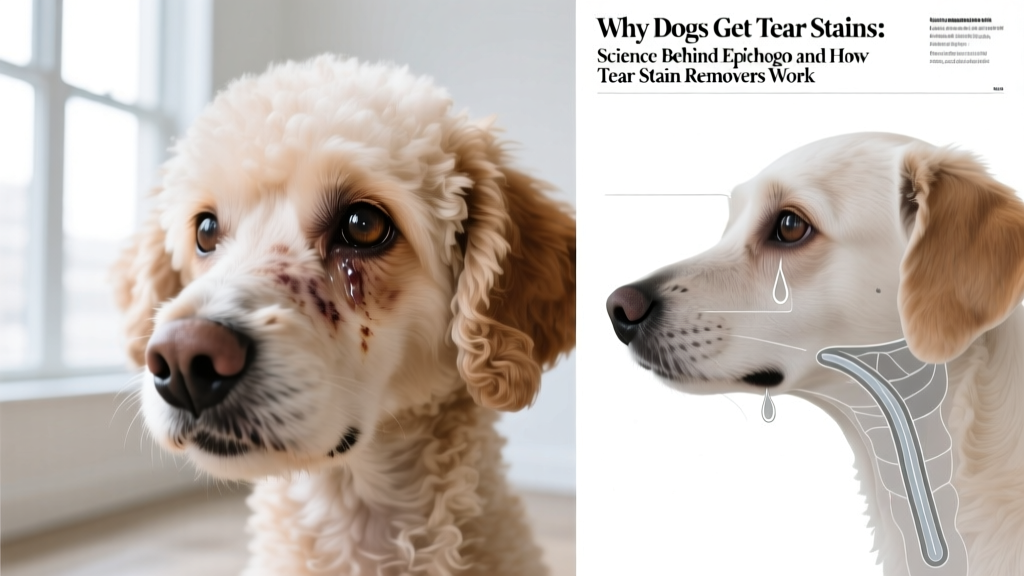
Quick Answer: What Causes Tear Stains and Do Removers Work?
Tear stains in dogs are caused by epiphora — excessive tear overflow that deposits porphyrin pigments (iron-containing molecules produced during red blood cell breakdown) onto facial fur. These reddish-brown stains are most common in brachycephalic breeds, dogs with shallow eye sockets, and those with nasolacrimal duct obstruction. Effective tear stain removers work by breaking down porphyrin bonds, reducing tear overflow, or addressing the underlying anatomical or medical cause. Surface cleaners alone rarely solve the problem long-term without identifying why tears are overflowing in the first place.
If you've ever noticed rust-colored streaks running from your dog's inner eye corners down their muzzle, you've witnessed a biochemical process that traces back to canine evolutionary anatomy. Tear stains aren't just cosmetic — they're a visible signal of how your dog's lacrimal system is (or isn't) functioning. Understanding the science behind porphyrin staining, nasolacrimal drainage, and breed-specific facial structure gives you the framework to choose a tear stain remover for dogs that actually addresses the root cause rather than just bleaching the symptom.
The Biochemistry of Tear Stains: Porphyrins Explained
How Porphyrins Create Reddish-Brown Staining
Tears contain multiple components: water, lipids, mucin, lysozyme, and trace amounts of porphyrins. Porphyrins are cyclic organic compounds that contain iron — specifically, they are byproducts of heme synthesis and degradation. When red blood cells break down naturally (their typical lifespan is approximately 110-120 days in dogs), hemoglobin is metabolized through a pathway that produces biliverdin, bilirubin, free iron, and carbon monoxide. Some of these porphyrin intermediates are excreted through tears, saliva, and urine.
When tears overflow onto fur and are exposed to air, the iron in porphyrins oxidizes — the same chemical process that causes rust on metal. This oxidation produces the characteristic reddish-brown to dark brown discoloration you see on light-colored fur. The longer the fur stays moist with tears, the deeper the oxidation and the more stubborn the stain becomes.
According to the Merck Veterinary Manual, epiphora — the clinical term for excessive tear overflow — is the primary driver of porphyrin staining in dogs. The staining itself is not harmful, but the chronic moisture it signals can lead to secondary bacterial or yeast infections in the skin folds beneath the eyes.
The key insight for choosing a tear stain remover: products that merely bleach or cover the stain miss the chemistry. Effective removers either contain chelating agents (compounds that bind iron and prevent oxidation) or enzymatic cleaners that break down the porphyrin molecular structure. Products relying solely on hydrogen peroxide or boric acid may lighten stains temporarily but can irritate delicate periocular skin with repeated use.
Evolutionary Context: Why Dogs Have This Drainage System
Ancestral Tear Drainage in Wolves and Wild Canids
Wolves and wild canids possess a functional nasolacrimal drainage system — tears produced by the lacrimal glands drain through puncta (small openings at the inner eye corner), travel through canaliculi into the lacrimal sac, and empty via the nasolacrimal duct into the nasal cavity. This system evolved to keep the cornea lubricated without external overflow. In wild canids, epiphora is rare because skull morphology allows proper duct alignment and drainage.
The problem arose through selective breeding for neotenic facial features. Humans preferentially bred dogs with shorter muzzles, flatter faces, and larger-appearing eyes — traits that mimic juvenile characteristics (paedomorphism). This dramatically altered the geometry of the nasolacrimal pathway. In brachycephalic breeds, the duct is compressed, kinked, or simply too short to drain effectively, causing tears to overflow onto the face instead of draining internally into the nose.
This is fundamentally an artifact of domestication. No wild canid species exhibits the degree of epiphora seen in Pugs, Shih Tzus, or Maltese. The tear staining problem is, in evolutionary terms, a trade-off for the facial features humans selected over thousands of years of breeding.
Physiological Mechanism: How the Lacrimal System Fails
Understanding the failure chain helps you identify where a tear stain remover for dogs can intervene — and where it cannot:
| Step | Normal Function | Failure Mode | Result |
|---|---|---|---|
| 1. Tear production | Lacrimal glands produce aqueous tears (15-25 µL/min in dogs) | Reflex hypersecretion from irritation (entropion, trichiasis, allergies) | Volume exceeds drainage capacity |
| 2. Puncta collection | Upper and lower puncta capture tears at medial canthus | Absent puncta (congenital in some breeds), blocked by debris or hair | Tears cannot enter drainage system |
| 3. Canalicular transport | Canaliculi carry tears to lacrimal sac via capillary action | Compression from shallow orbits, inflammation, or scar tissue | Tears pool at eye corner |
| 4. Nasolacrimal duct | Duct empties into nasal cavity at ventral meatus | Kinked duct (brachycephalic skull), dacryocystitis, foreign body | Complete overflow — chronic epiphora |
| 5. Facial contact | N/A — tears should not contact facial fur | Hair wicking (medial canthal hair draws tears onto face) | Porphyrin oxidation and staining |
Each failure point requires a different intervention. A topical tear stain remover addresses step 5 (the cosmetic result) but does nothing for steps 1-4 (the physiological cause). This is why many owners report that stains return within days of stopping a product — the overflow continues unabated.
Breed Variations: Who Gets Tear Stains and Why
Breed predisposition to epiphora and tear staining is well-documented in veterinary ophthalmology. The American Kennel Club notes that brachycephalic breeds and small companion breeds with long facial hair are disproportionately affected:
| Breed | Primary Anatomical Factor | Severity |
|---|---|---|
| Shih Tzu | Extremely shallow orbits, medial canthal pocket, long facial hair wicking | High |
| Maltese | White coat shows oxidation prominently, narrow nasolacrimal ducts | High |
| Pug | Severe brachycephaly compresses nasolacrimal duct, prominent globes | High |
| Bichon Frise | White coat, medial canthal hair, possible punctal aplasia | Moderate-High |
| Poodle (Toy/Miniature) | Curly periocular hair traps moisture, narrow duct diameter | Moderate |
| Pekingese | Extreme brachycephaly, nasal fold trichiasis irritating cornea | High |
| Cocker Spaniel | Long ear and facial hair, predisposition to primary seborrhea affecting skin folds | Moderate |
Dolichocephalic breeds (long-muzzled dogs like Greyhounds, Collies, and German Shepherds) rarely develop significant tear staining because their nasolacrimal ducts follow a straight, unobstructed path from eye to nasal cavity. If a dolichocephalic dog develops sudden tear staining, it more likely indicates an acquired problem — conjunctivitis, a foreign body, or dacryocystitis (infection of the lacrimal sac) — rather than anatomical predisposition.
Types of Tear Stain Removers: Mechanism of Action
Not all tear stain removers work the same way. Here's how the major categories function at the chemical level, with typical price ranges as of 2026:
| Category | Active Mechanism | Typical Price | Best For |
|---|---|---|---|
| Enzymatic cleaners | Proteolytic enzymes break down porphyrin protein bonds | $8-$18 (4 oz bottle) | Existing stain removal |
| Iron chelators | EDTA or similar agents bind free iron, preventing oxidation | $12-$25 | Prevention of new stains |
| Boric acid solutions | Mild antiseptic + mild bleaching effect on porphyrins | $5-$12 | Light maintenance (caution near eyes) |
| Oral supplements | Reduce porphyrin production or alter tear pH | $15-$35 (60-day supply) | Systemic reduction (consult vet first) |
| Antibiotic-based (tylosin) | Reduces porphyrin-producing bacteria; alters tear composition | Prescription only | Veterinary-directed treatment only |
Important safety note: Avoid any tear stain remover containing hydrogen peroxide in concentrations above 3%, undiluted bleach, or products not specifically formulated for periocular use. The skin around a dog's eyes is thin (approximately 0.5-1mm epidermis vs. 2-4mm on the body) and highly susceptible to chemical burns. Always consult your veterinarian before starting oral supplements marketed for tear stain reduction — some contain antibiotics like tylosin, and prolonged use without veterinary oversight contributes to antimicrobial resistance.
Common Misconceptions About Tear Stains
| Myth | Fact |
|---|---|
| "Tear stains mean my dog is sad or crying." | Dogs do not produce emotional tears. Reflex tearing is a physiological response to irritation, not emotion. Epiphora is a drainage problem, not an emotional signal. |
| "All tear stains are caused by diet." | While mineral content in water and food can influence porphyrin concentration, anatomy is the primary driver. A brachycephalic dog on a perfect diet will still stain if tears cannot drain. |
| "I can cure tear stains by switching to bottled water." | High-iron tap water can contribute marginally, but endogenous porphyrins (produced internally during RBC breakdown) are the dominant source. Switching water alone rarely resolves staining. |
| "Tear stains are purely cosmetic and harmless." | Chronic moisture in facial folds creates an environment for Malassezia yeast and bacterial overgrowth. Untreated epiphora can lead to moist dermatitis (hot spots) and secondary infections requiring veterinary treatment. |
| "Trimming the hair around the eyes will stop staining." | Trimming medial canthal hair reduces wicking and helps, but does not stop tear overflow. It's a management tool, not a cure — the tears still need somewhere to go. |
When Tear Staining Signals a Medical Problem
🚨 See Your Veterinarian If You Notice:
- Sudden onset of staining in a breed not previously prone to epiphora — may indicate conjunctivitis, corneal ulcer, foreign body, or nasolacrimal duct infection (dacryocystitis)
- Unilateral staining only (one eye) — suggests a localized problem (blocked punctum, eyelid mass, entropion) rather than systemic overproduction
- Thick, mucoid, or purulent discharge — normal reflex tears are clear and watery; yellow/green discharge signals infection
- Squinting, pawing at the eye, or photophobia — these indicate corneal pain and require immediate evaluation (corneal ulcers can progress to perforation within 24-48 hours if untreated)
- Swelling or redness at the medial canthus — possible dacryocystitis or lacrimal sac abscess
- Staining that worsens despite consistent cleaning — may indicate an undiagnosed anatomical obstruction requiring nasolacrimal duct flushing or surgical correction (dacryocystorhinostomy)
A veterinary ophthalmologist can perform a Jones test (fluorescein dye passage) to determine if the nasolacrimal duct is patent. Cost ranges from $80-$200 for a basic ophthalmic exam, with surgical interventions for duct obstruction typically $800-$2,500 depending on complexity.
The distinction between cosmetic staining and pathological epiphora matters enormously. A Maltese with bilateral, mild, chronic staining since puppyhood likely has anatomical epiphora — manageable with daily cleaning. A 7-year-old Labrador with new-onset unilateral tearing and staining needs a corneal exam and possibly a Schirmer tear test to rule out keratoconjunctivitis sicca (dry eye), which paradoxically causes reflex tearing as the eye attempts to compensate for inadequate lipid/mucin tear layers.
Practical Daily Management Protocol
Evidence-Based Daily Tear Stain Routine
- Morning cleaning (60 seconds): Use a lint-free gauze pad moistened with a veterinary-formulated enzymatic eye wash (e.g., Nutri-Vet Eye Rinse, $8-$12 per 4 oz bottle). Wipe from the medial canthus outward, using a fresh section of gauze for each eye to prevent cross-contamination.
- Keep medial canthal hair trimmed: Have a groomer or vet tech trim hair within 2-3mm of the medial canthus every 2-3 weeks. This eliminates the primary wicking pathway that draws tears onto the muzzle.
- Evening drying: After cleaning, gently pat the area dry with a clean cotton pad. Moisture left on the skin accelerates porphyrin oxidation and creates conditions for yeast growth.
- Weekly stain treatment: Apply an iron-chelating tear stain remover (look for EDTA or sodium borate on the ingredient list) to existing stains. Allow 3-5 minutes contact time before wiping clean. Expect visible lightening after 2-3 weekly applications.
- Water bowl hygiene: Stainless steel or ceramic bowls only — plastic bowls harbor bacteria in micro-scratches that can contribute to periocular and oral bacterial load. Wash daily.
Consistency matters more than product choice. Daily mechanical removal of tears prevents porphyrin oxidation before it sets. No topical product can outperform daily wiping with a clean, damp cloth.
How Is Canine Tear Staining Different From Humans?
Humans also produce porphyrins and can develop epiphora (particularly with nasolacrimal duct obstruction, which is common in infants and older adults). However, several factors make dogs more visibly affected:
- Fur absorption: Human tears drain down the cheek on bare skin where they evaporate quickly. Dog fur absorbs and retains moisture, prolonging oxidation time and concentrating porphyrin deposits on individual hair shafts.
- Coat color contrast: White and light-colored coats (common in many companion breeds selected for appearance) make reddish-brown porphyrin oxidation dramatically visible. Humans don't have facial fur to display the staining.
- Facial anatomy: The degree of brachycephaly seen in Pugs and Bulldogs has no human equivalent. Human epiphora is almost always pathological (duct obstruction, infection), whereas in many dog breeds it's considered a "normal" consequence of breed conformation.
- Blink mechanics: Dogs blink less frequently than humans (approximately 10-15 blinks/minute vs. 15-20 in humans), which means tears distribute less evenly across the corneal surface and are more prone to pooling at the medial canthus.
Frequently Asked Questions
Can dogs get tear stains from food allergies?
Food allergies primarily cause pruritus (itching), ear infections, and gastrointestinal signs in dogs — not isolated epiphora. However, allergic conjunctivitis can cause reflex tearing as a secondary effect. If your dog has tear staining plus itchy paws, recurrent ear infections, or seasonal worsening, discuss an elimination diet trial or allergy testing with your veterinarian. Environmental allergens (pollen, dust mites) are more common triggers for allergic conjunctivitis than food proteins.
Is it safe to use human eye drops as a tear stain remover?
No. Human eye drops (Visine, Clear Eyes) contain vasoconstrictors like tetrahydrozoline that are not tested for safety in canine eyes and can cause rebound hyperemia or corneal irritation. Artificial tears formulated for dogs (e.g., Genteal Pet, lubricant drops prescribed by your vet) are safe for moisture support but do not remove stains. Only use products labeled for veterinary periocular use.
Why does my dog's tear staining get worse in summer?
Seasonal worsening typically reflects environmental allergens (pollen, grasses) causing allergic conjunctivitis and reflex tearing. Higher ambient humidity also slows evaporation of tears from facial fur, extending oxidation time. Increase cleaning frequency during high-pollen months and consider wiping your dog's face after outdoor walks to remove allergen particles from periocular fur.
Do oral tear stain supplements with tylosin work?
Tylosin (an antibiotic in the macrolide class) does reduce porphyrin staining by altering bacterial flora and possibly reducing porphyrin synthesis. However, the AVMA and veterinary ophthalmologists discourage long-term antibiotic use for cosmetic purposes due to antimicrobial resistance concerns. Some previously OTC supplements containing tylosin (e.g., Angels' Eyes Original formula) have reformulated to remove antibiotics. Reserve antibiotic therapy for cases where a veterinarian has identified a specific infectious cause.
What's the fastest way to remove existing tear stains?
For established, dark stains, a two-step approach works fastest: (1) Apply an enzymatic porphyrin-removing solution daily for 5-7 days to break down oxidized deposits, then (2) transition to an iron-chelating preventive product applied 2-3 times weekly. Complete removal of deeply set stains on long fur may require trimming the stained hair and allowing fresh growth while maintaining the preventive protocol. Expect 2-4 weeks for visible improvement on severe staining.
References
- Merck Veterinary Manual: Epiphora in Small Animals — clinical overview of nasolacrimal disorders
- AKC: Tear Stains in Dogs — Causes and Treatments — breed-specific guidance
- AVMA: Antimicrobial Use Guidelines — context on responsible antibiotic use in companion animals
Tom Renshaw
All our authors care for dogs every day — read more of their work on the authors page.


