Breeds of Family Dogs: Why Canines Bond With Humans
Explore the canine science behind breeds of family dogs — from oxytocin bonding loops and evolutionary history to breed-specific temperament traits.
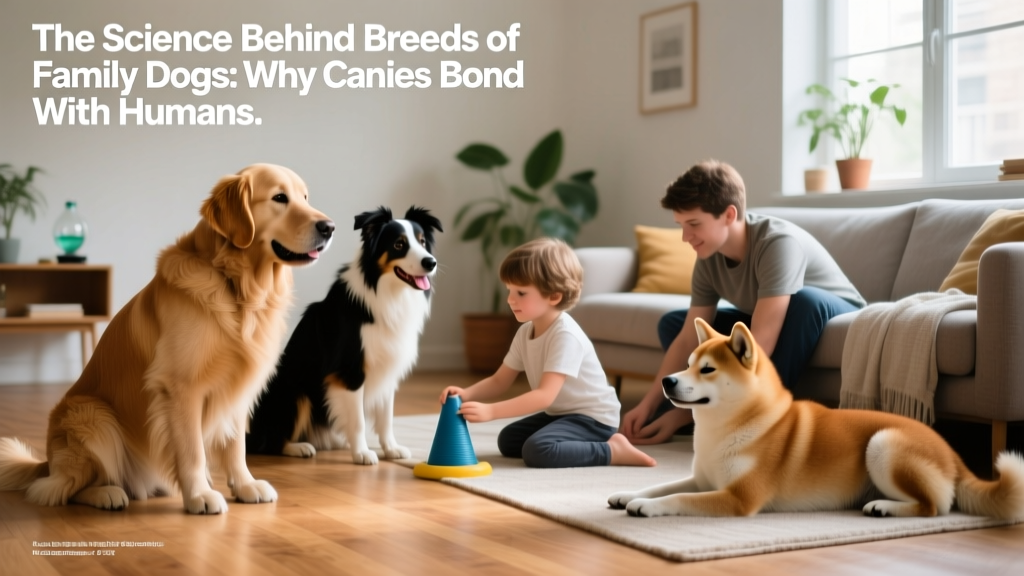
Quick Answer: The best breeds of family dogs — including Labrador Retrievers, Golden Retrievers, Beagles, and Cavalier King Charles Spaniels — share a suite of genetically influenced traits that promote human-directed sociability. Research published in Science Advances (2017) identified structural variants in the GTF2I and GTF2IRD1 genes that cause hypersociability in dogs, essentially making them biologically wired to seek human contact. These genetic adaptations, combined with thousands of years of selective breeding for cooperative temperaments, explain why certain breeds consistently rank as top family companions.
The Oxytocin Loop: How Dogs and Humans Bond at a Chemical Level
When you gaze into your dog's eyes, both of you experience a measurable spike in oxytocin — the same neuropeptide that facilitates bonding between human mothers and infants. A landmark 2015 study by Miho Nagasawa and colleagues at Azabu University in Japan, published in Science, demonstrated that mutual gaze between dogs and their owners increased urinary oxytocin by 130% in dogs and 300% in humans.
This isn't just a feel-good anecdote. The physiological mechanism works like this:
- Visual stimulus: Your dog makes eye contact with you, activating the superior colliculus (a midbrain structure involved in gaze processing).
- Neurochemical response: The hypothalamus releases oxytocin into the bloodstream and cerebrospinal fluid.
- Behavioral reinforcement: Oxytocin reduces cortisol (stress hormone) levels and activates the brain's reward circuitry — particularly the nucleus accumbens.
- Reciprocal loop: Your own oxytocin rise prompts you to pet, speak to, or play with your dog, which further stimulates their oxytocin production.
This cross-species oxytocin positive feedback loop is unique in the animal kingdom. Wolves raised by humans from birth do not show this reciprocal oxytocin response during mutual gaze, confirming that this trait evolved specifically during domestication rather than being inherited from a common ancestor.
The GTF2I Gene: "Williams Syndrome" in Dogs
Researchers at Princeton University identified that the same genetic region associated with Williams-Beuren syndrome in humans — a condition characterized by extreme friendliness and lack of social inhibition — is responsible for hypersociability in dogs. Dogs with specific insertions in the GTF2I and GTF2IRD1 genes on chromosome 6 show significantly more human-directed social behavior, including proximity-seeking, following, and reduced stranger anxiety. This genetic finding, published in Science Advances, provides a molecular explanation for why certain breeds of family dogs are so consistently people-oriented.
Evolutionary Context: From Wolf Pack to Family Couch
Evolutionary Timeline: Genetic evidence suggests dogs diverged from wolves between 20,000 and 40,000 years ago. The "self-domestication" hypothesis proposes that less fearful, more curious wolves began scavenging near human settlements. These proto-dogs gained a caloric advantage, and over generations, selection pressure favored individuals with lower flight distances and higher social tolerance — traits that eventually became hardwired into the canine genome.
The breeds we now classify as ideal family dogs share traits that map directly onto this domestication pathway:
- Low reactivity to novel stimuli: Family dog breeds typically show reduced neophobia (fear of new things) compared to working/guardian breeds.
- High social motivation: They seek proximity to humans even in the absence of food rewards.
- Inhibited bite response: Bite inhibition — the ability to mouth without applying full jaw pressure — is more pronounced and develops earlier in breeds selected for companionship.
- Neoteny (retained juvenile traits): Many family breeds maintain puppy-like playfulness and dependency into adulthood, a hallmark of domestication syndrome.
This evolutionary backdrop explains why a Golden Retriever will bring a stranger a toy (social offering behavior) while a livestock guardian breed like the Great Pyrenees will position itself between the stranger and its charges. Both are performing bred-in behaviors, but only one maps onto the "family companion" role most households need.
Breed Variations: Which Breeds of Family Dogs Score Highest on Sociability Metrics?
Not all breeds of family dogs are created equal when it comes to measurable sociability. The following table synthesizes data from the American Kennel Club temperament descriptions, the Canine Behavioral Assessment and Research Questionnaire (C-BARQ) developed at the University of Pennsylvania, and breed-specific health data to rank popular family breeds across key dimensions:
| Breed | Stranger-Directed Friendliness | Child Tolerance | Separation Anxiety Risk | Trainability | Avg. Weight (lb/kg) |
|---|---|---|---|---|---|
| Labrador Retriever | Very High | Very High | Moderate | Very High | 55-80 / 25-36 |
| Golden Retriever | Very High | Very High | Moderate-High | Very High | 55-75 / 25-34 |
| Beagle | High | High | High | Moderate | 20-30 / 9-14 |
| Cavalier King Charles Spaniel | Very High | High | Very High | High | 12-18 / 5.5-8 |
| Boxer | Moderate-High | Very High | Moderate | High | 50-80 / 23-36 |
| Bichon Frise | High | High | Very High | High | 12-18 / 5.5-8 |
Key insight from the data: Breeds scoring highest on stranger-directed friendliness and child tolerance (Labs, Goldens) also tend to score moderate-to-high on separation anxiety. This isn't a coincidence — the same genetic architecture that produces intense human attachment also produces distress when that attachment figure is absent. If your household involves long workdays, a breed with moderate rather than extreme sociability (like a well-socialized Boxer or a Basset Hound) may actually be a better fit.
Physiology of the "Family Dog Brain": What's Different?
Functional MRI studies conducted at Emory University by neuroscientist Gregory Berns have revealed that dogs' caudate nuclei — the brain region associated with reward anticipation and social attachment — activate significantly more in response to their owner's scent than to the scent of unfamiliar humans or unfamiliar dogs. In one study, the owner scent produced caudate activation comparable to what human brain imaging shows when subjects view photos of loved ones.
Here's how the canine social brain differs from both wolves and humans:
| Feature | Dogs | Wolves (Human-Raised) | Humans |
|---|---|---|---|
| Reciprocal oxytocin response to gaze | Yes | No | Yes |
| Caudate response to owner scent | Strong | Weak/Absent | Strong (loved ones) |
| Gaze alternation (looking at human then at problem) | Frequent | Rare | N/A |
| Referential gesture comprehension (pointing) | Innate (puppies 6+ weeks) | Requires extensive training | Develops ~9-12 months |
| Cortisol reduction from human touch | Significant (15-30 min) | Minimal | Significant |
The "gaze alternation" behavior is particularly telling. When a dog encounters an unsolvable problem (like a food container they can't open), they will look at the container, then look at their human, then back at the container — effectively asking for help. Wolves, even those hand-raised from 10 days old, will persistently try to solve the problem independently and almost never look to a human for assistance. This referential communication is a core feature of what makes certain breeds of family dogs so seamlessly integrated into human households.
Debunking Common Misconceptions About Family Dog Breeds
| Myth | Fact |
|---|---|
| "Family-friendly breeds never bite." | All dogs can bite under sufficient stress, pain, or fear. Breed temperament data shows variation within breeds, not guarantees. Even Golden Retrievers appear in bite incident reports. Proper socialization (exposure to 100+ people, surfaces, sounds before 16 weeks) and supervision around children are non-negotiable regardless of breed. |
| "Small breeds are better for apartments and families with young children." | Small breeds often have higher excitability and lower bite thresholds than medium-large breeds. Cavalier King Charles Spaniels and Bichons are exceptions, but many toy breeds (Chihuahuas, Yorkshire Terriers) score higher on C-BARQ aggression scales toward strangers and children. Size alone does not predict family compatibility. |
| "Mixed breeds are always healthier and more temperamentally stable." | While hybrid vigor can reduce risk of specific recessive disorders, mixed-breed dogs can inherit health issues from either parent breed. A 2013 study in the Journal of the American Veterinary Medical Association analyzing over 27,000 cases found that mixed breeds had higher rates of ruptured cranial cruciate ligaments and were equally susceptible to many cancers. Temperament in mixed breeds is also less predictable, which matters when children are involved. |
| "A dog's breed doesn't matter — it's all about how you raise them." | Genetics accounts for approximately 40-60% of behavioral variation in dogs, according to the Darwin's Ark study published in Science (2022). While upbringing and socialization are critical, breed ancestry significantly predicts traits like human sociability, biddability, and toy-directed play. Ignoring breed predispositions sets both dog and family up for frustration. |
Practical Implications: What the Science Means for Your Household
Actionable Guidance Based on Canine Behavioral Science
1. Match sociability to your schedule. If adults in your household work 8+ hours outside the home, avoid breeds with "Very High" separation anxiety risk (Cavaliers, Bichons, Vizslas). Instead, consider a Labrador Retriever or a Standard Poodle — breeds that bond strongly but tolerate alone time better when properly exercise-conditioned. Budget $15-$25/day for doggy daycare if you choose a high-attachment breed.
2. Leverage the oxytocin loop deliberately. Spend 5-10 minutes of calm, sustained eye contact and gentle petting with your dog each morning. This isn't just bonding — it measurably lowers cortisol in both of you for 2-4 hours afterward. For children, teach them to sit calmly and let the dog approach rather than grabbing or looming over the dog.
3. Use referential communication in training. Because family dog breeds are genetically predisposed to follow human pointing and gaze, use hand signals alongside verbal cues. Research shows dogs learn 30-40% faster when both modalities are used together. Point to the mat, then say "place" — your dog's brain is optimized for exactly this kind of cross-modal learning.
4. Don't skip breed-specific health screening. Family-friendly breeds carry specific genetic risks. Golden Retrievers have a 60% lifetime cancer rate (among the highest of any breed). Cavaliers have a 50%+ prevalence of mitral valve disease by age 5. Labs are prone to exercise-induced collapse (EIC), with carrier rates around 5-8% in the population. When purchasing from a breeder, require OFA (Orthopedic Foundation for Animals) health clearances and genetic test results. Expect to pay $1,500-$3,500 for a health-tested puppy from a responsible breeder.
5. Prioritize the critical socialization window. Puppies have a primary socialization period from approximately 3 to 14 weeks of age. During this window, positive exposure to diverse stimuli literally shapes the developing amygdala (fear-processing center). Enroll in a well-run puppy kindergarten class ($100-$200 for a 6-week course) and aim for 5-10 novel positive experiences per day during this period.
When Family Dog Behavior Signals a Problem
Because we expect family dog breeds to be consistently sociable, behavioral changes can be easy to dismiss or misinterpret. Consult your veterinarian if you observe any of the following:
Red Flags That Require Professional Evaluation:
- Sudden aggression in a previously friendly dog — often signals pain (dental disease, arthritis, ear infection). One study found that 41% of dogs presenting for aggression had an underlying medical cause.
- Excessive clinginess or following behavior that escalates — may indicate cognitive decline in senior dogs (canine cognitive dysfunction affects approximately 28% of dogs aged 11-12 years) or anxiety disorders requiring behavioral pharmacology.
- Loss of interest in social interaction — in breeds genetically predisposed to sociability, social withdrawal is a significant clinical sign. Rule out hypothyroidism, chronic pain, and depression-like states.
- Compulsive behaviors (flank sucking in Dobermans, tail chasing in Bull Terriers, light/shadow fixation in many breeds) — these have a genetic-neurological basis involving dopamine dysregulation and often require SSRI medication alongside behavioral modification.
Frequently Asked Questions
Why do some dog breeds bond more closely with families than others?
Breed differences in family bonding trace to both ancient domestication genes (GTF2I/GTF2IRD1) and more recent selective breeding. Breeds developed for cooperative work alongside humans — retrieving, herding, companionship — were selected for individuals that showed strong attachment, responsiveness to human cues, and distress when separated from their handler. Guarding and independent hunting breeds were selected for the opposite: autonomous decision-making and lower human dependency. The behavioral gap between these categories is real and measurable, not just anecdotal.
Can dogs actually understand human emotions?
Yes, to a significant degree. Research from the University of Lincoln (2016) demonstrated that dogs can integrate visual and auditory cues to form a multimodal representation of human emotional states. Dogs looked longer at facial expressions that matched the emotional tone of concurrent vocalizations — for example, staring longer at a happy face paired with a happy voice than at a mismatched pairing. This cross-modal emotional recognition was previously documented only in humans and primates. Family dog breeds with high human-sociability scores tend to perform best on these tasks.
How do dogs process human language compared to humans?
fMRI studies show that dogs process language using a two-pathway system similar to humans: the left temporal cortex processes word meaning (semantics), while the right auditory cortex processes intonation (prosody). Dogs show the strongest caudate activation when both the word and the intonation are positive — meaning they can distinguish between a praising word spoken in a neutral tone versus a praising word spoken enthusiastically. For family dog training, this means your tone genuinely matters alongside your word choice.
Is it normal for a family dog to follow me everywhere?
Following behavior (also called "shadowing") is normal and expected in most breeds of family dogs, particularly retrievers, spaniels, and companion breeds. It reflects the secure attachment bond analogous to the parent-child attachment studied in human developmental psychology. However, if the behavior escalates to distressed whining when you close a door, inability to settle when you're home, or destructive behavior during any separation, this crosses into separation anxiety territory — which affects an estimated 20-40% of dogs and benefits from structured desensitization protocols and, in some cases, veterinary-prescribed anxiolytics like fluoxetine or clomipramine.
How is a dog's social bonding different from humans bonding with each other?
The oxytocin mechanism is remarkably similar, but dogs lack the prefrontal cortex complexity that allows humans to engage in abstract social reasoning — evaluating reputation, planning long-term reciprocity, or feeling complex social emotions like guilt or spite. When your dog looks "guilty" after chewing your shoe, they're responding to your body language and tone, not experiencing guilt as humans understand it. This actually makes dogs more straightforward social partners: their attachment is immediate, present-focused, and not contingent on social calculations. For families, this directness is precisely what makes the bond so therapeutically valuable.
Key Research Referenced
- Nagasawa, M. et al. (2015). "Oxytocin-gaze positive loop and the coevolution of human-dog bonds." Science, 348(6232).
- von Holdt, B.M. et al. (2017). "Structural variants in genes associated with human Williams-Beuren syndrome underlie stereotypical hypersociability in domestic dogs." Science Advances, 3(7).
- Morrill, K. et al. (2022). "Ancestry-inclusive dog genomics challenges popular breed stereotypes." Science, 376(6592).
- Berns, G. (2013-2023). Dog fMRI research program, Emory University.
- Correia-Caeiro, C. et al. (2020). "Multimodal emotional perception in dogs." Biology Letters, University of Lincoln.
Aaron Whyte
All our authors care for dogs every day — read more of their work on the authors page.


