How Should Dogs Travel in Cars: The Science of Canine Vehicle Safety
How should dogs travel in cars? Explore the veterinary science, crash-test data, and physiology behind safe canine car travel, plus practical gear recommendations.
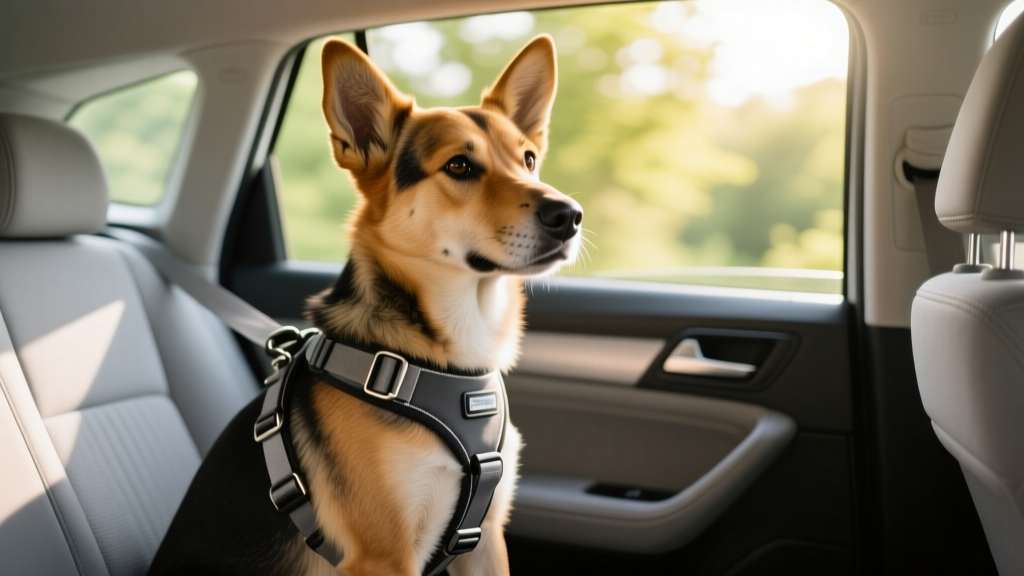
The Short Answer: How Should Dogs Travel in Cars?
Dogs should travel in a crash-tested, independently certified harness or a secured crate/kennel — positioned in the rear seat or cargo area of an SUV/wagon, never in the front passenger seat. The restraint must limit forward excursion to under 6 inches during a 30 mph collision. Small dogs (under 25 lb / 11 kg) do best in secured carriers; medium-to-large dogs (25–90 lb / 11–41 kg) should use a certified crash-test harness tethered to the vehicle's LATCH or seatbelt system. Dogs over 90 lb may require a crash-rated crate bolted to the cargo floor. Unrestrained dogs become projectiles at speeds as low as 25 mph, generating forces of 1,000+ pounds in a collision.
Why Restraint Matters: The Physics of an Unrestrained Dog
The numbers behind vehicular dog safety are sobering and frequently misunderstood. A 50 lb (23 kg) dog traveling at 35 mph generates approximately 1,750 pounds of force upon sudden deceleration in a collision. That same dog at 50 mph produces over 2,500 pounds of impact force — enough to cause fatal injuries to any human passenger the dog strikes, and almost certainly fatal to the dog.
The Center for Pet Safety (CPS), a nonprofit research organization, has been conducting independent crash tests on pet travel products since 2011 using the same FMVSS 213 testing protocols applied to child car seats. Their findings revealed that over 75% of pet harnesses marketed as "crash-tested" failed when subjected to actual crash dynamics at 30 mph. Many products simply used the term without submitting to independent laboratory verification.
This matters because canine anatomy doesn't absorb impact the way human anatomy does. Dogs lack the clavicular strut (collarbone structure) that helps humans distribute chest-impact forces. Their thoracic cage is more laterally compressed, and their internal organs sit differently relative to the rib cage. A harness that fails to distribute load across the sternum and rib cage can cause pulmonary contusions, cardiac tamponade, or hepatic laceration — injuries that are often fatal before reaching a veterinary hospital.
The Physiological Mechanism: Canine Motion Processing in Vehicles
A dog's vestibular system — the inner-ear apparatus responsible for balance and spatial orientation — evolved for terrestrial locomotion at speeds up to roughly 35–45 mph (in sprinting breeds). The semicircular canals detect rotational acceleration, while the otolith organs detect linear acceleration and gravity.
Inside a moving vehicle, a dog receives conflicting sensory inputs: the vestibular system detects acceleration, deceleration, and turning forces, but the dog's proprioceptive system (limb position sensors) reports that the body is stationary relative to the car floor. The visual system may or may not confirm motion depending on whether the dog can see outside. This intersensory conflict is the same neurological mechanism that causes motion sickness in humans, and it triggers the vomiting center in the medulla oblongata via the chemoreceptor trigger zone (CTZ).
Puppies under 12 months are disproportionately affected because their vestibular apparatus hasn't fully matured. Studies published in the Journal of Veterinary Behavior show that approximately 17% of dogs experience clinical motion sickness, while up to 40% show subclinical signs (lip-licking, yawning, drooling, restlessness) that owners frequently miss or misinterpret as excitement.
The Evolutionary Context: Why Dogs React to Car Travel the Way They Do
Ancestral Movement Patterns
Wolves and wild canids cover vast distances — gray wolves (Canis lupus) routinely travel 20–30 miles per day during territorial patrols, and up to 100+ miles when dispersing to new territory. However, this movement is self-propelled and self-paced. The animal controls speed, direction, and can stop at will.
Passive transport — being moved by an external force without controlling locomotion — has no evolutionary precedent in canids. The sensation of a vehicle's acceleration, the visual flow of passing scenery without corresponding limb movement, and the confined space all represent novel stimuli that the canine brain must process without any ancestral template. This is why some dogs exhibit stress behaviors (panting, pacing, vocalizing, attempting to escape) even when they show no overt fear of the car itself.
From an evolutionary standpoint, being trapped in a moving enclosure with no control over trajectory would have signaled extreme danger — comparable to being swept away in floodwater or carried by a predator. The stress response (cortisol release, sympathetic nervous system activation) is, in a sense, an appropriate evolutionary reaction to an unnatural situation.
Crash-Test Science: What the Data Actually Shows
The Center for Pet Safety conducted its landmark Safety Harness Crashworthiness Study in partnership with Subaru of America. Testing used an anthropomorphic canine test dummy ("Max") instrumented with accelerometers, designed to replicate the mass distribution and skeletal geometry of real dogs across three size categories: 25 lb (11 kg), 45 lb (20 kg), and 75 lb (34 kg).
Key findings from CPS testing across multiple product categories:
| Product Category | Pass Rate (CPS Testing) | Primary Failure Mode | Typical Cost Range |
|---|---|---|---|
| Crash-certified harnesses (5-star rated) | ~15–20% of all harnesses tested | N/A — these passed | $60–$100 |
| "Crash-tested" harnesses (unverified claims) | Failed in 75%+ of cases | Webbing tearing, buckle failure, excessive excursion | $25–$55 |
| Crash-rated crates (e.g., Ruff Land, Gunner, Variocage) | 85–95% when properly secured | Failure typically from improper anchoring, not crate itself | $250–$800 |
| Seat-belt tethers (clip-only, no harness) | Near 0% — not crash protective | Clips snap under load; no force distribution | $8–$20 |
| Wire crates (standard household) | Failed catastrophically | Wire welds fail; crate collapses and creates shrapnel | $40–$80 |
The Sleepypod Clickit Sport and Sleepypod Clickit Terrain were among the first harnesses to achieve CPS 5-star certification. The ZugoPet Rocket carrier (for dogs under 18 lb / 8 kg) and crates from Gunner Kennels (G1 series), Ruff Land Performance Kennels, and MIM Variocage have demonstrated crashworthiness in independent testing. These products range from $60 for a certified harness to $700–$800 for a premium crash-rated crate — a significant investment, but one that directly correlates with survival outcomes.
How Do Dogs Process the Car Environment? Sensory and Behavioral Science
Understanding how a dog perceives the car interior helps explain why certain travel setups succeed or fail from a welfare perspective — not just a crash-safety perspective.
Visual Processing and "Barrier Frustration"
Dogs possess approximately 220 million rod photoreceptors (compared to roughly 120 million in humans), giving them superior motion detection and low-light vision but poorer visual acuity (approximately 20/75 vs. human 20/20). When a dog watches scenery pass by a car window, the rapid visual flow creates high stimulation of the magnocellular visual pathway — the system responsible for detecting movement. For dogs with high prey drive (terriers, sighthounds, herding breeds), this can trigger barrier frustration: the dog perceives moving stimuli (other cars, animals, people) but cannot pursue them, leading to escalating arousal, barking, and lunging.
Auditory Stress in Vehicles
Canine hearing ranges from approximately 40 Hz to 60,000 Hz (vs. human 20 Hz to 20,000 Hz). Inside a vehicle, dogs are exposed to road noise, engine harmonics, tire hum, and wind turbulence at frequencies and intensities that humans don't perceive. A study in Applied Animal Behaviour Science found that sustained noise levels above 85 dB — common in vehicle cabins at highway speeds — can elevate canine cortisol levels within 15–20 minutes of exposure. For noise-sensitive breeds (herding dogs, some toy breeds), this chronic stress during long drives compounds the physical strain of travel.
Proprioceptive Confusion
A dog standing or sitting unrestrained on a car seat must continuously make micro-adjustments to maintain balance as the vehicle accelerates, brakes, and turns. This constant postural correction — without the ability to plant feet firmly on a stable surface — leads to muscular fatigue and stress. It's the canine equivalent of standing on a moving bus without holding a rail. A secured crate with a non-slip mat or a properly fitted harness eliminates this demand entirely, allowing the dog to relax.
Common Misconceptions About Dogs in Cars
| Myth | Fact (Science-Based) |
|---|---|
| "My dog loves hanging his head out the window — he's happy." | Head-out-window behavior exposes dogs to corneal abrasions from debris, dried-out conjunctiva, and risk of catastrophic injury from passing objects or sudden stops. Veterinary ophthalmologists regularly treat "road debris keratitis" in dogs who ride with heads out of windows. The dog is responding to olfactory stimulation (high scent density in moving air), not expressing a welfare-positive experience. |
| "A seatbelt tether clipped to a collar is safe enough." | Collars concentrate all crash force on the cervical spine and trachea. In a 30 mph collision, a collar-attached tether can cause tracheal collapse, cervical vertebral fracture, or laryngeal paralysis. Harnesses that distribute force across the sternum and rib cage are the minimum acceptable restraint. |
| "My dog is fine loose in the car — he just lies on the seat." | A loose dog doesn't stay on the seat during a collision. At 30 mph, a 60 lb (27 kg) dog becomes a 2,100 lb projectile. The dog will strike whatever is in its trajectory — typically the back of the front seat, the windshield, or a passenger. The dog also becomes an ejection risk through broken windows. |
| "Crate in the trunk is the safest spot." | The cargo area of an SUV can be safe if the crate is crash-rated and properly anchored. However, in rear-end collisions (which account for roughly 29% of all crashes per NHTSA data), the cargo area is the primary crumple zone. A standard wire or plastic crate will collapse. Only certified crash-tested crates with proper tie-down points provide meaningful protection in this position. |
| "Small dogs are safer on my lap." | Airbag deployment generates 200+ mph force within 30 milliseconds. A small dog on a driver's lap will be crushed between the deploying airbag and the steering column or dashboard. Lap dogs also obstruct the driver's ability to steer and operate controls, contributing to the accident itself. The NHTSA considers any animal on a driver's lap a distraction hazard equivalent to texting. |
Practical Setup Guide: Matching Restraint to Dog Size and Vehicle Type
The correct restraint system depends on your dog's weight, your vehicle type, and your typical driving patterns. Here is a decision framework based on CPS testing data and veterinary recommendations:
| Dog Weight | Recommended Restraint | Vehicle Position | Example Products (2026 Pricing) |
|---|---|---|---|
| Under 18 lb (8 kg) | Crash-certified soft carrier, seatbelt-routed | Rear seat, center position preferred | Sleepypod Air ($190), Sherpa Original Deluxe with CPS-certified liner ($80–$100) |
| 18–25 lb (8–11 kg) | Crash-certified harness OR certified carrier | Rear seat | Sleepypod Clickit Sport ($80), Kurgo Tru-Fit Enhanced (verify current CPS status, ~$55) |
| 25–55 lb (11–25 kg) | Crash-certified harness, dual-point tethering | Rear seat or cargo area (SUV) with anchor | Sleepypod Clickit Terrain ($90), Ruffwear Load Up Harness ($85) |
| 55–90 lb (25–41 kg) | Crash-certified harness OR crash-rated crate | Cargo area (SUV/wagon) preferred | Gunner G1 Intermediate ($550), Ruff Land Medium ($350), Variocage Large ($650) |
| 90+ lb (41+ kg) | Crash-rated crate, bolted to vehicle floor | Cargo area only | Gunner G1 Large ($650), Variocage XL ($750), Impact Dog Crates ($500–$700) |
Breed Variations and Special Considerations
Not all dogs experience car travel identically. Breed-specific physiology and temperament influence both safety needs and stress responses:
- Brachycephalic breeds (French Bulldogs, Pugs, Bulldogs, Shih Tzus): These dogs already have compromised airway function due to brachycephalic obstructive airway syndrome (BOAS). Vehicle cabins have reduced air circulation, and stress-induced panting can rapidly escalate to respiratory distress. Keep cabin temperature at 68–72°F (20–22°C), ensure direct airflow from vents, and limit continuous travel to under 2 hours without a rest break. These dogs are at elevated risk of heatstroke even in mild weather.
- Giant breeds (Great Danes, Saint Bernards, Mastiffs): Finding a crash-rated crate large enough is challenging and expensive. For dogs over 120 lb (54 kg), a certified harness in the rear seat of a full-size SUV (with the seat folded flat for anchor access) is often the most practical solution. Giant breeds are also at higher risk for gastric dilatation-volvulus (GDV/bloat) — avoid feeding within 2 hours before or 1 hour after car travel.
- Herding breeds (Border Collies, Australian Shepherds, German Shepherds): High visual sensitivity and motion reactivity make these dogs prone to barrier frustration and car sickness. Covering the crate or using a window barrier that blocks rapid visual flow can significantly reduce stress. Some owners report success with calming pheromone sprays (Adaptil Transport, ~$15) applied to the restraint 15 minutes before loading.
- Sighthounds (Greyhounds, Whippets, Italian Greyhounds): Their deep, narrow chests require specially shaped harnesses. Standard harnesses often gap at the sternum, reducing crash protection. Look for harnesses specifically designed for sighthound conformation — the Ruffwear Web Master has a wider sternum plate that accommodates deeper chests, though verify its current CPS certification status independently.
- Toy breeds (Chihuahuas, Yorkshire Terriers, Pomeranians): Extremely fragile skeletal structure means even low-speed collisions can cause serious injury. A certified carrier (not just a soft bag) is essential. Never use a harness-only system for dogs under 5 lb (2.3 kg) — their body mass is too low for any tether system to distribute force adequately.
When Travel Behavior Signals a Problem
Most dogs can learn to tolerate or even enjoy car travel with gradual desensitization and counter-conditioning — a force-free training protocol that pairs the car environment with positive outcomes. However, certain behavioral responses during or after car rides may indicate underlying medical or psychological issues that require professional attention:
Red Flags: When to Consult Your Veterinarian
- Vomiting that persists beyond 2–3 trips after desensitization attempts — may indicate clinical motion sickness requiring antiemetic medication (e.g., maropitant/Cerenia, prescribed by your vet at 8 mg/kg once daily)
- Extreme panic behaviors: sustained vocalization (5+ minutes of continuous crying/howling), self-injury attempts (chewing through harness, clawing until nails bleed), or elimination in the car after successful house-training
- Post-travel lethargy lasting more than 2 hours — could indicate vestibular dysfunction or undiagnosed inner ear disease
- Refusal to eat for 6+ hours after travel — stress anorexia at this duration warrants veterinary evaluation
- Head tilt or nystagmus (rapid eye oscillation) after car rides — possible vestibular disease; consult your veterinarian promptly
For severe travel anxiety that doesn't respond to behavioral modification, your veterinarian may discuss short-acting anxiolytic medications such as trazodone (typically 3–5 mg/kg given 90 minutes before travel) or gabapentin (10–20 mg/kg). Never administer human motion-sickness medications like dimenhydrinate (Dramamine) without veterinary guidance — dosing errors and drug interactions are common.
Is It Normal for Dogs to Dislike Car Travel? How This Differs from Humans
Yes — it is entirely normal for dogs to show stress during car travel, particularly during their first year of life. The key difference between canine and human responses to passive transport lies in predictive processing.
Humans have a prefrontal cortex that can model future outcomes: "The car is moving, but I know we'll arrive safely at the park." Dogs lack this capacity for abstract temporal reasoning. They process the current sensory experience without a cognitive framework for "this will end well." This is why positive associative learning — pairing the car with predictable, rewarding outcomes — is the gold-standard approach to improving canine travel tolerance.
A structured desensitization protocol typically follows this progression:
- Days 1–5: Dog approaches parked, off car; receives high-value treats (freeze-dried liver, boiled chicken) near and inside the vehicle. No engine, no movement.
- Days 6–10: Dog enters vehicle, sits on restraint/crate with door open, receives treats and chew toys. Engine started for 30 seconds, then off. Dog exits.
- Days 11–15: Short drives (2–3 minutes) to highly rewarding destinations (park, favorite walking trail). Dog in full restraint.
- Days 16–30: Gradually extend drive duration by 2–3 minutes per session. Vary destinations. Continue high-value reinforcement during and after rides.
- Ongoing: Occasional "fun trips" interspersed with necessary trips (vet visits) to prevent negative association dominance.
This protocol leverages the dog's associative learning capacity — specifically, classical conditioning of the car environment with dopamine-reward pathways. Research from the American Veterinary Medical Association supports gradual exposure over flooding (forcing extended car exposure), which can worsen anxiety and create lasting negative associations.
Related Behaviors and Cross-References
Understanding car travel behavior connects to several other aspects of canine science that every owner should explore:
- Separation anxiety and confinement distress: Dogs with separation anxiety often show amplified car stress because the vehicle represents both confinement and separation from their home territory. Treating the underlying anxiety disorder improves travel tolerance.
- Resource guarding in vehicles: Some dogs develop territorial behavior in cars — growling at passing dogs or people, or guarding the vehicle interior from passengers. This is a context-specific guarding behavior that requires counter-conditioning, not punishment.
- Noise phobias: Dogs with thunderstorm or fireworks phobias frequently generalize noise sensitivity to vehicle sounds. Addressing the primary phobia often improves car tolerance as a secondary benefit.
- Vestibular disease in senior dogs: Older dogs who suddenly develop car sickness may be experiencing age-related vestibular degeneration rather than behavioral anxiety. A veterinary neurological exam can differentiate these causes.
Key Takeaways for Every Dog Owner
- Invest in independently certified gear. Look for CPS (Center for Pet Safety) 5-star ratings or equivalent crash-test certification — not just the words "crash-tested" on packaging.
- Match restraint to dog size. Small dogs need carriers; large dogs need crates or certified harnesses. There is no one-size-fits-all solution.
- Never use collars as car restraints. Cervical spine injuries are a direct consequence.
- Front seats are off-limits. Airbags and driver distraction make this the most dangerous position.
- Desensitize gradually. Force-free, positive-reinforcement-based car training works — but it takes 3–5 weeks of consistent practice.
- Consult your veterinarian if your dog shows extreme stress, persistent vomiting, or any neurological signs after travel.
Frequently Asked Questions
Can dogs ride in the bed of a pickup truck?
No state or veterinary organization recommends this practice. Dogs in truck beds face ejection risk, heat-related paw burns from metal surfaces (truck bed temperatures can exceed 150°F / 65°C in direct sun), and zero crash protection. Several US states have specific laws prohibiting unrestrained animals in truck beds, and even tethered dogs in truck beds sustain injuries from sudden stops. If your truck is your only vehicle, a crash-rated crate secured in the bed with ratchet straps (not bungee cords) to the truck's tie-down points is the minimum acceptable setup — but an in-cabin restraint is always safer.
How long can a dog safely ride in a car without a break?
For healthy adult dogs, a break every 2–3 hours is recommended to allow hydration, elimination, and movement. Puppies under 6 months need breaks every 1–1.5 hours due to limited bladder capacity. Brachycephalic breeds, senior dogs, and dogs with cardiac or respiratory conditions should stop every 60–90 minutes. During breaks, offer water in small amounts (4–8 oz / 120–240 mL) rather than allowing unlimited drinking, which increases bloat risk in large breeds.
Is it safe to leave my dog in the car with the AC running?
No. Vehicle air conditioning systems can fail, engines can stall, and dogs cannot open doors or signal for help. Interior temperatures can rise to dangerous levels within 10 minutes if the AC stops — even on mild days. The AVMA warns that on a 70°F (21°C) day, a vehicle interior can reach 89°F (32°C) in 10 minutes and 104°F (40°C) in 30 minutes. If you cannot bring your dog with you, leave them at home.
What does it mean when my dog pants excessively in the car but seems fine otherwise?
Excessive panting in a car (beyond normal thermoregulation) is typically a stress indicator — specifically, activation of the sympathetic nervous system triggering increased respiratory rate. If the cabin is cool (under 72°F / 22°C) and your dog is still panting with a wide, spoon-shaped tongue, this signals anxiety rather than heat. Implement the desensitization protocol described above, and consider consulting a certified force-free behavior consultant (IAABC or CCPDT certified) if the behavior persists beyond 4–6 weeks of consistent training.
Are car seat covers or hammocks safe for dogs?
Seat covers and hammocks protect your car's upholstery but provide zero crash protection. They do not restrain the dog and can actually increase risk by creating a slippery surface. If you use a seat cover for cleanliness, your dog must still be in a certified harness or crate on top of that cover. Never rely on a hammock-style product as a safety restraint — these products are designed for mess containment, not crash dynamics.
How is canine motion sickness different from human motion sickness?
The underlying mechanism (intersensory conflict in the vestibular system) is the same, but dogs have a lower threshold for emesis (vomiting) because their CTZ is more readily triggered. Additionally, dogs cannot cognitively reframe the experience ("I know this feeling will pass"), so the anxiety component often amplifies the physical nausea. Medications like maropitant (Cerenia) work by blocking Substance P at the neurokinin-1 receptor in the vomiting center — a mechanism that works across species but requires species-specific dosing determined by your veterinarian.
Sources and Further Reading
- Center for Pet Safety — Crashworthiness testing protocols and certified product listings
- American Veterinary Medical Association — AVMA Pet Travel Guidelines
- Merck Veterinary Manual — Canine motion sickness and vestibular disease references
- NHTSA (National Highway Traffic Safety Administration) — FMVSS 213 testing standards referenced in CPS protocols
Beth Carrasco
All our authors care for dogs every day — read more of their work on the authors page.


