Greek Dogs: The Science Behind Ancient Hellenic Landrace Breeds
the canine science behind Greek dogs — from the Kokoni to the Greek Shepherd. Learn about evolutionary traits, genetics, & behavior of Hellenic landrace...
What Are Greek Dogs?
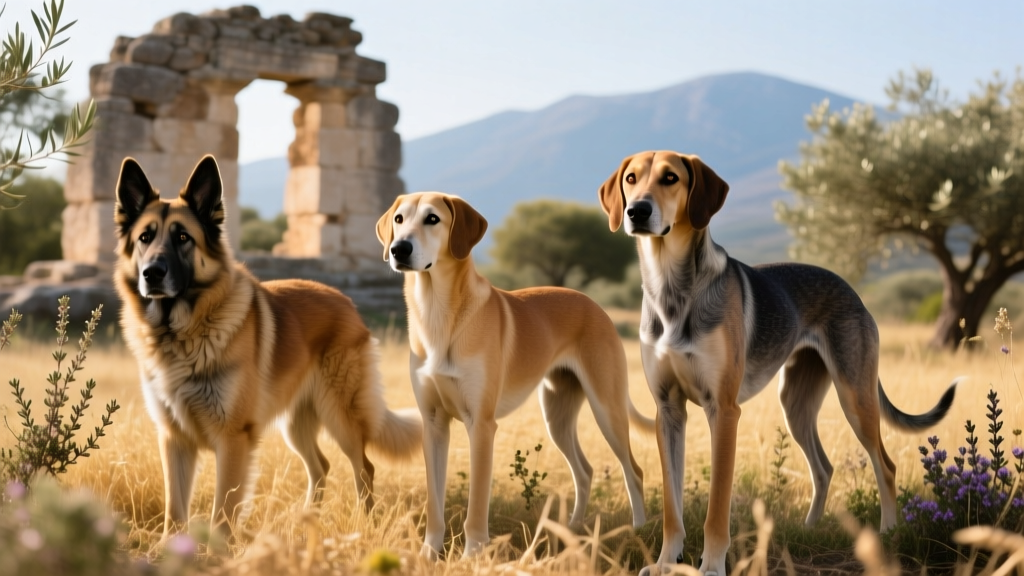
Greek dogs refer to the native landrace and recognized breeds originating from Greece and the broader Hellenic region. The most prominent include the Kokoni (small companion dog), the Greek Shepherd (livestock guardian), the Hellenic Hound (scent hound), and the Cretan Hound (primitive hunting dog, sometimes called the Kritikos Lagonikos). Unlike heavily selected modern breeds, most Greek dogs are landraces — populations shaped by natural selection and functional human partnership over thousands of years rather than closed-studbook breeding. This gives them distinctive genetic diversity, robust health profiles, and behavioral traits rooted in Mediterranean working-dog evolution.
The Evolutionary Origins of Greek Landrace Dogs
Evolutionary Context: Greek dogs descend from some of the earliest domesticated dog populations in Europe. Archaeological evidence from sites like Nea Nikomedeia (circa 6500 BCE) shows dog remains associated with early farming communities in northern Greece. These dogs were not "bred" in the modern sense — they were shaped by the demands of herding goats across rocky terrain, guarding flocks from wolves and jackals, and hunting hare in scrubland.
The concept of landrace is central to understanding Greek dogs. A landrace is a locally adapted, traditional variety of domesticated animal that developed through isolation, natural selection, and human functional selection — without formal breed registries or closed gene pools. According to research published in the journal Genes, landrace dogs retain significantly higher heterozygosity (genetic diversity) than closed-studbook breeds, which directly impacts disease resistance and longevity.
Greece's geography — mountainous terrain, thousands of islands, and historically isolated villages — created natural genetic bottlenecks and micro-populations. A shepherd dog on Crete faced different selective pressures than a companion dog in an Athenian household. This geographic fragmentation produced the distinct types we recognize today:
- Kokoni: Small companion/alert dog, likely derived from ancient Melita-type dogs depicted on Greek vases from the 5th century BCE
- Greek Shepherd (Ellinikos Poimenikos): Large livestock guardian, phenotypically similar to other Balkan and Anatolian flock guardians, shaped by predation pressure from wolves (Canis lupus) and golden jackals (Canis aureus)
- Hellenic Hound (Ellinikos Ichnilatis): Medium scent hound, selected for endurance pursuit of hare across limestone karst terrain
- Cretan Hound (Kritikos Lagonikos): One of Europe's oldest hunting dog types, depicted in Minoan frescoes dating to approximately 1700 BCE
Physiological Adaptations: How Greek Dogs Evolved for Mediterranean Life
Thermoregulation and Coat Structure
Mediterranean climates feature hot, dry summers (frequently exceeding 35°C / 95°F) and cool, wet winters. Greek landrace dogs evolved coats and body proportions suited to this pattern. The Kokoni, for example, typically weighs 4–8 kg (9–18 lb) with a short-to-medium coat — a body mass that dissipates heat efficiently due to a high surface-area-to-volume ratio. Larger Greek Shepherds (35–50 kg / 77–110 lb) tend toward lighter-colored coats (fawn, white, pale grey) that reflect solar radiation, a trait shared with other Mediterranean livestock guardian breeds like the Maremma and the Anatolian Shepherd.
Research on canine thermoregulation published in the American Journal of Physiology confirms that dogs with lighter pigmentation and shorter coats demonstrate measurably lower skin surface temperatures under direct solar exposure — an adaptation with direct survival value in Greek summers.
Sensory Specialization in Hellenic Hounds
The Hellenic Hound and Cretan Hound are scent hounds (lacones in ancient Greek terminology), selected over millennia for olfactory tracking. Their vomeronasal organ (Jacobson's organ) and olfactory epithelium surface area are proportionally larger than in brachycephalic breeds, allowing detection of scent molecules at concentrations as low as parts per trillion. This is not unique to Greek hounds, but the specific terrain selection — tracking across dry, rocky ground where scent molecules evaporate rapidly — selected for dogs that can work with intermittent scent trails rather than continuous ground scent.
How do Greek hounds process scent differently from, say, a Beagle? The selection pressure was for persistence over speed. A Cretan Hound may track a hare for 2–4 hours across broken terrain at a moderate trot, whereas a Beagle was selected for faster, tighter-circle work in the softer terrain of the British countryside. This translates to observable behavioral differences: Greek hounds tend to range wider, work more independently, and show less vocalization during the initial tracking phase (they typically vocalize only when the quarry is sighted or closely pressed).
Behavioral Science: What Greek Dog Temperament Tells Us
Why do Greek dogs behave the way they do? The answer lies in the functional roles that shaped each population's behavioral genetics.
Guardian Instinct in the Greek Shepherd
Livestock guardian dogs (LGDs) like the Greek Shepherd exhibit what researchers call low predatory motor sequence completion. In wolf predatory behavior, the full sequence is: orient → eye → stalk → chase → grab-bite → kill-bite → dissect → consume. LGDs have been selected to express the orient, eye, and stalk phases toward approaching threats, but not toward the livestock they protect. The grab-bite and kill-bite are directed at predators (wolves, jackals, stray dogs) that threaten the flock. This is not "training" in the conventional sense — it is a neurologically hardwired behavioral modification selected over hundreds of generations.
According to the Merck Veterinary Manual, LGD breeds show characteristic behavioral markers including high territoriality, low roaming drive (compared to hunting breeds), strong bonding to their "flock" (which can include human family members), and nocturnal alertness — all traits clearly visible in the Greek Shepherd.
Companion Dog Behavior in the Kokoni
The Kokoni represents a different evolutionary path. As a companion and alert dog, it was selected for neoteny — the retention of juvenile traits into adulthood. This includes smaller body size, shorter muzzle relative to skull, playfulness, and vocal alertness. These traits trigger caregiving responses in humans (a phenomenon documented in canine-human bonding research), which ensured the Kokoni's survival in domestic settings without needing to perform labor-intensive working roles.
Genetic Diversity and Health: The Landrace Advantage
| Trait | Greek Landrace Dogs | Typical Closed-Studbook Breed |
|---|---|---|
| Heterozygosity (genetic diversity) | High — outcrossing common in village populations | Low to moderate — limited founder pool |
| Inbreeding coefficient (COI) | Typically <5% in true landrace populations | Often 5–15% in popular breeds |
| Hereditary disease prevalence | Lower — natural selection purges severe defects | Higher — breed-specific conditions (e.g., IVDD in Dachshunds, hip dysplasia in GSDs) |
| Average lifespan | 12–16 years (Kokoni); 10–14 years (Greek Shepherd) | Varies widely; giant breeds often 7–10 years |
| Hybrid vigor | Inherent — landrace populations function similarly to continuous outcross programs | Must be deliberately introduced via outcross programs |
The concept of hybrid vigor (heterosis) — where genetically diverse offspring show improved biological function — is naturally present in Greek landrace populations. A Kokoni from a village in the Peloponnese may have ancestors from dozens of different lineages, making the expression of recessive deleterious alleles statistically unlikely. This does not mean Greek dogs are immune to disease — they are still susceptible to infectious diseases (leishmaniasis is endemic in Greece, transmitted by sand flies of the genus Phlebotomus), parasites, and age-related conditions. Consult your veterinarian for region-appropriate preventive care if you adopt or import a Greek dog.
Common Misconceptions About Greek Dogs
| Myth | Scientific Fact |
|---|---|
| "Greek dogs are just random mutts with no breed identity" | Landrace dogs have stable, recognizable phenotypes and behavioral profiles shaped by centuries of selection — they are not "mutts" in the random-breeding sense, but regionally adapted populations with consistent traits. |
| "The Cretan Hound is the oldest breed in Europe" | While Cretan Hound-type dogs appear in Minoan art (~1700 BCE), claiming "oldest breed" status is not scientifically verifiable. Multiple ancient dog types (Saluki, Basenji, Shiba Inu) have comparably ancient archaeological evidence. The Cretan Hound is more accurately described as one of Europe's oldest hunting dog types. |
| "Greek Shepherds are aggressive guard dogs" | Greek Shepherds are livestock guardians, not personal protection dogs. Their aggression is directed at perceived predators/threats to their territory, not at humans in normal social contexts. Properly socialized Greek Shepherds are typically calm and aloof with strangers rather than overtly aggressive. |
| "All Greek street dogs are Kokonis" | Greek street dogs (often called adéspoto) are mixed-heritage dogs of varying types. Some may have Kokoni ancestry, but most are generic medium-sized mixed dogs without specific landrace identity. True Kokonis have a more defined phenotype: 4–8 kg, moderately long coat, curled tail, pricked or semi-pricked ears. |
| "Landrace dogs can't be trained" | Landrace dogs are highly trainable using positive reinforcement methods. Their independent problem-solving ability (selected for in working contexts) can make them appear "stubborn" to owners used to biddable gundog breeds, but this is a training methodology mismatch, not a cognitive deficit. |
Practical Implications for Owners of Greek Dogs
If You're Adopting a Greek Dog or Greek Landrace Mix
- Leishmaniasis screening: Request a SNAP Leishmania test or quantitative serology (IFAT) from your vet, especially if the dog was recently in Greece. Canine leishmaniasis (caused by Leishmania infantum) is endemic throughout the Mediterranean and can present months after exposure. Treatment with allopurinol + miltefosine costs approximately $800–$2,500 for initial therapy.
- Heartworm and vector-borne disease panel: Greek dogs may carry Ehrlichia canis and Anaplasma phagocytophilum. A 4Dx SNAP test ($45–$80 at most US clinics) covers these tick-borne pathogens.
- Exercise requirements vary dramatically by type: A Kokoni needs 30–45 minutes of daily activity. A Greek Shepherd requires 60–90 minutes plus mental stimulation (scent work, structured patrol of property). A Hellenic Hound needs 90–120 minutes with off-leash running in secure areas — their prey drive makes them unreliable off-leash in unfenced spaces.
- Socialization window: If importing a Greek village dog as an adult, expect a longer adjustment period (4–12 weeks) compared to a puppy raised in a home environment. Adult landrace dogs from free-roaming populations may show initial wariness of confined spaces, leash pressure, and novel surfaces — use desensitization and counter-conditioning with high-value food rewards.
- Training approach: Greek landrace dogs respond best to LIMA (Least Intrusive, Minimally Aversive) training methods. Their independent problem-solving heritage means they may not offer the "eager to please" responsiveness of a Golden Retriever. Use food motivation, short sessions (5–10 minutes), and variable reinforcement schedules once behaviors are established.
When Behavioral Traits Signal a Problem
Some behaviors common in Greek dogs are normal breed traits; others may indicate underlying medical or behavioral issues:
- Greek Shepherd nighttime vigilance: Normal — LGDs are crepuscular/nocturnal in their guarding patterns. However, if accompanied by pacing, whining, or apparent distress, rule out pain (especially hip dysplasia or arthritis, which can worsen at night).
- Cretan Hound vocalization at prey: Normal during hunting contexts. If vocalization becomes compulsive (triggered by non-prey stimuli, not extinguishable with redirection), consult a certified applied animal behaviorist (CAAB).
- Kokoni alert barking: Normal — this is the function they were selected for. If barking escalates to barrier frustration or aggression at windows/doors, implement counter-conditioning protocols rather than punishment-based suppression.
Greek Dogs Compared: How Do They Differ From Other Mediterranean Breeds?
How is a Greek dog different from, say, an Italian or Spanish landrace? The key differences lie in selection pressures:
- vs. Italian Maremma Sheepdog: Both are LGDs, but the Greek Shepherd tends to be slightly lighter (35–50 kg vs. 40–60 kg for the Maremma) with a shorter coat, reflecting Greece's hotter summers. Behavioral differences are subtle — both show classic LGD temperament, but Greek Shepherds from island populations may show stronger territoriality due to geographic isolation.
- vs. Spanish Galgo (Greyhound): The Cretan Hound is a sight-and-scent hound (a primitive type), whereas the Galgo is a pure sighthound. Cretan Hounds use olfaction for initial tracking and switch to visual pursuit at close range — a more ancestral hunting strategy than the Galgo's pure-velocity approach.
- vs. Maltese: The Kokoni and Maltese share ancient Mediterranean companion-dog ancestry, but the Kokoni is larger (4–8 kg vs. 1.8–3.6 kg for the Maltese), more athletic, and less brachycephalic. The Kokoni retains more functional working-dog traits (alert barking, moderate prey drive) compared to the highly neotenized Maltese.
Frequently Asked Questions About Greek Dogs
Is it normal for my Greek rescue dog to be fearful indoors?
Yes, initially. Dogs from free-roaming Greek village populations often have limited experience with enclosed spaces, hard flooring, and artificial lighting. This is not a permanent temperament trait — with patient desensitization (start with short, positive indoor sessions of 2–5 minutes, pairing with high-value food), most dogs acclimate within 2–6 weeks. If fear persists beyond 8 weeks or escalates to panic responses (destructive escape attempts, self-injury), consult a veterinary behaviorist.
Can Greek dogs live in cold climates?
Yes, with accommodations. The Kokoni and Hellenic Hound have single coats or short double coats that provide limited insulation below 5°C (41°F). Provide insulated shelters, heated water bowls, and dog coats for walks in freezing weather. Greek Shepherds, with their denser double coats, tolerate cold better but still need windbreak shelter and increased caloric intake (approximately 10–25% more food) in sustained sub-zero temperatures.
What does it mean when my Greek Shepherd stands between me and a stranger?
This is classic LGD positioning behavior — the dog is placing itself between its "flock" (you) and a perceived potential threat. It is not necessarily aggression; it is protective positioning. If the dog remains calm and disengages when you greet the stranger warmly, this is normal, functional guardian behavior. If the dog escalates to lunging, snarling, or biting, this crosses from normal guarding into problematic reactivity and requires professional behavioral intervention.
How do Greek hounds process scent differently from other hound breeds?
Greek hounds (Hellenic and Cretan) were selected for persistence tracking in arid, rocky terrain where scent molecules dissipate quickly. This means they work with intermittent scent "puzzles" rather than continuous trails. They tend to pause, re-orient, and use wider search patterns compared to hounds bred for lush, moisture-rich environments (like the Basset Hound in French woodland). This is an adaptation to Mediterranean ecology, not a deficiency in olfactory ability.
Are Greek dogs recognized by the AKC or FCI?
The Kokoni is provisionally recognized by the FCI (Fédération Cynologique Internationale) — it was accepted into the FCI register in 2005. The Greek Shepherd, Hellenic Hound, and Cretan Hound are recognized by the Greek Kennel Club (ΚΟΕ) but not yet fully recognized by the AKC or FCI. If you encounter claims of "AKC-registered Greek Shepherds," verify through the AKC's official breed recognition list — as of 2026, these breeds remain outside AKC registry.
References
- Irving-Pease, E.K., et al. (2018). "The Evolutionary Origins of Dog Breeds." Journal of Heredity. Available via Oxford Academic.
- Fan, Z., et al. (2016). "Worldwide Patterns of Genomic Variation and Admixture in Dogs." Genome Research, 26(11), 1507–1516.
- Merck Veterinary Manual: Livestock Guardian Dog Behavior. merckvetmanual.com/dog-behavior
- FCI Breed Standard: Kokoni (Provisional). Fédération Cynologique Internationale, Standard No. 388.
Marcus Aldridge
All our authors care for dogs every day — read more of their work on the authors page.


