Foxtails in Dogs: How Grass Awns Migrate and Cause Harm
Learn the science behind foxtails in dogs — how grass awns migrate through tissue, why they're dangerous, breed risks.
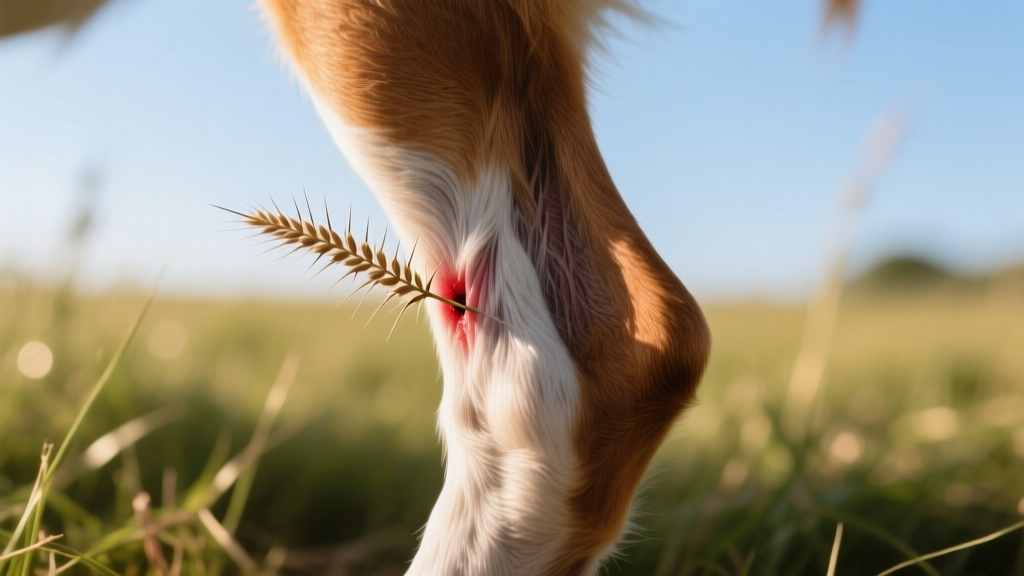
Quick Answer: Are Foxtails Dangerous to Dogs?
Yes — foxtails are among the most dangerous plant hazards for dogs. Foxtails (grass awns from the genus Hordeum, Bromus, and related species) possess backward-pointing barbs that allow them to migrate in only one direction once embedded in tissue. They cannot be expelled naturally and can penetrate skin, ear canals, nasal passages, between toes, and even migrate into the thoracic or abdominal cavity. If you spot a foxtail lodged in your dog's coat, remove it immediately with tweezers. If it has already penetrated skin or entered an ear, eye, or nose, do not attempt removal at home — see your veterinarian immediately. Untreated foxtail migration can cause abscesses, organ perforation, and life-threatening infection within 24–72 hours.
The Botanical Science Behind Foxtails
The term "foxtail" refers to the seed-bearing spikelets of several grass species, most commonly Hordeum murinum (wild barley), Bromus tectorum (cheatgrass), and Setaria species. These grasses are ubiquitous across the western and southern United States, thriving in disturbed soil, trailsides, parks, and open fields. They produce mature seed heads from late spring through early autumn — roughly May through October in most temperate zones.
Each foxtail spikelet measures approximately 2–5 cm in length and features a structure that botanical researchers describe as a diode-like mechanism. The awn is covered in retrose (backward-pointing) scabrid trichomes — microscopic barbs that grip tissue fibers and allow unidirectional movement. Research published in the Merck Veterinary Manual confirms that these barbs respond to changes in humidity, expanding and contracting in a ratcheting motion that drives the awn deeper with each moisture cycle.
The Hygroscopic Ratchet Mechanism
A 2019 study by researchers at the University of Washington (published in Proceedings of the National Academy of Sciences) demonstrated that grass awns from Hordeum species function as hygroscopic actuators. When ambient humidity rises (such as when an awn contacts warm, moist canine tissue), the awn's cellulose structure absorbs water and elongates. When humidity drops, it contracts. Because the retrose barbs catch on surrounding fibers, each expansion-contraction cycle advances the awn approximately 0.5–2 mm deeper into tissue. This is the same principle that allows certain wild grass seeds to self-bury into soil.
For dogs, this means a foxtail that enters the ear canal at 10:00 AM could migrate past the tympanic membrane by the following morning. The mechanism is purely physical — no bacterial or enzymatic process is required for migration, though secondary infection almost always follows.
How Foxtails Migrate Through Canine Tissue
Understanding the physiological pathway of foxtail migration helps owners recognize why early intervention is critical. Here is the typical progression:
- Attachment (0–30 minutes): The foxtail adheres to the coat, typically between the toes, inside the ear flap, or along the underbelly. Dogs with long or dense coats may carry foxtails for hours before they reach skin.
- Penetration (30 minutes–6 hours): The barbed tip punctures the epidermis, most commonly at interdigital spaces (between toes), the external ear canal, or the conjunctiva of the eye. Nasal inhalation during sniffing can draw awns directly into the nasal passage.
- Unidirectional Migration (6–72 hours): The hygroscopic ratchet mechanism drives the awn deeper. In the ear, it progresses toward the tympanic membrane. Between the toes, it migrates proximally along tendon sheaths. In the nasal cavity, it can reach the frontal sinus or be aspirated into the trachea.
- Foreign Body Reaction (24–96 hours): The canine immune system recognizes the awn as a foreign body. Neutrophils and macrophages infiltrate the area, forming a granuloma or abscess. The silica-rich composition of the awn resists enzymatic degradation — the body cannot dissolve it.
- Secondary Infection and Complication (3–14 days): Bacteria carried on the awn's surface (commonly Staphylococcus, Streptococcus, and soil-borne Actinomyces species) establish infection. Deep migration can lead to pyothorax (pus in the chest cavity), vertebral osteomyelitis, or peritonitis depending on the migration path.
| Entry Site | Estimated Frequency | Migration Risk | Typical Clinical Signs |
|---|---|---|---|
| Interdigital (between toes) | ~40% of cases | Moderate — can track up limb | Licking, swelling, draining tract, lameness |
| External Ear Canal | ~30% of cases | High — tympanic membrane rupture | Head shaking, ear scratching, pain on palpation, head tilt |
| Nasal Cavity | ~15% of cases | High — aspiration, sinus involvement | Violent sneezing, nasal discharge (often bloody), pawing at nose |
| Conjunctiva/Eye | ~8% of cases | High — corneal ulceration | Squinting, tearing, redness, third eyelid protrusion |
| Inhalation/Aspiration | ~5% of cases | Critical — pyothorax, lung abscess | Coughing, fever, lethargy, difficulty breathing |
| Ingestion/Oral | ~2% of cases | Moderate-High — tonsillar, esophageal | Gagging, retching, difficulty swallowing, oral swelling |
Evolutionary Context: Why Dogs Are Vulnerable to Grass Awns
Ancestral Exposure and Coat Evolution
Domestic dogs (Canis lupus familiaris) descended from wolves that inhabited diverse Eurasian landscapes, including grassland steppes where awn-bearing grasses were abundant. However, wolves possess several natural defenses that most domestic dogs have lost:
- Dense double coats with guard hairs: Wolf pelage features stiff, oily guard hairs that shed debris efficiently. Many domestic breeds have been selectively bred for softer, longer, or denser coats that trap — rather than shed — plant material.
- Self-grooming behavior: Wolves engage in frequent mutual and self-grooming, removing debris before it penetrates skin. Domestic dogs groom less systematically.
- Habitat range: Wild canids move through grasslands at speed, limiting prolonged contact with seed-heavy vegetation. Domestic dogs on leash often stand or play in concentrated foxtail patches.
Additionally, the domestic dog's investigative behavior — pressing the nose into dense vegetation, digging in grassy areas, and rolling in fields — increases exposure far beyond what ancestral wolves typically experienced. This behavioral trait was selected for during domestication (curiosity and environmental engagement were advantageous for scavenging and hunting alongside humans) but creates a maladaptive vulnerability to grass awns in modern environments.
Breed Variations: Which Dogs Face the Greatest Foxtail Risk?
While any dog can be affected by foxtails, certain anatomical and coat characteristics create measurable differences in risk:
Highest-risk breeds and types:
- Long-haired sporting Breeds: Golden Retrievers, English Springer Spaniels, and Setters have feathering on legs and ears that traps awns readily. Their field-working heritage also means they are more likely to push into dense vegetation.
- Floppy-eared breeds: Cocker Spaniels, Basset Hounds, and Beagles have pendulous ear flaps that create warm, humid ear canal environments. Once a foxtail enters, the enclosed space accelerates the hygroscopic ratchet mechanism.
- Wire-haired and curly-coated breeds: Poodles, Doodle crosses, and Wirehaired Pointing Griffons have coat textures that grip and hold awns tenaciously, making them difficult to spot during post-walk checks.
- Brachycephalic breeds with skin folds: Bulldogs and Shar-Peis have deep facial folds where awns can lodge and migrate subcutaneously, often going undetected until abscess formation.
Lower-risk breeds:
- Short-coated sighthounds: Greyhounds and Whippets have sleek, single-layer coats with minimal surface area for awn attachment.
- Hairless breeds: Chinese Crested and Xoloitzcuintli have minimal coat for awns to adhere to, though exposed skin is vulnerable to direct penetration.
Practical Implications: Evidence-Based Foxtail Prevention
Your Foxtail Prevention Protocol
Based on veterinary dermatology and emergency medicine guidelines, here is a structured prevention approach:
Before the Walk
- Check seasonal risk: In most of the western U.S., foxtail season runs May through October. Peak danger is June–August when seed heads are mature and dry.
- Consider protective gear: Products like the Outfox Field Coat (approximately $65–$85, available in sizes XS–XL) use tightly woven mesh over the torso and ear covers to block awn penetration. For high-risk dogs in heavy foxtail areas, this is a worthwhile investment.
- Trim interdigital hair: Use blunt-nosed grooming scissors to keep hair between the paw pads short (under 0.5 cm). This reduces the surface area where awns can lodge.
During the Walk
- Avoid known foxtail areas: Stay on cleared trails. Avoid letting your dog push through dry, waist-high grass.
- Keep leash length short in areas where foxtails are visible at ground level.
After the Walk (Critical 10-Minute Protocol)
- Visual scan: Run hands over the entire coat, paying attention to the belly, armpits, groin, and tail base.
- Paw inspection: Spread each toe and check interdigital spaces. Look for small, yellowish-brown awn tips protruding from skin.
- Ear check: For floppy-eared breeds, lift the ear flap and visually inspect the external ear opening. Use a flashlight to look for awns lodged in ear canal hair.
- Comb through: Use a fine-toothed metal grooming comb (such as the Chris Christensen Big G, ~$35) to comb through feathering and longer coat areas. The comb teeth will catch awns that fingers miss.
- Nose and eyes: Check for any awn tips protruding from nostrils or caught on eyelashes/conjunctiva.
Cost context for foxtail-related veterinary care (2026 estimates):
| Procedure | Estimated Cost Range | Notes |
|---|---|---|
| Superficial awn removal (skin/toe, no sedation) | $75–$200 | Office visit + minor procedure fee |
| Ear awn removal (requires sedation + otoscope) | $250–$600 | Sedation often required; may need follow-up for otitis |
| Nasal awn removal (rhinoscopy under anesthesia) | $800–$2,000 | Requires general anesthesia and endoscopic equipment |
| Surgical exploration for deep migration | $1,500–$5,000+ | Thoracotomy or exploratory surgery; ICU stay possible |
| CT scan for awn localization | $1,000–$2,500 | Used when awn has migrated deep and cannot be found by ultrasound |
Common Misconceptions About Foxtails Debunked
| Myth | Fact |
|---|---|
| "If a foxtail goes in, it will eventually work itself out." | False. The retrose barb structure prevents backward movement. Foxtails can only move deeper. The body's immune response walls them off with scar tissue, trapping them permanently unless surgically removed. |
| "Foxtails are only a problem in rural areas." | False. Foxtail grasses thrive in urban environments — vacant lots, sidewalk cracks, park edges, and suburban yards. Hordeum murinum is one of the most common urban weeds in California, Oregon, and Washington. |
| "Short-haired dogs don't need to worry about foxtails." | False. While long coats trap more awns, short-haired breeds are still vulnerable to nasal inhalation, ear entry, and direct skin penetration — especially between the toes where skin is thin regardless of coat type. |
| "I can pull out an embedded foxtail with tweezers at home." | Partially true, with major caveats. If the entire awn is visible and you can grasp it at the entry point, gentle extraction along the axis of entry is acceptable. However, if the awn breaks (common — they are brittle) or has penetrated beyond the skin surface, home removal often leaves fragments behind. Retained fragments cause chronic draining tracts. Consult your veterinarian for anything beyond superficial removal. |
| "Foxtails are only dangerous in summer." | Mostly false. While peak risk is late spring through early fall, dried foxtail seed heads can persist on the ground through winter in mild climates (USDA zones 7–10). In California and the Southwest, foxtail risk is nearly year-round. |
When Foxtail Exposure Signals a Veterinary Emergency
🚨 Seek Immediate Veterinary Care If Your Dog Shows:
- Violent, repeated sneezing that doesn't stop within 5 minutes (indicates nasal cavity penetration)
- Head tilt or loss of balance (suggests awn has reached the middle ear or ruptured the tympanic membrane)
- Persistent coughing with fever (possible aspiration into the lower respiratory tract)
- Squinting with visible swelling around the eye (corneal penetration risk — can lead to eye loss within 24 hours)
- A draining tract (small hole oozing pus or blood) between the toes or on the body that doesn't heal within 48 hours — this almost always indicates a retained foreign body
- Lethargy, fever (over 103°F / 39.4°C), or loss of appetite following known foxtail exposure — these suggest systemic infection from deep migration
If your regular vet is closed, visit an emergency veterinary hospital. Deep foxtail migration is time-sensitive — delays beyond 48–72 hours significantly increase the risk of thoracic or abdominal cavity involvement, which carries a mortality rate of approximately 10–15% even with surgical intervention.
Diagnostic Approaches: How Veterinarians Locate Migrated Foxtails
One of the most challenging aspects of foxtail cases is that the awns are nearly invisible on standard radiographs (X-rays). Grass awns are composed primarily of cellulose and silica, which are radiolucent — they don't show up on X-ray the way metal or bone would. This is a common source of frustration for owners whose dogs have chronic draining tracts that "nothing shows up" on imaging.
Veterinary specialists use a combination of techniques to locate migrated awns:
- High-frequency ultrasound (10–18 MHz): The most commonly used first-line tool. Grass awns appear as hyperechoic (bright), linear structures with acoustic shadowing. Sensitivity is approximately 80–90% for awns within 5 cm of the skin surface. Cost: $200–$500 as an add-on to a veterinary visit.
- Computed tomography (CT): Superior for deep thoracic or abdominal migration. CT can identify the soft-tissue tract leading to the awn, even when the awn itself is difficult to visualize directly. Requires general anesthesia. Cost: $1,000–$2,500.
- Rhinoscopy/bronchoscopy: A rigid or flexible endoscope is passed into the nasal cavity or airways under general anesthesia to visually locate and retrieve awns. This is both diagnostic and therapeutic. Cost: $800–$2,500 depending on complexity.
- Exploratory surgery: When imaging fails to locate the awn but clinical signs strongly suggest its presence, surgical exploration of the affected area may be necessary. The surgeon follows the granulation tissue tract to its origin.
Related Hazards: Other Problematic Grass Awns
Foxtails are not the only dangerous grass awns. Several related species present identical risks:
- Cheatgrass (Bromus tectorum): Prevalent across the western U.S. Produces sharp, stiff awns that are slightly shorter than foxtails but equally capable of migration. Often forms dense monocultures on trailsides.
- Needlegrass (Nassella / Stipa species): Features extremely long, hair-like awns (up to 10 cm) that can wrap around limbs and penetrate deeply. Common in California coastal ranges and foothills.
- Spear grass (Heteropogon contortus): Found in the southern U.S. and Hawaii. The awns twist when dry, generating rotational force that can drive them into skin.
- Ripgut brome (Bromus diandrus): A larger relative of cheatgrass with stiffer, more dangerous awns. Common in California and increasingly reported in the Pacific Northwest.
According to the American Veterinary Medical Association (AVMA), seasonal awareness of grass awn hazards is one of the most overlooked aspects of warm-weather pet safety.
Frequently Asked Questions
Can dogs eat foxtails without harm?
Accidental ingestion of a single foxtail while chewing grass is unlikely to cause serious harm in most cases — the awn may pass through the gastrointestinal tract. However, foxtails can lodge in the tonsillar crypts, the back of the throat, or the esophagus, causing gagging, retching, and local abscessation. If your dog shows persistent throat discomfort after chewing in a foxtail area, a veterinary oral examination under sedation may be needed to check for lodged awns.
How do foxtails differ from other plant hazards like burrs or stickers?
Burrs (from plants like burdock or cocklebur) and stickers (from thistles or sandburs) are designed to adhere to the surface of passing animals for seed dispersal. They cause matting and skin irritation but do not actively migrate into tissue. Foxtail awns are structurally unique — their retrose barbs and hygroscopic ratchet mechanism allow them to penetrate and move unidirectionally through living tissue, making them fundamentally more dangerous than surface-adhering plant material.
Is foxtail exposure normal for active outdoor dogs?
Exposure is common — most dogs in foxtail-endemic areas will encounter awns regularly during outdoor activity. However, penetration and migration are not normal or acceptable. Consistent post-walk inspection and preventive measures should keep actual foxtail injuries to zero. If your dog has repeated foxtail injuries (more than one per season), review your prevention protocol and consider protective gear.
What does it mean when my dog keeps licking the same spot on their paw?
Persistent, focused licking of a single interdigital space is the most common early sign of a foxtail lodged between the toes. Dogs lick in an attempt to dislodge the foreign body. If you cannot find and remove a visible awn, and the licking continues for more than a few hours, schedule a veterinary visit. Early removal (within 24 hours) is typically a simple, low-cost procedure. Delayed presentation often requires surgical exploration of a draining tract.
Are foxtails different from the foxtail palm plant?
Yes. The foxtail palm (Wodyetia bifurcata) is an ornamental landscape palm with no relation to grass awn foxtails. It does not produce migratory seed awns and poses no foreign body risk to dogs. When veterinarians refer to "foxtails," they mean the grass awns of Hordeum, Bromus, and related genera — not palm species.
This article provides educational information about foxtail hazards and canine physiology. It is not a substitute for professional veterinary advice. If you suspect your dog has a foxtail injury, consult your veterinarian promptly. For toxic plant ingestion concerns, contact the ASPCA Animal Poison Control Center at (888) 426-4435 (24/7, consultation fee applies).
Robin Maitland
All our authors care for dogs every day — read more of their work on the authors page.


