Flirt Pole Dog Training: The Science Behind Prey Drive Play
Discover the canine science behind flirt pole dog play — how prey drive works, why it taps into evolutionary instincts, and how to use it safely.
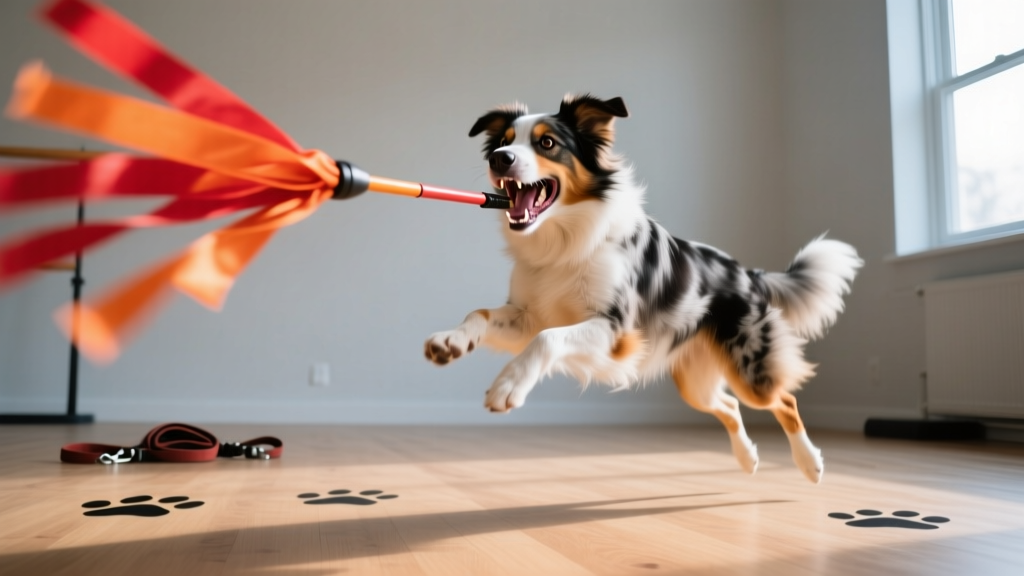
A flirt pole is a long pole with a rope and a lure (usually a toy or fabric strip) attached to the end, designed to simulate prey movement and trigger a dog's natural chase instinct. When used correctly, a flirt pole channels your dog's prey drive — the hardwired motor pattern sequence of search, stalk, chase, grab, and kill — into a controlled, exhausting, and mentally enriching game. It is one of the most effective tools for high-drive breeds, reactive dogs needing impulse-control training, and any dog that needs intense physical exercise in a small space.
Quick Answer: What Is a Flirt Pole and Why Does It Work?
A flirt pole exploits the canine predatory motor sequence — an evolutionary neural pathway inherited from wolves. The erratic, ground-dragging movement of the lure triggers the "chase" and "grab" phases of prey drive. Research in applied animal behavior shows that satisfying these innate drive sequences reduces frustration-based behaviors and improves overall welfare in domestic dogs.
Why Do Dogs Chase Flirt Poles? The Predatory Motor Sequence
To understand why a flirt pole is so magnetically appealing to dogs, you need to understand the predatory motor sequence (PMS). This is not a learned behavior — it is a deeply conserved neural circuit inherited from Canis lupus, the gray wolf. Ethologists describe the full sequence as:
- Orient — Eyes and ears lock onto movement or sound
- Eye/Stalk — Body lowers, slow approach, fixed gaze
- Chase — High-speed pursuit triggered by fleeing motion
- Grab-Bite — Seizing the prey with the mouth
- Kill-Bite — A shaking or tearing motion (the "kill shake")
- Dissect — Pulling apart (rarely seen in play)
- Consume — Eating (absent in toy play)
Different breeds have been selectively bred to amplify or suppress specific phases. Border Collies show exaggerated eye-stalk. Terriers show amplified grab-bite and kill-shake. Pointers freeze at the orient/stalk phase. A flirt pole activates the chase and grab-bite phases most intensely, which is why nearly any dog — regardless of breed — will respond to the rapid, erratic lure movement.
Evolutionary Context: From Wolf Pack Hunts to Backyard Play
Wolves rely on the predatory motor sequence for survival. A pack hunting elk will move through orient → stalk → chase → grab → kill over distances of several miles. Domestic dogs no longer need to hunt for food, but the neural hardware remains largely intact. According to research compiled in Merck Veterinary Manual's overview of dog behavior, these fixed action patterns persist even when they serve no survival function. The flirt pole provides a safe, controlled outlet for sequences that would otherwise be directed at squirrels, cars, joggers, or livestock.
The Neuroscience of Prey Drive: Dopamine, Adrenaline, and the Chase
When your dog locks onto a flirt pole lure, a cascade of neurochemical events unfolds:
- Visual cortex activation: Dogs have a high density of rod photoreceptors optimized for detecting motion (not color). The temporal resolution of canine vision — roughly 75 Hz flicker fusion rate versus 60 Hz in humans — means dogs perceive the lure's movement more fluidly and react faster than we can.
- Dopaminergic reward pathway: The pursuit triggers dopamine release in the nucleus accumbens, the brain's primary reward center. This is why dogs will chase a flirt pole repeatedly without apparent fatigue — each chase cycle delivers a neurochemical reward.
- Adrenaline and cortisol surge: High-speed pursuit activates the sympathetic nervous system (fight-or-flight), increasing heart rate to 120–160 BPM in medium breeds during intense play. This is comparable to a human sprinting interval.
- Motor cortex and cerebellar engagement: The rapid direction changes required to track an erratic lure demand intense proprioceptive processing, engaging fast-twitch muscle fibers and sharpening coordination.
A 2019 study published in the journal Applied Animal Behaviour Science found that dogs engaging in prey-drive-simulating play showed lower baseline cortisol levels (a stress marker) in the hours following play sessions compared to dogs given only free-roaming yard time. The structured "hunt" appears to provide a satisfaction that undirected exercise does not.
Breed Variations: Which Dogs Go Hardest for a Flirt Pole?
While virtually all dogs will show some interest in a flirt pole, breed genetics determine the intensity and style of engagement. The table below maps common breed groups to their dominant PMS phases and flirt pole suitability.
| Breed Group | Dominant PMS Phases | Flirt Pole Intensity | Recommended Session Length | Notes |
|---|---|---|---|---|
| Terriers (Jack Russell, Pit Bull types, Rat Terrier) | Chase, Grab-Bite, Kill-Shake | Very High (9–10/10) | 10–15 min, 2x/day | Will attempt to destroy lure; use heavy-duty toys. Excellent for impulse-control drills. |
| Herding (Border Collie, Australian Shepherd, Malinois) | Eye-Stalk, Chase | High (8–9/10) | 15–20 min, 2x/day | May obsess. Build in "drop" and "wait" commands to prevent fixation. |
| Sighthounds (Greyhound, Whippet, Saluki) | Orient, Chase | Very High (9–10/10) | 5–10 min sprints | Pure speed chasers. Need long, straight runs — use extra-long poles (6–8 ft). |
| Sporting (Labrador, Golden Retriever, Springer Spaniel) | Orient, Chase, Grab | Moderate-High (6–8/10) | 15–20 min | Good all-around flirt pole dogs. Pair with retrieve for variety. |
| Brachycephalic (Bulldog, Pug, Shih Tzu) | Variable | Low-Moderate (3–5/10) | 5–8 min max | Airway compromise risk (BOAS). Keep sessions short, avoid heat. See AKC guidance on brachycephalic breeds. |
| Toy (Chihuahua, Pomeranian, Papillon) | Chase, Grab | Moderate (5–7/10) | 5–10 min | Surprisingly enthusiastic. Use mini flirt poles (3–4 ft) with lightweight lures. |
| Guardian/Livestock (Great Pyrenees, Anatolian, Mastiff) | Orient (suppressed chase) | Low (2–4/10) | 5 min | Bred to suppress chase. Some individuals may ignore the lure entirely — this is normal. |
How to Use a Flirt Pole Safely: Practical Guidelines
A flirt pole is powerful — which means it can also cause injury or behavioral problems if misused. Follow these evidence-based guidelines:
Equipment Specifications
- Pole length: 36–48 inches (91–122 cm) for medium/large dogs; 24–36 inches (61–91 cm) for small breeds. Fiberglass or flexible nylon poles reduce joint impact vs. rigid PVC.
- Cord length: 4–6 feet (122–183 cm) of braided nylon. Avoid chain links — they add dangerous weight and can injure teeth.
- Lure type: Fleece tug toys, braided fabric strips, or squeaker toys. Avoid hard plastic or rubber lures that can fracture teeth on high-speed grabs. Replace lures when torn.
- Cost range: Basic models: $15–$25. Heavy-duty models (e.g., Squishface, Dawg-A-Bull): $30–$55. Replacement lures: $8–$15 each.
Session Protocol
- Warm-up (2 minutes): Walk your dog on a loose leash or do 5–10 "sit-stand" repetitions to engage muscles and establish focus.
- Start low: Drag the lure slowly along the ground in short arcs. Let your dog catch it within 3–5 chases to build confidence.
- Build intensity: Gradually increase speed and add direction changes. Sweep the lure in figure-eights, zigzags, and brief "escape" sprints away from your dog.
- Let them win: Every 4–6 chases, allow your dog to catch and tug the lure for 10–15 seconds. This completes the grab-bite phase and prevents frustration buildup.
- Impulse-control drills: Mid-session, command "wait" or "leave it" while the lure is moving. Reward compliance with a catch. This is where flirt poles become a serious training tool for reactivity and self-control.
- Cool-down (2–3 minutes): Slow the lure to ground-dragging speed. End with a final catch and a calm settle on a mat.
Key Takeaways for Daily Life
- A 15-minute flirt pole session can equal 45–60 minutes of walking in terms of energy expenditure for high-drive breeds.
- Flirt poles work in spaces as small as a 10×10 ft area — ideal for apartment dwellers or bad-weather days.
- Pair flirt pole sessions with obedience cues ("sit," "drop," "wait") to convert raw drive into trained impulse control.
- Use flirt poles as a reward in training: "If you heel for 20 steps, you earn a chase." This leverages the Premack principle — using a high-probability behavior (chasing) to reinforce a low-probability behavior (heeling).
Common Misconceptions About Flirt Poles and Prey Drive
| Myth | Fact |
|---|---|
| "Flirt poles make dogs aggressive." | Flirt poles channel prey drive into a toy, not a living target. Research in Journal of Veterinary Behavior (2020) found no correlation between structured prey-drive play and increased human-directed or dog-directed aggression. Aggression stems from fear, resource guarding, or poor socialization — not from chase play. |
| "Letting my dog 'win' the toy will make them dominant." | Dominance theory has been thoroughly debunked in domestic dog science (see AVSAB Position Statement on Dominance). Letting your dog catch the lure completes the motor sequence and prevents frustration. It does not create behavioral problems. |
| "My dog will get bored of it." | Prey drive is an intrinsic, self-reinforcing behavior — unlike food motivation, which satiates. Dogs do not habituate to chase stimuli the way they habituate to repeated food rewards. Vary the movement pattern and lure type to maintain novelty. |
| "Flirt poles are only for big, athletic dogs." | Mini flirt poles work excellently for Chihuahuas, Dachshunds, and toy breeds. Adjust intensity, session length, and lure size. Even senior dogs can enjoy slow, ground-level lure dragging as low-impact enrichment. |
| "It's just a toy — no rules needed." | Unstructured, uncontrolled flirt pole play can reinforce over-arousal, poor impulse control, and joint stress. Always build in start/stop cues and "drop it" commands. |
When Flirt Pole Behavior Signals a Problem
While flirt pole play is overwhelmingly beneficial, certain behavioral or physical responses warrant attention:
Behavioral Red Flags
- Obsessive fixation: If your dog cannot disengage from the pole even after the lure is put away, pacing, whining, or destroying objects to reach it, this may indicate compulsive disorder. Consult a veterinary behaviorist.
- Resource guarding the lure: Growling, snapping, or stiffening when you approach during a catch is resource guarding — not prey drive. Pause flirt pole use and work with a certified force-free trainer on guarding protocols.
- Redirected aggression: If your dog bites your hand or arm instead of the lure during high arousal, this is redirected bite — common in terriers and herding breeds. Lower the intensity, use longer cords to increase distance from your body, and build impulse-control drills before resuming full-speed play.
Physical Red Flags
- Lameness or stiffness post-session: The rapid direction changes in flirt pole play place significant torque on joints. Dogs with hip dysplasia, IVDD predisposition (Dachshunds, Corgis), or cruciate ligament issues should avoid tight turning. Run the lure in straight lines and wide arcs only.
- Excessive panting, collapse, or blue-tinged gums: Stop immediately. These are signs of heatstroke or cardiovascular distress. Brachycephalic breeds are at highest risk. Seek veterinary care.
- Broken or cracked teeth: High-speed grabs on hard lures can fracture carnassial teeth. Use soft fleece or braided fabric lures exclusively.
When to Consult Your Veterinarian
If your dog shows sudden disinterest in a previously loved flirt pole, limps after sessions, or exhibits obsessive behaviors around chase toys, schedule a veterinary exam. Sudden behavioral changes can signal pain, neurological issues, or endocrine disorders. Always consult your veterinarian before starting intense exercise programs with senior dogs, dogs with known orthopedic conditions, or brachycephalic breeds.
How Is Canine Prey Drive Different from Human Play Motivation?
Humans play for social bonding, cognitive challenge, and dopamine reward — but our play is largely learned and culturally mediated. Canine prey drive, by contrast, is a fixed action pattern — a hardwired motor sequence that triggers automatically in response to specific stimuli (rapid, erratic movement at ground level). Key differences:
- Trigger specificity: A dog's prey drive activates based on movement characteristics (speed, direction, proximity to ground), not on "fun" as a conscious concept. A fleeing squirrel triggers the sequence; a stationary toy does not.
- Satiation resistance: Humans lose interest in repetitive tasks quickly (habituation). Dogs will chase the same lure hundreds of times because the motor sequence is intrinsically self-reinforcing at a subcortical level — the brain rewards the behavior before conscious processing occurs.
- Motor pattern rigidity: You can teach a human to play a new sport. You cannot teach a Pointer to "chase" instead of "freeze" — the breed-specific modification of the PMS is genetically fixed.
- Emotional valence: Human play is associated with positive affect (joy, laughter). Canine prey drive is more accurately described as compulsive urgency — the dog is not "happy" in a human sense; it is neurologically compelled to complete the sequence.
Related Behaviors and Cross-References
Understanding prey drive through flirt pole play connects to several other canine behavior topics:
- Leash reactivity: Many leash-reactive dogs are displaying frustrated prey drive — they see movement (other dogs, bikes, joggers) and cannot complete the chase sequence. Flirt pole training with impulse-control drills is a core component of desensitization and counter-conditioning protocols for reactivity.
- Herding behavior: Nipping at heels, circling, and body-blocking are modified prey-drive sequences. Herding breeds benefit enormously from flirt pole outlets to reduce these behaviors directed at children or other pets.
- Toy drive vs. prey drive: Toy drive (fetch, tug) is a subset of prey drive focused on the grab-and-hold phase. Flirt poles engage the full chase sequence, making them more stimulating than fetch for most high-drive dogs.
- Scent work: The "orient" phase of the PMS includes olfactory searching. Pairing flirt pole play with hide-and-seek lure games engages both visual and scent-tracking pathways.
Frequently Asked Questions
Can flirt pole play replace regular walks?
No. Flirt poles provide intense anaerobic exercise and prey-drive satisfaction, but they do not replicate the olfactory enrichment, social exposure, and slow-paced exploration that walks provide. Use flirt poles as a supplement — not a replacement — for daily walks. A balanced routine might include a 30-minute sniff walk in the morning and a 15-minute flirt pole session in the evening.
Is flirt pole play safe for puppies?
Flirt poles can be introduced to puppies from 12 weeks of age, but sessions must be extremely short (2–3 minutes) and low-intensity. Puppies' growth plates are open until 12–18 months (breed-dependent), and the rapid pivoting of flirt pole play can stress developing joints. Keep the lure at ground level, avoid jumps, and prioritize "catch and hold" over high-speed chasing. Consult your veterinarian about appropriate exercise levels for your puppy's breed and growth stage.
My dog drops the lure immediately after catching it. Is this normal?
Yes — this typically indicates that the chase phase is the primary driver, and the grab-bite phase is less reinforcing. Some breeds (especially sighthounds) are bred for pursuit rather than holding. Try using a lure with more texture (braided fleece, knotted rope) to increase oral satisfaction, or briefly engage in a tug-of-war after the catch to extend the grab phase.
Can flirt poles help with separation anxiety?
Indirectly, yes. A physically and mentally exhausted dog is less likely to engage in anxiety-driven destruction. A 15-minute flirt pole session before you leave the house can reduce arousal levels. However, separation anxiety is a complex condition that typically requires a multi-modal approach including desensitization protocols, environmental management, and potentially medication prescribed by your veterinarian.
How often should I use a flirt pole with my dog?
For high-drive breeds (terriers, herding, sighthounds): daily sessions of 10–20 minutes, ideally split into two shorter sessions. For moderate-drive breeds: 3–4 times per week. Always include rest days and vary exercise types to prevent repetitive stress injuries and maintain overall fitness.
Priya Sutaria
All our authors care for dogs every day — read more of their work on the authors page.


