FHO Surgery in Dogs: The Science of Recovery and How Dogs Adapt
Understand the canine science behind FHO surgery for dogs — how the body adapts, recovery timelines, costs, and what research shows about long-term outcomes.
What Is FHO Surgery in Dogs? (Quick Answer)
FHO (Femoral Head Ostectomy) surgery is a procedure where the ball portion of the hip joint (femoral head and neck) is surgically removed. The dog's body then forms a false joint (pseudoarthrosis) from fibrous scar tissue, allowing pain-free movement without bone-on-bone contact. FHO surgery in dogs is most commonly recommended for hip dysplasia, Legg-Calvé-Perthes disease, hip fractures, or avascular necrosis. Recovery typically takes 6–12 weeks, and most dogs regain 80–90% of normal limb function. Costs range from $1,200–$3,500 depending on clinic type and geographic region.
Always consult your veterinarian to determine whether FHO is the right option for your dog's specific condition and body type.
The Biomechanics: Why Removing the Hip Joint Actually Works
How the Canine Hip Joint Functions
The normal canine hip is a ball-and-socket synovial joint. The femoral head (ball) rotates within the acetabulum (socket) of the pelvis, cushioned by articular cartilage and lubricated by synovial fluid. This joint bears roughly 40–60% of the dog's hind limb weight during normal stance and up to 80% during galloping or jumping.
When disease or trauma destroys the cartilage surface — as in severe hip dysplasia or a fractured femoral neck — bone rubs directly on bone. This generates inflammatory cytokines (IL-1β, TNF-α), degrades remaining cartilage via matrix metalloproteinases, and creates chronic pain signals transmitted through the sciatic and obturator nerves.
The Pseudoarthrosis Mechanism
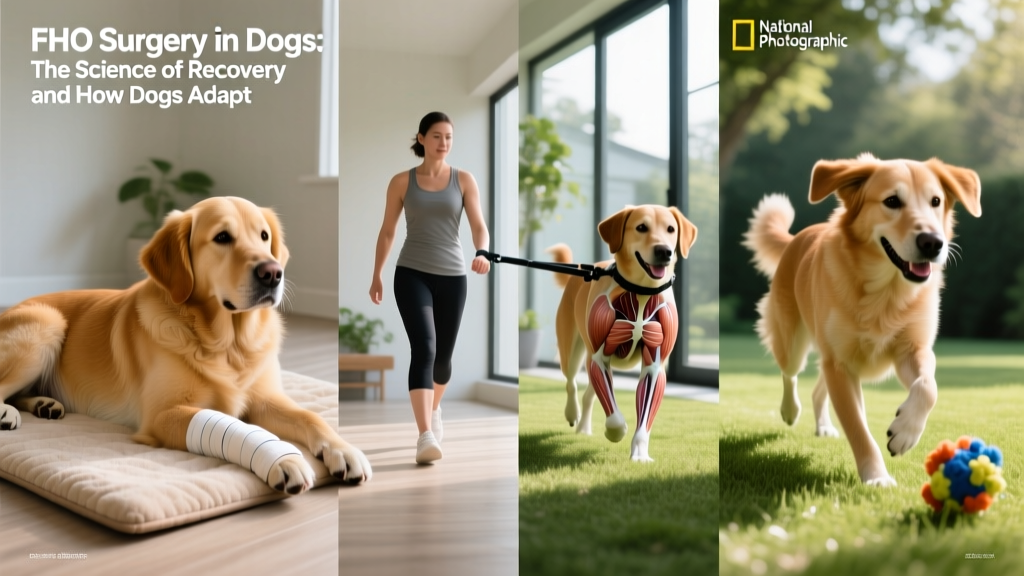
After the femoral head is removed, the body initiates a wound-healing cascade. Fibroblasts migrate into the void between the cut femoral shaft and the acetabulum, depositing type I and type III collagen. Over 6–10 weeks, this collagen matrix matures into dense fibrous tissue — essentially a flexible, shock-absorbing sling. This pseudoarthrosis lacks the rigid stability of a true joint but provides pain-free range of motion because no bone surfaces contact each other.
Research published in the American Journal of Veterinary Research has demonstrated that dogs post-FHO develop compensatory muscle hypertrophy in the gluteal and quadriceps groups, which stabilizes the false joint during weight-bearing activity.
Evolutionary Context: Why Canine Hips Are Vulnerable
Ancestral hip structure: The gray wolf (Canis lupus) evolved a hip joint optimized for endurance running and explosive acceleration. The acetabulum is deep, the femoral head is large and spherical, and the surrounding musculature (gluteus medius, biceps femoris, semitendinosus) is proportionally massive compared to body size.
What changed with domestication: Selective breeding over 15,000+ years prioritized traits like size, coat type, and temperament — often at the expense of structural soundness. Breeds like German Shepherds, Labrador Retrievers, and Saint Bernards were selected for rapid growth and large body mass, creating a mismatch between skeletal development rate and muscle/tendon maturation. This is why hip dysplasia prevalence exceeds 20% in over 50 AKC-recognized breeds, according to data from the Orthopedic Foundation for Animals (OFA).
Why FHO works evolutionarily: Canids are remarkably adaptable locomotors. Wolves with traumatic injuries in the wild have been observed modifying gait and relying on compensatory muscle recruitment — the same physiological plasticity that allows domestic dogs to thrive post-FHO. The canine body's ability to form functional scar tissue bridges is an evolutionary holdover from survival mechanisms that prioritized mobility over anatomical perfection.
How Dogs Process Movement After FHO: The Neurological Adaptation
The most scientifically fascinating aspect of FHO recovery is the proprioceptive recalibration that occurs. Proprioception — the body's sense of limb position in space — relies on mechanoreceptors in joint capsules, ligaments, and muscles. When the hip joint is removed, the brain loses a major source of proprioceptive input.
Here's how the canine nervous system compensates:
- Weeks 1–2 post-surgery: The dog relies heavily on visual and vestibular (inner ear balance) cues to place the affected limb. Gait is cautious, with shortened stride length and reduced stance time on the surgical side.
- Weeks 3–6: Muscle spindles in the remaining gluteal and thigh muscles become hypersensitive, providing enhanced proprioceptive feedback to the spinal cord and cerebellum. The dog begins to "trust" the limb again.
- Weeks 6–12: Cortical motor maps in the brain reorganize. Studies using force-plate analysis show that ground reaction forces on the FHO limb reach 85–95% of the contralateral (opposite) limb by week 12 in most medium-sized dogs.
- Months 3–6: Full neuromuscular adaptation. Most dogs show no visible lameness at a walk or trot, though high-impact activities (agility, flyball) may reveal subtle asymmetries.
This neurological plasticity is significantly greater in dogs than in humans, partly because quadrupeds can redistribute weight across three limbs during recovery, reducing the functional demand on any single joint.
Practical Implications: What FHO Means for Your Dog's Daily Life
Recovery Timeline and Milestones
| Timeframe | What to Expect | Activity Level |
|---|---|---|
| Days 1–3 | Hospital discharge; incision monitoring; pain management (NSAIDs + gabapentin typical) | Strict crate rest; leash-only bathroom breaks |
| Weeks 1–2 | Suture/staple removal at day 10–14; begin passive range-of-motion (PROM) exercises | 5-minute leash walks, 3x daily; no stairs |
| Weeks 3–6 | Noticeable improvement in weight-bearing; begin controlled strengthening | 10–15 min walks; underwater treadmill if available; sit-to-stand exercises |
| Weeks 6–12 | Near-normal gait at walk; vet recheck with radiographs | 20–30 min walks; gentle hills; controlled off-leash in small area |
| Months 3–6 | Full functional recovery for most daily activities | Gradual return to normal activity; avoid repetitive high-impact jumping |
Rehabilitation Exercises That Matter Most
- Sit-to-stand repetitions: 5–10 reps, 2x daily — builds quadriceps and gluteal strength. Use a treat to lure the dog into a square sit, then a stand.
- Figure-8 walking: Walk your dog in a tight figure-8 pattern around two cones spaced 4 feet apart. This forces hip adduction/abduction and builds stabilizer muscles.
- Cavaletti rails: Place poles on the ground at hock-height spacing (roughly the dog's stride length). Walking over them encourages full hip flexion and extension.
- Underwater treadmill: If available ($45–$85 per session at rehab facilities), water buoyancy reduces joint loading by 30–50% while providing resistance. Ideal starting at week 3–4.
Cost Breakdown (2026 Estimates)
| Expense Category | Low Range | High Range |
|---|---|---|
| Pre-surgical diagnostics (X-rays, bloodwork) | $150 | $450 |
| FHO surgery (general practice) | $1,200 | $2,200 |
| FHO surgery (specialty/board-certified surgeon) | $2,500 | $3,500 |
| Post-op medications (NSAIDs, gabapentin, antibiotics) | $40 | $120 |
| Physical rehabilitation (6–8 sessions) | $300 | $680 |
| Follow-up radiographs (6-week and 12-week) | $100 | $300 |
| Total estimated cost | $1,790 | $5,250 |
Breed Variations: Who Does Best After FHO Surgery?
Body weight is the single most important predictor of FHO outcome. The procedure works best in dogs under 50 lb (23 kg), though it can be performed on dogs of any size when total hip replacement (THR) is not an option.
| Weight Category | Expected Outcome | Common Breeds | Special Considerations |
|---|---|---|---|
| Small (<20 lb / 9 kg) | Excellent — often indistinguishable from normal by week 12 | Yorkshire Terrier, Pomeranian, Toy Poodle, Chihuahua | Legg-Calvé-Perthes disease is the most common FHO indication in this group |
| Medium (20–50 lb / 9–23 kg) | Very good — mild gait asymmetry possible at high speed | Cocker Spaniel, Beagle, Border Terrier, Miniature Poodle | Weight management critical; each extra pound increases pseudoarthrosis load |
| Large (50–90 lb / 23–41 kg) | Good — functional for daily life; may show lameness after heavy exercise | Labrador Retriever, Boxer, Australian Shepherd | Intensive rehab essential; consider bilateral FHO staging (8–12 weeks apart) if both hips affected |
| Giant (>90 lb / >41 kg) | Fair — THR preferred if possible; FHO is salvage option | Great Dane, Saint Bernard, Mastiff, Newfoundland | Higher risk of contralateral limb overload and secondary cruciate injury; strict weight control mandatory |
Common Misconceptions About FHO Surgery Debunked
| Myth | Fact (Supported by Evidence) |
|---|---|
| "FHO is only a last-resort surgery." | FHO is a primary treatment option for Legg-Calvé-Perthes disease, certain fractures, and small-breed hip dysplasia. It is not merely a salvage procedure — it is the preferred procedure in many clinical scenarios, according to the Merck Veterinary Manual. |
| "My dog will always limp after FHO." | Most dogs under 50 lb achieve a visually normal gait within 12 weeks. Force-plate studies show ground reaction forces within 85–95% of normal. Some subtle asymmetry may persist at high speeds but is rarely clinically significant. |
| "Bigger dogs can't have FHO — they need total hip replacement." | While THR offers superior biomechanical outcomes in large breeds, FHO can be successfully performed on dogs over 90 lb. It is a valid option when THR cost ($5,000–$8,000+), surgical availability, or the dog's health status make THR impractical. |
| "FHO recovery is too painful." | Modern multimodal pain protocols (NSAID + gabapentin + local nerve block) manage post-operative pain effectively. Most dogs are comfortable within 48–72 hours and are bearing partial weight within the first week. |
| "My dog will never be active again." | Post-FHO dogs regularly return to hiking, swimming, and even low-level agility. The key is structured rehabilitation and maintaining lean body condition (BCS 4–5 out of 9). |
When FHO Might Signal a Bigger Problem
If your veterinarian is recommending FHO, it's worth understanding why the hip joint has failed, because the underlying cause can have implications for the other hip, other joints, or overall health:
- Bilateral hip dysplasia: If one hip requires FHO, the contralateral hip has a high probability of also being dysplastic. Plan for monitoring and possible staged bilateral surgery.
- Early-onset Legg-Calvé-Perthes (small breeds, 4–12 months): This avascular necrosis condition has a suspected genetic basis. Affected dogs should not be bred. Discuss screening littermates with your vet.
- Traumatic hip luxation with femoral neck fracture: If the injury resulted from minimal trauma (e.g., jumping off a couch), your vet may want to investigate bone density or metabolic conditions like hyperparathyroidism.
- Chronic NSAID use pre-surgery: Dogs that have been on pain medication for months before FHO should have liver and kidney panels checked, as long-term NSAID use can affect organ function.
Post-FHO Red Flags — Call Your Vet Immediately If:
- Sudden refusal to bear weight after initial improvement (possible fracture or implant issue)
- Swelling, redness, or discharge at the incision site after day 3 (infection risk)
- Fever above 103°F (39.4°C)
- Loss of appetite for more than 24 hours post-discharge
- Signs of gastrointestinal bleeding (black/tarry stool, vomiting) while on NSAIDs
How Is FHO Different From Total Hip Replacement (THR)?
| Factor | FHO (Femoral Head Ostectomy) | THR (Total Hip Replacement) |
|---|---|---|
| Procedure | Removes femoral head; body forms scar-tissue pseudoarthrosis | Replaces both ball and socket with titanium/cobalt-chrome implants and polyethylene liner |
| Cost | $1,200–$3,500 | $5,000–$8,000+ per hip |
| Recovery time | 6–12 weeks | 8–16 weeks (more restrictive initially) |
| Functional outcome | 80–90% normal function (weight-dependent) | 95–100% normal function regardless of size |
| Ideal candidate | Small/medium dogs; salvage cases; budget-conscious owners | Large/giant breeds; active working/sport dogs; no financial constraint |
| Complication rate | Low (5–10%); mostly minor | Moderate (10–20%); includes luxation, infection, implant loosening |
| Surgeon availability | Most general practitioners and all surgeons | Board-certified surgeons only; limited geographic availability |
Frequently Asked Questions
Why do dogs need FHO surgery?
Dogs need FHO when the hip joint becomes a source of chronic, unmanageable pain. The most common causes are severe hip dysplasia (malformed joint causing cartilage destruction), Legg-Calvé-Perthes disease (blood supply loss to the femoral head in small breeds), traumatic fractures of the femoral neck, and failed previous hip surgeries. FHO eliminates the source of pain — bone-on-bone contact — by removing the damaged joint surfaces entirely.
Can dogs walk normally after FHO surgery?
Yes, most dogs walk with a visually normal gait within 8–12 weeks of surgery. The body forms a functional false joint from fibrous tissue, and the surrounding muscles strengthen to stabilize the area. Small and medium dogs have the best outcomes. Force-plate gait analysis studies show that ground reaction forces on the operated limb reach 85–95% of the unaffected limb, which is typically not noticeable to the casual observer.
How do dogs sense their limb position after the hip joint is removed?
Dogs rely on proprioceptive receptors in the remaining muscles, tendons, and skin around the hip. After FHO, muscle spindles in the gluteal and quadriceps groups become more sensitive, providing the brain and spinal cord with updated positional data. This neurological adaptation happens over 6–12 weeks and is supported by structured rehabilitation exercises that challenge balance and coordination.
What does it mean when my dog seems stiff in the morning after FHO?
Morning stiffness is common during the first 3–6 months post-FHO and occasionally persists long-term. It occurs because the fibrous pseudoarthrosis tissue, like all connective tissue, stiffens during prolonged immobility (sleeping). Gentle movement warms the tissue and restores flexibility within 5–10 minutes. If stiffness worsens over time or is accompanied by pain vocalization, consult your veterinarian — it may indicate arthritis development in other joints from compensatory loading.
Is FHO surgery normal and widely accepted in veterinary medicine?
Absolutely. FHO has been performed in veterinary medicine since the 1960s and is considered a well-established, evidence-based procedure. It is taught in all accredited veterinary schools and is endorsed by the American College of Veterinary Surgeons. The ACVS describes FHO as a reliable option for managing painful hip conditions across all dog sizes.
How is a dog's FHO recovery different from a human hip replacement?
Humans almost exclusively receive total hip replacement (THR) — the equivalent of removing the joint and forming a false joint is rarely done in human medicine because bipedal locomotion places 100% of body weight through each hip alternately. Dogs, as quadrupeds, can distribute weight across three limbs, making the pseudoarthrosis approach viable. Additionally, dogs have greater neuromuscular plasticity in their hind limb motor control, allowing faster functional adaptation than humans typically achieve post-surgery.
Robin Maitland
All our authors care for dogs every day — read more of their work on the authors page.


