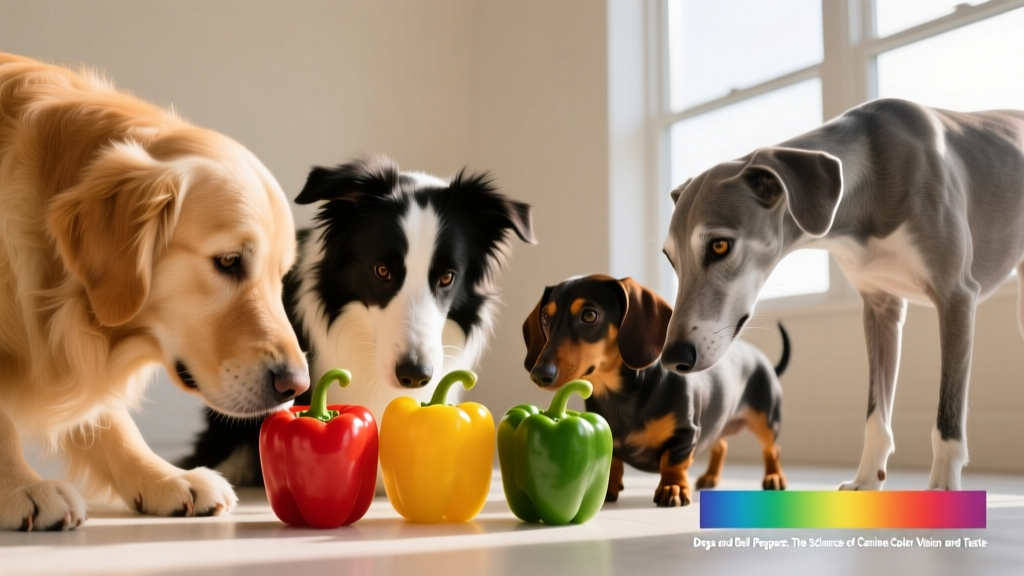
Dogs and Bell Peppers: The Science of Canine Color Vision and Taste
Explore the science behind dogs and bell peppers — how canine color vision, taste receptors, and evolutionary biology shape their response to this colorful vegetable.
Can Dogs Eat Bell Peppers? The Quick Answer
YES — bell peppers are safe for dogs in appropriate serving sizes. All colors (green, red, yellow, orange) are non-toxic and provide vitamin C, beta-carotene, and fiber. Remove stems and seeds before serving. Red bell peppers contain up to 11 times more beta-carotene than green varieties, according to USDA nutrient data. Typical serving: 1–2 tablespoons of chopped pepper per 20 lb of body weight, offered 2–3 times per week as a treat supplement. Always introduce gradually to avoid gastrointestinal upset.
When you toss a bright red bell pepper slice to your dog, something interesting is happening beneath the surface. Your dog doesn't see that pepper the same way you do. Their perception of color, taste, and texture is filtered through a sensory system shaped by 15,000+ years of domestication and millions of years of carnivore evolution. Understanding the science behind how dogs experience bell peppers reveals far more than a simple "safe or not safe" answer — it opens a window into canine neurobiology, nutritional adaptation, and the evolutionary compromises that make your dog the omnivorous opportunist they are today.
How Dogs Perceive Color: The Dichromatic Reality
The Science of Canine Color Vision
Dogs possess dichromatic vision, meaning their retinas contain two types of cone photoreceptors compared to the three types found in most humans. Research published in the Journal of Comparative Neurology (Neitz et al.) confirmed that canine cones are sensitive to wavelengths in the blue-violet range (~429–435 nm) and the yellow-green range (~555 nm). This means dogs perceive the world in a palette roughly equivalent to a human with red-green color blindness.
What does this mean for that vibrant red bell pepper on your cutting board? Your dog likely sees it as a muted yellowish-gray or brownish tone against a similarly muted background. The red pepper doesn't "pop" visually for them the way it does for you. A green bell pepper would appear as a dull blue-gray. Yellow and orange peppers fall closer to the wavelengths dogs can distinguish, making them slightly more visually salient — though the difference is subtle.
This matters practically: if you're using bell pepper pieces as training treats, your dog is identifying them primarily by scent and texture, not by their vivid color. The visual appeal of a colorful veggie platter is for your benefit, not theirs.
How Is Canine Color Vision Different From Humans?
| Feature | Human (Trichromatic) | Dog (Dichromatic) |
|---|---|---|
| Cone types | 3 (red, green, blue) | 2 (blue-violet, yellow-green) |
| Red bell pepper appears as | Vivid red | Muted yellow-brown |
| Green bell pepper appears as | Bright green | Blue-gray tone |
| Low-light vision | Moderate | Superior (tapetum lucidum) |
| Visual acuity (Snellen) | 20/20 typical | Approximately 20/75 |
| Motion detection | Good | Exceptional (rod-dominant retina) |
Dogs compensate for reduced color perception with extraordinary motion sensitivity and low-light capability. Their retinas are rod-dominant — approximately 97% rods to 3% cones — which made their ancestors exceptional crepuscular hunters (active at dawn and dusk). That evolutionary trade-off persists in your living room: your dog may not appreciate a red pepper's color, but they'll detect it moving across the floor faster than you will.
The Evolutionary Basis: From Carnivore Ancestors to Omnivorous Companions
Why Can Dogs Digest Plant Matter at All?
The gray wolf (Canis lupus), ancestor of all domestic dogs, is classified as a carnivore. So why can your dog digest bell peppers — a plant food their wild ancestors would never have encountered?
The answer lies in convergent evolution during domestication. A landmark 2013 study published in Nature (Axelsson et al.) compared the genomes of dogs and wolves and identified 36 genomic regions showing evidence of positive selection in dogs. Ten of these regions were involved in starch digestion and fat metabolism. Specifically, dogs evolved additional copies of the AMY2B gene (pancreatic amylase), giving them 7–30 times more amylase activity than wolves.
This genetic shift occurred because early domesticated dogs scavenged alongside human agricultural settlements, consuming starchy plant scraps. Dogs that could digest carbohydrates more efficiently had a survival advantage. Over thousands of generations, this selected for dogs with enhanced omnivorous capacity — meaning your dog's ability to derive nutrition from bell peppers is a direct product of their shared evolutionary history with farming humans.
Bell peppers (Capsicum annuum) are native to Central and South America and were unknown to Eurasian wolves entirely. However, the broader physiological adaptation — enhanced carbohydrate digestion, modified bile acid profiles, and longer intestinal transit times relative to body size — means modern dogs can process the fiber, sugars, and plant cell walls in bell peppers without difficulty.
What About Capsaicin? Why Bell Peppers Don't Burn
Bell peppers belong to the Capsicum genus but carry a recessive gene that prevents capsaicin production. Hot peppers contain capsaicin, which binds to TRPV1 receptors — the same pain-sensing ion channels dogs share with humans. Dogs have TRPV1 receptors in their oral cavity, esophagus, and gastrointestinal tract, making hot peppers genuinely painful and potentially harmful. Bell peppers, with zero Scoville heat units, bypass this system entirely. This is an important distinction: the safety of bell peppers does not extend to jalapeños, habaneros, or any pepper variety producing capsaicin.
Physiological Mechanisms: How Dogs Taste and Process Bell Peppers
A dog's tongue carries approximately 1,700 taste buds — roughly one-sixth the number found on a human tongue (~10,000). However, canine taste bud distribution reveals a system finely tuned to their evolutionary diet:
- Type I (sweet) — concentrated at the tip of the tongue; dogs have a unique sweet receptor (T1R2/T1R3 heterodimer) that responds strongly to amino acids and sugars. Bell peppers contain approximately 2.5–5g of natural sugars per 100g, which registers as mildly sweet to dogs.
- Type II (bitter) — distributed across the rear of the tongue; evolutionary defense against toxins. Green bell peppers contain slightly higher levels of pyrazines and alkaloid compounds that may register as faintly bitter, which is why many dogs show preference for red or yellow peppers.
- Type III (sour/salt) — moderate sensitivity; dogs have relatively low salt sensitivity compared to humans, consistent with a carnivore ancestor that obtained sodium from prey blood.
- Type IV (umami/meaty) — dogs have a dedicated receptor (T1R1/T1R3) tuned to L-amino acids, particularly glutamate and inosine monophosphate. Bell peppers score low on umami, which explains why many dogs find them less compelling than meat-based treats.
Dogs also possess a specialized "water taste" receptor at the tip of the tongue — identified by researchers at Yale — that responds to water after eating salty or sugary foods. The high water content of bell peppers (approximately 92%) may activate this receptor, contributing to a perception of freshness that some dogs find appealing.
Nutritional Breakdown: What Bell Peppers Deliver
| Nutrient (per 100g raw) | Red Pepper | Green Pepper | Relevance to Dogs |
|---|---|---|---|
| Vitamin C | 128 mg | 80 mg | Dogs synthesize their own vitamin C hepatically; supplemental C is generally unnecessary but not harmful |
| Beta-carotene (Vitamin A precursor) | 3,131 IU | 370 IU | Supports immune function and retinal health; dogs convert beta-carotene to retinol less efficiently than humans |
| Vitamin B6 | 0.29 mg | 0.22 mg | Supports neurotransmitter synthesis and glucose regulation |
| Fiber | 2.1 g | 1.7 g | Moderate fiber supports gut motility; excess causes loose stools |
| Calories | 31 kcal | 20 kcal | Low-calorie treat option for weight management |
One important physiological note: unlike humans, dogs produce their own vitamin C in the liver via the enzyme L-gulonolactone oxidase. The vitamin C in bell peppers is not essential to canine health the way it is for humans (who lost this synthesis pathway through a GULO gene mutation). However, during periods of stress, illness, or intense exercise, endogenous vitamin C production may be insufficient, and dietary sources can provide supportive benefit.
Practical Implications: Feeding Bell Peppers Safely
Serving Guidelines by Dog Size
| Dog Weight | Serving Size | Frequency | Preparation |
|---|---|---|---|
| Under 15 lb (7 kg) | 1–2 teaspoons, finely chopped | 2–3× per week | Raw or lightly steamed, seeds and stem removed |
| 15–30 lb (7–14 kg) | 1 tablespoon, chopped | 2–3× per week | Raw, steamed, or roasted (no oil/seasoning) |
| 30–60 lb (14–27 kg) | 2 tablespoons, chopped | 2–3× per week | Raw, steamed, or roasted (no oil/seasoning) |
| Over 60 lb (27+ kg) | 3–4 tablespoons, chopped | 2–3× per week | Raw, steamed, or roasted (no oil/seasoning) |
Treats (including vegetables) should never exceed 10% of your dog's daily caloric intake. For a 30 lb dog eating ~600 kcal/day, that's a maximum of 60 kcal from all treat sources combined. One tablespoon of red bell pepper contributes roughly 5 kcal — well within safe limits.
Preparation Methods Ranked
- Lightly steamed (best for digestion) — Steaming for 3–4 minutes softens cell walls, making beta-carotene and other carotenoids more bioavailable. Dogs have shorter digestive tracts than humans (approximately 4× body length vs. 6×), so breaking down plant cell walls through cooking improves nutrient absorption.
- Raw, finely chopped — Retains maximum vitamin C (heat-sensitive), but the tough cellulose structure of raw pepper skin may pass through partially undigested. Chop into pieces no larger than ½ inch for small dogs and 1 inch for large dogs to reduce choking risk.
- Roasted (plain) — Roasting at 400°F (204°C) for 15–20 minutes concentrates flavor and softens texture. Never use olive oil, garlic, onion, salt, or seasoning blends. Garlic and onion are toxic to dogs at sufficient doses, causing oxidative damage to red blood cells (ASPCA Toxic Plants List).
Common Misconceptions Debunked
| Myth | Fact |
|---|---|
| "Dogs need vitamin C from food like humans do." | Dogs synthesize vitamin C in their liver via L-gulonolactone oxidase. Healthy dogs do not require dietary vitamin C. The amount in bell peppers is a bonus, not a necessity. |
| "Red peppers are too 'spicy' for dogs." | Bell peppers of all colors contain zero capsaicin (0 Scoville units). They are not spicy. The sweetness of red peppers comes from higher sugar content, not heat compounds. |
| "Green peppers are toxic to dogs." | Green bell peppers are simply unripe red/yellow/orange peppers. They are non-toxic. They contain slightly more pyrazines (bitter-tasting compounds), which some dogs may reject, but this is preference, not toxicity. |
| "Dogs can't digest vegetables at all." | Domestic dogs evolved enhanced starch digestion capabilities (AMY2B gene amplification) during domestication. While they digest plant matter less efficiently than omnivores like bears, they absolutely can extract nutrients from cooked vegetables. |
| "If my dog won't eat peppers, they're being picky." | Dogs have ~1,700 taste buds vs. ~10,000 in humans, and their umami-dominant taste preference means low-protein vegetables simply don't trigger the same reward response as meat. Disinterest in peppers is neurobiology, not stubbornness. |
Breed Variations and Individual Differences
While all dog breeds share the same basic dichromatic visual system and taste receptor profile, individual and breed-level variation influences how dogs respond to novel foods like bell peppers:
- Scent-hound breeds (Beagles, Bloodhounds, Basset Hounds) — These breeds have up to 300 million olfactory receptors (vs. ~220 million in most breeds and ~5 million in humans). They are more likely to investigate and accept novel foods based on scent profiling. A Beagle may readily accept bell pepper because their olfactory system has thoroughly "identified" it before the first bite.
- Brachycephalic breeds (Pugs, Bulldogs, Boston Terriers) — Shortened skulls compress the nasal cavity and reduce olfactory surface area. These breeds may rely more heavily on texture and taste rather than scent when evaluating food. The crisp crunch of raw bell pepper may be more appealing than its aroma to a brachycephalic dog.
- Neophobic tendencies — Some individual dogs display food neophobia (fear of novel foods), which has been linked to serotonin pathway variation and early socialization history. Dogs weaned on diverse diets between 3–12 weeks of age typically show greater dietary flexibility as adults. This is a developmental window issue, not a breed-specific trait, though herding breeds (German Shepherds, Border Collies) may show slightly higher neophobia rates, consistent with their overall vigilance phenotype.
- Giant breeds (Great Danes, Saint Bernards) — While they can eat proportionally more bell pepper by volume, their predisposition to gastric dilatation-volvulus (GDV/bloat) means any new food should be introduced in very small quantities and never fed immediately before or after vigorous exercise.
When Bell Pepper Interest (or Avoidance) Signals a Problem
Behavioral and Medical Red Flags
While bell pepper consumption itself is benign, changes in how your dog interacts with food can indicate underlying issues:
- Sudden appetite changes — A dog that previously enjoyed treats (including vegetables) and suddenly refuses all food should be evaluated by a veterinarian within 24 hours. Appetite loss can signal dental disease, gastrointestinal obstruction, metabolic disorders, or systemic illness.
- Compulsive food-seeking behavior — If your dog obsessively raids counters, garbage, or gardens for peppers and other food items, this may indicate insufficient caloric intake, endocrine disorders (Cushing's disease, diabetes mellitus), or anxiety-driven compulsive behavior. Consult your veterinarian to rule out medical causes before addressing behaviorally.
- Gastrointestinal distress after eating peppers — Vomiting, diarrhea, or excessive flatulence within 4–12 hours of eating bell peppers may indicate individual food sensitivity, overconsumption of fiber, or a reaction to pesticide residue. Wash all peppers thoroughly and reduce serving size. If symptoms persist across multiple exposures, discontinue and discuss with your vet.
- Pica (eating non-food items) — If your dog is eating the entire pepper including the stem, core, or the plastic bag it came in, this suggests pica — a condition associated with nutritional deficiency, boredom, anxiety, or gastrointestinal disease. The fibrous stem poses a choking and intestinal blockage risk. Veterinary evaluation is recommended.
What Does It Mean When My Dog Spits Out a Bell Pepper?
This is usually normal and not a cause for concern. Dogs evaluate food through a sequence: scent → visual assessment (limited) → oral texture → taste → post-ingestive feedback. If your dog picks up a pepper piece, chews briefly, and spits it out, they've completed the evaluation and decided the taste/texture doesn't meet their preference threshold. This is the canine equivalent of tasting something and deciding you don't like it. It does not indicate illness, and you should not force the issue. Try steaming the pepper or mixing small amounts into their regular food — but respect their preference if rejection continues.
Frequently Asked Questions
Why do some dogs love bell peppers while others ignore them?
Individual variation in taste receptor sensitivity, early dietary exposure, olfactory acuity, and learned food preferences all contribute. Dogs exposed to diverse flavors during the 3–12 week socialization window tend to be more adventurous eaters. Additionally, some dogs have genetic variation in their T1R2 sweet receptor that makes them more responsive to the natural sugars in red peppers.
Can dogs eat bell pepper seeds and stems?
Seeds are not toxic but are difficult to digest and may cause mild gastrointestinal irritation or present a choking hazard in small dogs. Stems are fibrous and tough — they pose a higher risk of choking or intestinal blockage, especially in dogs under 20 lb. Always remove seeds and stems before offering bell pepper to your dog.
Is it normal for my dog to prefer red peppers over green?
Yes, and there's a scientific basis for it. Red bell peppers contain significantly more natural sugars (approximately 4.2g per 100g vs. 2.4g in green peppers) and lower levels of bitter pyrazine compounds. Given that dogs have functional sweet taste receptors and an evolutionary drive toward calorie-dense foods, preferring sweeter red peppers over slightly bitter green ones aligns with their neurobiology.
How is a dog's sense of taste different from humans when eating vegetables?
Dogs have roughly one-sixth the number of taste buds and lack the full range of bitter receptors humans possess. Their taste system prioritizes umami (meaty/amino acid flavors) and sweet, with relatively weak bitter and salt detection. When eating bell peppers, dogs experience a muted, simplified version of what you taste — mostly the sweetness and the physical crunch, without the complex vegetal, slightly bitter notes humans perceive.
Can bell peppers help with my dog's bad breath?
There is no evidence that bell peppers specifically improve canine halitosis. The crunchy texture of raw pepper may provide minor mechanical cleaning of tooth surfaces, similar to other crisp vegetables. However, persistent bad breath in dogs is most commonly caused by periodontal disease, which affects an estimated 80% of dogs over age 3 (AVMA Dental Care). If your dog has noticeable oral odor, schedule a veterinary dental examination rather than relying on vegetables as a remedy.
Are cooked bell peppers better than raw for dogs?
From a nutritional bioavailability standpoint, yes — lightly steamed bell peppers make carotenoids (beta-carotene, lutein, zeaxanthin) more accessible because cooking breaks down the cellulose cell walls that dogs' shorter digestive tracts struggle to penetrate. However, cooking destroys some vitamin C. Since dogs synthesize their own vitamin C, the trade-off favors light cooking for maximum overall nutrient absorption.
Sources & Further Reading
- Axelsson, E. et al. (2013). "The genomic signature of dog domestication reveals adaptation to a starch-rich diet." Nature, 495(7441), 360–364.
- Neitz, J. et al. (1989). "Color vision in the dog." Visual Neuroscience, 3(2), 119–125.
- Merck Veterinary Manual — Overview of the Digestive System in Dogs
- AKC — Can Dogs Eat Bell Peppers?
- ASPCA Animal Poison Control Center — (888) 426-4435
Veterinary Disclaimer: This article is for educational purposes and does not replace professional veterinary advice. If your dog has a pre-existing health condition, food allergies, or you are considering significant dietary changes, consult your veterinarian before introducing new foods.
Aaron Whyte
All our authors care for dogs every day — read more of their work on the authors page.


