How to Get Dog Hair Out of Car Carpet: The Science-Based Guide
Learn how to get dog hair out of car carpet using science-backed methods.
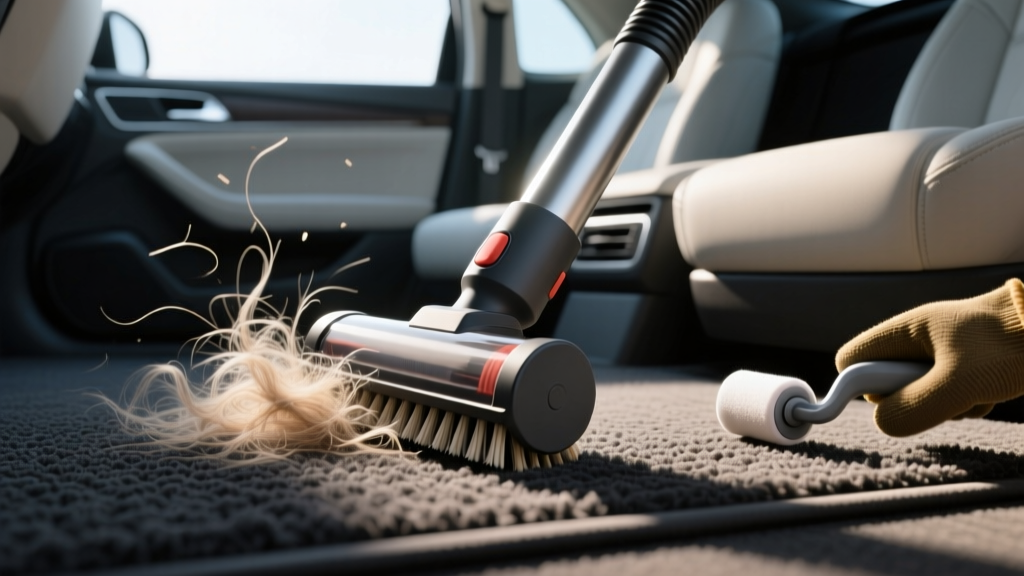
Quick Answer: How to Get Dog Hair Out of Car Carpet
The most effective method combines moisture, friction, and directional brushing. Lightly mist the carpet with water mixed with a small amount of fabric softener (1 tablespoon per cup), let it sit for 3-5 minutes, then use a rubber squeegee or silicone pet hair removal brush in one direction to lift embedded hairs. Follow with a vacuum using a motorized brush attachment. This works because water breaks the static charge that anchors hair to synthetic fibers, while rubber creates friction that grabs loose strands.
The Science of Why Dog Hair Clings to Car Carpet
Car carpet is typically made from nylon or polypropylene fibers with a cut-pile construction. These synthetic materials are triboelectric — they generate static charge when contacted by other materials, including dog hair. According to triboelectric series research, dog hair (primarily keratin protein) sits at a different electrostatic potential than nylon, creating an attraction force of approximately 0.1-0.5 millinewtons per hair fiber.
Additionally, dog hair has a microscopic cuticle structure — overlapping scales along the hair shaft similar to human hair but with species-specific spacing. These scales create mechanical interlocking with carpet fibers, especially when the hair is dry and the cuticle is raised. Humidity levels inside vehicles fluctuate dramatically (from 10% in winter with heat running to 80%+ in summer), which affects cuticle position and static charge intensity.
Key Physics at Play
- Electrostatic adhesion: Opposite charges attract hair to synthetic fibers
- Mechanical interlocking: Hair cuticle scales catch on carpet fiber irregularities
- Van der Waals forces: Weak molecular attraction between hair and carpet surfaces
- Fiber geometry: Dog hair diameter (15-80 micrometers depending on breed) allows penetration deep into carpet pile
The Evolutionary Basis of Dog Shedding
Domestic dogs (Canis lupus familiaris) inherited their coat structure from gray wolves, but artificial selection has dramatically altered shedding patterns. Wolves have a double coat consisting of:
- Guard hairs (primary coat): Coarse, 2-4 inches long, waterproof outer layer
- Undercoat (secondary coat): Fine, dense, insulating layer, 0.5-1 inch long
Wild canids shed seasonally — losing undercoat in spring for thermoregulation and regrowing it in autumn. This photoperiod-driven cycle is controlled by melatonin production in the pineal gland, which responds to daylight length changes.
Modern domestic dogs living in climate-controlled homes with artificial lighting experience disrupted photoperiod cues. Research published in the Journal of Veterinary Behavior shows that indoor dogs shed more consistently year-round rather than in distinct seasonal peaks, because their melatonin cycles don't receive clear seasonal signals. This means your car accumulates hair continuously, not just during traditional "blow coat" seasons.
The Fibroblast Growth Factor 5 (FGF5) gene controls hair length and growth cycle duration. Mutations in this gene are responsible for long-haired breeds, while the wild-type allele produces short coats. Breeds with the RSPO2 gene variant (wire-haired dogs like terriers) have different shedding mechanics — their hair breaks off rather than releasing from follicles cleanly.
Physiological Mechanism: How Hair Releases from Follicles
Dog hair growth follows three phases:
- Anagen (growth phase): 30-90 days depending on breed and coat type
- Catagen (transition): 2-3 weeks, follicle shrinks
- Telogen (resting): Hair is anchored loosely, ready to shed
Shedding occurs when telogen hairs are mechanically displaced — through brushing, scratching, or friction against surfaces like car seats. The arrector pili muscles (tiny muscles attached to hair follicles) can also contract, pushing hairs outward. This is the same mechanism that causes "goosebumps" and makes a dog's hackles rise.
Double-coated breeds have asynchronous shedding cycles — different follicles are in different phases simultaneously, creating continuous low-level shedding with periodic "blow out" events where large numbers of telogen undercoat hairs release at once. Single-coated breeds tend toward more synchronized shedding.
Proven Methods: How to Get Dog Hair Out of Car Carpet
| Method | Effectiveness (1-10) | Time Required | Cost | Best For |
|---|---|---|---|---|
| Rubber squeegee + water mist | 9 | 15-20 min | $8-15 (tool) | Embedded hair, heavy buildup |
| Silicone pet hair brush (e.g., Lilly Brush) | 8 | 10-15 min | $12-18 | Moderate hair, regular maintenance |
| Lint roller (Scotch-Brite) | 5 | 20-30 min | $8-12 per pack | Surface hair, quick touch-ups |
| Wet rubber gloves | 7 | 15-20 min | $5-8 | Budget option, light hair |
| Shop-vac with brush attachment | 6 | 10-15 min | $60-120 (vacuum) | Loose surface hair only |
| Professional detailing | 10 | 0 (outsourced) | $150-300 | Extreme cases, resale prep |
Step-by-Step: Rubber Squeegee Method
- Prep: Remove floor mats if possible. Vacuum loose debris first with a standard attachment (not brush roll — it can push hair deeper).
- Mix solution: 1 cup water + 1 tablespoon liquid fabric softener in a spray bottle. Fabric softener contains cationic surfactants that neutralize static charge.
- Apply: Lightly mist carpet (damp, not soaked). Wait 3-5 minutes for moisture penetration.
- Squeegee: Pull rubber blade in one direction with firm pressure. Hair will ball up along the blade edge.
- Collect: Pick up hair balls by hand or with a dustpan.
- Final vacuum: Use motorized brush attachment to capture remaining loose hairs.
Why This Works (The Science)
Water increases carpet fiber flexibility and reduces static charge. Fabric softener's cationic compounds coat fibers with a thin conductive layer, preventing charge buildup. Rubber's high coefficient of friction (0.5-0.8 against nylon) mechanically grabs hair that vacuum suction alone cannot dislodge. The directional motion aligns hair fibers for easier collection.
Common Misconceptions About Dog Hair Removal
| Myth | Scientific Fact |
|---|---|
| "Stronger vacuum suction removes more hair" | Suction alone cannot overcome mechanical interlocking. Without agitation (brush roll) or friction (rubber), embedded hair stays anchored regardless of suction power. |
| "Dryer sheets prevent hair from sticking" | Dryer sheets deposit waxy residues that can actually increase hair adhesion over time. They work temporarily on smooth surfaces but are ineffective on textured carpet. |
| "Tape and lint rollers are the best method" | Adhesive methods only capture surface hair. They cannot reach hair embedded deeper than 1-2mm into carpet pile, and adhesive loses effectiveness after 3-4 uses. |
| "Brushing your dog eliminates car hair" | Brushing reduces loose hair but doesn't eliminate shedding. Telogen hairs continue releasing through friction during car rides regardless of grooming frequency. |
| "Short-haired dogs shed less in cars" | Short, stiff hairs (like those from Boxers, Dalmatians) actually embed more deeply and are harder to remove than long, flexible hairs that sit on the surface. |
Breed Variations: Which Dogs Leave the Most Hair?
Hair characteristics vary dramatically by breed, affecting both shedding volume and removal difficulty:
- High-shedding, difficult removal: German Shepherds, Huskies, Malamutes (dense double coat, fine undercoat penetrates deeply)
- High-shedding, easier removal: Golden Retrievers, Labs (longer guard hairs that sit on surface)
- Low-shedding but persistent: Poodles, Bichons (hair grows continuously but breaks off, creating small fragments)
- Stubborn embedding: Boxers, Dobermans, Dalmatians (short, stiff hairs act like needles)
The hair diameter-to-length ratio determines embedding behavior. Short, thick hairs (high ratio) penetrate carpet pile more readily than long, fine hairs (low ratio). This is why Dalmatian hair seems impossible to remove — each hair is essentially a tiny, stiff projectile.
When Excessive Shedding Signals a Problem
While shedding is normal, sudden increases can indicate:
- Stress/anxiety: Cortisol release during car rides can trigger acute shedding (telogen effluvium). Dogs with car anxiety may shed 2-3x their baseline during trips.
- Nutritional deficiencies: Omega-3 fatty acid deficiency, zinc deficiency, or inadequate protein can cause excessive shedding. Merck Veterinary Manual details specific nutrient requirements.
- Endocrine disorders: Hypothyroidism, Cushing's disease, and sex hormone imbalances cause coat changes and increased shedding.
- Parasites: Flea allergy dermatitis causes scratching that releases hair prematurely.
- Seasonal flank alopecia: Some breeds develop symmetrical hair loss on flanks, unrelated to overall shedding.
If your dog's shedding pattern changes suddenly or is accompanied by skin redness, bald patches, or behavioral changes, consult your veterinarian.
Prevention: Reducing Hair Accumulation in Your Car
- Seat covers: Waterproof, machine-washable covers (Kurgo, 4Knines) cost $40-80 and prevent carpet contact entirely
- Pre-trip brushing: 5 minutes of brushing with an undercoat rake removes loose telogen hairs before they shed in the car
- Cargo liners: For SUVs/hatchbacks, rubber or fabric liners ($60-150) are easier to clean than carpet
- Air filtration: Running your car's cabin air filter on recirculate reduces airborne hair settling
- Regular grooming schedule: Professional deshedding treatments (Furminator-style) every 6-8 weeks reduce shedding by 60-80% for 2-3 weeks post-treatment
Frequently Asked Questions
Can I use a steam cleaner on car carpet to remove dog hair?
Yes, but with caution. Steam can loosen embedded hair, but excessive moisture can damage carpet backing adhesive and promote mold growth in padding. Use a low-moisture setting and ensure thorough drying (windows open, fans running) within 2-4 hours.
How often should I clean dog hair from my car carpet?
For daily dog transport, weekly cleaning prevents buildup. Hair accumulation follows an exponential curve — once a base layer establishes, new hair adheres more readily to existing hair than to carpet. Regular maintenance is more efficient than periodic deep cleaning.
Is dog hair in my car a health concern?
For most people, no. However, dog hair can carry dander (primary allergen source), environmental pollen, and occasionally parasites. If you have dog allergies, hair accumulation increases allergen exposure. Regular cleaning and HEPA cabin filters reduce allergen load.
Why does my dog shed more in the car than at home?
Car rides can trigger stress-induced shedding through cortisol-mediated follicle cycling acceleration. Additionally, vibration and friction against seats mechanically dislodge telogen hairs that would otherwise remain anchored until the next grooming session.
Do anti-static sprays help prevent hair from sticking?
Anti-static sprays (like Static Guard) can reduce initial hair adhesion by 40-60% for 24-48 hours. However, they don't prevent mechanical interlocking and must be reapplied regularly. They're most effective as a preventive measure on clean carpet.
Beth Carrasco
All our authors care for dogs every day — read more of their work on the authors page.


