Dog Ghost Phenomenon: Why Dogs React to Things You Can't See
Why does your dog bark at nothing? Explore the science behind dog ghost behavior — canine senses, evolutionary biology, and when to worry.
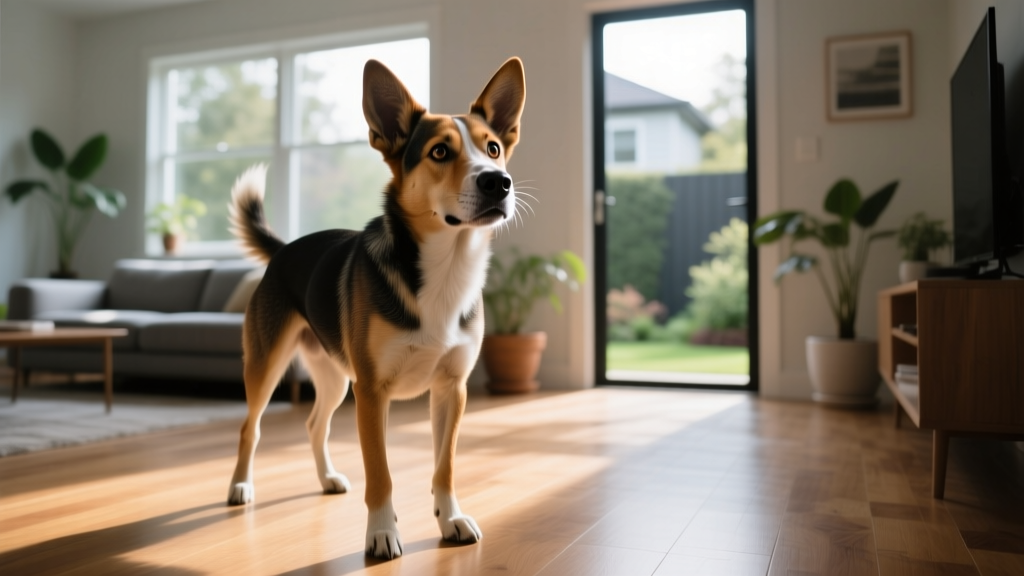
Quick Answer: Do Dogs See Ghosts?
No scientific evidence supports dogs seeing ghosts or supernatural entities. When your dog stares at an empty corner, barks at "nothing," or tracks something invisible across the room, they are almost certainly responding to real stimuli that fall outside human perception — ultrasonic sounds, minute air currents, trace scent particles, or subtle light shifts. Dogs possess sensory ranges far exceeding our own, making them appear to react to the paranormal when they are actually detecting very real, physical phenomena we simply cannot perceive.
The Science Behind Why Dogs React to "Nothing"
What owners commonly label as "dog ghost" behavior — staring fixedly at walls, sudden alertness in empty rooms, barking at seemingly nothing — almost always traces back to canine sensory biology. Dogs operate with perceptual equipment that dwarfs human capabilities across multiple modalities, and understanding these differences reframes the mystery entirely.
Hearing: The Ultrasonic Advantage
Dogs hear frequencies up to 45-65 kHz, compared to the human ceiling of roughly 20 kHz. This means your dog can detect sounds you literally cannot: the ultrasonic vocalizations of rodents inside walls, the high-frequency whine of electrical wiring or appliances, the scratch of insects in ceiling joists, and distant sounds carried through building materials that dissipate before reaching human ears.
According to research published in the Journal of Veterinary Behavior, canine auditory localization is also superior — dogs can pinpoint sound sources within 1-2 degrees of accuracy, compared to roughly 9 degrees for humans. When your dog stares intently at a specific spot on the wall, they are likely tracking a sound source with remarkable precision.
Smell: The Olfactory Superpower
The canine olfactory system contains approximately 300 million olfactory receptors (versus our 6 million), and the olfactory bulb is proportionally 40 times larger than in humans. Dogs can detect odor concentrations at parts per trillion — equivalent to detecting a single drop of liquid in 20 Olympic-sized swimming pools.
This means your dog may smell:
- A neighbor's pet walking outside your apartment, three floors down
- Gas leaks, mold, or pest activity behind drywall
- Chemical off-gassing from new furniture or building materials
- Trace scent carried through HVAC ductwork from distant rooms
- Changes in barometric pressure that carry new scent profiles through window seals
Vision: Motion Detection and Low-Light Sensitivity
While dogs have lower visual acuity than humans (roughly 20/75), they excel at motion detection and low-light vision. Their retinas contain a higher ratio of rod cells to cone cells, and the tapetum lucidum — a reflective layer behind the retina — amplifies available light. Dogs can detect movement at distances and light levels where humans see only stillness or darkness.
A shadow shifting by fractions of an inch, dust particles catching a sliver of light, or the flicker of a screen reflection can all trigger a dog's visual tracking response.
Evolutionary Context: Why These Senses Developed
Ancestral survival depended on detecting the undetectable. The gray wolf (Canis lupus), from which all domestic dogs descend, evolved as a crepuscular and nocturnal hunter across vast territories. Survival required detecting prey animals hidden in dense brush, underground, or at distances beyond human perception.
Wolves that could hear the faint rustle of a vole beneath snow, smell a deer herd two miles downwind, or spot the slightest movement in twilight conditions had a decisive survival advantage. These sensory traits were selected for over hundreds of thousands of years. Domestication has not erased them — a 2021 genomic study in Science confirmed that domestic dogs retain over 99% of the gray wolf genome, including the neurological architecture for these heightened senses.
In your living room, this evolutionary hardware means your Border Collie is still scanning for movement with the same neural circuits her ancestors used to track prey across tundra. Your Beagle's nose is still processing scent layers with the same olfactory machinery that helped wolves locate carrion across miles of forest. The environment has changed; the biology has not.
Physiological Mechanisms: How the Canine Brain Processes "Invisible" Stimuli
Understanding the neurological pathway from stimulus to behavior helps explain why dogs sometimes appear to "see ghosts."
The Orienting Response
When a dog detects a novel or unexpected stimulus — a sound, scent, or visual cue — the brain triggers what behavioral scientists call the orienting response. This involves:
- Sensory detection: The ear, nose, or eye captures the stimulus
- Thalamic relay: The thalamus routes sensory information to the appropriate cortical region
- Salience assessment: The amygdala and prefrontal cortex evaluate whether the stimulus is threatening, novel, or significant
- Motor response: The dog orients head and ears toward the source, freezes, or vocalizes
This sequence can occur in under 100 milliseconds. To an owner watching, the dog appears to react to nothing — but the dog's brain has already detected, processed, and responded to a real stimulus before the owner has even registered that something happened.
The Role of the Vomeronasal Organ
Dogs possess a vomeronasal organ (Jacobson's organ), located between the nose and mouth, which detects pheromones and chemical signals that the main olfactory system does not process. This organ connects directly to the amygdala and hypothalamus — brain regions governing emotion and instinctive behavior.
When a dog appears to "taste the air" or holds their mouth slightly open while staring at nothing, they may be engaging the vomeronasal organ to analyze airborne chemical signals. These could include pheromones from another animal that passed through the area hours earlier, or chemical changes in the environment imperceptible to humans.
Common Misconceptions About Dogs and the Paranormal
| Myth | Scientific Fact |
|---|---|
| Dogs can see ghosts or spirits | No peer-reviewed evidence supports canine perception of supernatural entities. All documented "ghost" behaviors have identifiable sensory explanations. |
| Dogs bark at nothing | Dogs bark at something — sounds, scents, or movements outside human detection range. "Nothing" is a human perceptual limitation, not an absence of stimulus. |
| If a dog growls at an empty corner, something is there | Often true — but "something" is usually a mouse in the wall, a draft carrying scent, or a reflection, not a spirit. |
| Dogs sense death or dying people supernaturally | Dogs can detect volatile organic compounds (VOCs) associated with metabolic changes in dying or seriously ill patients. This is biochemistry, not mysticism — confirmed by studies in journals like BMC Medical Research Methodology. |
| Howling at night means a dog sees a ghost | Nocturnal howling is a retained wolf behavior related to territory proclamation, social contact calling, and response to high-pitched environmental sounds (sirens, wind, other dogs). |
When "Ghost" Behavior Signals a Medical or Behavioral Problem
While most instances of dogs reacting to unseen stimuli are normal sensory behavior, certain patterns warrant veterinary attention.
Red Flags: Consult Your Veterinarian If Your Dog Shows:
- Fixation on empty space with no apparent trigger — especially if the dog snaps at the air repeatedly ("fly-snapping" behavior), which can indicate focal seizures, neurological disorders, or gastrointestinal discomfort
- Sudden onset of staring or pacing in a previously calm senior dog — potential signs of Canine Cognitive Dysfunction (CCD), the canine equivalent of dementia
- Compulsive shadow-chasing or light-chasing — a recognized stereotypic behavior disorder that can escalate without intervention
- Head pressing against walls — a serious neurological symptom requiring immediate veterinary evaluation
- Behavioral changes paired with appetite loss, disorientation, or altered sleep-wake cycles
CCD affects an estimated 28% of dogs aged 11-12 years and up to 68% of dogs aged 15-16 years, according to the Merck Veterinary Manual. If your senior dog begins staring at walls or corners, a veterinary neurology workup is appropriate.
Canine Cognitive Dysfunction and "Ghost" Staring
In older dogs, apparent ghost-seeing can be a hallmark of CCD. The condition involves beta-amyloid plaque accumulation in the brain — similar to Alzheimer's pathology in humans — leading to disorientation, altered social interactions, and changes in activity levels. Dogs with CCD may:
- Stand in corners or behind furniture, seemingly confused
- Stare blankly at walls or into space for extended periods
- Fail to recognize familiar people or navigate familiar rooms
- Experience disrupted sleep-wake cycles (wandering at night, sleeping all day)
Treatment options include selegiline (Anipryl), prescription therapeutic diets rich in antioxidants and medium-chain triglycerides (such as Hill's b/d or Purina NeuroCare), and environmental enrichment protocols. Your veterinarian will determine the appropriate approach based on symptom severity.
Practical Implications: What This Means for Daily Life
Managing Normal "Ghost" Behavior
If your dog's reactions to unseen stimuli are within normal range — alerting to sounds outside, sniffing walls where pests may be, tracking scents through the home — consider these practical strategies:
- Audit your environment for hidden stimuli. Check for rodent activity in walls or attic spaces, inspect HVAC ducts for gaps carrying outside scents, and identify any ultrasonic devices (pest repellers, electronic training collars from neighbors) operating in your home's frequency range. A $15-$30 ultrasonic frequency detector app or device can help you identify sounds your dog hears but you cannot.
- Use white noise to mask triggering sounds. A white noise machine ($20-$50) or a fan running near your dog's resting area can reduce the salience of distant or ultrasonic sounds that trigger alerting behavior. This is especially useful for apartment dogs who react to neighbor noise through shared walls.
- Provide structured enrichment to satisfy sensory drives. Nosework games, snuffle mats ($15-$35), and frozen Kongs give your dog's olfactory and problem-solving systems appropriate outlets. A dog whose sensory needs are met through enrichment is less likely to become hyperfixated on environmental stimuli.
- Teach an "all done" or "enough" cue. Using positive reinforcement, train a release cue that signals to your dog that you have acknowledged the alert and the situation is handled. Reward the dog for alerting once, then redirect to a settled behavior. This prevents escalation into prolonged barking or fixation.
- Record the behavior for veterinary review. If you are unsure whether your dog's reactions are normal or compulsive, set up a pet camera ($35-$80, such as Furbo or Wyze) and capture 24-48 hours of footage. Share specific clips with your veterinarian or a certified veterinary behaviorist (DACVB) for assessment.
Breed Variations in Sensory Sensitivity
Not all dogs are equally likely to display "ghost" behavior. Breeds selected for specific sensory tasks tend to show heightened reactivity to stimuli outside human perception:
| Breed Group | Heightened Sense | Common "Ghost" Behaviors |
|---|---|---|
| Scent hounds (Beagles, Basset Hounds, Bloodhounds) | Olfaction (up to 300M+ receptors in Bloodhounds) | Extended sniffing of walls/floors, tracking invisible scent trails indoors, nose-to-ground fixation |
| Terriers (Jack Russell, Rat Terrier, Cairn Terrier) | Hearing + prey drive | Alerting to rodents in walls, digging at floors/baseboards, intense staring at specific wall points |
| Herding breeds (Border Collie, Australian Shepherd, German Shepherd) | Vision (motion sensitivity) + hearing | Tracking shadows/light reflections, reacting to subtle environmental movement, compulsive staring |
| Nordic breeds (Husky, Malamute, Samoyed) | Hearing + vocalization instinct | Howling at inaudible sounds, alerting to distant noises, nocturnal vocalizing |
| Sighthounds (Greyhound, Whippet, Saluki) | Vision (motion detection at distance) | Fixating on distant objects or movement outside windows, sudden visual tracking in low light |
Brachycephalic breeds (Bulldogs, Pugs, Shih Tzus) tend to show somewhat reduced auditory and olfactory sensitivity compared to mesocephalic and dolichocephalic breeds, and are statistically less likely to display intense "ghost" behaviors — though individual variation always applies.
Frequently Asked Questions
Why do dogs stare at walls or empty corners?
Dogs staring at walls are typically responding to sounds within the wall (plumbing, electrical buzzing, rodent activity), scent traces from pests or previous occupants, or light reflections. In senior dogs, wall-staring can signal Canine Cognitive Dysfunction and warrants veterinary evaluation.
Can dogs sense death or illness in humans?
Yes, but through biochemistry, not supernatural means. Dogs can detect volatile organic compounds (VOCs) associated with metabolic changes in cancer, diabetic episodes, and end-of-life physiological decline. Studies have demonstrated detection dogs identifying cancer samples with accuracy rates above 90%. Family dogs may pick up on these same chemical changes in their owners without formal training.
How do dogs process sounds humans cannot hear?
The canine cochlea processes frequencies up to 45-65 kHz, compared to roughly 20 kHz in humans. The pinna (external ear) is controlled by 18+ muscles allowing independent rotation to capture and localize sound. Neural pathways from the auditory cortex to the amygdala allow dogs to assess threat significance of novel sounds in milliseconds.
What does it mean when my dog barks at an empty room?
Your dog is most likely barking at a real stimulus: a sound from an adjacent unit, a scent carried through ventilation, a reflection, or a small animal. If barking becomes compulsive, repetitive, or occurs without any environmental trigger, consult your veterinarian to rule out neurological or behavioral disorders.
Is it normal for my dog to howl when nobody is home?
Howling in isolation is normal canine behavior — it serves as a contact call (attempting to reach pack members) and can be triggered by environmental sounds like sirens, music, or distant dogs. However, excessive howling paired with destructive behavior or house soiling may indicate separation anxiety, which responds well to desensitization and counter-conditioning protocols with a certified trainer or veterinary behaviorist.
How is canine sensory perception different from humans?
Dogs exceed humans in hearing range (3x higher frequencies), olfactory receptor count (50x more receptors), low-light vision, and motion detection. Humans exceed dogs in visual acuity, color discrimination, and cognitive abstraction. The "dog ghost" phenomenon is essentially a gap between canine sensory input and human sensory input — your dog is not seeing the supernatural, they are perceiving the natural world at a resolution you cannot access.
Related Canine Sensory Abilities
Understanding the "dog ghost" phenomenon connects to several other areas of canine sensory science worth exploring:
- Barometric pressure sensitivity: Dogs may detect approaching storms 30-60 minutes before humans notice changes, responding to pressure drops through the inner ear and potentially through the vomeronasal organ detecting ionization changes.
- Seizure alerting: Some dogs spontaneously alert to their owner's epileptic seizures minutes before onset, likely detecting VOCs from pre-seizure metabolic changes. This ability is being studied for clinical applications.
- Geomagnetic field alignment: A 2013 study published in Frontiers in Zoology documented that dogs preferentially align their bodies along the north-south axis of the Earth's magnetic field during defecation — a finding that suggests magnetoreception abilities previously documented mainly in migratory species.
References
Jonas Cole
All our authors care for dogs every day — read more of their work on the authors page.


