Why Dogs Prefer Sleeping Elevated: The Science Behind Dog Cot Use
Discover the canine science behind why dogs gravitate toward elevated dog cot beds, covering thermoregulation, joint health, and evolutionary denning instincts.
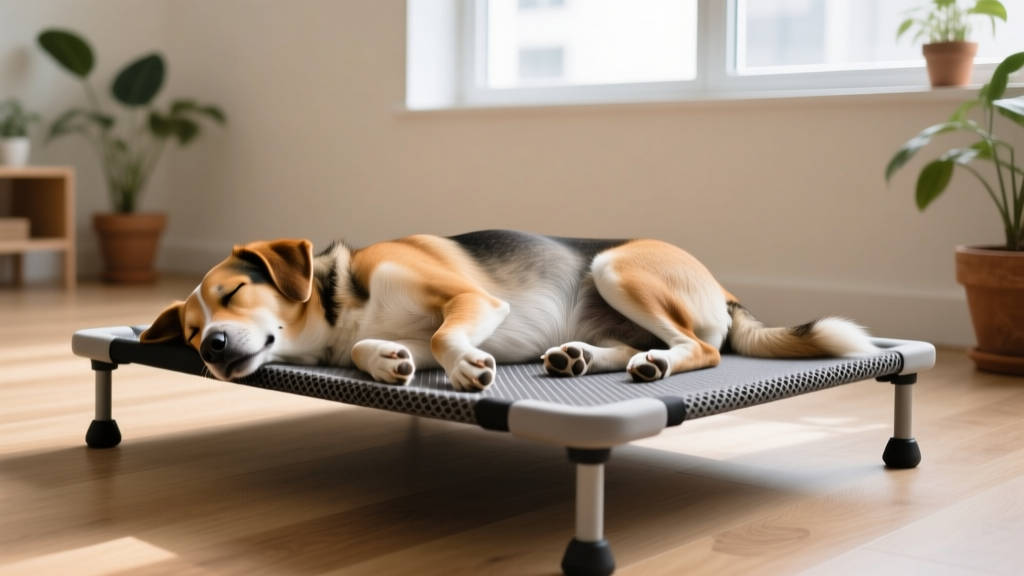
Do Dogs Actually Prefer Sleeping on Elevated Dog Cots?
Yes — for most dogs, an elevated dog cot offers measurable benefits over floor sleeping. The preference stems from three overlapping canine science principles: thermoregulation (airflow beneath the body helps dissipate heat), orthopedic relief (elevated, taut surfaces distribute weight more evenly than hard floors), and evolutionary vigilance behavior (a raised platform provides a wider sightline, reducing anxiety in alert-prone breeds). However, preference varies by breed, coat type, age, and ambient temperature. Senior dogs with arthritis, short-coated breeds in warm climates, and anxious dogs who benefit from a defined "safe zone" show the strongest cot preference. Brachycephalic breeds and double-coated northern breeds in cold climates may prefer insulated floor beds instead.
The Evolutionary Basis: Why Elevation Matters to Canines
Ancestral context: Wild canids — including gray wolves (Canis lupus) and African wild dogs (Lycaon pictus) — routinely select elevated or semi-elevated resting sites when available. Ridge lines, fallen logs, termite mounds, and rocky outcroppings serve as preferred sleep locations in the wild. This isn't random.
Three evolutionary pressures shaped this behavior over millions of years of canid evolution:
- Predator detection: Even as apex predators, wolves remain vulnerable during sleep. An elevated position extends the visual horizon and allows earlier detection of approaching threats. Research published in Applied Animal Behaviour Science has documented that captive canids given multi-level enclosures preferentially rest on raised platforms, particularly during lighter sleep phases.
- Thermal regulation: Ground contact transfers heat rapidly — both into and out of the body. In warm environments, wild canids dig shallow depressions to access cooler soil, but in moderate conditions, resting on elevated surfaces (rocks, logs) allows convective cooling via airflow beneath the body. This dual strategy — elevation for moderate heat, ground contact for extreme heat — is well-documented in field studies of African wild dogs.
- Parasite and moisture avoidance: Sleeping directly on damp ground increases exposure to ticks, fleas, soil-transmitted parasites (hookworm larvae, for example, penetrate skin on contact), and fungal organisms. Elevated resting reduces this exposure significantly.
Domestic dogs (Canis lupus familiaris) retain these ancestral preferences despite 15,000–30,000 years of domestication. The neural circuits governing resting-site selection are deeply conserved — they reside in the hypothalamus and brainstem, regions that have changed relatively little through domestication compared to the cerebral cortex.
The Physiology: How a Dog's Body Responds to Elevated Sleep Surfaces
Thermoregulation and the Canine Vascular System
Dogs dissipate heat primarily through panting (evaporative cooling from the respiratory tract) and vasodilation in their paw pads and belly skin. Unlike humans, dogs have very limited eccrine sweat glands — only on their paw pads — making convective and conductive cooling critically important.
When a dog lies on a solid floor, the contact surface traps body heat. A 65 lb (29.5 kg) dog generates approximately 70–80 watts of metabolic heat at rest. On a non-breathable surface, that heat has nowhere to go, raising the dog's skin temperature by 2–4°F (1–2°C) within 20–30 minutes. An elevated dog cot with a mesh or fabric-sling design allows air to circulate beneath the dog, carrying heat away via convection. This is the same principle behind elevated bed designs used in human tropical medicine.
Orthopedic Load Distribution
The canine skeletal system bears weight through four relatively narrow contact points (the paws), with the spine acting as a suspended bridge between the forequarters and hindquarters. When a dog lies on a hard floor, pressure concentrates at the bony prominences: the elbows (olecranon), hocks (calcaneus), hips (greater trochanter of the femur), and the lateral aspect of the shoulder.
A study in the Journal of Veterinary Internal Medicine found that large-breed dogs sleeping on hard surfaces showed significantly higher rates of hygromas (fluid-filled swellings over pressure points) and callus formation — early indicators of chronic pressure discomfort. Elevated cots with taut, suspended fabric distribute body weight across the entire torso rather than concentrating it at bony landmarks.
Here's how pressure distribution compares across common sleep surfaces:
| Sleep Surface | Pressure Distribution | Airflow Beneath Dog | Best For |
|---|---|---|---|
| Hard floor (tile, hardwood) | Poor — concentrated at joints | None | Heat-stressed dogs seeking conductive cooling (short periods only) |
| Thin pad/blanket on floor | Fair — slight cushioning | None | Healthy young dogs in moderate climates |
| Orthopedic foam bed (floor-level) | Good — conforms to body | Minimal | Senior dogs, post-surgical recovery |
| Elevated dog cot (mesh/sling) | Very good — full-torso distribution | Full convective airflow | Hot climates, dogs with allergies, joint-conscious breeds |
| Elevated cot with padded topper | Excellent — distribution + cushioning | Partial airflow | Senior large breeds, arthritic dogs in warm homes |
Breed Variations: Which Dogs Benefit Most from a Dog Cot?
Not all dogs respond identically to elevated sleep surfaces. Breed-specific physiology, coat architecture, and temperament create meaningful variation:
High-Benefit Breeds
- Large and giant breeds (German Shepherds, Labrador Retrievers, Great Danes, Rottweilers): These dogs are predisposed to hip dysplasia and elbow dysplasia. Reducing pressure-point stress during sleep is a legitimate preventive measure. A Great Dane weighing 130–175 lb (59–79 kg) exerts enormous pressure on hip joints when lying on hard surfaces.
- Short-coated breeds (Boxers, Dobermans, Greyhounds, Whippets): Minimal subcutaneous fat and thin coats provide almost no natural padding. These breeds develop pressure sores and hygromas more readily than thick-coated breeds.
- Brachycephalic breeds in warm climates (French Bulldogs, English Bulldogs, Pugs): These dogs already struggle with thermoregulation due to brachycephalic obstructive airway syndrome (BOAS). An elevated cot's cooling effect reduces panting effort during sleep.
- Allergy-prone breeds (West Highland White Terriers, Chinese Shar-Peis, Bulldogs): Elevation reduces contact with dust mites, mold spores, and flea larvae in carpeting.
Lower-Benefit or Neutral Breeds
- Double-coated northern breeds (Siberian Huskies, Alaskan Malamutes, Samoyeds): Their dense undercoat provides both insulation and natural padding. In cool climates, these dogs often prefer floor contact for conductive cooling of their core temperature — counterintuitive, but thermodynamically sound.
- Small toy breeds (Chihuahuas, Yorkshire Terriers): These dogs lose body heat rapidly due to high surface-area-to-volume ratios. Elevated cots without added padding can make them uncomfortably cool. A floor-level enclosed bed (bolster or cave-style) typically suits them better.
Common Misconceptions About Dogs and Elevated Beds
| Myth | Scientific Fact |
|---|---|
| "Dogs sleep on the floor because they like it — they don't need a bed." | Dogs are opportunistic resters. They sleep where they feel safest and most thermally comfortable. Floor sleeping often reflects lack of a better option, not preference. When given a choice in controlled studies, most dogs select elevated or padded surfaces. |
| "An elevated cot is just a luxury — it doesn't affect health." | Chronic pressure on bony prominences causes hygromas, calluses, and can accelerate joint discomfort in predisposed breeds. Surface selection is a legitimate environmental modification, not cosmetic indulgence. |
| "All dogs should use a cot — it's universally better." | Small breeds, cold-climate dogs, and dogs with certain anxiety profiles (those who seek enclosed, den-like spaces) may do better with floor-level bolstered beds. One size does not fit all. |
| "If my dog doesn't use the cot, they're being stubborn." | Dogs have individual thermal comfort zones (thermoneutral zones) that vary by breed, coat, body fat, and health status. A dog avoiding a cot may be too cold, uncomfortable with the texture, or anxious about the height. This is information, not defiance. |
| "Cots are only useful outdoors." | Indoor airflow, HVAC patterns, and floor surface temperature all affect canine comfort. Indoor cot use provides the same thermoregulatory and orthopedic benefits as outdoor use. |
Practical Implications: Choosing and Introducing a Dog Cot
What This Science Means for Your Daily Life
Sizing: Your dog's cot should be at least 6 inches (15 cm) longer than their body length (nose to base of tail) and 4 inches (10 cm) wider than their shoulder width. A 70 lb (32 kg) Labrador typically needs a cot at least 42 × 30 inches (107 × 76 cm).
Height: Most commercial dog cots sit 6–9 inches (15–23 cm) off the ground. For senior dogs or dogs with mobility issues (IVDD, severe arthritis, post-surgical), choose a lower-profile model (4–5 inches / 10–13 cm) or add a ramp. The Coolaroo Elevated Pet Bed and the Kuranda Chew-Proof Cot are two widely available options in the $40–$130 range with proven durability records.
Fabric: Look for PVC-coated polyester mesh (breathable, easy to clean, resistant to chewing) or Textilene fabric. Avoid cotton or canvas slings — they retain moisture and harbor bacteria.
Introduction protocol (force-free, positive reinforcement):
- Place the cot in your dog's preferred resting area — don't move it to an unfamiliar room.
- Scatter high-value treats (freeze-dried liver, small cheese pieces) on the cot fabric. Let the dog step on and off freely without any physical guidance.
- Once the dog steps onto the cot voluntarily (usually 1–5 sessions), begin marking the behavior with a verbal cue ("place" or "cot") followed by a treat reward.
- Gradually increase duration on the cot before rewarding — start with 2 seconds, build to 30 seconds over 5–7 days.
- Never force, lift, or physically place the dog onto the cot. This creates negative associations and undermines the voluntary "safe space" function.
Cost expectations: A quality elevated dog cot ranges from $35 (basic steel-frame, single-mesh models) to $150+ (chew-proof aluminum frames with replaceable fabric). Replacement fabric slings cost $15–$30. Budget roughly $50–$80 for a good initial setup for a medium-to-large dog.
When Cot Behavior (or Avoidance) Signals a Problem
Changes in resting-site preference can be an early indicator of health issues. Watch for these signals:
- Sudden avoidance of a previously favored cot: This may indicate joint pain making the step-up difficult, vision decline causing spatial uncertainty, or vestibular disease affecting balance. Schedule a veterinary exam if avoidance persists beyond 3–5 days.
- Excessive seeking of hard, cool floor surfaces: While normal in hot weather, persistent floor-seeking in moderate temperatures can signal fever, Cushing's disease (which causes heat intolerance), or hypothyroidism-related discomfort.
- Restlessness — moving between cot, floor, and furniture repeatedly: This pattern often indicates pain that isn't relieved by any single position. Common causes include abdominal pain (pancreatitis, GDV prodrome), spinal pain (IVDD), or anxiety disorders.
- Refusal to lie down at all (remaining standing or sitting for hours): This is a red flag. Dogs with pleural effusion, severe heart failure, or advanced laryngeal paralysis may be unable to lie down comfortably because recumbency worsens their breathing. Seek veterinary care immediately.
Always consult your veterinarian if you notice a sudden, persistent change in your dog's sleeping behavior or resting-site preferences. These changes are often the first visible sign of underlying conditions that benefit from early intervention.
Related Canine Behaviors and Cross-References
Understanding cot preference connects to several other well-studied canine behaviors:
- Circling before lying down: This nesting behavior is a vestigial action from wild canids trampling grass or snow to create a level, concealed resting site. It persists in domestic dogs even on perfectly flat surfaces — a fixed action pattern triggered by the intention to rest.
- Digging at bedding: Related to thermoregulation — wild canids dig to reach cooler soil layers or to create an insulating depression. Dogs who dig at cot fabric are expressing this same drive; providing a separate digging outlet (sandbox, snuffle mat) can redirect this behavior.
- Seeking enclosed spaces (under tables, behind furniture): This is the complementary behavior to elevation-seeking. Dogs balance two needs: visibility (elevation) and security (enclosure). Some dogs prioritize one over the other based on temperament and early socialization.
- Co-sleeping and contact-resting: Pack-resting behavior where dogs sleep touching littermates or humans. This serves both thermoregulatory (shared warmth) and social-bonding functions mediated by oxytocin release.
Sources and Further Reading
- Merck Veterinary Manual — Brachycephalic Airway Syndrome in Dogs
- American Kennel Club — Hip Dysplasia in Dogs
- Horowitz, A. (2009). Inside of a Dog: What Dogs See, Smell, and Know. Scribner. — Referenced for canine sensory ecology and resting behavior.
- Overall, K.L. (2013). Manual of Clinical Behavioral Medicine for Dogs and Cats. Elsevier. — Referenced for environmental modification and resting-site selection in anxiety management.
Frequently Asked Questions
Why do dogs prefer elevated sleeping surfaces?
Dogs inherit a resting-site preference from wild canid ancestors who selected elevated positions for predator detection, thermal regulation, and parasite avoidance. An elevated dog cot triggers these same instinctive comfort signals — better sightlines, airflow beneath the body, and reduced ground-level allergen exposure.
Can dogs sleep comfortably on a cot without padding?
Most healthy adult dogs can sleep comfortably on a taut mesh or fabric sling without added padding, because the suspended surface distributes weight across the entire torso. However, senior dogs, thin-coated breeds (Greyhounds, Dobermans), and dogs with existing joint disease benefit from a padded topper or orthopedic insert placed on the cot frame.
How do dogs regulate body temperature while sleeping?
Dogs use vasodilation (expanding blood vessels near the skin surface, especially on the belly and paw pads), panting, and conductive heat transfer (pressing their body against cool surfaces) to shed heat. During sleep, panting decreases, making conductive and convective cooling — the airflow a cot provides — disproportionately important for maintaining safe core temperature.
What does it mean when my dog refuses to use their cot?
Cot refusal can indicate physical discomfort (the height is too challenging, the fabric texture is unpleasant, the room is too cold), anxiety (the cot is in an unfamiliar or high-traffic area), or a medical issue (joint pain, vision changes, vestibular dysfunction). Rule out environmental factors first, then consult your veterinarian if refusal persists.
Is it normal for my dog to sleep on the floor instead of their cot?
Yes — floor sleeping is normal, especially in warm weather or for double-coated breeds seeking conductive cooling. However, chronic hard-floor sleeping in large breeds increases the risk of hygromas and joint discomfort over time. Offering both options and observing your dog's choice across different temperatures gives you the best information about their actual preference.
How is canine sleep surface preference different from humans?
Humans prioritize spinal alignment and pressure relief in mattress selection, driven by our bipedal anatomy and side-sleeping habits. Dogs prioritize thermal regulation and security (sightlines + enclosure), driven by their quadrupedal anatomy, limited sweat glands, and evolutionary need for vigilance even during rest. A dog's "ideal bed" solves different physiological problems than a human's.
Jonas Cole
All our authors care for dogs every day — read more of their work on the authors page.


