The Canine Science Behind Group Dog Training Classes:...
Discover the behavioral science and evolutionary biology behind why group dog training classes work — and how social learning shapes your dog's obedience.
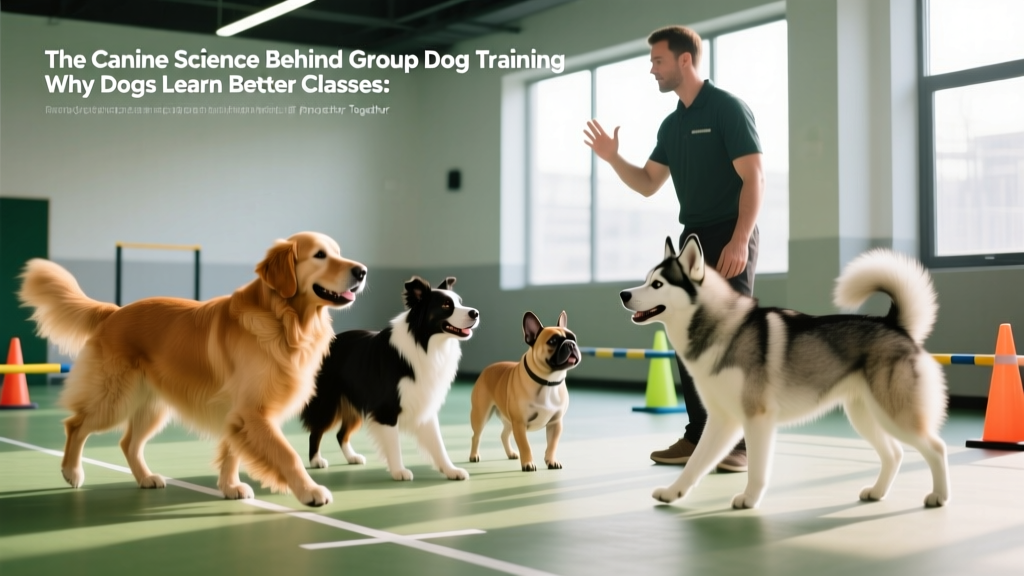
Direct Answer: Dogs learn effectively in group training classes because they are evolutionarily wired for social learning — a trait inherited from their wolf ancestors who relied on coordinated group behavior for survival. Research in canine cognition shows that dogs observe and mimic the actions of other dogs (a process called social facilitation), making group environments powerful learning accelerators. However, group classes work best when structured around positive reinforcement methods, appropriate dog-to-dog ratios (ideally 4–6 dogs per instructor), and controlled exposure that prevents overstimulation.
Why Do Dogs Learn in Group Settings? The Science of Social Facilitation
If you've ever watched your dog completely ignore a "sit" command at home only to nail it the moment another dog in class sits perfectly beside them, you've witnessed social facilitation in real time. This isn't coincidence — it's a well-documented phenomenon in canine behavioral science.
What Is Social Facilitation in Dogs?
Social facilitation describes the tendency of an animal to perform a behavior more readily or with greater intensity when in the presence of conspecifics (members of the same species) performing that same behavior. In dogs, this manifests as:
- Behavioral mimicry: A dog copies the posture or action of another dog (e.g., lying down when the class settles).
- Increased arousal: The presence of other dogs raises mild physiological arousal, which can enhance performance on well-learned tasks (the Yerkes-Dodson principle applied to canines).
- Competitive motivation: Dogs in group settings often work harder for food rewards when they observe another dog receiving reinforcement — a phenomenon documented in studies by researchers at the University of Veterinary Medicine Vienna.
A landmark study published in Animal Cognition (Fugazza & Miklósi, 2014) demonstrated that dogs who observed a demonstrator dog performing a novel action were significantly more likely to reproduce that action themselves compared to dogs who watched a human perform the same task. This "Do as I do" protocol revealed that dogs possess a form of deferred imitation — the ability to observe, retain, and replicate actions after a delay — that is functionally similar to imitation in human toddlers.
In practical terms, this means a group dog training class of six dogs isn't just six individual learning sessions happening simultaneously. It's a social learning network where each dog serves as both student and teacher.
The Evolutionary Basis: Pack Coordination and Observational Learning
From Wolves to Classroom: The Ancestral Thread
Gray wolves (Canis lupus) are among the most socially coordinated mammals on Earth. Pack hunting, pup-rearing, and territory defense all require individuals to observe, interpret, and synchronize with the actions of group members. This evolutionary pressure selected for wolves — and by extension, domestic dogs — who were highly attentive to the behavior of conspecifics.
Domestication over the past 15,000–30,000 years did not erase this social learning capacity. Instead, it redirected it. Dogs evolved to attend not only to other dogs but also to human social cues — gaze direction, pointing gestures, and emotional expressions. Research from the Family Dog Project at Eötvös Loránd University in Budapest has shown that dogs outperform even chimpanzees in reading human communicative intent.
In a group training class, your dog is essentially operating within two overlapping social frameworks:
- Intraspecific social learning (dog-to-dog): Observing other dogs sit, stay, or walk on leash activates ancestral mimicry circuits.
- Interspecific social learning (dog-to-human): Watching a handler cue and reward another dog teaches your dog what the human expects — even before the cue is directed at them.
This dual-channel learning is unique to dogs among domestic animals and explains why group dog training classes produce results that purely individual sessions sometimes cannot replicate.
The Neurobiology: What Happens Inside Your Dog's Brain During Group Training
Understanding the physiological mechanisms behind group learning requires looking at three key neurochemical systems:
| Neurochemical System | Role in Group Training | Trigger in Class Setting |
|---|---|---|
| Dopaminergic reward pathway | Reinforces correct behavior; drives motivation to repeat actions that earn rewards | Receiving treats, praise, or play after a correct response; observing another dog receive rewards (vicarious reinforcement) |
| Oxytocin system | Promotes social bonding, reduces stress, enhances attention to social partners | Positive physical contact with handler, calm proximity to other dogs, cooperative interaction |
| Mirror neuron network | Enables action observation and motor simulation — the neural basis for imitation | Watching another dog perform a commanded behavior (sit, down, recall) |
While the mirror neuron system in dogs is less extensively mapped than in primates, functional MRI studies conducted by Dr. Gregory Berns at Emory University have confirmed that dogs possess neural circuits in the caudate nucleus that activate in response to observing familiar actions and anticipating rewards. When your dog watches a classmate earn a treat for a "down," their caudate is essentially running a simulation: "If I do that, I get that."
The oxytocin component is equally critical. A 2015 study published in Science (Nagasawa et al.) demonstrated a positive oxytocin feedback loop between dogs and their owners during mutual gaze. In a well-run group class, this bonding mechanism extends to the training environment itself — your dog associates the class setting with positive social interaction, which lowers cortisol (stress hormone) levels and creates optimal conditions for memory consolidation.
How Is Canine Social Learning Different From Human Learning?
It's tempting to assume that dogs in group classes learn the same way human children learn in a classroom. The reality is more nuanced:
| Common Misconception | What the Science Actually Shows |
|---|---|
| "My dog feels embarrassed when they fail in front of other dogs." | Dogs lack the self-conscious emotions (embarrassment, shame) that require a developed theory of mind. They respond to your emotional state, not social judgment from peers. |
| "My dog is 'showing off' when they perform better in class than at home." | Performance improvement in groups is social facilitation, not ego display. The heightened arousal and mimicry cues make execution easier, not a desire to impress. |
| "Dogs learn commands by understanding what the words mean." | Dogs learn associative chains: sound pattern → expected body position → reward outcome. They process cues as discriminative stimuli, not linguistic symbols. |
| "All dogs benefit equally from group classes." | Dogs with severe fear, aggression, or overstimulation issues may experience social inhibition — the opposite of facilitation — where group presence suppresses learning entirely. |
| "More dogs in class means more learning opportunities." | Research on optimal group size suggests 4–6 dogs per certified instructor maximizes individual attention while maintaining social learning benefits. Beyond 8 dogs, distraction typically outweighs facilitation. |
Breed Variations: Which Dogs Thrive in Group Classes — and Which Need a Different Approach?
Not all breeds process group social environments identically. Centuries of selective breeding have shaped different social orientations:
| Breed Group | Typical Group Class Response | Considerations |
|---|---|---|
| Herding breeds (Border Collies, Australian Shepherds, Shelties) | High social attentiveness; rapid observational learning; may attempt to "herd" moving classmates | Need mental challenge beyond basic obedience to prevent boredom-driven disruption. Look for classes incorporating agility or nose work. |
| Retrievers & Sporting breeds (Labs, Goldens, Spaniels) | Excellent group learners; strong food/toy motivation; thrive on handler focus | Generally the easiest breed group for class settings. Watch for overexcitement during greeting periods. |
| Primitive/Spitz breeds (Shiba Inus, Akitas, Huskies) | More independent; may show less interest in mimicking other dogs; higher distractibility from scents/sounds | Benefit from smaller classes (3–5 dogs) and higher-value rewards. Patience with slower initial progress is essential. |
| Guardian breeds (Great Pyrenees, Anatolian Shepherds, Mastiffs) | May perceive unfamiliar dogs as territorial intrusions rather than classmates; slower social warm-up | Require careful introduction protocols. Private sessions followed by gradual group integration often work best. Consult a certified behaviorist (CAAB or DACVB) if reactivity emerges. |
| Toy breeds (Chihuahuas, Pomeranians, Yorkies) | Can be overwhelmed by large dogs in mixed-size classes; may show fear-based inhibition | Seek small-dog-specific classes or ensure the facility separates by size. Elevated platforms or barriers help toy breeds feel secure. |
When Group Training Might Signal a Problem: Red Flags to Watch For
Group classes are beneficial for most dogs, but certain behavioral signals indicate your dog may need individual assessment before continuing:
Behavioral Red Flags in Group Class Settings
- Whale eye (half-moon eye whites showing) combined with a rigid, frozen body — indicates high fear, not "calm submission"
- Persistent lip-licking or yawning when not tired or eating — displacement signals indicating chronic stress
- Refusal of high-value treats that your dog readily accepts at home — appetite suppression is a reliable cortisol indicator
- Leash reactivity escalating across multiple sessions rather than improving — suggests the environment exceeds your dog's threshold
- Aggressive lunging or snapping directed at other dogs or handlers — requires immediate removal and professional behavior consultation
- Shutting down completely (lying flat, refusing to move, trembling) — learned helplessness, not "settling"
If you observe any of these signs across two or more consecutive sessions, pause group classes and consult a veterinarian or a certified applied animal behaviorist. Your vet can rule out underlying medical causes (pain, thyroid dysfunction, neurological issues) that may be driving the behavior.
Practical Takeaways: How to Maximize Group Class Effectiveness
Evidence-Based Strategies for Group Training Success
- Choose the right class size. Optimal learning occurs in groups of 4–6 dogs with at least one certified instructor (CPDT-KA, KPA-CTP, or equivalent credential) and ideally one assistant per additional 3 dogs. Expect to pay $150–$300 for a 6–8 week group course in 2026, depending on your metro area and instructor credentials.
- Pre-exercise before class. A 20-minute sniffing walk or 10-minute fetch session reduces excess arousal, moving your dog into the optimal zone of the Yerkes-Dodson curve where learning peaks. Avoid high-intensity exercise that leaves your dog exhausted — moderate arousal is the goal.
- Bring higher-value treats than you use at home. In a distracting group environment, kibble may not compete. Use real chicken, freeze-dried liver, or string cheese cut into pea-sized pieces (approximately 1–2 calories each to avoid overfeeding across a 45–60 minute session).
- Position strategically. If your dog is easily overstimulated, choose a spot at the periphery of the training area rather than the center. This reduces visual stimulus load while still providing social learning exposure.
- Practice at home within 4 hours of class. Memory consolidation research in canines suggests that rehearsal within the same day significantly improves retention. A 10–15 minute home practice session the evening after class is more effective than a 45-minute session three days later.
- Use only positive reinforcement methods. The American Veterinary Society of Animal Behavior (AVSAB) explicitly recommends force-free training. Aversive tools (shock collars, prong collars, choke chains) elevate cortisol and suppress the very social engagement that makes group learning effective. Look for instructors who use clicker markers, lure-reward systems, and shaping protocols.
Frequently Asked Questions About Group Dog Training
Is group training normal for puppies as young as 8 weeks?
Yes. The AVSAB recommends that puppies begin socialization classes as early as 7–8 weeks of age, provided they have received at least one set of DHPP vaccines and a first deworming. The critical socialization window closes around 12–14 weeks, so delaying class enrollment until "all vaccines are done" (typically 16 weeks) risks missing this developmental window entirely. Well-managed puppy classes maintain sanitized environments and require proof of age-appropriate vaccinations.
Can dogs with mild reactivity still benefit from group classes?
It depends on the severity and trigger distance. Dogs who bark at unfamiliar dogs within 10–15 feet but can redirect to their handler at greater distances may benefit from "reactive dog" specific group classes that use visual barriers and increased spacing. However, dogs who exhibit redirected aggression (biting the handler when frustrated) or who cannot eat treats in the presence of any other dog should begin with private sessions before transitioning to group work. A certified behavior consultant (IAABC-certified or CAAB) can assess readiness.
What does it mean when my dog performs worse in class than at home?
This typically indicates that the class environment exceeds your dog's current stimulus threshold. The competing stimuli — unfamiliar dogs, new scents, multiple handlers, fluorescent lighting, echoing floors — consume cognitive bandwidth that would otherwise go toward processing your cues. This is normal in early sessions and usually resolves within 2–3 classes as your dog habituates. If it persists beyond week 3, discuss environmental modifications with your instructor or consider a smaller class.
How do dogs process multiple handlers giving commands in a class?
Dogs are highly skilled at discriminative stimulus recognition — they learn to respond specifically to their handler's voice, body language, and scent profile. Studies show that dogs can distinguish their owner's voice from strangers' voices with high accuracy. In class, your dog is primarily attending to your cues while using other dogs' responses as supplemental social information. This is why consistency in your cue words and hand signals matters more than the noise of other handlers around you.
Are online group classes as effective as in-person group classes?
Online group classes (live via Zoom or similar platforms) provide handler education benefits — you learn timing, mechanics, and troubleshooting from watching other participants. However, they lack the core social facilitation component for the dog, since your dog cannot observe or mimic other dogs through a screen. Online formats are excellent for teaching foundational skills in low-distraction environments and are ideal for reactive dogs who need distance from triggers. For full social learning benefits, in-person group dog training classes remain superior. Expect online group courses to cost $80–$180 for a multi-week series in 2026.
Sources & Further Reading
- Fugazza, C. & Miklósi, Á. (2014). "Deferred imitation and declarative memory in dogs." Animal Cognition, 17(2), 237–247.
- Nagasawa, M. et al. (2015). "Oxytocin-gaze positive loop and the coevolution of human-dog bonds." Science, 348(6232), 333–336.
- American Veterinary Society of Animal Behavior — Position Statements on Puppy Socialization and Training Methods
- AKC Expert Advice: Training — breed-specific training considerations
Tom Renshaw
All our authors care for dogs every day — read more of their work on the authors page.


