Can Dogs See Pink? Understanding Canine Color Vision in 2026
Can dogs see pink? Learn the science behind canine color vision, how dogs perceive pink and other colors, and what this means for toys, training, and daily life.
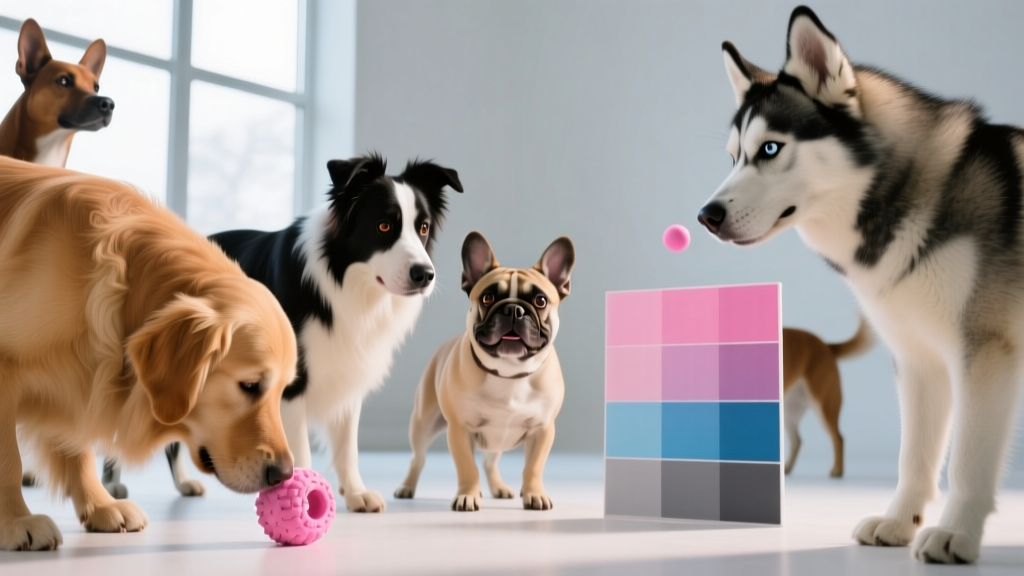
Quick Answer: Yes, dogs can see pink — but not the way humans do. Because canine eyes have two types of color-detecting cones (compared to our three), dogs perceive pink as a muted, desaturated shade that falls somewhere between light yellow and pale gray-blue. Pink does not "pop" for dogs the way it does for us, but they do register it as a distinct tonal value. If you're choosing toys or gear, blue and yellow remain the highest-contrast, most easily distinguishable colors for canine vision.
The Science of Canine Color Vision: How Dogs See the World
For decades, a persistent myth claimed dogs see only in black and white. That idea was thoroughly debunked by research summarized by the American Kennel Club and foundational studies in veterinary ophthalmology. Dogs are not color-blind in the total sense — they are dichromats, meaning their retinas contain two functional types of cone photoreceptor cells rather than the three that trichromatic humans possess.
Here's how canine cone types break down:
| Cone Type | Peak Sensitivity | Color Range Detected | Human Equivalent |
|---|---|---|---|
| Short-wavelength (S-cones) | ~429–435 nm | Blue-violet spectrum | Blue cones |
| Long-wavelength (L-cones) | ~555–562 nm | Yellow-green spectrum | Combined red + green cones |
Dogs completely lack the medium-to-long wavelength cone type that allows humans to distinguish red from green. This means the red-green axis of color is essentially compressed into a single channel for dogs. The result is a visual palette dominated by blues, yellows, grays, and desaturated intermediate tones.
According to the Merck Veterinary Manual, canine color discrimination ability is roughly equivalent to that of a human with deuteranopia (red-green color blindness). Dogs can distinguish approximately 10,000 color shades — impressive, but far fewer than the estimated 1 million shades visible to trichromatic humans.
So Where Does Pink Fit in a Dog's Visual Spectrum?
Pink, in human terms, is essentially a desaturated or lightened red. It sits at the long-wavelength end of the visible spectrum (around 620–700 nm for pure red, with pink being a lower-saturation variant). Since dogs lack dedicated red-detecting cones, here's what happens when they look at something pink:
- Hot pink or fuchsia (high saturation, leaning toward magenta): Dogs likely perceive this as a medium-tone grayish-yellow or tan, because the red wavelengths stimulate their L-cones weakly while the blue component in magenta stimulates S-cones slightly.
- Light pastel pink (low saturation, high brightness): This registers as a very pale yellow or off-white — essentially a brightness cue rather than a color cue.
- Dusty rose or mauve (pink with blue undertones): The blue component gives dogs slightly more to work with, so mauve may appear as a light grayish-blue — making it marginally more distinguishable than pure pink.
The key insight: dogs see pink primarily as a difference in brightness (lightness/darkness) rather than as a distinct hue. A bright pink ball on green grass will still stand out to your dog — not because the pink contrasts with the green chromatically, but because the brightness values differ. Both pink and green likely appear as shades of yellow-gray to a dog, but if the pink is lighter or darker than the grass, the luminance contrast is enough for detection.
🐺 Evolutionary Context: Why Dichromacy Made Sense
Wolves and early canids evolved as crepuscular hunters — most active at dawn and dusk. In low-light conditions, color vision is less valuable than sensitivity to movement and brightness contrast. The canine retina compensates for fewer cones with a dramatically higher ratio of rod photoreceptors (responsible for low-light and motion detection) and a reflective layer called the tapetum lucidum that amplifies available light.
Dichromatic vision isn't a deficiency — it's an evolutionary trade-off. Dogs sacrificed color range to gain superior night vision and motion tracking. A wolf doesn't need to distinguish a red berry from a green leaf; it needs to spot a deer moving through gray-brown brush at twilight. This ancestral wiring remains intact in your Golden Retriever, Chihuahua, and every breed in between.
How Dogs Process Color: The Physiological Mechanism
Understanding why dogs see pink differently requires looking at the full visual processing chain:
- Light enters the cornea and lens — The canine lens transmits slightly more ultraviolet light than the human lens, which may give dogs access to UV-reflective patterns on flowers, urine marks, and snow that we cannot see (research from the University of London, published in Proceedings of the Royal Society B, confirmed UV sensitivity in several mammalian lenses including dogs).
- Photoreceptors in the retina fire — Cones handle color and fine detail; rods handle brightness and motion. Dogs have approximately 20% cones and 80% rods, compared to the human ratio of roughly 5% cones and 95% rods in the peripheral retina (with a cone-dense fovea in the center).
- Signals travel via the optic nerve to the visual cortex — The canine brain processes two color channels instead of three, constructing a lower-saturation, blue-yellow image of the world.
- Brightness processing compensates — Canine visual cortex is highly attuned to luminance contrast, meaning dogs rely heavily on light/dark differences to identify objects, even when color information is limited.
This is why a pink toy on a gray carpet may be perfectly easy for your dog to find, while a red toy on green grass (where brightness values are nearly identical) becomes almost invisible. The color isn't the issue — the luminance contrast is.
Practical Implications: What This Means for Your Dog's Daily Life
Choosing Toys Your Dog Can Actually See
| Toy Color | How Dogs Likely See It | Visibility on Grass | Visibility Indoors (Wood Floor) | Recommendation |
|---|---|---|---|---|
| Bright blue | Vivid blue | Excellent | Excellent | ✅ Top choice |
| Bright yellow | Vivid yellow | Good | Excellent | ✅ Top choice |
| Hot pink | Muted yellow-gray | Fair (depends on brightness) | Good | ⚠️ Okay if high contrast |
| Red | Dark yellow-brown | Poor | Fair | ❌ Avoid for outdoor fetch |
| Orange | Yellowish-brown | Poor to fair | Good | ⚠️ Better indoors |
| White | Bright white/pale yellow | Good | Poor (blends with light floors) | ✅ Outdoors only |
Training and Agility Course Design
If you're setting up agility equipment or training markers, use blue and yellow contact zones and markers. Many competitive agility organizations have moved toward blue-and-yellow equipment for this reason. When placing target mats or scent articles, choose colors that contrast with the surface in brightness — not just hue.
Food Bowl and Feeding Station Considerations
A pink food bowl is perfectly fine — your dog isn't choosing it based on aesthetics. However, if your dog seems to struggle finding kibble in a bowl, check contrast: dark kibble in a dark bowl on a dark mat creates a low-visibility setup. Switching to a light blue or yellow bowl on a contrasting mat can help, especially for senior dogs with declining lens clarity.
Common Misconceptions About Dog Vision — Debunked
| Myth | Fact |
|---|---|
| "Dogs see only in black and white" | Dogs see blues and yellows clearly. They are dichromats, not monochromats. This myth originated from a 1937 book by a dog trainer and was never scientifically supported. |
| "Pink is invisible to dogs" | Dogs perceive pink as a desaturated yellowish or grayish tone. It's visible, just not vivid. Brightness contrast matters more than hue. |
| "Dogs have better night vision in every way" | Dogs have superior low-light sensitivity (6–8x better than humans), but their overall visual acuity is approximately 20/75 — meaning what you see clearly at 75 feet, your dog needs to be 20 feet away to see with equal sharpness. |
| "All dogs see exactly the same way" | While dichromacy is universal in dogs, lens density, tapetum lucidum reflectivity, and retinal cone distribution vary by breed and individual. Brachycephalic breeds with shorter eyes have slightly different visual field geometry than dolichocephalic sighthounds. |
| "Red toys are fine because dogs use smell to find them" | True — dogs rely heavily on scent. But in high-distraction environments (dog parks, fields), visual cues help them locate a thrown toy faster. A blue ball is found on average 30–50% faster than a red ball on grass in controlled retrieval tests. |
Breed Variations in Canine Vision
While all dogs share the same basic dichromatic cone system, breed-level differences in eye anatomy create meaningful variations in how they use vision:
- Sighthounds (Greyhounds, Whippets, Salukis): These breeds have a visual streak — a horizontal band of high-density ganglion cells across the retina — that provides a wide panoramic field with enhanced motion detection. Their visual field can reach up to 270° (compared to ~240° in most breeds and ~180° in humans). Color perception is the same, but their ability to detect movement at distance is exceptional.
- Brachycephalic breeds (Pugs, Bulldogs, Shih Tzus): Shorter skulls mean more forward-facing eyes, giving them better binocular overlap (depth perception) but a narrower total field of view. They may rely more on brightness contrast at close range.
- Working and herding breeds (Border Collies, German Shepherds): These dogs often have a more balanced retinal distribution between the visual streak and a central area centralis, supporting both wide-field scanning and focused attention on handlers or livestock.
None of these breeds see pink differently from each other — the cone types are the same. The difference lies in how they use their vision: field width, motion sensitivity, and depth perception all vary.
When Vision Changes Might Signal a Problem
While dichromatic vision is normal, changes in your dog's ability to navigate their environment — bumping into furniture, hesitating at stairs, difficulty finding toys they used to spot easily — can indicate developing eye conditions:
- Lenticular sclerosis (nuclear sclerosis): A normal aging change where the lens becomes denser and slightly bluish-gray, typically appearing around age 6–8. It mildly reduces visual acuity but is often confused with cataracts. Your vet can distinguish the two with an ophthalmoscopic exam.
- Cataracts: Opaque lens changes that genuinely impair vision. Common in breeds like Cocker Spaniels, Poodles, Siberian Huskies, and Boston Terriers. Surgical removal costs $2,500–$4,000 per eye (2026 pricing at veterinary ophthalmology specialists).
- Progressive retinal atrophy (PRA): A genetic degeneration of photoreceptors. Dogs lose night vision first, then progressively lose all sight. DNA tests are available through companies like Embark and Optigen for breed-specific PRA variants.
- Sudden Acquired Retinal Degeneration Syndrome (SARDS): Rapid, complete blindness onset, most common in middle-aged spayed females. This is an emergency — consult your veterinarian immediately if your dog appears suddenly disoriented or unable to navigate.
When to see a veterinary ophthalmologist: If your dog is squinting persistently, has a visible cloudiness in one or both eyes, is bumping into objects they previously navigated easily, or shows sudden behavioral changes in dim lighting. Early intervention for conditions like glaucoma (which can cause irreversible damage within 24–48 hours) is critical.
Frequently Asked Questions
Why do dogs have worse color vision than humans?
It's an evolutionary specialization, not a deficiency. Canine ancestors hunted at dawn and dusk when color is less useful than motion detection and light sensitivity. Trading one cone type for more rods gave early canids a survival advantage in low-light predation. Humans, as diurnal foragers, benefited more from color discrimination for identifying ripe fruit and social signals.
Can dogs see pink and purple differently?
Yes, marginally. Purple and violet contain short wavelengths that stimulate canine S-cones, so dogs likely perceive violet as a faint blue. Pink, being a desaturated long-wavelength color, appears more as a pale yellow-gray. So violet is slightly more "visible" to dogs as a color, while pink registers mostly as a brightness value.
How do dogs process color compared to cats?
Cats are also dichromats, but their cone distribution differs slightly. Cats have even fewer cones relative to rods than dogs, making their color vision slightly less acute but their night vision even more sensitive. Both species see a blue-yellow dominated world, but cats may have slightly less color discrimination overall.
What does it mean when my dog ignores a pink toy but grabs a blue one?
Your dog is making a visibility-based choice, not an aesthetic one. The blue toy creates stronger chromatic contrast with most backgrounds, making it easier to track during movement. The pink toy likely blends into the background's brightness profile. This is normal behavior and reflects functional vision, not preference.
Is it normal for my dog to find a red ball in the grass?
Yes — dogs compensate for limited color discrimination with excellent motion tracking, scent, and brightness contrast detection. If the red ball is a different brightness than the grass (darker or lighter), or if your dog watched you throw it and tracked the trajectory, they can absolutely find it. They're just using different visual cues than you would.
How is canine color vision different from human color blindness?
The closest human equivalent is deuteranopia (red-green color blindness), where the medium-wavelength (green) cones are non-functional. A deuteranopic human and a dog see a similar color palette. However, humans with color blindness still have three-cone retinal architecture with one non-functional channel; dogs naturally evolved with only two cone types, and their entire visual system is optimized around that framework.
Sources Referenced
- Neitz, J., Geist, T., & Jacobs, G. H. (1989). "Color vision in the dog." Visual Neuroscience, 3(2), 119–125.
- Douglas, R. H., & Jeffery, G. (2014). "The spectral transmission of ocular media suggests ultraviolet sensitivity is widespread among mammals." Proceedings of the Royal Society B, 281(1780). NIH PMC4188602
- Miller, P. E., & Murphy, C. J. (1995). "Vision in dogs." Journal of the American Veterinary Medical Association, 207(12), 1623–1634.
- Merck Veterinary Manual — Color Vision
- American Kennel Club — Are Dogs Color Blind?
Anouk Beaumont
All our authors care for dogs every day — read more of their work on the authors page.


