Africanis Dog: The Science Behind Africa's Ancient Landrace Breed
Explore the Africanis dog through canine science — genetics, evolution, temperament, and what makes this ancient African landrace uniquely adapted to modern life.
The Evolutionary Origins of the Africanis Dog
The story of the Africanis begins roughly 6,000–8,000 years ago, when early domesticated dogs migrated into sub-Saharan Africa alongside human populations moving southward from the Nile Valley and the Horn of Africa. These early dogs — likely descended from Near Eastern and Egyptian pariah-type dogs — encountered an environment radically different from the temperate zones where most modern breeds later developed.
Archaeological evidence from sites in South Africa, including dog remains found at Iron Age settlements dating to approximately 570 CE, confirms that dogs were well-established in southern Africa long before European colonization. Rock art from the San (Bushmen) people depicts dogs with the lean, medium-built morphology that closely matches the modern Africanis — prick or semi-prick ears, a curved tail, and a short, sleek coat.
The term "Africanis" was coined in the late 20th century by South African cynologist Johannes Gallant (also known as J. Gallant), who recognized that the diverse village dogs across southern Africa shared a common type despite never being formally bred. The Africanis Society of Southern Africa, founded in 1998, established a breed description and conservation program to preserve the landrace before urbanization and crossbreeding with European breeds eroded the gene pool.
Genetic Diversity: Why the Africanis Dog Defies Breed Norms
One of the most scientifically fascinating aspects of the Africanis is its extraordinary genetic heterozygosity. A study published in PLOS ONE examining African village dogs found that indigenous African dog populations harbor significantly more genetic diversity than most recognized breeds. This is directly attributable to their landrace status — without closed stud books or bottleneck breeding events, the Africanis gene pool has remained broad and healthy.
Here's what this means in practical genetic terms:
| Metric | Africanis (Landrace) | Typical Purebred (e.g., Labrador Retriever) |
|---|---|---|
| Coefficient of Inbreeding (COI) | Estimated 2–8% (variable by population) | Often 5–15%+ depending on breed |
| Known Breed-Specific Genetic Disorders | Very few documented; no closed gene pool | 20–200+ depending on breed (e.g., hip dysplasia, PRA, EIC) |
| MHC (Immune System) Diversity | High — broad pathogen recognition | Reduced in bottlenecked breeds |
| Effective Population Size | Large (thousands across southern Africa) | Often 50–300 for many breeds |
| Hybrid Vigor (Heterosis) | Strong — natural selection favors robustness | Limited within closed registries |
The concept of heterozygosity — having two different alleles at a given gene locus — is critical here. High heterozygosity means the immune system can recognize a wider array of pathogens, that recessive deleterious mutations are less likely to pair up and express, and that the overall population retains adaptive flexibility. For owners, this translates to a dog that is, on average, healthier and less prone to the hereditary diseases that plague many purebred lines.
Physiology and Physical Adaptations of the Africanis
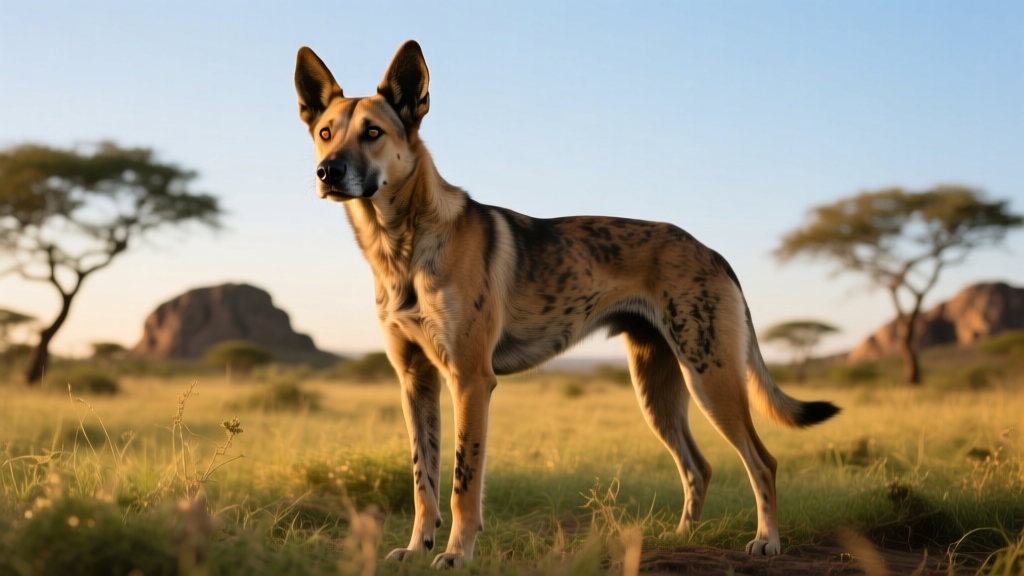
The Africanis typically stands 20–24 inches (50–61 cm) at the shoulder and weighs 33–55 lb (15–25 kg). The body is rectangular — slightly longer than tall — with a deep chest, tucked abdomen, and well-angled hindquarters built for endurance running rather than sprinting. This morphology reflects the breed's evolutionary history as a companion to pastoralist and hunter-gatherer peoples who covered vast distances on foot.
Coat colors are extraordinarily variable: brindle, black, tan, fawn, parti-color, and merle-like patterns all appear. This diversity is a hallmark of landrace populations where no artificial selection for color has occurred. The coat itself is typically short and dense, requiring minimal grooming — a functional adaptation to environments where veterinary care for skin conditions was nonexistent and parasites like ticks were (and remain) endemic.
Natural Disease Resistance
Perhaps the most remarkable physiological feature of the Africanis is its evolved resistance to diseases that devastate other dog populations in Africa. Research has shown that indigenous African dogs exhibit higher survival rates when exposed to canine distemper virus (CDV), canine parvovirus (CPV-2), and Ehrlichia canis (the tick-borne bacterium causing canine ehrlichiosis) compared to imported European breeds.
This resistance isn't absolute immunity — it's a population-level advantage conferred by thousands of years of natural selection. Dogs that succumbed to these pathogens didn't reproduce. Dogs with genetic variants conferring partial resistance survived and passed those alleles forward. The result is a population with robust Major Histocompatibility Complex (MHC) gene diversity, enabling broader immune surveillance.
Important caveat: This natural resistance does not replace vaccination. If you own an Africanis, your veterinarian should still administer core vaccines (DHPP, rabies) per the AVMA vaccination guidelines. Natural resistance reduces mortality risk but does not eliminate infection risk.
Behavioral Science: Temperament and Cognition in the Africanis
The Africanis exhibits behavioral traits that reflect both its ancestral wolf heritage and its unique co-evolution with African human communities. Unlike breeds selected for specific working roles (herding, retrieving, guarding), the Africanis was selected — naturally and culturally — for a different suite of behaviors: cooperative scavenging, territorial awareness without unprovoked aggression, social bonding with humans, and independent problem-solving.
Why Do Africanis Dogs Show High Environmental Sensitivity?
Africanis dogs are frequently described as "alert," "watchful," and "sensitive to their surroundings." This isn't anecdotal — it reflects an evolved cognitive strategy. In environments where predators (lions, leopards, hyenas) posed real threats, dogs that maintained high situational awareness survived. This manifests as:
- Hyper-vigilance in novel environments: Africanis dogs often scan new spaces thoroughly before settling, a behavior rooted in predator-avoidance neural circuitry (the amygdala-hippocampal threat-assessment pathway).
- Sound sensitivity: Many Africanis dogs react strongly to unfamiliar sounds, a trait linked to survival in environments where auditory cues signaled approaching danger.
- Social referencing: Africanis dogs frequently look to their owners for cues in uncertain situations — a behavior documented in canine cognition research as evidence of the dog-human cooperative bond.
Is the Africanis Dog's Independence a Problem?
A common misconception is that the Africanis's independent thinking indicates poor trainability or low intelligence. This is incorrect. Independent problem-solving is a hallmark of landrace and primitive dogs — it's the same cognitive trait that allowed their ancestors to survive without human direction. The Africanis learns quickly but may not obey commands it perceives as pointless. This is a motivational difference, not a capacity difference.
Positive reinforcement training methods — using food rewards, clicker training, and play — are highly effective with Africanis dogs. Force-free methods align with the breed's sensitivity; harsh corrections or aversive tools (shock collars, prong collars) will damage trust and trigger avoidance behaviors in this environmentally sensitive dog.
Common Misconceptions About the Africanis Debunked
| Myth | Scientific Reality |
|---|---|
| "Africanis dogs are just mutts or mongrels with no value." | The Africanis is a recognized landrace with a documented lineage spanning millennia. Genetic studies confirm its distinct identity. The Africanis Society of Southern Africa maintains a formal breed description and registry. Landrace dogs represent the oldest and most genetically healthy form of domestic dog. |
| "They can't be trained like 'proper' breeds." | Africanis dogs are highly trainable using positive reinforcement. Their independent nature requires motivational training approaches rather than compulsive methods. Many Africanis dogs excel in agility, scent work, and obedience when trained with patience and reward-based techniques. |
| "They don't need veterinary care because they're 'naturally healthy.'" | While the Africanis has fewer hereditary diseases than many purebreds, they are still susceptible to infectious diseases, parasites, dental disease, and age-related conditions. Regular veterinary checkups, vaccinations, and preventive care are essential. Always consult your veterinarian for a care plan tailored to your individual dog. |
| "They're aggressive because they're 'wild' dogs." | Properly socialized Africanis dogs are typically loyal, gentle with family members, and reserved (not aggressive) with strangers. Aggression in any dog is more often a product of poor socialization, fear, or pain than breed identity. Africanis dogs that were raised in stable, positive environments are known for their calm, bonded temperament. |
| "They can adapt to any living situation immediately." | Africanis dogs evolved in rural and semi-rural environments with space to roam. While they can adapt to urban living, they need adequate exercise (minimum 60–90 minutes daily), mental stimulation, and a gradual transition. Dogs moved from rural to urban settings may need structured desensitization to traffic, crowds, and confined spaces. |
Practical Implications for Owners: Living With an Africanis
Exercise Requirements
The Africanis was shaped by environments where dogs walked, trotted, and ran alongside humans for hours each day. Expect to provide:
- Minimum 60–90 minutes of active exercise daily — this can include brisk walks, jogging, hiking, or off-leash play in secure areas.
- Mental stimulation — puzzle feeders, scent work games, and training sessions. An under-stimulated Africanis will find its own entertainment, often destructively.
- Structured exploration — regular visits to new environments (parks, trails, beaches) satisfy the breed's environmental sensitivity in a positive way.
Nutrition and Feeding
Africanis dogs in their native environment historically survived on varied, opportunistic diets — scraps, hunted prey, and whatever was available. In a modern home, feed a high-quality, AAFCO-compliant commercial diet appropriate for your dog's life stage. For a 33–55 lb (15–25 kg) adult Africanis, expect to feed approximately 700–1,100 kcal/day depending on activity level. Monitor body condition score (BCS) — aim for a BCS of 4–5 on the 9-point scale, where ribs are easily felt but not visible.
Socialization Timeline
Given the Africanis's natural environmental sensitivity, early socialization is critical. The primary socialization window closes around 12–14 weeks of age. During this period:
- Expose your puppy to diverse surfaces, sounds, people, and other animals.
- Use counter-conditioning and positive reinforcement to build positive associations with novel stimuli.
- Avoid flooding (forced exposure to frightening stimuli) — this can create lasting fear responses in sensitive landrace dogs.
When Behavior Might Signal a Problem
While the Africanis's alertness and independence are normal breed traits, certain behavioral changes warrant veterinary attention:
- Sudden increase in fear or aggression: Could indicate pain (dental disease, musculoskeletal injury), hypothyroidism, or neurological issues.
- Compulsive behaviors (excessive licking, tail chasing, flank sucking): May indicate anxiety, allergies, or underlying medical conditions. These are not typical Africanis traits and should be evaluated.
- Lethargy or withdrawal in a normally active dog: Potential indicators of infectious disease, anemia, or metabolic disorders.
- Excessive vocalization without apparent trigger: Could signal cognitive dysfunction in senior dogs or pain.
If you observe any of these changes, consult your veterinarian promptly. Behavioral shifts are often the first indicator of medical problems in dogs, and the Africanis's stoic nature (a survival adaptation) can mask discomfort until it becomes severe.
Africanis vs. Other Primitive and Landrace Breeds
| Trait | Africanis | Basenji | Carolina Dog (American Dingo) | Thai Ridgeback |
|---|---|---|---|---|
| Origin | Southern Africa | Central Africa (Congo) | Southeastern United States | Thailand |
| Classification | Landrace (not fully standardized) | Standardized breed (AKC Hound Group) | Landrace/semi-standardized (UKC) | Standardized breed (FCI) |
| Weight Range | 33–55 lb (15–25 kg) | 22–24 lb (10–11 kg) | 30–55 lb (14–25 kg) | 51–75 lb (23–34 kg) |
| Bark Behavior | Normal barker, alert-oriented | Rarely barks (yodels instead) | Moderate barker | Low-to-moderate barker |
| Trainability | Moderate-high (reward-based) | Low-moderate (very independent) | Moderate (sensitive, needs patience) | Moderate (strong-willed) |
| Known Hereditary Diseases | Very few documented | Fanconi syndrome, PRA, hemolytic anemia | Few documented | Dermoid sinus, hip dysplasia |
| Availability Outside Origin Region | Very rare outside southern Africa | Available globally (specialized breeders) | Rare; mostly US Southeast rescues | Rare outside Thailand |
Cost and Availability of the Africanis Dog
Because the Africanis is primarily found in southern Africa and is not widely bred or exported, acquiring one outside the region is challenging. In South Africa, adoption from shelters or direct acquisition from rural communities is common, often at minimal cost (R500–R2,000, approximately $27–$110 USD). Registered Africanis Society puppies from conservation breeders may cost R3,000–R6,000 ($165–$330 USD).
For prospective owners outside Africa, the most realistic path is through breed-specific rescue organizations or international adoption programs. Annual care costs (food, veterinary care, preventive medications, supplies) are estimated at $800–$1,500 USD depending on your region — comparable to other medium-sized, healthy dogs.
Frequently Asked Questions About the Africanis
Why do Africanis dogs look so different from one another?
Because the Africanis is a landrace, not a standardized breed, there is no closed stud book or rigid breed standard dictating appearance. Natural selection favors functional traits (health, mobility, thermoregulation) over cosmetic uniformity. This means coat color, ear carriage, size, and markings vary widely — and that variation is a sign of genetic health, not a defect.
Can Africanis dogs live in cold climates?
The Africanis evolved for warm environments and lacks the dense undercoat that insulates northern breeds. In climates where temperatures regularly drop below 40°F (4°C), an Africanis will need a well-fitting insulated coat for outdoor activities and should not be left outside in freezing conditions. Indoor heating and warm bedding are essential in winter months.
How do Africanis dogs process social bonds differently from modern breeds?
Africanis dogs form deep, loyal bonds with their primary caregivers but may be more reserved with strangers than breeds like Labrador Retrievers or Golden Retrievers, which were specifically selected for gregariousness. This isn't shyness or aggression — it's a normal landrace trait. Their social cognition is oriented toward a tight social group, mirroring the pack structure of their wolf ancestors more closely than breeds selected for indiscriminate friendliness.
What does it mean when my Africanis dog stalks and watches before approaching something new?
This is a classic risk-assessment behavior rooted in the breed's evolutionary history. In the wild, dogs that charged blindly into novel situations were more likely to encounter predators or hazards. The Africanis's cautious approach is an adaptive survival strategy. Allow your dog time to investigate at its own pace — forcing interaction can trigger fear-based responses.
Is the Africanis recognized by major kennel clubs?
The Africanis is not currently recognized by the American Kennel Club (AKC) or the Fédération Cynologique Internationale (FCI). It is recognized by the Kennel Union of Southern Africa (KUSA) and maintained by the Africanis Society of Southern Africa. Its lack of international recognition actually helps preserve its genetic diversity — closed registries often accelerate inbreeding.
Is an Africanis dog a good family pet?
Yes, with the right family. Africanis dogs are loyal, intelligent, and generally good with children they're raised alongside. They do best with active families who can provide ample exercise, mental stimulation, and patient socialization. First-time dog owners can succeed with an Africanis if they commit to positive reinforcement training and understand the breed's need for environmental engagement. They are less suited to sedentary households or owners who are away for long periods.
- Boyko, A.R. et al. "Complex population structure in African village dogs and its implications for inferring dog domestication history." Proceedings of the National Academy of Sciences, 2009.
- Pilot, M. et al. "Genetic differentiation of African village dogs." PLOS ONE, 2012.
- Africanis Society of Southern Africa: africanis.co.za
- Merck Veterinary Manual — Canine Genetics: merckvetmanual.com
Robin Maitland
All our authors care for dogs every day — read more of their work on the authors page.


