Standard Poodle Puppies: Purebred & Designer Mixes
Everything about standard poodle puppies: purebred traits, popular designer mixes like Goldendoodles and Labradoodles, costs, health, and temperament.
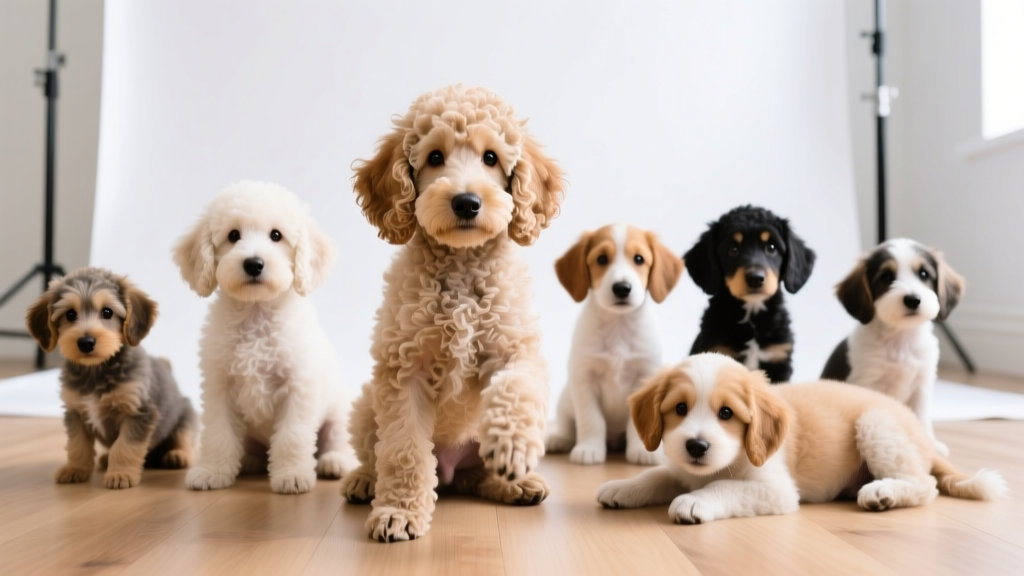
Standard Poodle Puppies: Purebred Foundations and Designer Mixes
If you've been researching standard poodle puppies, you've likely noticed something: the search results don't just show purebred Poodles. They're flooded with "doodles" — Goldendoodles, Labradoodles, Bernedoodles, and a growing list of designer crosses that use the Standard Poodle as one parent. That's no accident. The Standard Poodle's intelligence, low-shedding coat, and athletic build make it the most popular foundation breed in the designer dog world.
But here's what most breed guides won't tell you: a standard poodle puppy and a Poodle-mix puppy are fundamentally different propositions. One comes with a predictable breed standard backed by over a century of documented lineage. The other is a genetic roll of the dice — sometimes wonderful, sometimes disappointing, always variable.
This guide covers both. We'll break down what you're actually getting when you bring home a standard poodle puppy, whether purebred or part of a designer cross, so you can make an informed decision with realistic expectations.
The Standard Poodle Parent: What Makes This Breed So Popular
Before evaluating any mix, you need to understand the parent breed. The Standard Poodle is not a separate breed from Miniature or Toy Poodles — they're all the same breed, differentiated only by height. According to the American Kennel Club breed standard, a Standard Poodle stands over 15 inches at the shoulder, with most adults ranging from 15 to 22 inches and weighing 40 to 70 pounds (18–32 kg).
Standard Poodle Quick Facts
| Trait | Details |
|---|---|
| Height | 15–22 inches (38–56 cm) at shoulder |
| Weight | 40–70 lb (18–32 kg) |
| Lifespan | 12–15 years |
| Coat | Curly, dense, single-layer; low-shedding |
| Energy Level | High — 60+ minutes of vigorous daily exercise |
| Trainability | Exceptional — ranked #2 in Stanley Coren's intelligence rankings |
| AKC Group | Non-Sporting (originally a water retriever) |
What surprises many new owners is the Poodle's athleticism. These dogs were originally bred as water retrievers in Germany and France, and they retain strong hunting instincts. A standard poodle puppy will need more physical and mental stimulation than most people assume. Think agility courses, advanced obedience, swimming, and puzzle work — not just a leisurely walk around the block.
The Poodle's signature curly coat is hair rather than fur, which means it grows continuously and sheds minimally. This is precisely why breeders chose Poodles as the foundation for nearly every popular "doodle" cross. However, "low-shedding" does not mean "no grooming." Standard Poodles require professional grooming every 4–8 weeks, with costs typically ranging from $60 to $120 per session depending on your region and the complexity of the clip.
Popular Designer Mixes Using Standard Poodle Puppies
The Standard Poodle has been crossed with dozens of breeds, but a handful of designer mixes dominate the market. Here's how the most common Poodle-based crosses break down by parentage, size, and what you can reasonably expect.
| Designer Mix | Other Parent Breed | Typical Adult Weight | Coat Type Range | Popularity Rank |
|---|---|---|---|---|
| Goldendoodle | Golden Retriever | 50–90 lb (23–41 kg) | Wavy to curly; low to moderate shed | #1 Poodle mix |
| Labradoodle | Labrador Retriever | 50–85 lb (23–39 kg) | Wavy to curly; low to moderate shed | #2 Poodle mix |
| Bernedoodle | Bernese Mountain Dog | 60–100 lb (27–45 kg) | Wavy to curly; moderate shed possible | #3 Poodle mix |
| Sheepadoodle | Old English Sheepdog | 55–85 lb (25–39 kg) | Wavy to straight; moderate shed common | Growing |
| Newfypoo | Newfoundland | 70–130 lb (32–59 kg) | Wavy to curly; moderate shed possible | Niche |
| Irish Doodle | Irish Setter | 45–70 lb (20–32 kg) | Wavy; low to moderate shed | Niche |
Notice the weight ranges. A Goldendoodle from Standard Poodle lines can weigh anywhere from 50 to 90 pounds — that's a 40-pound spread. This variability is the single biggest challenge with designer mixes, and it's something every prospective owner should plan for.
Understanding Generations: F1, F1B, F2, and Multigen Explained
If you're looking at designer mixes involving standard poodle puppies, you'll encounter generation labels. These aren't marketing fluff — they directly affect coat type, shedding level, and trait predictability. Here's what each term means:
Generation Guide for Poodle Crosses
- F1 (First Generation): One purebred Poodle parent × one purebred other-breed parent. Maximum genetic diversity, but the most unpredictable coat and appearance. Some F1 puppies look almost entirely like one parent.
- F1B (First Generation Backcross): An F1 doodle × a purebred Poodle. Approximately 75% Poodle genetics. Higher likelihood of a curly, low-shedding coat. This is the generation most commonly marketed to allergy sufferers.
- F2 (Second Generation): Two F1 doodles bred together. Genetics become highly unpredictable — you can get puppies ranging from nearly straight-coated (Retriever-like) to fully curly (Poodle-like) in the same litter. Many experienced breeders avoid F2 pairings for this reason.
- F3 and Beyond (Multigen): Two multigenerational doodles bred together. Some lines have been selectively bred for 5+ generations and achieve reasonable consistency. The Australian Labradoodle, for example, has its own breed standard through organizations like the Australian Labradoodle Association.
The practical takeaway: If low-shedding is a priority (for allergy management or cleanliness), an F1B or multigen cross gives you better odds than an F1. But no generation guarantees a hypoallergenic dog — that's a marketing term, not a genetic certainty.
Size Predictions: How Big Will a Standard Poodle or Mix Get?
One of the most common questions from buyers of standard poodle puppies — especially mixed-breed puppies — is how large the dog will grow. For purebreds, the answer is relatively straightforward. For mixes, it requires educated estimation.
| Category | Weight Range (lb / kg) | Height Range (in / cm) | Predictability |
|---|---|---|---|
| Purebred Standard Poodle | 40–70 lb / 18–32 kg | 15–22 in / 38–56 cm | High — breed standard is well-established |
| F1 Goldendoodle (Standard) | 50–90 lb / 23–41 kg | 20–26 in / 51–66 cm | Moderate — depends on Golden parent size |
| F1 Labradoodle (Standard) | 50–85 lb / 23–39 kg | 21–25 in / 53–64 cm | Moderate — Lab size is fairly consistent |
| F1 Bernedoodle (Standard) | 60–100 lb / 27–45 kg | 22–28 in / 56–71 cm | Low — Bernese size varies significantly |
| Multigen Australian Labradoodle | 50–75 lb / 23–34 kg | 21–24 in / 53–61 cm | Higher — selectively bred for consistency |
A useful rule of thumb for mixed-breed puppies: ask the breeder for the exact weights of both parents. The puppy's adult weight typically falls within 10–15% of the average of the two parents' weights. If one parent weighs 65 lb and the other 55 lb, expect the puppy to land around 55–65 lb as an adult — but understand this is an estimate, not a guarantee.
Temperament: Best-Case Scenarios and Real Challenges
Standard Poodles are exceptionally intelligent, alert, and people-oriented. They bond closely with their families and tend to be reserved with strangers — not aggressive, but observant. They're sensitive dogs that don't respond well to harsh training methods; positive reinforcement and force-free techniques produce the best results by a wide margin.
When you cross a Poodle with another breed, temperament becomes a spectrum:
Best-Case Temperament Outcomes
- Poodle × Golden Retriever: Friendly, gentle, eager to please, excellent with children. Combines the Poodle's intelligence with the Golden's easygoing nature.
- Poodle × Labrador: Energetic, trainable, outgoing. Well-suited to active families and dog sports.
- Poodle × Bernese Mountain Dog: Calmer than a pure Poodle, affectionate, good with children. Often described as "gentle giants."
Challenging Temperament Scenarios
- High-strung sensitivity: Some Poodle crosses inherit the Poodle's alertness without the other breed's calmness, resulting in dogs that are easily overstimulated, bark excessively, or develop anxiety.
- Separation distress: Both Poodles and many of their common cross breeds (Goldens, Labs, Bernese) are prone to separation anxiety. A cross can amplify this tendency.
- Stubborn streaks: While Poodles are highly trainable, some crosses inherit independence from the non-Poodle parent (especially Bernese or Sheepdog lines) combined with the Poodle's intelligence — creating a dog that can learn but chooses not to comply.
The honest truth: temperament in designer mixes is the most unpredictable trait of all. Two puppies from the same F1 Goldendoodle litter can have dramatically different personalities. Meeting both parent dogs is the single best predictor available — if either parent shows fearfulness, aggression, or extreme hyperactivity, walk away.
Health Considerations: Hybrid Vigor vs. Reality
Let's address the most persistent myth in the designer dog world: that crossing two breeds automatically produces healthier puppies through "hybrid vigor." The concept of heterosis (hybrid vigor) is real in animal science — it's well-documented in livestock and some canine studies. However, it does not mean mixed-breed dogs are immune to genetic disease. It means they may have reduced risk for conditions caused by recessive genes that are common within a single breed's gene pool.
Here's what this means in practice for standard poodle puppies and Poodle-based mixes:
| Health Condition | Standard Poodle Risk | Common Cross-Breed Risks | Recommended Screening |
|---|---|---|---|
| Hip Dysplasia | Moderate (~12% prevalence per OFA data) | Goldens, Labs, Bernese all carry high hip dysplasia risk — mixing does NOT eliminate it | OFA or PennHIP evaluation of both parents |
| Addison's Disease | Elevated — Poodles are predisposed | Can appear in any Poodle mix; not well-screened | No standard genetic test; monitor for symptoms |
| Progressive Retinal Atrophy (PRA) | Moderate | Present in Poodles, Goldens, Labs, Bernese | DNA test for prcd-PRA; CERF eye exam |
| Gastric Dilatation-Volvulus (Bloat) | High — deep-chested breed | Any large, deep-chested mix is at risk | Prophylactic gastropexy discussion with vet |
| Sebaceous Adenitis | Elevated — Poodle-specific skin condition | Can pass to mixes; often undiagnosed | Dermatological exam; biopsy if skin issues arise |
| Cancer | Moderate | Bernese Mountain Dogs have extremely high cancer rates (~50% die of cancer); Bernedoodles inherit elevated risk | No screening available; regular vet checkups |
| Elbow Dysplasia | Low | Goldens, Labs, Bernese have moderate-to-high rates | OFA elbow evaluation of both parents |
The key insight: when you cross a Poodle with a breed that shares the same genetic vulnerabilities (like hip dysplasia in Golden Retrievers and Labs), you're not reducing risk — you're combining two gene pools that both carry the condition. This is why responsible breeders of designer mixes health-test both parent dogs, not just one.
According to the Merck Veterinary Manual, hip dysplasia is influenced by both genetics and environmental factors including growth rate, nutrition, and exercise during puppyhood. Regardless of your puppy's breed mix, keeping them lean during growth and avoiding excessive high-impact exercise before skeletal maturity (typically 12–18 months for large breeds) reduces risk.
Always consult your veterinarian about breed-specific health screening, appropriate growth-rate nutrition, and a preventive care schedule tailored to your individual puppy's genetic background.
Coat Types and Grooming: What to Expect
Coat inheritance is one of the most visible — and most variable — traits in Poodle crosses. The Poodle carries genes for a curly, continuously-growing, single-layer coat. The other parent breed typically carries genes for a straight or wavy, double-layer, shedding coat. What the puppy actually gets depends on which genes are dominant and how they interact.
Coat Possibilities in Poodle Mixes
- Curly (Poodle-dominant): Tight curls, single layer, minimal shedding. Requires professional grooming every 4–8 weeks. Daily brushing to prevent matting. Most likely in F1B and multigen puppies.
- Wavy ("fleece" coat): Loose waves, may be single or double layer. Low to moderate shedding. Easier to maintain than curly coats but still needs brushing 3–4 times per week and professional grooming every 6–10 weeks.
- Straight (other-breed-dominant): Straight to slightly wavy, double layer, moderate to heavy shedding. Least expensive to groom but sheds significantly. Most common in F1 litters and F2 litters.
Is a Poodle mix hypoallergenic? No dog is truly hypoallergenic. Allergens are found in dander (skin flakes), saliva, and urine — not just hair. Low-shedding, curly-coated dogs produce less airborne dander, which helps some allergy sufferers. But individual reactions vary enormously. If allergies are a concern, spend at least 2–3 hours with the specific puppy or adult dog before committing, and understand that symptoms can develop over weeks of exposure even if the initial meeting seemed fine.
Estimated Annual Grooming Costs
| Coat Type | Professional Grooming Frequency | Estimated Annual Cost |
|---|---|---|
| Curly (Poodle-type) | Every 4–6 weeks | $720–$1,440 |
| Wavy (fleece) | Every 6–10 weeks | $420–$840 |
| Straight (shedding) | Every 8–12 weeks (bath/nails) + home brushing | $200–$400 |
Costs: What Standard Poodle Puppies and Mixes Actually Cost
Pricing varies dramatically based on whether you're buying a purebred Standard Poodle, a designer mix, or adopting from a rescue. Here are realistic 2026 price ranges based on current market data:
| Source | Price Range | What's Typically Included |
|---|---|---|
| AKC-registered Standard Poodle (responsible breeder) | $2,000–$4,500 | Health testing of parents, first vaccines, deworming, microchip, health guarantee, spay/neuter contract |
| Goldendoodle / Labradoodle (F1, reputable breeder) | $2,500–$5,000 | Parent health testing, early socialization program, vaccines, health guarantee |
| Goldendoodle / Labradoodle (F1B or multigen, established program) | $3,500–$7,000 | Comprehensive genetic panel, OFA scores, temperament testing, puppy curriculum, extended health guarantee |
| Bernedoodle (Standard size) | $3,000–$6,000 | Parent health testing, vaccines, health guarantee |
| Rescue / Rehoming (Poodle or Poodle mix) | $200–$800 | Spay/neuter, vaccines, microchip, basic veterinary exam |
Red flags that indicate a backyard breeder or puppy mill: Prices under $1,500 for a "designer" puppy, no health testing documentation, refusal to let you visit the breeding facility, multiple litters always available, no questions asked about your home situation, and puppies shipped without a video meeting. Reputable breeders of both purebreds and designer mixes will have waitlists — often 6 to 18 months — and will interview you extensively.
Don't overlook breed-specific rescues. Organizations like ASPCA-affiliated shelters and Poodle-specific rescues regularly have Standard Poodles and Poodle mixes available, including young dogs surrendered by owners who underestimated the grooming commitment or exercise needs.
Who Should Consider a Standard Poodle or Poodle Mix?
After covering traits, variability, health, and costs, here's a practical framework for deciding whether a standard poodle puppy — purebred or mixed — fits your life.
Best Fit
- Active households: You can provide 60–90 minutes of daily physical activity plus mental enrichment (training sessions, puzzle toys, nose work).
- Families with children (ages 6+): Standard Poodles and most mixes are gentle and patient, but their size (50+ lb) means very small children could be accidentally knocked over during play.
- Allergy-conscious owners (with caveats): If you choose an F1B or multigen puppy with a confirmed curly coat, you'll have the best chance of tolerating the dog. Always do a trial exposure first.
- People who enjoy training: These dogs thrive on learning. If you want a dog for agility, obedience competition, or therapy work, Poodle-based dogs excel.
- Owners prepared for grooming costs: Budget $600–$1,500 annually for professional grooming, plus at-home brushing time.
Poor Fit
- Sedentary lifestyles: A Standard Poodle or large Poodle mix that doesn't get adequate exercise will develop behavioral problems — destructive chewing, excessive barking, hyperactivity indoors.
- Long daily absences: These dogs are social and bond closely. If you're away 10+ hours daily without a dog walker or daycare arrangement, separation anxiety is likely.
- Budget-constrained owners: Between the purchase price ($2,000–$7,000), grooming ($600–$1,500/year), preventive veterinary care ($800–$1,500/year), and potential treatment for breed-associated conditions, the first-year cost of ownership often exceeds $5,000–$8,000.
- Anyone wanting guaranteed traits: If you need a specific size, coat type, or temperament, a purebred Standard Poodle offers far more predictability than any designer mix.
Frequently Asked Questions
What two breeds make up the most popular Poodle mixes?
The most common crosses pair a Standard Poodle with a Golden Retriever (Goldendoodle), Labrador Retriever (Labradoodle), or Bernese Mountain Dog (Bernedoodle). Less common crosses include Old English Sheepdog (Sheepadoodle), Newfoundland (Newfypoo), and Irish Setter (Irish Doodle). The Poodle is chosen for its low-shedding coat and intelligence; the other parent is typically chosen for temperament traits like friendliness or calmness.
How big will a standard poodle puppy mix get?
Purebred Standard Poodles typically reach 40–70 lb (18–32 kg) and 15–22 inches at the shoulder. Poodle mixes vary more widely: Goldendoodles often reach 50–90 lb, Bernedoodles can reach 60–100 lb, and Newfypoos can exceed 130 lb. The best predictor is the weight of both parents — expect the puppy to land within 10–15% of their average.
What will the temperament of a Poodle mix be like?
Temperament is the most unpredictable trait in any mixed-breed dog. Best-case scenarios combine the Poodle's intelligence and trainability with the other breed's friendliness (Golden Retriever) or calmness (Bernese Mountain Dog). Challenging outcomes include high-strung sensitivity, separation anxiety, or a stubborn streak. Meeting both parent dogs and observing their behavior is the best available predictor.
Is a Poodle mix hypoallergenic or low-shedding?
No dog is truly hypoallergenic. Allergens come from dander, saliva, and urine, not just hair. Poodle mixes with curly, Poodle-dominant coats shed minimally and produce less airborne dander, which helps some allergy sufferers. F1B and multigen puppies have the highest probability of a low-shedding coat. F1 and F2 puppies are more likely to inherit a shedding coat from the non-Poodle parent. Always spend extended time with a specific dog before committing.
What health issues might a Poodle mix inherit?
Standard Poodles are predisposed to hip dysplasia, Addison's disease, progressive retinal atrophy (PRA), bloat (GDV), and sebaceous adenitis. When crossed with breeds that share vulnerabilities (Golden Retrievers and Labs also carry high hip dysplasia rates; Bernese Mountain Dogs have extremely high cancer rates), the mix can inherit conditions from both sides. Health testing of both parent dogs — including OFA hip/elbow scores, CERF eye exams, and breed-relevant DNA panels — is essential.
How much does a designer Poodle mix cost?
In 2026, expect to pay $2,500–$5,000 for an F1 Goldendoodle or Labradoodle from a reputable breeder, $3,500–$7,000 for F1B or multigen puppies from established breeding programs, and $2,000–$4,500 for a purebred AKC Standard Poodle. Rescue adoption fees for Poodles and Poodle mixes typically range from $200–$800. First-year total ownership costs (including purchase, veterinary care, grooming, supplies, and food) typically range from $5,000 to $8,000+.
Should I get a purebred Standard Poodle or a designer mix?
Choose a purebred if predictability matters to you — you'll know the expected size, coat type, temperament tendencies, and health risks with reasonable certainty. Choose a well-bred designer mix if you want to blend traits from two breeds (such as the Poodle's low-shedding coat with a Golden Retriever's easygoing temperament) and you're comfortable accepting variability in the outcome. In either case, prioritize breeders who health-test both parents and provide documentation.
Jonas Cole
All our authors care for dogs every day — read more of their work on the authors page.


