Decoding Canine Calming Signals for Resource Guarding 2026
Learn to decode canine calming signals to prevent resource guarding in multi-dog homes. Expert 2026 guide on body language and de-escalation.
The Evolution of Canine Communication Science in 2026
Understanding your dog requires far more than simply listening to their barks or observing their tail wags; it demands a keen, educated eye for the subtle, silent language they use to navigate their social world. As we move through 2026, the field of canine cognitive science and applied ethology has made massive strides in decoding these micro-expressions. While early dog training relied heavily on dominance-based theories, modern veterinary behaviorists now emphasize a cooperative, communication-based approach. At the heart of this paradigm shift is the concept of 'calming signals'—a term popularized by Norwegian dog trainer and behaviorist Turid Rugaas, which has since become foundational in modern multi-dog household management.
With the rise of urban multi-dog households and smaller living spaces in 2026, resource guarding over high-value items like interactive puzzle toys, raw meaty bones, or even preferred resting spots has become a primary concern for pet owners. Resource guarding is not born out of malice or a desire to dominate; rather, it is an emotional response rooted in anxiety and the fear of losing a vital resource. By learning to identify and respond to canine calming signals, owners can de-escalate tension long before a growl or snap ever occurs, fostering a safer and more harmonious home environment.
What Exactly Are Calming Signals?
Calming signals are a diverse repertoire of body language cues and displacement behaviors that dogs use to communicate peaceful intentions, reduce their own stress, and de-escalate potential conflicts with other dogs or humans. According to the American Kennel Club's expert guidelines on dog body language, these signals are the canine equivalent of a human holding up their hands in a peaceful gesture or taking a deep breath to remain calm in a tense situation.
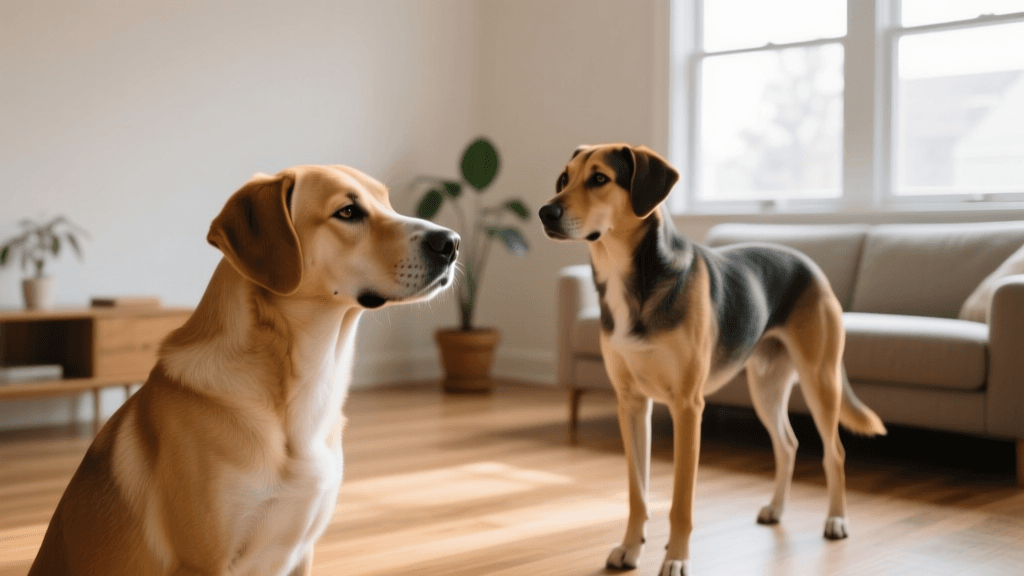
When a dog feels threatened or overstimulated—such as when another dog approaches their food bowl or a human reaches for their favorite chew toy—they will instinctively deploy these signals to say, 'I am not a threat, please give me space, and let us avoid a fight.' Recognizing these signals is the most critical step in preventing resource guarding incidents. Unfortunately, many owners misinterpret these subtle cues as signs of submission, distraction, or even guilt, missing the critical window for intervention.
The Resource Guarding Escalation Ladder
Dogs rarely bite without warning. In almost all cases of resource guarding, the dog will progress through a predictable escalation ladder. If the early, subtle calming signals are ignored or punished, the dog is forced to escalate to more overt, aggressive warnings. Understanding this ladder is vital for any multi-dog home in 2026.
| Escalation Stage | Canine Signal | Description & Context | Recommended Human Response |
|---|---|---|---|
| Stage 1: Subtle | Lip Licking & Yawning | Quick flicks of the tongue or exaggerated yawns when not tired. Indicates mild internal stress or an attempt to appease an approaching dog. | Stop the approach. Give the dog space. Do not punish the signal. |
| Stage 2: Avoidance | Whale Eye & Head Turns | Showing the whites of the eyes (lunula) while keeping the head turned away from the resource. A clear request for distance. | Call the approaching dog away. Toss a high-value treat away from the guarded item. |
| Stage 3: Displacement | Sudden Sniffing & Scratching | The guarding dog suddenly becomes intensely interested in the floor or scratches their neck. This is a displacement behavior to avoid direct conflict. | Manage the environment. Use a physical barrier or remove the competing dog from the room. |
| Stage 4: Overt | Freezing & Hard Stare | The dog becomes completely rigid over the resource, staring directly at the perceived threat. This is a critical pre-bite warning. | Do not approach. Avert your eyes, back away slowly, and consult a professional behaviorist. |
| Stage 5: Aggressive | Growling, Snapping, Biting | The final defensive measure when all previous calming signals have been ignored or punished. | Ensure immediate safety. Seek emergency veterinary and behavioral intervention. |
Identifying 'Whale Eye' and 'Freezing' in Real-Time
Two of the most critical signals on the escalation ladder are 'whale eye' and 'freezing.' Whale eye occurs when a dog turns their head away from a perceived threat but keeps their eyes fixed on it, exposing the crescent-shaped white of the eye (the sclera). In a resource guarding scenario, you might see this when a dog is lying on their bed with a Kong Classic toy, and another dog walks into the room. The guarding dog will keep their nose pointed at the toy or the wall, but their eyes will track the intruder, showing a prominent white half-moon.
Freezing is equally dangerous if misunderstood. When a dog freezes, their entire body becomes rigid. They may stop chewing, hold their breath, and lock their gaze onto the approaching entity. Many owners mistakenly believe a still dog is a calm dog. In reality, freezing is the canine equivalent of a coiled spring. The Humane Society of the United States emphasizes that a freezing dog is making a split-second calculation about whether to flee or fight, and in a resource guarding context, they are almost always preparing to defend their item.
Practical De-escalation: Managing the Multi-Dog Home
If you share your home with multiple dogs, environmental management is your first line of defense against resource guarding. In 2026, the market offers excellent tools to help separate dogs during high-value activities, reducing the need for them to use calming signals in the first place.
Step 1: Environmental Management and Separation
Never feed high-value chews or use interactive feeders like the Outward Hound Nina Ottosson Dog Brick Puzzle in a shared, open space. Utilize physical barriers such as the Carlson Pet Products Extra-Wide Walk-Through Gate to separate dogs into different rooms or designated zones. This removes the social pressure entirely, allowing the guarding dog to relax and consume their resource without feeling the need to monitor the movements of their housemates.
Step 2: Mimicking Canine Calming Signals
Humans can actively use canine body language to communicate peaceful intentions. If you must approach a dog who is showing early signs of resource guarding, avoid a direct, frontal approach. In dog language, walking straight toward someone is confrontational. Instead, use a 'curved approach.' Walk in a wide arc, keep your body turned slightly sideways, and avoid direct eye contact. You can also employ the human equivalent of a calming signal by blinking slowly, yawning, or stopping to look at the ground. This mimics the displacement behaviors dogs use to signal that they are not a threat.
Step 3: The 'Drop and Trade' Protocol
If a dog has picked up an item they shouldn't have, never chase them or pry their jaws open. This validates their fear that you are a resource thief. Instead, approach from the side, avoid eye contact, and toss a piece of high-value food (like boiled chicken or freeze-dried liver) a few feet away. When the dog drops the item to investigate the food, calmly pick up the forbidden item and toss another treat. This teaches the dog that human proximity to their resources results in a net gain, not a loss.
When to Seek Professional Behavioral Help
While understanding and managing calming signals can resolve mild resource guarding, severe cases require professional intervention. If your dog has progressed to Stage 4 (freezing and hard staring) or Stage 5 (growling, snapping, or biting), it is time to bring in an expert. Punishing a dog for growling or showing calming signals is incredibly dangerous; it teaches the dog to skip the warning phase and go straight to biting the next time they feel threatened.
In 2026, the gold standard for behavioral intervention is a certified professional who utilizes force-free, fear-free methodologies. The International Association of Animal Behavior Consultants (IAABC) maintains a directory of certified experts who specialize in complex multi-dog dynamics and severe resource guarding. These professionals will help you implement a structured desensitization and counter-conditioning program, ensuring the safety of both your pets and your family.
Conclusion: Listening to the Silent Language
Decoding canine calming signals is not just about preventing bites; it is about building a profound level of trust with your dog. When you acknowledge their lip licks, yawns, and whale eyes, you are telling your dog that you hear them, respect their boundaries, and will protect their sense of safety. By combining this deep understanding of canine communication with smart environmental management, you can transform a tense, multi-dog household into a peaceful, cooperative pack. Pay attention to the whispers of their body language, so you never have to deal with the shouts of their aggression.
robin-maitland
All our authors care for dogs every day — read more of their work on the authors page.