2026 Departure Cue Desensitization For Dog Separation Anxiety
Master your dog's separation anxiety in 2026 with our smart camera departure cue desensitization protocol, featuring step-by-step conditioning guides.
Understanding Canine Separation Anxiety in 2026
As we navigate the evolving landscape of dog ownership in 2026, separation anxiety remains one of the most pervasive and distressing behavioral challenges for both pets and their humans. Unlike general boredom or isolation distress, true canine separation anxiety is a profound panic response triggered by the absence of a specific attachment figure. Dogs suffering from this condition do not simply miss their owners; they experience a physiological fight-or-flight response that can lead to destructive behavior, excessive vocalization, house soiling, and even self-mutilation.
According to the American Society for the Prevention of Cruelty to Animals (ASPCA), separation anxiety is often triggered by a change in schedule, a move to a new home, or the sudden absence of a family member. However, the root of the daily panic often lies in the "departure cues"—the subconscious routines owners perform right before leaving the house. By utilizing modern technology and systematic desensitization, we can rewire a dog's emotional response to being left alone.
The Science of Departure Cues and Classical Conditioning
Dogs are master pattern recognizers. Long before you actually walk out the front door, your dog has already cataloged a sequence of micro-behaviors that predict your departure. Picking up your car keys, putting on your work shoes, grabbing your coat, or even applying sunscreen are all "departure cues." For a dog with separation anxiety, these cues trigger an immediate spike in cortisol and adrenaline. The panic begins not when you leave, but when you put on your shoes.
The goal of the Smart Camera Departure Cue Desensitization Protocol is to break the associative bond between these triggers and the event of you leaving. We achieve this through classical counter-conditioning and systematic desensitization, using 2026's advanced AI-driven pet cameras to monitor the dog's micro-expressions of stress without the owner's physical presence influencing the dog's behavior.
Essential 2026 Tech for Monitoring Stress Thresholds
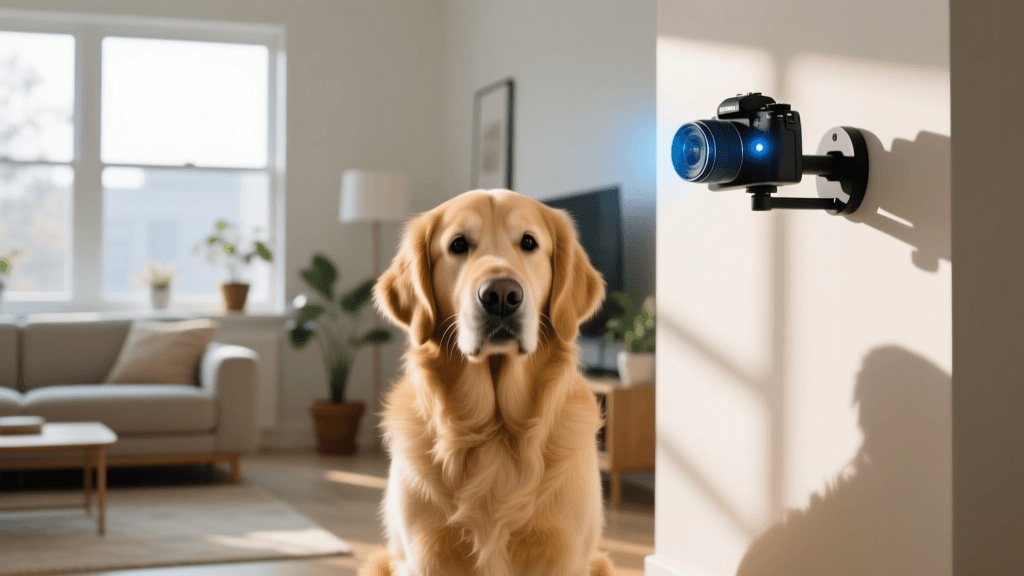
To successfully implement this protocol, you must be able to observe your dog's stress signals objectively. In 2026, standard Wi-Fi cameras are no longer sufficient; you need a smart pet camera equipped with AI behavioral tracking, two-way audio (used sparingly), and automated treat-tossing capabilities. Devices like the latest Furbo 360 or Eufy Pet AI models offer features that alert you to pacing, whining, or vomiting, allowing you to track your dog's baseline anxiety levels accurately.
Before beginning the training protocol, set up your camera to cover the primary departure zone (usually the front door or the dog's designated safe space). Ensure the lighting is adequate so you can review recorded footage and identify subtle calming signals, such as lip licking, yawning, or "whale eye" (showing the whites of the eyes).
The 4-Phase Departure Cue Desensitization Protocol
This protocol requires patience. Depending on the severity of your dog's anxiety, progressing through these phases may take several weeks or even months. Always review your smart camera footage to ensure your dog remains under their stress threshold before advancing to the next step.
Phase 1: Neutralizing Triggers (Days 1-14)
The objective here is to make departure cues meaningless. Throughout the day, when you are not planning to leave, perform your departure cues. Pick up your keys and sit down on the couch to watch television. Put on your work shoes and cook dinner. Grab your coat and fold laundry. Do this 10 to 15 times a day. Initially, your dog may exhibit anxiety when you pick up the keys, but as you repeatedly fail to leave, the predictive value of the keys diminishes. The American Kennel Club (AKC) emphasizes that consistency in neutralizing these triggers is the foundation of all separation anxiety training.
Phase 2: The Door Approach (Days 15-21)
Once your dog no longer reacts to keys or shoes, begin interacting with the door. Walk to the door, touch the handle, and walk away. Walk to the door, turn the knob, release it, and walk away. Open the door one inch, close it, and walk away. If your dog shows signs of stress (pacing, whining, panting), you have moved too fast. Return to the previous step and utilize your smart camera to monitor their recovery time.
Phase 3: Micro-Departures (Days 22-30)
Now you will actually step outside. Open the door, step out, close it, and immediately (within one second) step back inside. Do not make a fuss when you return; ignore your dog until they are calm. Gradually increase the time outside: three seconds, five seconds, ten seconds. Use your smart camera app to watch your dog's reaction the moment the door clicks shut. If they rush the door or bark, the duration was too long.
Phase 4: Extending Duration and Adding Enrichment
Once your dog can comfortably handle 30-second departures without displaying stress signals, begin pairing your departure with a high-value enrichment activity. Right before you step out, present a frozen enrichment toy. Step outside for one minute, then return. Slowly build the time to five minutes, then fifteen minutes, always monitoring via your camera.
Tracking Stress Thresholds: Canine Body Language Guide
Use the following table to evaluate your dog's camera footage and determine if you should advance, hold, or retreat in your training phases.
| Stress Signal Observed on Camera | Severity Level | Protocol Action Required |
|---|---|---|
| Occasional yawning, brief sniffing of door | Mild / Green Zone | Proceed to next duration increment. |
| Lip licking, panting, pacing near door | Moderate / Yellow Zone | Hold current duration; increase distance from door before leaving. |
| Whining, scratching at door, trembling | High / Orange Zone | Retreat to previous phase immediately; consult vet behaviorist. |
| Destructive chewing, elimination, howling | Severe / Red Zone | Stop protocol; dog requires pharmacological support and professional intervention. |
Building a Positive Alone-Time Environment
Desensitization to departure cues must be paired with creating an environment that promotes relaxation. In 2026, veterinary behaviorists strongly advocate for multi-sensory enrichment to lower a dog's baseline arousal levels before the owner even touches the doorknob.
- Olfactory Enrichment: Snuffle mats and scent work engage the canine brain and naturally lower heart rates. Scatter high-value treats in a snuffle mat 15 minutes before your departure routine begins.
- Gustatory Enrichment: Licking and chewing release endorphins. Prepare frozen Kongs or lick mats using a mixture of plain canned pumpkin, low-sodium bone broth, and your dog's daily kibble ration. Freeze them overnight to ensure they last through your micro-departures.
- Auditory Enrichment: Silence can amplify the sound of triggering neighborhood noises. Utilize bio-acoustic music specifically designed for canine nervous systems, such as the Through a Dog's Ear series, or run a white noise machine near the dog's safe space to mask outside stimuli.
Professional Support and Pharmacological Interventions
It is crucial to understand that training alone is often insufficient for dogs suffering from severe separation anxiety. When a dog is in a state of panic, the learning centers of the brain shut down; they are physically incapable of forming new, positive associations. As noted by Fear Free Pets, combining behavior modification with anti-anxiety medication is the gold standard of treatment for severe cases.
"Punishing a dog for separation anxiety behaviors is not only ineffective, but it actively worsens the underlying panic. The dog is not acting out of spite; they are experiencing a genuine psychological crisis. Medication can provide the neurochemical bridge necessary for the dog to finally benefit from desensitization training."
If your smart camera footage consistently shows Red Zone behaviors despite weeks of careful desensitization, consult a board-certified veterinary behaviorist. Modern 2026 treatment plans frequently utilize a combination of daily SSRIs (like fluoxetine) to lower baseline anxiety, paired with fast-acting situational medications (like trazodone or gabapentin) administered 90 minutes before your departure cues begin. This pharmacological support prevents the rehearsal of panic behaviors while you work through the micro-departure protocol.
Conclusion
Overcoming canine separation anxiety is a marathon, not a sprint. By leveraging 2026's smart camera technology to objectively monitor stress signals, systematically neutralizing departure cues, and providing deep sensory enrichment, you can help your dog build the confidence needed to thrive independently. Remember to celebrate the micro-victories—a relaxed sigh on the camera after a five-second departure is a monumental step toward a peaceful, panic-free home.
anouk-beaumont
All our authors care for dogs every day — read more of their work on the authors page.