Senior Dog Brain Games: Top Puzzle Toys & Snuffle Mats 2026
Discover the best puzzle toys and snuffle mats for senior dogs in 2026. Learn how foraging games combat cognitive decline and boost canine brain health.
The Rise of Canine Cognitive Dysfunction in 2026
As veterinary medicine continues to advance in 2026, our canine companions are living longer, healthier lives. However, this increased longevity has brought a sharper focus on age-related neurological conditions, particularly Canine Cognitive Dysfunction (CCD). Often compared to Alzheimer's disease in humans, CCD affects a significant percentage of dogs over the age of ten. Symptoms include disorientation, altered sleep-wake cycles, house-soiling, and a noticeable decrease in social interaction.
While pharmaceutical interventions and specialized senior diets play a vital role in managing CCD, veterinary behaviorists increasingly emphasize the power of mental enrichment and puzzle games. Engaging an aging dog's brain through targeted foraging and scent work is no longer just a trend; it is a cornerstone of holistic senior dog care in 2026. Providing the right cognitive stimulation can slow the progression of CCD, reduce anxiety, and dramatically improve your senior dog's quality of life.
The Science Behind Scent Work and Foraging
To understand why puzzle toys and snuffle mats are so effective, we have to look at canine neurology. A dog's olfactory lobe—the part of the brain dedicated to processing scent—is proportionally 40 times larger than a human's. When a dog sniffs, their heart rate actually decreases, promoting a state of calm and focus. This phenomenon, known as 'sniffari' enrichment, triggers the release of dopamine, the neurotransmitter responsible for pleasure and reward.
For senior dogs experiencing cognitive decline, scent-based foraging acts as a form of neuroplasticity training. It forces the brain to create new neural pathways, keeping the mind sharp even as the body slows down. According to the Texas A&M College of Veterinary Medicine, keeping a senior dog's brain active through environmental enrichment and problem-solving tasks is one of the most effective non-pharmaceutical strategies for managing cognitive decline and maintaining their daily functioning.
Top 3 Commercial Puzzle Toys for Aging Dogs (2026 Editions)
When selecting puzzle toys for senior dogs in 2026, you must balance cognitive challenge with physical accessibility. Arthritis, diminished eyesight, and dental sensitivities mean that toys requiring aggressive pawing or hard chewing are no longer appropriate. Here are the top three vet-recommended puzzle toys for senior dogs this year.
1. Nina Ottosson Dog Brick Level 2
The Dog Brick remains a gold standard for intermediate canine puzzles. The 2026 manufacturing updates feature enhanced, phthalate-free, and BPA-free composite materials that are gentle on aging teeth. The puzzle requires dogs to slide covers and lift flaps to reveal hidden treats. Why it works for seniors: The sliding mechanisms require minimal bite force, relying instead on nose-nudging and paw-swiping, which is excellent for dogs with mild arthritis in their jaw or neck.
2. Outward Hound Hide-A-Squirrel (2026 Reinforced Edition)
A classic plush puzzle that doubles as a comfort toy. The 2026 reinforced edition features double-stitched seams to withstand gentle chewing while maintaining a soft texture that is soothing for senior gums. Why it works for seniors: It taps into natural hunting and foraging instincts without requiring complex mechanical problem-solving. The soft plush squirrels are easy for dogs with missing teeth or weak bite strength to carry and manipulate.
3. West Paw Toppl
The Toppl is a modular treat-stuffing toy made from Zogoflex, a proprietary rubber that is incredibly durable yet soft and pliable. Why it works for seniors: Unlike hard rubber Kongs that can fracture brittle senior teeth, the Toppl yields slightly under pressure. You can interlock a small and large Toppl to increase the difficulty, or use it as a slow feeder with soft, senior-specific canned food or bone broth frozen inside.
DIY Upcycled Snuffle Mat: A 2026 Step-by-Step Guide
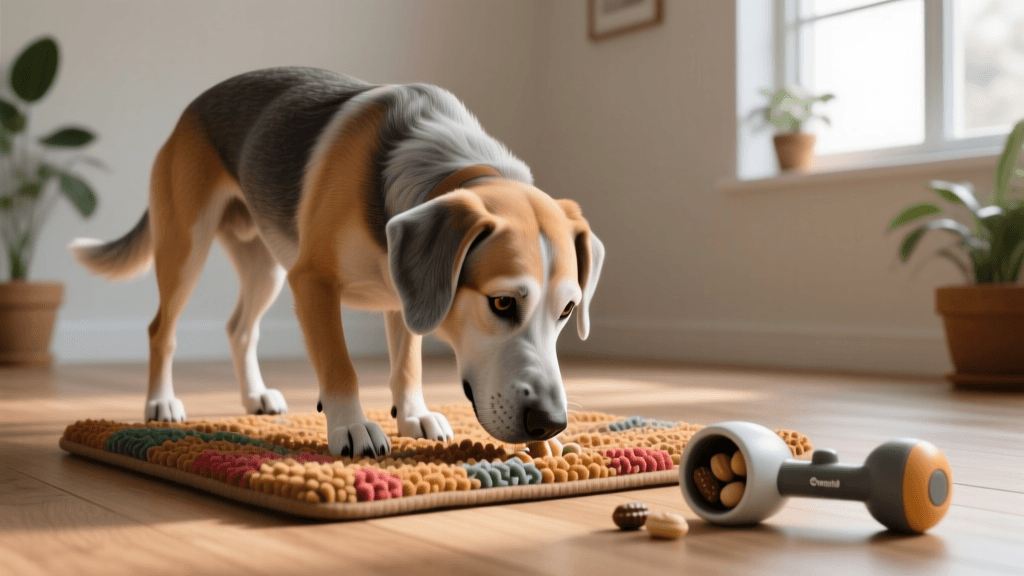
Commercial snuffle mats can be expensive, but creating a custom, senior-friendly snuffle mat at home is cost-effective and allows you to control the fabric density. Thicker, longer fleece strips are better for senior dogs with poorer eyesight, as the treats are easier to spot and extract.
Materials Needed:
- 1 Rubber sink mat with holes (approx. 12x12 inches)
- 2 yards of anti-pill fleece fabric (choose high-contrast colors like yellow and blue, as dogs see these best)
- Scissors
- High-value, soft, low-calorie training treats (e.g., Zuke's Mini Naturals)
Instructions:
- Cut the fleece into strips measuring 1.5 inches wide and 7 inches long. You will need approximately 150 strips.
- Thread a strip through a hole in the rubber mat and tie a loose overhand knot. Do not pull it too tight; you want the fleece to stand up and create 'grass'.
- Repeat this process until every hole in the mat is filled. The denser the mat, the higher the difficulty.
- Fluff the fleece strips upward. Sprinkle a handful of soft treats deep into the base and near the top of the fleece.
- Place the mat on a non-slip rug to prevent it from sliding while your senior dog forages.
Comparison Chart: Finding the Right Enrichment Tool
| Enrichment Tool | Difficulty Level | Best For | 2026 Est. Cost |
|---|---|---|---|
| Nina Ottosson Dog Brick | Level 2 (Intermediate) | Dogs needing sliding/pulling mechanics | $25 - $30 |
| Outward Hound Hide-A-Squirrel | Level 1 (Beginner) | Dogs with dental issues or weak bite force | $18 - $22 |
| West Paw Toppl | Adjustable (Beginner to Adv.) | Slow feeding soft foods; gentle chewers | $20 - $28 |
| DIY Fleece Snuffle Mat | Level 1 (Beginner) | Scent work; anxiety reduction; poor eyesight | $15 (Materials) |
Monitoring Frustration vs. Engagement
One of the most critical aspects of introducing puzzle games to senior dogs is monitoring their frustration levels. Cognitive decline can make problem-solving more difficult, and a puzzle that is too hard can lead to stress, pacing, and a refusal to engage. This is counterproductive to the goal of mental enrichment.
You must find the 'Goldilocks Zone' of cognitive stimulation. If your dog paws at the toy aggressively, barks at it, or walks away after less than a minute, the puzzle is too difficult. In this scenario, make the game easier: leave the compartments partially open on the Dog Brick, or place treats at the very top of the snuffle mat rather than burying them at the base. The goal is a steady, rhythmic sniffing and licking behavior, which indicates a state of flow and cognitive engagement.
Building a Daily Cognitive Enrichment Routine
Consistency is key when managing canine cognitive health. The American Kennel Club recommends integrating short, frequent brain games into your dog's daily schedule rather than relying on one long session, which can lead to mental fatigue in older dogs.
Sample 2026 Senior Dog Enrichment Schedule:
- Morning (8:00 AM): Ditch the food bowl. Serve breakfast inside the West Paw Toppl. This provides 15 minutes of focused licking and foraging, which releases endorphins and sets a calm tone for the day.
- Afternoon (2:00 PM): A 10-minute snuffle mat session. This breaks up the afternoon nap cycle and provides a burst of olfactory stimulation right when dogs with CCD tend to become restless or anxious.
- Evening (6:00 PM): A 5-minute session with the Hide-A-Squirrel or Dog Brick before dinner. This encourages problem-solving and builds appetite.
By replacing passive feeding with active foraging, you are not just feeding your dog; you are providing vital mental exercise. In 2026, we understand that a dog's brain ages just like their joints. Through the thoughtful use of puzzle toys, snuffle mats, and scent-based games, you can help your senior dog maintain their spark, joy, and cognitive vitality well into their golden years.
jonas-cole
All our authors care for dogs every day — read more of their work on the authors page.