Top Puzzle Toys For Smart Dogs: Canine Enrichment Guide
Discover the best puzzle toys for intelligent, high-drive dogs. Compare top enrichment products to satisfy your dog's breed instincts and prevent boredom.
The Evolutionary Mismatch: Why Dogs Need to Work for Food
To truly understand your dog, you must look past their modern living room environment and into their evolutionary history. In the wild, canines spend up to 80% of their waking hours foraging, scavenging, and hunting. They are hardwired to solve problems to secure their next meal. Today, the average pet dog is presented with a bowl of kibble that takes less than sixty seconds to consume. This severe 'evolutionary mismatch' leaves a massive cognitive void, often resulting in destructive chewing, excessive barking, hyperactivity, and anxiety.
According to the American Kennel Club, mental stimulation is just as exhausting for a dog as physical exercise, if not more so. Ten minutes of intense cognitive work can burn as much energy as a 30-minute walk. By replacing the standard food bowl with interactive puzzle toys, you are not just buying a product; you are fulfilling a deep-seated biological imperative. This buyer's guide will help you select the best enrichment tools tailored to your dog's specific breed instincts and cognitive needs.
Decoding Breed Instincts Through Play
Not all dogs interact with the world in the same way. A Border Collie's approach to a problem will differ vastly from a Beagle's or a Jack Russell Terrier's. Understanding your dog's breed group is the first step in choosing the right enrichment product:
- Herding Breeds (e.g., Collies, Shepherds): These dogs are visual problem solvers. They excel at tasks requiring spatial reasoning, such as sliding blocks, flipping lids, and manipulating levers.
- Scent Hounds (e.g., Beagles, Basset Hounds): Driven by their olfactory cortex (which is up to 40 times larger than a human's), these dogs need toys that require deep sniffing and tracking, like snuffle mats or hidden-compartment feeders.
- Terriers (e.g., Jack Russells, Rat Terriers): Bred to hunt and kill vermin, terriers need durable toys they can shake, paw at aggressively, and 'dissect' to get the reward inside.
Buyer’s Guide: Top 4 Canine Enrichment Products
1. Outward Hound Nina Ottosson Dog Brick Interactive Puzzle
Best For: Herding breeds and beginner-to-intermediate problem solvers.
Cost: $15.00 - $22.00
Measurements: 12.75 x 9.25 x 2 inches
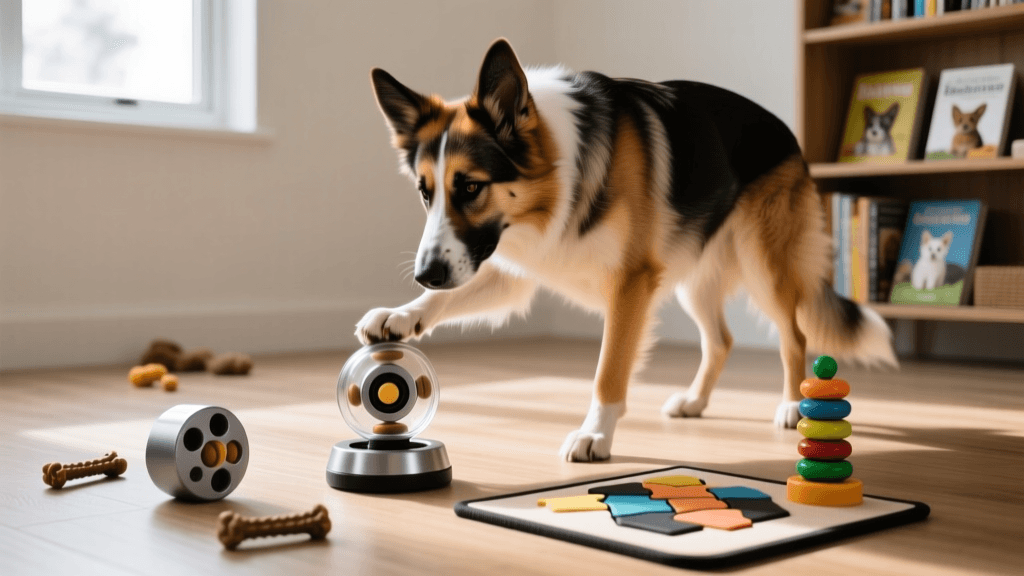
The Dog Brick is a staple in the canine enrichment community. It features three types of treat-hiding compartments: flip caps, sliding blocks, and removable bone-shaped pegs. The genius of this toy lies in its adjustable difficulty. You can start by leaving the sliding blocks open, gradually increasing the challenge as your dog's cognitive skills improve. Made from BPA-free, phthalate-free plastic, it is easy to clean but not designed for aggressive chewers. It is an excellent tool for teaching dogs the concept of 'manipulation' to achieve a reward.
2. West Paw Toppl Treat Dispensing Dog Toy
Best For: Power chewers, retrievers, and dogs prone to separation anxiety.
Cost: $20.00 - $28.00 (depending on size)
Measurements: Small (3 inches), Large (4 inches)
Unlike traditional tube-shaped dispensers, the Toppl features an open, cup-like design with inner 'fingers' that grip soft treats, kibble, or frozen yogurt. The true value of the Toppl is its interlocking capability; you can buy a small and large size and snap them together to create a complex, spherical puzzle. Made from West Paw's proprietary Zogoflex rubber, it is incredibly durable, buoyant, and dishwasher safe. It satisfies the retriever instinct to carry and chew while providing a long-lasting licking challenge that releases soothing endorphins.
3. KONG Wobbler Action Treat Dispensing Toy
Best For: Highly food-motivated dogs, fast eaters, and large breeds.
Cost: $18.00 - $25.00
Measurements: Small (holds 1/2 cup), Large (holds 1 cup)
The KONG Wobbler mimics the unpredictable movement of prey. Shaped like a classic KONG but made from hard, food-grade polycarbonate, it sits upright until the dog paws or noses it. It then spins, wobbles, and dispenses kibble through a single side hole. This toy engages a dog's paw-eye coordination and encourages physical movement. Because it is heavy (the large version weighs over 1.5 pounds) and made of hard plastic, it is highly durable but should be used on hard floors or rugs, as it can scratch delicate hardwood.
4. AWOSU Pet Snuffle Mat for Dogs
Best For: Scent hounds, senior dogs, and dogs on restricted exercise.
Cost: $20.00 - $35.00
Measurements: Typically 17 x 21 inches
A snuffle mat is essentially a foraging simulator. Made from hundreds of soft fleece strips tied to a durable base, it allows you to bury dry kibble deep within the 'grass'. This taps directly into a dog's primal scavenging instincts. According to the RSPCA, scent-based enrichment is one of the most effective ways to lower a dog's heart rate and reduce stress. It is entirely silent, requires no physical exertion, and is perfect for rainy days or post-surgery recovery when physical exercise is limited.
Product Comparison Chart
| Product Name | Primary Instinct Targeted | Difficulty Level | Price Range | Material |
|---|---|---|---|---|
| Nina Ottosson Dog Brick | Problem Solving / Herding | Level 2 (Intermediate) | $15 - $22 | BPA-Free Plastic |
| West Paw Toppl | Chewing / Retrieving | Level 1-3 (Adjustable) | $20 - $28 | Zogoflex Rubber |
| KONG Wobbler | Hunting / Paw Coordination | Level 1 (Beginner) | $18 - $25 | Polycarbonate |
| AWOSU Snuffle Mat | Scavenging / Scent Work | Level 1 (Beginner) | $20 - $35 | Polar Fleece / Felt |
A Step-by-Step Guide to Introducing Puzzle Toys
Buying the right toy is only half the battle; introducing it correctly is crucial to preventing frustration. If a puzzle is too difficult, a dog will simply abandon it or resort to destructive chewing to break it open.
- Start Transparently: For the first few sessions, use transparent toys or leave puzzle compartments partially open so the dog can see and smell the reward easily.
- Use High-Value Currency: When introducing a new, difficult puzzle, do not use dry kibble. Use freeze-dried liver, small cheese cubes, or boiled chicken to maintain motivation.
- The 5-Minute Rule: Keep initial sessions under five minutes. End the session on a positive note while the dog is still engaged and successful.
- Assist, Don't Solve: If your dog gets stuck, do not solve the puzzle for them. Instead, point to the mechanism, tap it gently, or use a verbal cue to redirect their focus.
'The goal of canine enrichment is not to frustrate the animal, but to build their confidence through achievable challenges. If a dog walks away from a puzzle, the difficulty has been scaled too quickly.'
Safety, Hygiene, and Maintenance
While enrichment toys are fantastic tools for behavioral management, they require strict safety protocols. Never leave a dog unattended with a plastic puzzle toy like the Dog Brick or KONG Wobbler until you are 100% certain they will not attempt to chew and ingest the plastic components. Ingestion of hard plastics can lead to severe gastrointestinal blockages requiring emergency surgery.
Hygiene is equally important. Saliva and food particles trapped in the crevices of puzzle toys can harbor dangerous bacteria like Salmonella or E. coli. Rubber toys like the West Paw Toppl should be placed on the top rack of your dishwasher weekly. Plastic puzzles should be hand-washed in warm, soapy water after every use. Fleece snuffle mats can typically be machine-washed on a gentle cycle, but ensure they are completely dry before storing to prevent mold growth.
By thoughtfully selecting and implementing these enrichment tools, you bridge the gap between your dog's ancestral instincts and their modern lifestyle. You will not only see a reduction in unwanted behavioral issues but also witness the profound joy and satisfaction your dog experiences when they are finally allowed to 'work' for their living.
aaron-whyte
All our authors care for dogs every day — read more of their work on the authors page.