Puppy Teething Psychology & Best Soothing Toys for 2026
Discover the psychology behind puppy teething and explore the best soothing toys of 2026 to relieve pain, curb destructive chewing, and aid bite inhibition.
The Canine Psychology of Teething: More Than Just Sore Gums
When we think of puppy teething, we often focus solely on the physical discomfort of erupting teeth or the immediate inconvenience of chewed-up furniture. However, from a behavioral and psychological standpoint, teething is one of the most critical developmental milestones in a dog's life. Puppies do not just chew to alleviate the physical pain of shifting dentition; they chew to map their environment, relieve stress, and satisfy deep-seated predatory instincts. Understanding the 'why' behind your puppy's relentless need to gnaw is the first step in selecting the right tools to guide their behavior positively.
According to the American Kennel Club (AKC), the teething process is a prolonged sensory experience that heavily influences how a puppy interacts with the world. A puppy's mouth is their primary tool for environmental exploration, much like a human toddler's hands. When a puppy is denied appropriate outlets for this instinctual mapping, the resulting frustration can manifest as anxiety, hyperactivity, and destructive behavioral patterns that persist well into adulthood.
The Timeline of Canine Dental Development
To effectively manage your puppy's behavior, you must understand the biological timeline they are operating on. Puppies are born without teeth. Their deciduous (baby) teeth begin to erupt around three to four weeks of age. By the time they are eight weeks old and typically ready to join their new families, they possess a full set of 28 needle-sharp baby teeth.
The most behaviorally challenging phase begins around 12 to 16 weeks of age. This is when the roots of the baby teeth begin to resorb, and the permanent adult teeth start pushing through the gum line. This process causes significant gingival inflammation, itching, and deep jaw aching. By six to eight months, all 42 adult teeth should be in place. During this four-month window of intense oral transition, a puppy's bite inhibition and chewing habits are permanently forged.
How Teething Pain Influences Puppy Behavior and Bite Inhibition
Pain makes puppies cranky. Just as a human with a severe toothache might become irritable and short-tempered, a teething puppy often exhibits a lowered threshold for stress. You may notice increased nipping, mouthing, and a seeming inability to settle down. This is not 'bad behavior'; it is a stress response to chronic, low-grade oral pain.
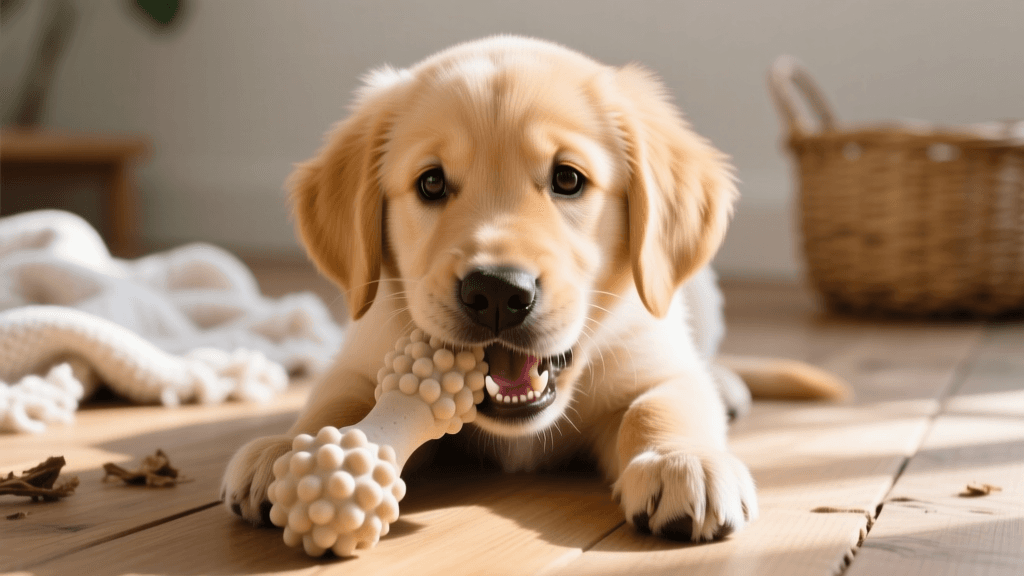
This phase is also the critical window for teaching bite inhibition. When puppies play with their littermates, a bite that is too hard results in a yelp and the cessation of play. As the ASPCA notes, redirecting this natural mouthing behavior onto appropriate, textured surfaces is vital. If a puppy learns that human skin is entirely off-limits, but a specific rubber toy provides immense relief to their aching gums, they will naturally choose the toy. The right teething toy acts as a behavioral anchor, teaching the puppy how to self-soothe without resorting to destructive or aggressive outlets.
What Makes a Teething Toy Behaviorally Effective?
Not all chew toys are created equal, especially when viewed through the lens of canine psychology. A behaviorally effective teething toy must satisfy three core criteria:
- Proprioceptive Feedback: The toy must offer resistance that satisfies the puppy's instinctual need to exercise their jaw muscles and 'kill' or dismantle prey.
- Thermal or Textural Relief: Inflamed gums crave cold temperatures and varied textures to massage the tissue and numb the nerve endings.
- Ergonomic Manipulation: Puppies need to be able to hold the toy between their front paws while chewing. Toys that are too small or perfectly spherical often cause frustration because the puppy cannot secure them.
The Best Teething Toys of 2026: A Behavioral Review
Based on veterinary recommendations, material safety standards, and canine behavioral feedback, here are the top teething toys for 2026 that address both the physical and psychological needs of your puppy.
1. KONG Puppy Goodie Bone (Soft Rubber Formula)
The KONG Puppy Goodie Bone remains a staple in 2026 for its brilliant psychological design. Unlike a standard ball, the bone shape allows the puppy to grip it securely, satisfying their instinct to hold and manipulate. The patented soft pink rubber is specifically engineered to be yielding enough for developing jaw structures while still providing the deep-tissue gum massage that puppies crave. The 'Goodie Grippers' on the ends are perfect for stuffing with frozen puppy-safe yogurt or peanut butter, which introduces a foraging element. This mental stimulation tires the puppy out cognitively, reducing the hyperactive nipping that often accompanies teething pain.
2. Benebone Puppy Zaggler
For the aggressive, determined chewer, the Benebone Puppy Zaggler offers unparalleled ergonomic satisfaction. Made from a slightly softer, puppy-specific nylon infused with real bacon, this toy addresses the psychological need to chew on hard, unyielding objects (like furniture legs) but does so safely. The unique, curved Zaggler shape is designed to be easily grabbed by clumsy puppy paws. The ridges provide excellent dental scraping action, which helps loosen stubborn baby teeth that are refusing to fall out, thereby reducing the behavioral irritability caused by 'stuck' teeth.
3. Nylabone Puppy Chill'n Chew Freezer Bone
Cold therapy is a cornerstone of pain management, and the Nylabone Puppy Chill'n Chew capitalizes on this beautifully. This toy features a soft, thermoplastic polymer exterior that retains freezing temperatures for extended periods. When a puppy is experiencing acute gum inflammation, their instinct is to seek out cold, hard surfaces (often resulting in them chewing on baseboards or metal table legs). Providing this freezer bone redirects that specific thermal-seeking behavior into a safe, vet-approved outlet. The raised bristles also act as a toothbrush, promoting early positive associations with dental hygiene.
Comparison Chart: Matching Toys to Puppy Chewing Styles
| Toy Name | Best For (Behavioral Need) | Texture & Material | Durability | Avg. Price (2026) |
|---|---|---|---|---|
| KONG Puppy Goodie Bone | Foraging, self-soothing, mild chewers | Soft, yielding rubber | Moderate | $14.99 |
| Benebone Puppy Zaggler | Heavy chewing, grip frustration, stuck teeth | Puppy-soft nylon with bacon | High | $18.50 |
| Nylabone Chill'n Chew | Acute pain relief, thermal-seeking behavior | Freezable thermoplastic polymer | Moderate-High | $12.99 |
Behavioral Management Tips for the Teething Phase
Providing the best toys is only half the equation; how you manage the environment and your puppy's reactions is equally important. VCA Animal Hospitals emphasizes the importance of supervision and redirection during this developmental window.
- The 'Trade-Up' Game: Never forcefully pry a forbidden object (like a shoe) from a teething puppy's mouth. This triggers resource guarding and increases anxiety. Instead, offer a high-value, frozen teething toy. When they drop the shoe for the toy, praise them lavishly.
- Implement Nap Times: Puppies often become 'bitey monsters' when they are overtired and in pain. If your puppy is frantically chewing and nipping despite having access to toys, they likely need a forced nap in a quiet, dimly lit crate or pen to decompress.
- Rotate the Toy Selection: Dogs suffer from habituation. If a toy is always available, it loses its psychological novelty and rewarding properties. Keep a rotation of three or four different textured toys, freezing some and leaving others at room temperature, to keep your puppy's interest piqued.
Conclusion
The teething phase is a temporary but highly formative period in your dog's psychological development. By viewing their relentless chewing not as an act of defiance, but as a biological imperative driven by pain and instinct, you can respond with empathy and strategy. Equipping your home with the best soothing toys of 2026, utilizing cold therapy, and practicing gentle redirection will not only save your furniture but will also lay the foundation for a calm, well-adjusted adult dog with excellent bite inhibition and healthy chewing habits.
aaron-whyte
All our authors care for dogs every day — read more of their work on the authors page.