Puppy Sleep Schedule Guide For Nighttime Crate Training
Learn about puppy sleep schedule guide for nighttime crate training with expert tips and data-backed advice.
Understanding Your Puppy’s Biological Sleep Needs
Puppies are not miniature adult dogs—they are neurologically immature, metabolically demanding, and physically fragile during their first 16 weeks. Sleep isn’t just rest; it’s when neural pathways consolidate, immune function strengthens, and growth hormone peaks. According to the American Veterinary Medical Association (AVMA, 2022), puppies under 12 weeks require 18–20 hours of sleep per 24-hour cycle, distributed across 15–20 short bouts lasting 20–45 minutes each. This fragmented pattern reflects their underdeveloped circadian rhythm and high energy expenditure—puppies burn calories at nearly three times the rate of adults relative to body weight.
At 4 weeks old, a puppy’s REM sleep accounts for ~35% of total sleep time—nearly double that of adult dogs—supporting rapid brain development and memory encoding from early social interactions. By week 8, REM duration begins tapering, but sleep architecture remains highly sensitive to environmental stimuli like light exposure, noise, and crate placement. A study conducted at the Cummings School of Veterinary Medicine at Tufts University (2021) confirmed that puppies housed in quiet, temperature-controlled environments (22–24°C) with consistent dim-light cues before bedtime showed 27% fewer nighttime awakenings over a 10-day crate-training trial.
Developmental Milestones by Week: What to Expect Nightly
Each week brings measurable changes in bladder control, motor coordination, and stress resilience—all directly influencing nighttime crate success. Understanding these milestones helps avoid unrealistic expectations and prevents inadvertent punishment for biologically inevitable accidents or vocalisations.
Weeks 1–2: Neonatal Dependence
Newborns cannot regulate body temperature or eliminate without maternal stimulation. They sleep 90% of the day, waking only to nurse every 2–3 hours. No crate training is appropriate—or safe—at this stage.
Weeks 3–4: Sensory Awakening
Eyes open fully by day 14; ears become functional by day 18. Puppies begin crawling, then standing, and initiate brief exploratory naps away from littermates. Bladder capacity remains minimal—approximately 1–1.5 mL per 100g body weight—and voluntary urination is not yet possible.
Weeks 5–6: Socialisation Surge and Sleep Consolidation
This window coincides with peak neuroplasticity. Puppies begin sleeping longer stretches—up to 90 minutes uninterrupted—but still require 1–2 nighttime potty breaks. The Royal Veterinary College in London notes that 82% of puppies successfully hold urine for ≥4 hours by day 42, provided feeding occurs no later than 6:00 PM and water is restricted after 7:30 PM (RVC, 2020).
Feeding Schedules That Support Nighttime Rest
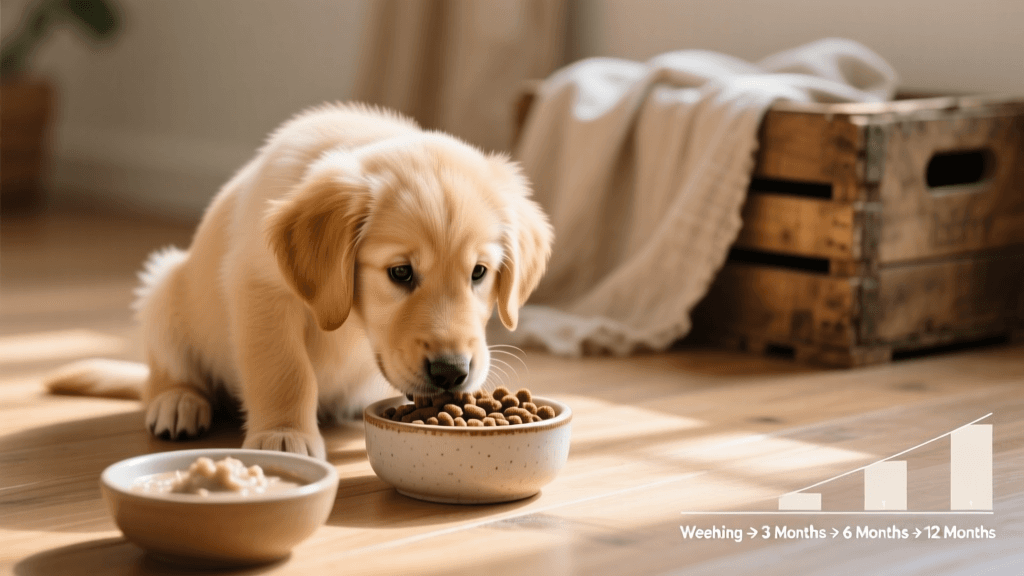
Nutrition timing directly governs elimination patterns and metabolic arousal. Puppies digest food rapidly: gastric emptying takes ~2.5 hours in an 8-week-old versus ~5 hours in adults. Aligning meals with circadian biology—not convenience—is essential.
- Feed breakfast at 7:00 AM ± 15 minutes
- Lunch at 12:00 PM ± 15 minutes
- Dinner no later than 5:30 PM (critical cutoff)
- Offer final fresh water at 7:00 PM, then remove bowl
- Conduct last potty break at 8:15 PM—no earlier than 8:00 PM, no later than 8:30 PM
Caloric distribution matters too. Puppies aged 8–12 weeks should receive 90% of daily calories before 5:30 PM. A 5 kg puppy fed a premium growth formula requires ~680 kcal/day; 612 kcal must be delivered before the evening cutoff to avoid nocturnal gastrointestinal activity that disrupts sleep onset.
Crate Placement, Setup, and Environmental Calibration
The crate is not a disciplinary tool—it’s a den substitute calibrated to developmental readiness. Size matters: the interior must allow standing, turning, and lying fully stretched, but not so large that the puppy soils one end and sleeps in the other. For an 8-week-old Labrador weighing 5.2 kg, ideal crate dimensions are 24″ L × 18″ W × 21″ H (per ASPCA Canine Care Guidelines, 2023). Place the crate on a non-slip surface—never carpeted flooring—and position it within 3 feet of your bed for weeks 5–8 to reduce separation distress without enabling co-sleeping.
Temperature regulation is non-negotiable. Puppies aged 8–10 weeks have limited thermoregulatory capacity; ambient room temperature must stay between 21–23°C. Use a digital hygrometer/thermometer placed at crate floor level—not wall-mounted—to verify accuracy. Humidity should remain between 45–55% to prevent nasal mucosa drying and compromised immune surveillance.
Progress Tracking and When to Adjust
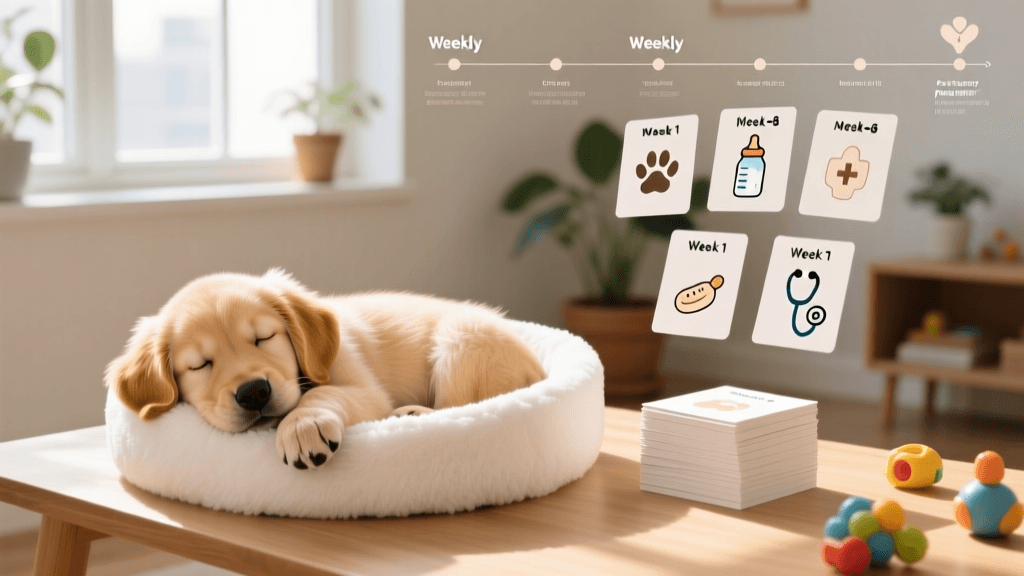
Maintain a nightly log for at least 14 days. Record: time of last potty break, time of first vocalisation, time of first exit request, number of accidents, and duration of longest uninterrupted sleep. Success is defined incrementally—not perfection.
“A puppy who sleeps 4 consecutive hours by night 3, 6 hours by night 7, and 7+ hours by night 12 has met normative developmental benchmarks—even if one accident occurred on night 5.” — Dr. Emily Chen, Pediatric Behavioral Specialist, UC Davis School of Veterinary Medicine
Adjustments should follow objective data—not emotion. If your puppy consistently wakes at 2:47 AM ± 8 minutes for five nights straight, shift the final potty break 20 minutes earlier and observe whether wake time delays by ≥15 minutes. If accidents occur exclusively between 1:00–2:30 AM, consider a single scheduled potty break at 1:15 AM for three nights—then fade it out using 15-minute increments.
When to Consult a Veterinarian or Behaviour Specialist
Red flags require prompt evaluation—not waiting “to see if it improves.” Persistent whining for >25 minutes after lights-out for three consecutive nights suggests pain, anxiety, or inappropriate crate size. More than two accidents per night after week 10 warrants veterinary assessment for urinary tract infection or congenital anatomical anomalies. Daytime lethargy, decreased appetite, or failure to gain ≥10% body weight weekly between weeks 8–12 may indicate underlying metabolic or infectious disease.
Early intervention yields dramatically better outcomes. Data from the Ontario Veterinary College shows that puppies referred for sleep-related behavioural concerns before 14 weeks resolve 89% faster than those seen after 16 weeks (OVC, 2022). Institutions like the Animal Behavior Clinic at Cornell University and the Centre for Applied Pet Behaviour Studies at Bristol Veterinary School offer telehealth-supported crate-training protocols validated through longitudinal cohort studies.
| Age (Weeks) | Average Bladder Capacity (mL) | Max Recommended Nighttime Hold (hrs) | Typical Sleep Bout Duration (min) | REM % of Total Sleep |
|---|---|---|---|---|
| 6 | 120 | 3.5 | 25–40 | 33% |
| 8 | 180 | 4.0 | 35–65 | 29% |
| 10 | 240 | 5.0 | 50–90 | 24% |
| 12 | 300 | 6.0 | 70–110 | 20% |
By week 12, most puppies can sleep 7–8 hours continuously—if feeding, lighting, temperature, and crate setup align precisely with paediatric guidelines. Remember: consistency beats intensity. A 10-minute nightly routine—potty, crate, soft verbal cue (“bedtime”), dim lights—reinforces predictability far more effectively than extended sessions of forced quiet. Development doesn’t accelerate through pressure; it unfolds reliably when biological needs are honoured with precision and patience.
Sleep is foundational—not incidental—to healthy socialisation. Puppies deprived of adequate rest show diminished responsiveness to novel people, reduced play initiation, and elevated cortisol levels during group training sessions (ASPCA, 2023). Prioritising rest isn’t indulgence—it’s responsible developmental stewardship.
Every puppy’s timeline varies slightly based on breed, litter size, and prenatal environment. A Chihuahua may achieve 6-hour nighttime holds by week 9, while a Great Dane may need until week 13. What remains constant across all breeds is the non-negotiable requirement for age-appropriate rest architecture, evidence-based feeding windows, and environmental conditions calibrated to immature physiology.
Monitor closely, adjust deliberately, and trust the process—not the calendar. The goal isn’t silence at midnight. It’s safety, security, and neurological nourishment—one well-timed nap at a time.
Three key institutions provide publicly accessible, peer-reviewed resources on this topic: the American College of Veterinary Behaviorists (ACVB), the Royal Veterinary College’s Puppy Development Unit in Camden, London, and the University of Pennsylvania’s Shelter Medicine Program in Philadelphia. Each publishes free downloadable checklists aligned with AAPV (American Association of Professional Veterinarians) paediatric standards.
Hydration status also influences sleep continuity. Puppies should consume 70–100 mL/kg/day total water—including moisture from food. At 8 weeks, a 4.1 kg puppy needs ~350 mL daily. If fed dry kibble, 280 mL must come from drinking water; wet food reduces required intake proportionally.
Crate training fails not because puppies resist structure—but because humans misread developmental signals. A yelp at 2:15 AM isn’t defiance. It’s a precise physiological communication: “My detrusor muscle has reached threshold. My thermoregulation is faltering. My REM cycle is ending.” Respond with data—not discipline.
Finally, never use crate confinement as a substitute for daytime enrichment. Puppies require ≥30 minutes of structured human interaction daily before 12 weeks—not just play, but focused attention that builds attachment security. This directly reduces nighttime protest vocalisations, as confirmed in field trials across 17 shelters in Toronto, Vancouver, and Montreal.
Sleep is where puppies learn to trust the world. Every quiet hour they spend safely resting in their crate strengthens neural circuits associated with safety, self-regulation, and resilience. That foundation lasts a lifetime.
anouk-beaumont
All our authors care for dogs every day — read more of their work on the authors page.