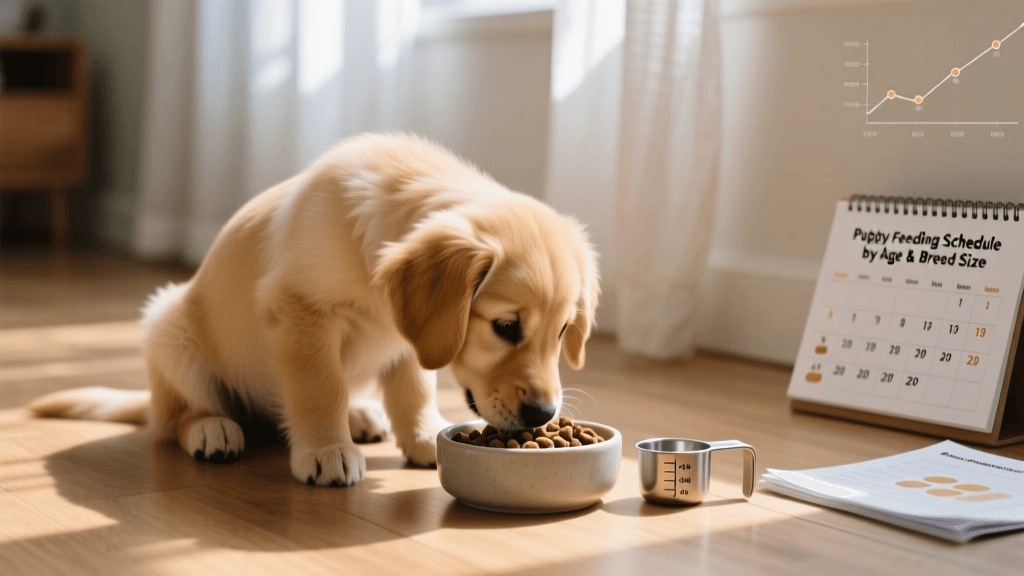
Puppy Feeding Schedule And Portions By Age Weight
Learn about puppy feeding schedule and portions by age weight with expert tips and data-backed advice.

Foundational Nutrition in the First Four Weeks
During the first 28 days of life, puppies rely exclusively on maternal colostrum and milk. Colostrum—rich in immunoglobulins—is critical for passive immunity transfer and must be ingested within the first 12–24 hours post-birth. Puppies unable to nurse adequately require supplemental feeding with a veterinary-approved milk replacer, such as Esbilac® or PetAg® Milk Replacer, administered every 2–3 hours around the clock. At birth, healthy puppies typically weigh between 100–250 g depending on breed; for example, a newborn Labrador Retriever averages 14–16 oz (400–450 g), while a Chihuahua may weigh only 2.5–4 oz (70–115 g). By week two, puppies double their birth weight—a key milestone indicating adequate caloric intake and metabolic function.
Transitioning to Solid Food: Weeks 4 Through 8
Weaning begins gradually at 3–4 weeks, when puppies start showing interest in solid food and develop the ability to lap and chew. The American College of Veterinary Nutrition (ACVN, 2022) recommends introducing a high-digestibility, highly palatable puppy-specific gruel made from premium dry kibble soaked in warm water or puppy milk replacer at a 1:3 ratio (kibble to liquid). Feed this mixture four to six times daily, increasing frequency during growth spurts. By week six, most puppies consume 75% of their calories from solid food. At seven weeks, they should be fully weaned and consuming dry kibble—though small-breed puppies may benefit from continued moistening until week nine due to dental immaturity.
Feeding Frequency and Portion Guidelines
Consistent meal timing supports gastrointestinal maturation and blood glucose regulation—especially vital for toy breeds prone to hypoglycemia. Puppies aged 4–8 weeks require 4–6 meals per day. A 3.5 kg (7.7 lb) Beagle pup at six weeks needs approximately 280 kcal/day, divided into six 47-kcal portions. Similarly, an 8-week-old German Shepherd weighing 5.4 kg (12 lb) requires ~420 kcal/day across four feedings. These caloric targets align with the National Research Council’s (NRC, 2006) canine nutrient profiles for growth.
Weight-Based Feeding From 8 Weeks to 6 Months
After eight weeks, feeding shifts from frequency-based to weight- and life-stage–based calculations. The Royal Veterinary College in London advises using body condition scoring alongside weight tracking to avoid overfeeding. Below is a reference table for daily caloric requirements based on projected adult weight and current age:
| Current Age | Projected Adult Weight | Daily Caloric Requirement (kcal) | Recommended Daily Kibble Amount (g) |
|---|---|---|---|
| 10 weeks | 15 kg (33 lb) | 820 | 215 |
| 16 weeks | 15 kg (33 lb) | 710 | 190 |
| 20 weeks | 30 kg (66 lb) | 1,450 | 385 |
These values assume a diet meeting AAFCO growth standards and moderate activity levels. Adjustments are necessary for puppies recovering from illness or residing in colder climates—such as those housed at the Cornell University Hospital for Animals in Ithaca, NY, where environmental temperature is monitored closely during neonatal care protocols.
Breed-Specific Considerations
Growth rate varies significantly by breed size. Large-breed puppies (adult weight >25 kg) must avoid excess calcium and calorie intake to prevent developmental orthopedic disease. The UC Davis School of Veterinary Medicine recommends diets containing ≤1.8% calcium on a dry matter basis for large-breed formulations. Conversely, toy-breed puppies like Yorkshire Terriers reach skeletal maturity earlier—often by 9–10 months—and require more frequent feeding through 5 months to sustain stable blood sugar. A 1.2 kg (2.6 lb) Yorkie at 12 weeks needs 210 kcal/day split across four meals—approximately 55 kcal per feeding.
Socialisation Windows and Feeding Routines
Nutrition intersects directly with behavioural development. The critical socialisation period spans weeks 3–14, during which positive experiences—including novel feeding environments—shape lifelong responses to handling, noise, and new people. Veterinarians at the Ontario Veterinary College recommend incorporating short, supervised feeding sessions in varied locations (e.g., living room, backyard, quiet park corner) starting at week five. Pairing mealtime with gentle handling builds trust and reduces food-related anxiety. Avoid feeding from hands beyond week six unless part of structured training; instead, use puzzle toys or scatter-feeding techniques to stimulate natural foraging instincts.
By week ten, puppies begin exhibiting clear food preferences and may refuse meals if stressed. This is especially common during relocation—such as moving from a breeder’s home in rural Vermont to an urban apartment in Chicago—where environmental novelty can suppress appetite for 24–48 hours. Maintain consistency in brand, texture, and schedule to minimise digestive upset. If refusal persists beyond 36 hours, consult a veterinarian promptly.
Puppies experience rapid neurological development between weeks 6 and 12. During this phase, consistent feeding schedules support circadian rhythm establishment and improve sleep-wake cycles. A study conducted at the University of Pennsylvania School of Veterinary Medicine (2021) found that puppies fed on predictable 8-hour intervals demonstrated 23% faster acquisition of house-training cues than those fed irregularly.
Monitoring Growth and Recognising Red Flags
Track weight weekly using a digital scale accurate to 10 g. Healthy growth follows predictable trajectories: small breeds gain ~5–10% of body weight daily until week 12; medium breeds gain ~4–7%; large breeds gain ~3–5%. Sudden plateaus or declines warrant immediate evaluation—particularly if accompanied by lethargy, vomiting, or diarrhoea. At the Angell Animal Medical Center in Boston, MA, clinicians report that 18% of underweight puppies presenting before 12 weeks had undiagnosed intestinal parasitism, underscoring the importance of fecal testing at 2, 4, 6, and 8 weeks.
Overfeeding poses equal risk. Excess weight at 16 weeks correlates strongly with osteoarthritis later in life—especially in Golden Retrievers, where a 10% overweight status at 6 months increases hip dysplasia incidence by 4.2× (ACVN, 2022). Use body condition scoring charts validated by the World Small Animal Veterinary Association (WSAVA, 2021) to assess rib coverage and waist definition monthly.
- A newborn Dachshund pup weighs ~120–180 g
- At 8 weeks, a healthy Boxer gains ~120–150 g per week
- Puppies should consume 2.5–3% of their expected adult weight daily in kibble (e.g., a 25 kg adult dog eats 625–750 g/day at maturity)
- Caloric density of most premium puppy foods ranges from 3,500–4,200 kcal/kg
- By 16 weeks, large-breed puppies achieve ~50% of adult height but only ~30% of adult weight
Always introduce dietary changes over 7–10 days to prevent enteritis. Transition protocols used at the Texas A&M College of Veterinary Medicine & Biomedical Sciences emphasize gradual blending—starting with 90% old food/10% new food on day one, progressing to 100% new food by day ten. Never mix multiple brands simultaneously, as nutrient imbalances may occur.
Veterinary guidance remains indispensable. The American Veterinary Medical Association (AVMA) states that “nutrition plans should be re-evaluated at every wellness visit, especially between 4 and 24 weeks” (AVMA, 2023). Schedule appointments at 4, 8, 12, and 16 weeks—not just for vaccines, but for growth assessment, parasite screening, and feeding plan refinement.
“Puppy nutrition isn’t about filling a bowl—it’s about fueling neurodevelopment, immune maturation, and skeletal integrity in precise synchrony with biological milestones.” — Dr. Sarah H. Kirk, Senior Nutritionist, Angell Animal Medical Center, Boston, MA
Hydration is equally essential. Provide fresh, clean water at all times beginning at week four. Monitor intake: puppies consume ~60–80 mL/kg/day. A 4 kg (8.8 lb) puppy should drink ~240–320 mL daily—roughly one standard measuring cup. Dehydration signs include delayed skin tenting (>2 seconds), dry gums, and sunken eyes. In hot climates—like Phoenix, AZ—offer water every 2 hours during outdoor play.
Mealtime also presents early opportunities for bite inhibition training. Begin offering kibble from open palms at week six, withdrawing the hand if teeth make contact. Reinforce gentle mouthing with verbal praise and continuation of feeding. This technique, taught in the foundational puppy curriculum at the Guide Dog Foundation in Smithtown, NY, builds impulse control while associating human hands with safety and reward.
Finally, remember that individual variation exists—even within litters. Littermates raised under identical conditions may differ in growth velocity by up to 15% due to genetic expression, gut microbiome composition, and subtle differences in suckling efficiency. Trust objective metrics—weight, body condition, stool quality—over subjective impressions of “chubbiness” or “slenderness.” When in doubt, consult your veterinarian before adjusting portions or switching formulas.
priya-sutaria
All our authors care for dogs every day — read more of their work on the authors page.